

Quick answer: BACB prorated hours for partial months are handled as a documented fieldwork decision, not as an automatic “days worked divided by days in the month” calculation. A partial month can occur when fieldwork starts, ends, or pauses before a full calendar month is completed. You and your supervisor must identify the applicable requirement edition, review the monthly requirements, record the partial-month status on the correct verification form, and preserve evidence of how any adjustment was made.
Table of Contents
- What Does BACB Prorated Hours for Partial Months Mean?
- How Should You Start With the Calendar?
- Which Rule Set Applies?
- How Are Monthly Requirements Adjusted?
- How Do You Keep the Raw Log and Eligible Hours Separate?
- What Mistakes Create the Biggest Problems?
- What Should You Check Before Signing?
- Frequently Asked Questions
- Official Sources Used
- Take the Free BCBA Mock Exam
What Does BACB Prorated Hours for Partial Months Mean?
In BACB fieldwork documentation, a partial month is a supervisory period in which the trainee did not accrue fieldwork across a full calendar month. The common examples are a mid-month start, a school placement that ends mid-month, a documented pause, or a transition between organized fieldwork experiences. The important point is that the calendar description starts a review; it does not finish the calculation.
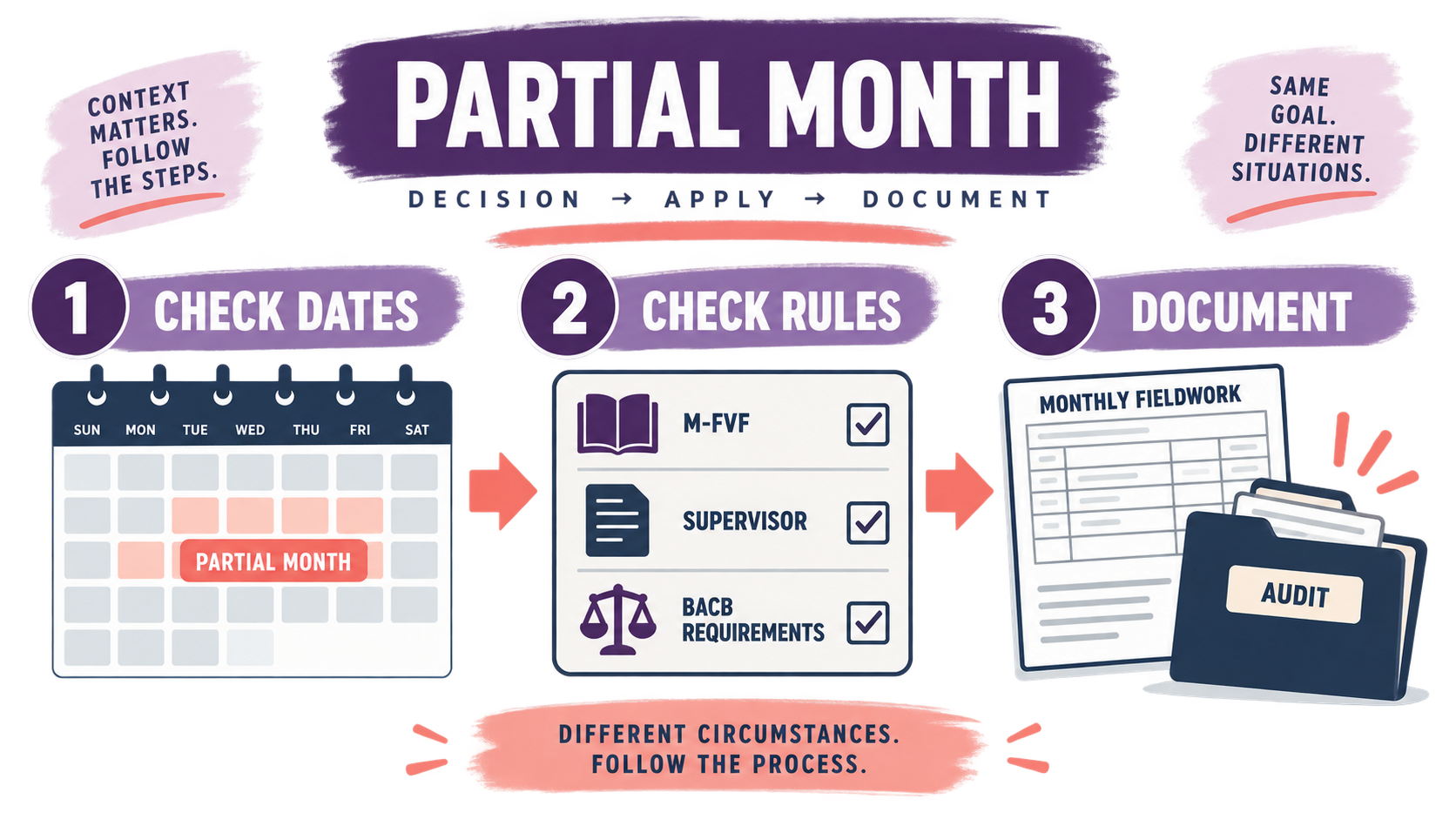
The BACB’s fieldwork guidance says that some requirements, such as the number of supervisor-trainee contacts, may need to be prorated when a trainee does not work a full calendar month. It also says that the BACB does not provide a formula for every possible deviation. The supervisor must determine how to prorate the fieldwork and associated requirements, mark the partial-month status on the applicable Monthly Fieldwork Verification Form (M-FVF) and Final Fieldwork Verification Form (F-FVF) when required, and retain evidence that the result was compliant.
That makes the reader’s real task a three-part review: identify the dates, apply the correct rule set, and document both the original record and the eligible result. A tracker can organize the information, but it does not replace the current BACB handbook, form instructions, or supervisor judgment. For broader context, compare this narrow decision with our BCBA supervision requirements guide.
How Should You Start With the Calendar?
Begin with the actual supervisory period rather than the date you opened a spreadsheet. Write down the first and last date on which fieldwork was accrued for that period, then confirm which organized fieldwork experience and supervisor relationship the hours belong to. This prevents hours from two separate arrangements from being blended simply because they appear in the same calendar month.
Use a dated source log before you touch an eligibility calculation. At minimum, the log should let you trace activities, hours, fieldwork type, supervision, observations, contacts, and signatures. The record should show what happened, not only the number that you hope will count.
- Record the first fieldwork date and the last fieldwork date for the supervisory period.
- Separate hours by organized fieldwork experience when the site, contract, or supervisor changes.
- Mark whether the period is a partial calendar month and why.
- List supervisor contacts and client observations with dates, not only a monthly total.
- Keep independent, supervised, individual, group, restricted, and unrestricted categories traceable.
- Save the requirement edition and form version used for the review.
Do not infer a partial month from a low total alone. A person can have fewer hours because of a mid-month start, but a person can also have a full month with a requirement failure. Those are related review questions, not the same fact. The reason matters because the adjustment path may differ.
Which Rule Set Applies?
The answer depends on the hours and application pathway being documented. The BACB’s current 2027 BCBA requirements describe supervised fieldwork as 2,000 total hours, a minimum of 20 and maximum of 160 hours per supervisory period, 5% supervision, 60 cumulative observation minutes, at least 50% of supervised hours as individual supervision, and at least 60% unrestricted activities. Concentrated supervised fieldwork has a separate 1,500-hour pathway and higher monthly supervision and observation requirements.
Those 2027 figures are not a reason to copy a number from an older worksheet into a current form. The 2024 BACB newsletter described a systematic adjustment policy for hours accrued on or after January 1, 2025 and used a 130-hour example when explaining how some missed requirements could reduce eligible hours. That example belongs to the rule context described in the newsletter. It should not be treated as a universal 2027 cap when the current 2027 requirement page lists a 160-hour maximum for supervised fieldwork.
| Review question | Why it matters | Evidence to keep |
|---|---|---|
| Which application and requirement edition applies? | Monthly minimums, maximums, supervision percentages, and form versions can change. | Current BACB handbook, requirements page, transition guidance, and the form version used. |
| Is the period supervised or concentrated supervised fieldwork? | The categories have different monthly thresholds, and concentrated supervised fieldwork cannot be prorated or adjusted. | M-FVF classification, observation record, supervision record, and supervisor review. |
| Is this a partial month or a missed requirement in a full month? | The explanation and adjustment trail must match the event that actually occurred. | Calendar dates, activity log, contact and observation dates, and written supervisor decision. |
When the transition is close, read the official 2027 requirements and the current BCBA Handbook together. The requirements page itself says the overview does not replace the detailed fieldwork section of the handbook. If your records cross an application or form-version boundary, ask the supervisor which documentation set controls before signing.
How Are Monthly Requirements Adjusted?
For hours accrued under the policy described in the BACB’s October 2024 newsletter, the monthly review occurs after the month’s hours have been documented and before the M-FVF is completed. If a monthly requirement is not met, the trainee and supervisor determine whether a systematic reduction can make the month compliant. The adjustment changes the hours that are eligible; it does not erase the underlying activity record.
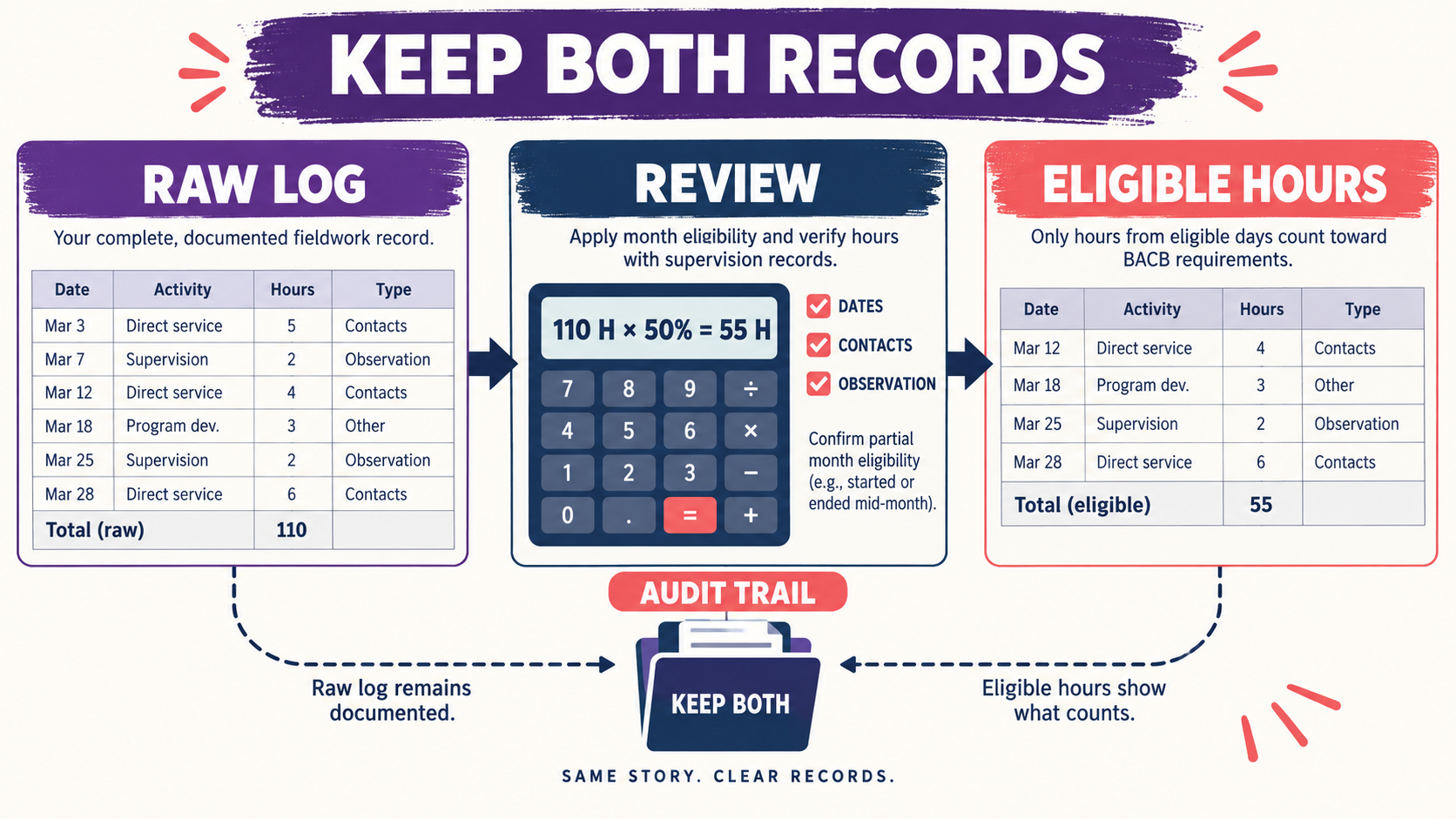
The newsletter gives examples of the logic. No client observation or fewer than 20 total hours can result in no eligible hours for the month under the described rule. If the supervision percentage is too low, independent hours may be reduced until the required percentage is met. If group supervision is greater than individual supervision, group hours may be reduced. For insufficient contacts, the newsletter gives a worked example: two of four required contacts equals 50 percent, so 110 hours multiplied by 0.50 produces 55 eligible hours. This is an example of a stated adjustment method, not a universal formula for every partial month.
That distinction is especially important in 2027 planning. A 2027 applicant should not assume that every partial month is eligible, that every requirement is reduced by the same percentage, or that a concentrated fieldwork month can be rescued by prorating. The supervisor must evaluate the applicable rule set, the fieldwork type, and the evidence for that period.
- Do not reduce hours before documenting the raw activity record.
- Do not use a simple calendar-day fraction for every requirement.
- Do not apply a 2025 newsletter example to a 2027 form without checking the current rules.
- Do not convert concentrated supervised fieldwork into a prorated supervised month.
- Do not treat a spreadsheet formula as the supervisor’s compliance decision.
How Do You Keep the Raw Log and Eligible Hours Separate?
A reliable system has two layers. The first layer is the complete, unadjusted fieldwork log: every activity, date, category, contact, observation, and hour accrued. The second layer is the eligibility review: the amount that can be reported after the monthly requirements and the applicable adjustment rules are checked.
For example, if a stated rule allows a 50 percent adjustment after two of four contacts occurred, a raw log may still show 110 hours accrued. The eligibility record would show 55 hours for that specific example, the reason for the reduction, the rule source, and the supervisor’s review. A later auditor should be able to reproduce the path from 110 to 55 without guessing which rows disappeared.
| Record layer | What it answers | What not to do |
|---|---|---|
| Raw activity log | What happened during the period, when it happened, and how many hours were accrued? | Do not overwrite original entries with adjusted totals. |
| Eligibility review | Which hours meet the requirements after the supervisor reviews the period? | Do not present an estimate as an official BACB approval. |
| Verification form and audit file | Which form was signed, by whom, when, and what supports the adjustment? | Do not delete the source log after signing the M-FVF. |
Store the form and supporting records together, use consistent file names, and note the date of every correction. The BACB reminds trainees that they are responsible for maintaining documentation and that software calculations should be checked rather than assumed correct. A tracker is useful because it exposes missing dates and mismatched totals; it is not a substitute for reading the official instructions. If the terminology is the main problem, our restricted versus unrestricted BCBA hours comparison can help you separate activity categories before the monthly review.
What Mistakes Create the Biggest Problems?
Most partial-month errors are not arithmetic errors. They are classification and documentation errors that make a reasonable calculation impossible to verify later.
- Mixing 2022, 2025, and 2027 figures: A copied template may contain a real number from a different requirement edition.
- Using the 130-hour example as a 2027 rule: The newsletter example and the current 2027 maximum are not interchangeable.
- Calling every low-hour month partial: A full month with a missed observation is a different compliance question.
- Prorating concentrated fieldwork: BACB guidance specifically says concentrated supervised fieldwork cannot be prorated or adjusted.
- Keeping only the final number: An adjusted total without the raw log and reason lacks an audit trail.
- Assuming a vendor tracker is official: The BACB does not endorse fieldwork software simply because it calculates a total.
- Signing before review: The trainee and supervisor should agree on the dates, categories, and applicable rule set before the form is signed.
What Should You Check Before Signing?
Use this short checklist at the end of the month. It is a preparation tool, not a replacement for the official handbook or supervisor review.
- Have you identified the exact first and last fieldwork dates?
- Have you separated each organized fieldwork experience and supervisor relationship?
- Have you selected the current BCBA requirement edition and M-FVF version?
- Have you classified the month as supervised or concentrated supervised fieldwork?
- Have you recorded raw hours before applying any adjustment?
- Have you checked the minimum hours, maximum hours, supervision, observation, contact, individual/group, and unrestricted requirements that apply?
- Does the adjustment explanation match the requirement that was not met?
- Can the eligible total be traced back to dated source entries?
- Have you marked the partial-month status on the form when the current instructions require it?
- Have you and your supervisor reviewed and signed the correct form by the applicable deadline?
Frequently Asked Questions
Is there one BACB formula for every partial month?: No. The BACB states that it does not provide a formula for every deviation in a supervisory period. Some requirements may be prorated, while other failures can require a systematic reduction or make no hours eligible. The supervisor must determine the defensible method under the applicable rules.
Can I prorate a concentrated supervised fieldwork month?: No. Current BACB fieldwork guidance says concentrated supervised fieldwork cannot be prorated or adjusted. If the month does not meet the concentrated requirements, review the classification and current handbook with the supervisor rather than converting it into a prorated calculation.
Should the raw hours remain in my tracker?: Yes. Keep the unadjusted hours in the documentation system and show the adjusted eligible hours separately. The BACB’s adjustment guidance specifically distinguishes the adjusted hours reported on the form from all hours accrued in the underlying documentation system.
Where should I verify a 2027 question?: Start with the official 2027 BCBA Requirements and the current BCBA Handbook. For the adjustment history and the worked contact example, read the BACB October 2024 newsletter. Then confirm the interpretation with your supervisor before signing.
Next step: Once your fieldwork records are organized, you can use a short free BCBA mock exam session to practice distinguishing requirement details from tempting but incorrect shortcuts. The practice resource is for exam preparation; it does not approve fieldwork hours or replace BACB guidance.
Official Sources Used
Take the Free BCBA Mock Exam
If you want a low-pressure way to check your recall, use the free practice resource below. Take the Free BCBA Mock Exam



