
Before you can sit the BCBA exam, you must complete supervised fieldwork — and the rules trip up a lot of candidates. This guide breaks down the BCBA fieldwork and supervision requirements: the two pathways, restricted vs unrestricted hours, how much supervision you need, and the deadlines, so your hours actually count.
Table of Contents
- The two fieldwork pathways
- Restricted vs unrestricted hours
- Supervision requirements
- Monthly limits & the 5-year window
- Who can supervise you
- How to track & document
- Examples: unrestricted vs restricted hours
- Common fieldwork mistakes that cost you hours
- How to find a qualified supervisor
- After fieldwork: passing the exam
- How to start your BCBA fieldwork (step by step)
- Fieldwork in the bigger certification picture
- Bottom line
- Frequently Asked Questions
- References
Short answer: complete 2,000 hours of Supervised Fieldwork (supervised ≥ 5%/month) or 1,500 hours of Concentrated Supervised Fieldwork (supervised ≥ 10%/month), with ≥60% unrestricted hours, 20–130 hours/month, finished within 5 years.
Note: the BACB is transitioning to updated 2027 requirements — always confirm the current rules on the BACB website before you begin.
Video Study: Section I / Supervision
Watch: BCBA® Section I Explained | 6th ed. Supervision, Performance & Data Decisions
Use this lesson to connect the exam-strategy points below with a concise visual review before moving into the detailed guidance.
Prefer a second pass? Open this lesson on YouTube.
The two fieldwork pathways
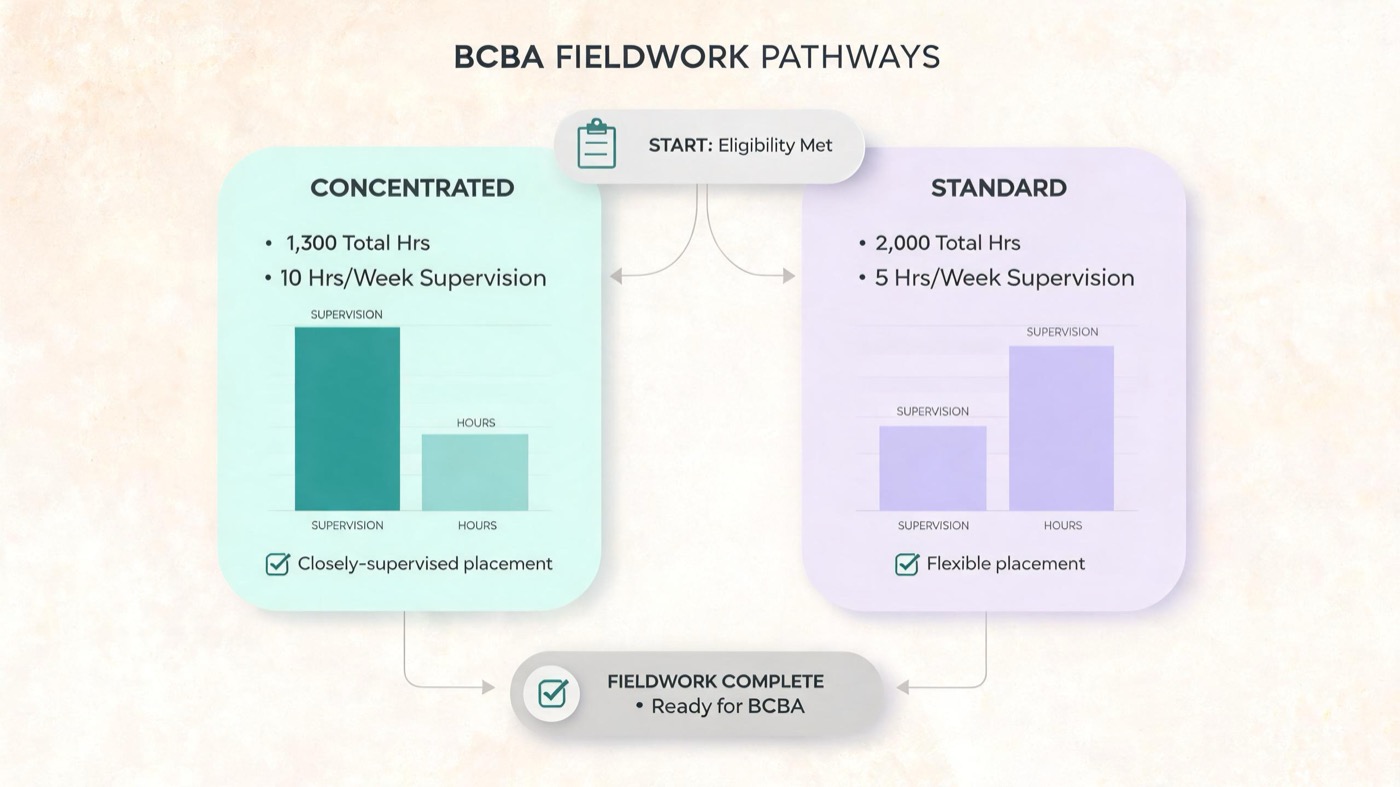
You can choose between two routes to the same goal. They differ in total hours and required supervision intensity.
| Pathway | Total hours | Supervision / month |
|---|---|---|
| Supervised Fieldwork | 2,000 | ≥ 5% |
| Concentrated Supervised Fieldwork | 1,500 | ≥ 10% |
Concentrated fieldwork requires fewer total hours but more supervision per month — useful if you can work in a closely-supervised, fieldwork-focused placement. Supervised fieldwork spreads a lighter supervision percentage over more hours.
Restricted vs unrestricted hours
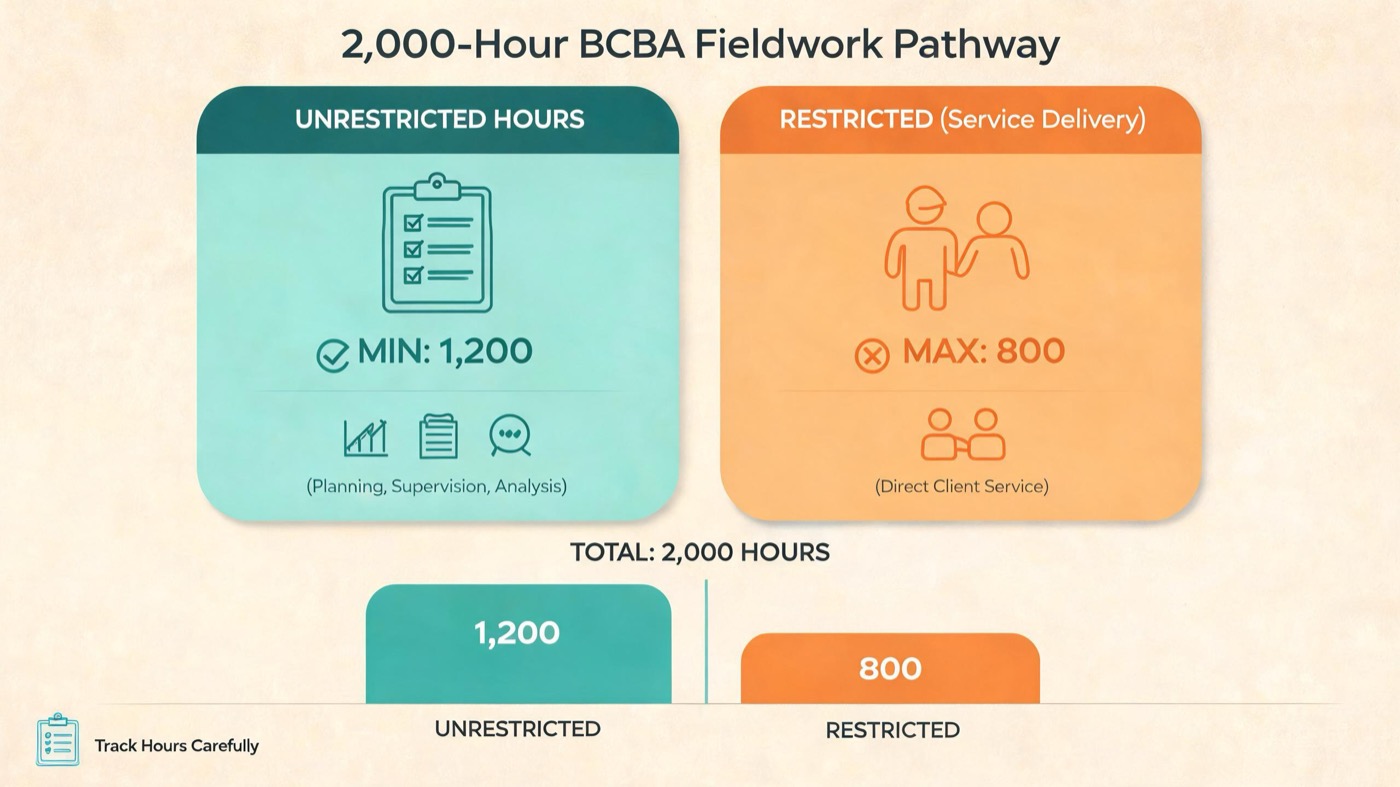
Not all hours count the same. The BACB caps how much “service-delivery” time you can use:
- Unrestricted hours (≥60%): core behavior-analytic activities — conducting assessments, designing programs, analyzing data, and supervising others.
- Restricted hours (≤40%): delivery of direct therapy and similar implementation work.
On the 2,000-hour pathway, that means at least 1,200 unrestricted hours and no more than 800 restricted. Many candidates under-log unrestricted activities, so track them carefully from day one.
Supervision requirements
- Amount: supervision contacts must total at least 5% of monthly fieldwork hours (10% for concentrated).
- Format: at least 50% individual supervision (the rest may be small-group).
- Observation: your supervisor must observe you working with a client at least once each supervisory period.
Quality supervision is not just a box to check — it is where you build the competencies the exam (and your career) demand. Your role as a supervisee is to seek feedback and apply it.
Monthly limits & the 5-year window
- Per month: accrue no fewer than 20 and no more than 130 hours.
- Overall: all fieldwork must be completed within five continuous years; hours older than that expire.
Who can supervise you
Your supervisor must hold an active, qualifying BACB certification and meet the BACB’s supervisor requirements (including supervision training and ongoing CEUs). Confirm your supervisor is eligible before you start logging hours under them — hours supervised by an unqualified supervisor may not count.
How to track & document
- Log every session: date, hours, restricted vs unrestricted, and supervision received.
- Keep monthly fieldwork forms signed by you and your supervisor.
- Separate unrestricted and restricted totals so you can prove the 60/40 split.
- Review your running totals monthly so you are not surprised at the finish line.
Once your hours are complete and verified, the exam is the final hurdle — and it is a real one: the first-time pass rate is just 51%. Plan your prep with a realistic study timeline.
Examples: unrestricted vs restricted hours
The 60/40 split confuses many trainees. A rough guide:
- Unrestricted (the work of a behavior analyst): conducting assessments (FBA, preference assessments), designing or revising programs, graphing and analyzing data, writing behavior plans, and supervising/training others.
- Restricted (implementation): delivering direct 1:1 therapy and running programs that someone else designed.
Direct therapy is valuable experience, but it is capped at 40% — so deliberately seek out assessment, program-design, and data-analysis opportunities to build your unrestricted total.
Common fieldwork mistakes that cost you hours
- Logging too many restricted hours. Candidates who only do direct therapy hit the 40% cap and waste hours that cannot count.
- Starting under an unqualified supervisor. If your supervisor does not meet BACB requirements, those hours may be rejected — verify first.
- Sloppy documentation. Missing or unsigned monthly forms can invalidate hours; keep contemporaneous records.
- Letting hours expire. The five-year clock is continuous — plan your pace so early hours do not lapse.
- Under-counting supervision. Falling below the monthly supervision percentage means that month may not count in full.
How to find a qualified supervisor
Your supervisor must hold an active qualifying BACB certification and have completed the required supervision training plus ongoing CEUs. Good places to look include your workplace (many ABA agencies provide supervision), your graduate programs network, and professional communities. Before committing, confirm their credential is active, agree on a supervision schedule that meets the monthly percentage, and clarify how observations and feedback will work. A strong supervisor does more than sign forms — they shape the clinician you become.
After fieldwork: passing the exam
Completing and verifying your hours makes you eligible to test — but eligibility is not the same as readiness. The BCBA exam is demanding, so treat the gap between finishing fieldwork and sitting the exam as dedicated study time. Map out a plan, target your weak domains, and confirm your readiness with full-length practice before you schedule.
How to start your BCBA fieldwork (step by step)
- Confirm your coursework path. Be enrolled in or have completed the required graduate coursework before accruing hours.
- Secure a qualified supervisor and a setting that offers genuine behavior-analytic work (not only direct therapy).
- Sign a supervision contract that spells out the schedule, supervision percentage, observation plan, and responsibilities of both parties.
- Set up your tracking system on day one — a spreadsheet or app that separates unrestricted and restricted hours and logs supervision.
- Review totals every month with your supervisor and sign the monthly form together.
- Apply to the BACB once hours are complete and verified, then shift fully into exam prep.
Fieldwork in the bigger certification picture
Fieldwork is one of three pillars of BCBA certification: the right graduate degree and coursework, supervised fieldwork (this guide), and passing the exam. Each has its own rules, and missing a detail in any one can delay you by months. Get the fieldwork structure right early — the 60/40 split, the supervision percentage, and clean documentation — and you remove the most common avoidable setbacks on the path to certification.
For the steps that come after your hours, see how hard the exam really is in our BCBA pass rate guide, what score you need on the passing score page, and how to budget your prep in the study timeline guide.
Bottom line
BCBA fieldwork is straightforward once you know the rules: pick the 2,000-hour or 1,500-hour concentrated pathway, keep at least 60% of hours unrestricted, meet the monthly supervision percentage with a qualified supervisor, stay within 20–130 hours a month, and finish inside five years. The candidates who avoid delays are the ones who set up clean tracking and confirm their supervisors eligibility before logging a single hour. Get the structure right, document everything, and your hours will count the first time you submit — leaving you free to focus on passing the exam.
Fieldwork done? Get exam-ready
Once your hours are in, the exam is the last step. See where you stand with a free, full-length BCBA mock exam.
Start the Free BCBA Mock Exam →
Frequently Asked Questions
How many fieldwork hours do you need for the BCBA?
Either 2,000 hours of Supervised Fieldwork (supervised at least 5% of hours each month) or 1,500 hours of Concentrated Supervised Fieldwork (supervised at least 10% each month).
What is the difference between restricted and unrestricted hours?
Unrestricted hours involve direct behavior-analytic work (assessment, program design, supervision); restricted hours are delivery of services like direct therapy. You need at least 60% unrestricted and no more than 40% restricted.
How much supervision do you need each month?
At least 5% of your monthly fieldwork hours (10% for concentrated), with at least 50% of supervision delivered individually and the supervisor observing you with a client at least once per supervisory period.
How long do you have to complete BCBA fieldwork?
Fieldwork must be completed within five continuous years, accruing no fewer than 20 and no more than 130 hours per month.
References
- Behavior Analyst Certification Board — FAQs: Supervised Fieldwork Requirements and BCBA Handbook.
Complete BCBA Exam Prep
Turn this topic into exam-day practice
Practice concepts in context with five full-length 6th Edition mock exams, two bonus practice exams, a 6th Edition study guide, and key-term flashcards—all in one $120 USD package.
Get the $120 All-in-One Prep Pack
Review everything included on the product page before ordering. No pass guarantee is implied.




Pingback: BACB Prorated Hours for Partial Months: BCBA Guide