

The exact phrase BACB fieldwork and practicum experience supervision form usually points to an older or program-specific supervision record. It was designed to capture what happened during a supervision period: dates, hours, supervision characteristics, topics discussed, feedback, professional behavior, and signatures. For the current source of truth, start with the BACB BCBA fieldwork resources rather than a copied template.
Table of Contents
- In This Guide
- BACB Fieldwork and Practicum Experience Supervision Form: The Direct Answer
- What the Older Supervision Form Was Designed to Record
- How It Fits With Current Fieldwork Documentation
- How to Complete and Reconcile a Supervision-Period Record
- What to Check During the 2022-to-2027 Transition
- Common Documentation Mistakes
- Frequently Asked Questions
- Take the Free BCBA Mock Exam
For current BCBA planning, do not assume that this old form is the only document you need or that a third-party copy is the current BACB requirement. The BACB’s current resource hub emphasizes a supervision contract, an ongoing documentation system, Monthly Fieldwork Verification Forms, and Final Fieldwork Verification Forms. Use the older form as a clue to the information that must be documented, then match your actual records to the current handbook and form edition.
In This Guide
BACB Fieldwork and Practicum Experience Supervision Form: The Direct Answer
The BACB fieldwork and practicum experience supervision form is best understood as a supervision-period record, not a universal substitute for every current BACB fieldwork document. Older versions and university handbooks show a form completed by a supervisee and supervisor for a defined period. It typically captures the meeting dates, hours accrued, characteristics of supervision, BACB Task List topics, feedback, professional conduct, and signatures.
The current BACB BCBA fieldwork resource page uses different document names. It links to Monthly Fieldwork Verification Forms and Final Fieldwork Verification Forms, with individual-supervisor and organization versions, and it also provides fieldwork checklists and guidance on documenting hours. The current BACB documentation guidance says that both the trainee and supervisor should track the hours and that the supervisor should review the hours for each supervisory period before signing a monthly verification form.
| Record people often mean | Main purpose | What it should not replace |
|---|---|---|
| Supervision-period form | Connects a supervision period with hours, topics, feedback, and signatures. | The complete fieldwork record or current application documents. |
| Monthly Fieldwork Verification Form | Verifies the fieldwork hours for the relevant month under the applicable requirements. | A supervision contract or unique documentation system. |
| Final Fieldwork Verification Form | Summarizes completed fieldwork after the underlying records have been maintained. | Missing monthly records, supervision notes, or proof of the fieldwork arrangement. |
| Supervision contract | Defines the relationship, responsibilities, objectives, and documentation expectations. | A log of the actual work and feedback completed during each period. |
If a program gives you a form with the long legacy name, ask which requirement edition it supports, how it relates to the current Monthly Fieldwork Verification Form, and whether it is an internal training record or a BACB-facing document. That short conversation can prevent a year of records from being organized around the wrong template.
What the Older Supervision Form Was Designed to Record
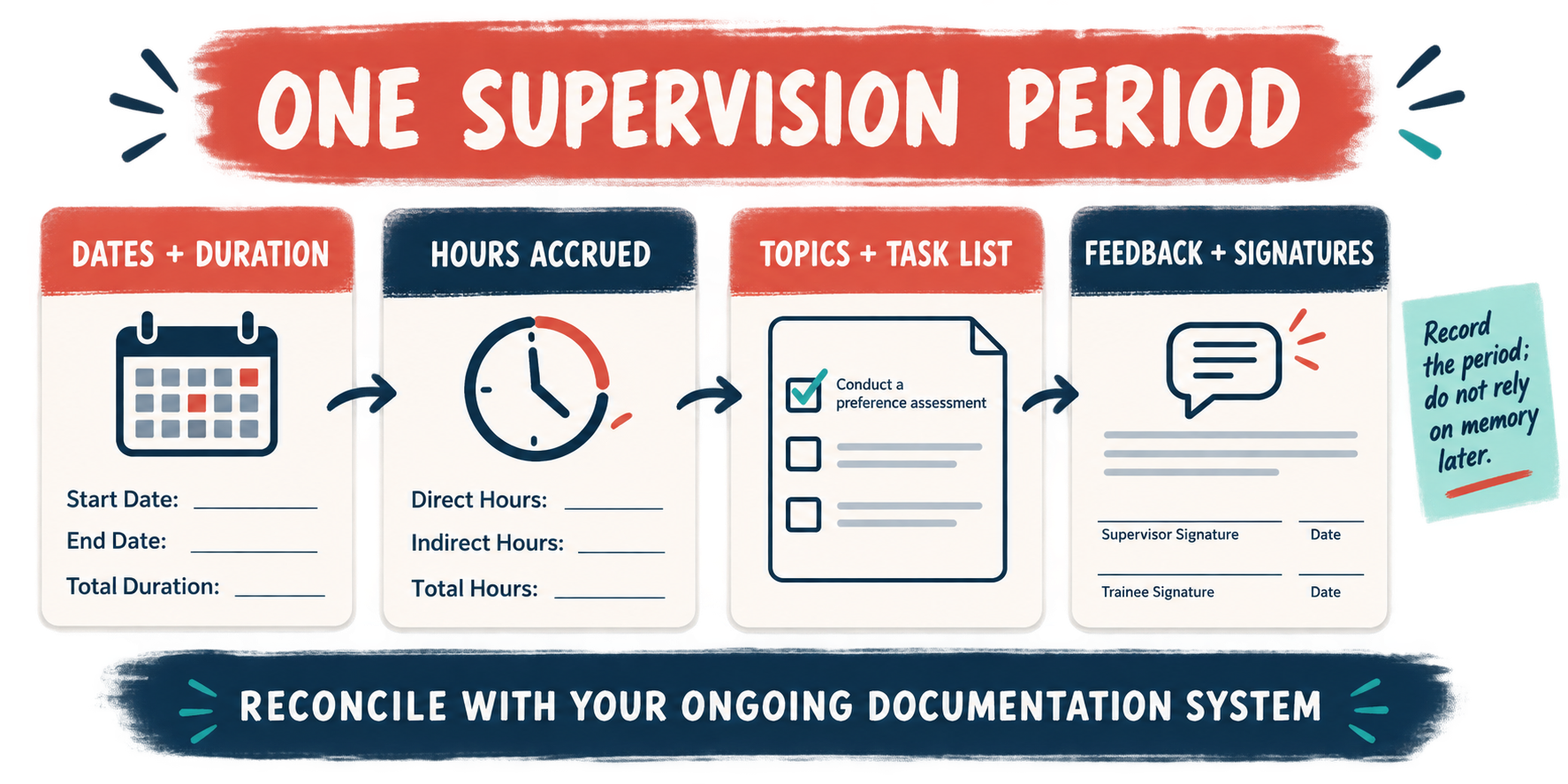
Older examples show why candidates still search for this form. It is more detailed than a simple attendance sheet, but it is narrower than a complete fieldwork file. Its value is the connection between a defined supervision period and the professional development that occurred during that period.
Dates, duration, and hours: The record should identify the supervisee, supervisor, date or date range, start and end time when required, and hours accrued during the period. Make the period precise enough that another person can compare it with the fieldwork log and monthly record. Do not use a vague label such as “April supervision” if the form asks for actual dates or a defined supervisory period.
Characteristics of supervision: Legacy forms commonly include checkboxes for individual or group supervision, office or on-site supervision, remote supervision, and observation of the supervisee. They may also ask whether specific clients were discussed and whether client privacy was protected. These fields are useful only when they describe what actually happened. Never check every box to make the form look complete.
Topics, readings, and Task List areas: Older versions often list BACB Task List areas, readings suggested by the supervisor, and readings discussed during supervision. A useful record names the competency or professional task discussed and briefly connects it to the trainee’s work. A copied list of ten task numbers without a topic, example, or feedback trail is not a meaningful learning record.
Feedback, professional conduct, and signatures: Many examples include ratings or comments about professional integrity, responsiveness to feedback, communication, preparation, and self-improvement. These sections turn a meeting record into a feedback record. Both parties should review what is written, correct factual errors before signing, and keep the signed copy in a secure location.
Protect client privacy in every field. A supervision form does not need a client’s name, diagnosis, or identifying details to show that a behavior-analytic topic was discussed. Use the minimum information needed to connect the supervision record to the work, and follow your employer’s privacy rules.
How It Fits With Current Fieldwork Documentation
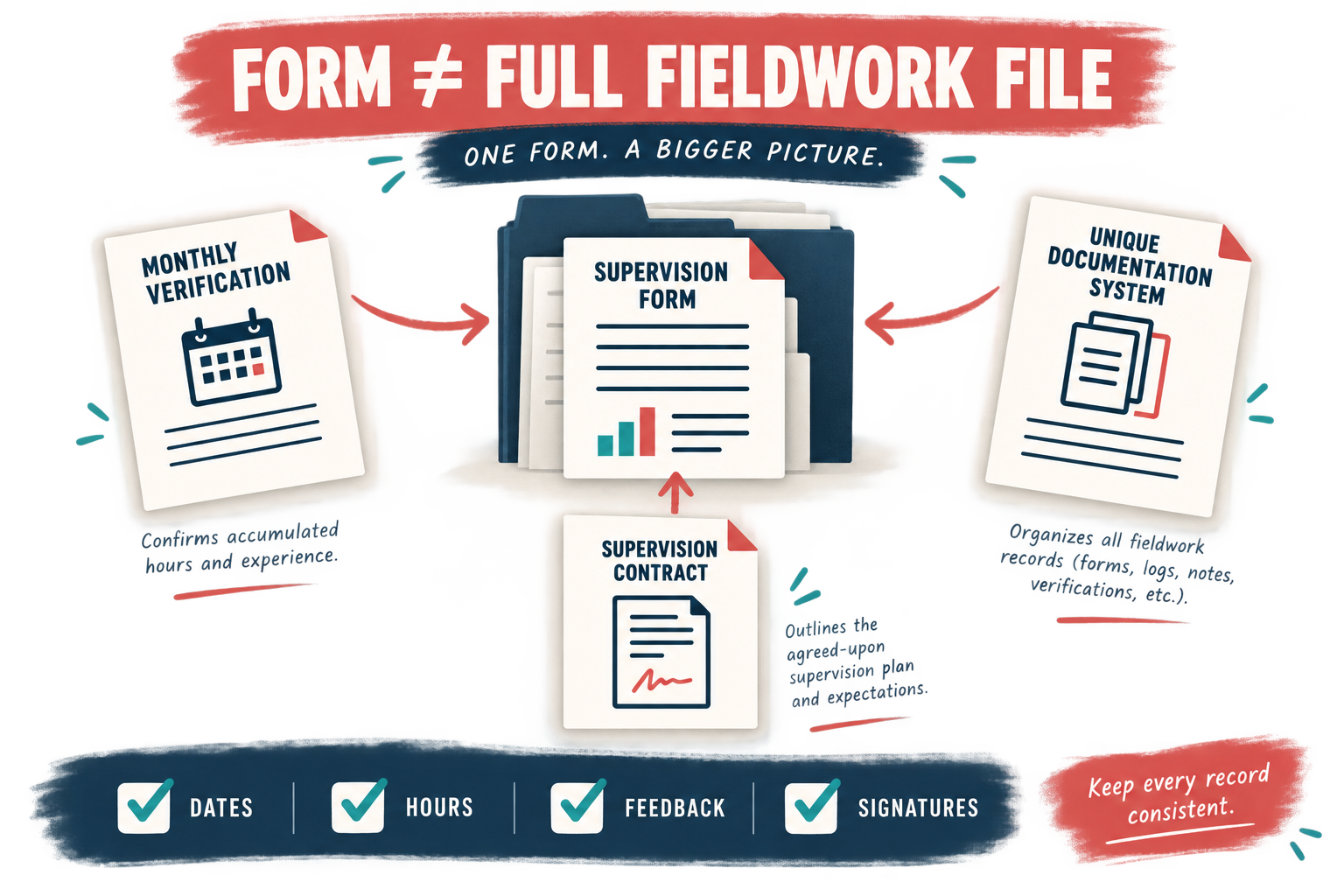
The most important distinction is that a supervision-period form is one layer of documentation. The current BACB FAQ on documenting fieldwork says that the trainee and supervisor should both track hours, and that the supervisor should review the hours for each supervisory period before signing the Monthly Fieldwork Verification Form. That guidance makes the relationship clear: a detailed period record can support the monthly form, but it does not make the monthly form unnecessary. Think of the documentation system as a stack:
- Supervision contract: the agreement that sets responsibilities, objectives, supervision expectations, and recordkeeping rules.
- Ongoing documentation system: the detailed record of activities, dates, durations, supervision contacts, observations, feedback, and other information required by the applicable handbook.
- Monthly verification: the period-level verification that the hours and supervision record are accurate for that month.
- Final verification: the end-of-fieldwork summary that should reconcile with the monthly records rather than replace them.
- Supporting evidence: evaluations, contracts, amendments, schedules, and other records that the BACB or supervisor may need if a question arises.
This stack also explains why third-party form editors are risky. A form host can display an old template, but it cannot tell you whether the template matches your requirement edition or supervision arrangement. It may also ask you to upload private fieldwork records. Use the current BACB resource page as the version authority and keep sensitive documents in a controlled location.
How to Complete and Reconcile a Supervision-Period Record
Use the following workflow whether your program calls the document a supervision form, practicum form, period record, or supporting log.
- Confirm the requirement edition: identify whether the hours are being accrued under the 2022 requirements or the 2027 requirements, and follow the current handbook and transition guidance.
- Confirm the record’s role: ask whether the form is a program record, an ongoing documentation component, a monthly verification support document, or a submission document. Do not infer the role from the title.
- Define the period: enter the dates and duration exactly as requested. Keep the form’s period aligned with the hours and supervision notes it summarizes.
- Record the actual hours: separate the categories required by the applicable form and do not guess, backfill, or apply a multiplier in a field that asks for actual hours.
- Describe supervision: mark only the characteristics that occurred and include a concise note about the topics, readings, observations, or task areas addressed.
- Record feedback: describe the skill or professional behavior reviewed, the feedback given, and the next action. “Reviewed work” is less useful than a specific, factual note.
- Protect confidentiality: use de-identified descriptions and store the file in a secure location. Do not upload client information to a public form editor.
- Reconcile before signatures: compare hours and dates with the unique documentation system and the monthly verification record. Resolve differences with the supervisor before signing.
- Retain the signed copy: keep the form with the rest of the fieldwork file for the period required by the current BACB instructions and your professional obligations.
Try one practical audit: select a completed supervision period and trace one line from the period form to the activity log, the monthly verification, and the supervisor feedback. If the dates, hours, or categories do not agree, treat the mismatch as a documentation problem to resolve now, not as a detail to remember at application time.
What to Check During the 2022-to-2027 Transition
The BACB’s 2027 BCBA Requirements document says that major eligibility and maintenance changes take effect January 1, 2027. The BACB fieldwork resource hub now lists 2027 Monthly and Final Fieldwork Verification Forms alongside the standard fieldwork resources. That makes the edition decision part of the form-selection process.
The current application-processing page states that BCBA and BCaBA Final and Monthly Fieldwork Verification Forms may be accepted in any version as long as they are for the 2022 Fieldwork Requirements. This is a current, time-sensitive administrative note, not a universal permission to use any old supervision template. If your hours or application fall under the 2027 requirements, use the 2027 forms and handbook guidance. For a practicum or fieldwork timeline that crosses the transition, write down:
- the months and hours governed by each requirement edition;
- the form or record your supervisor expects for each period;
- which records are monthly verification documents and which are supporting supervision notes;
- how concentrated supervised fieldwork is represented when a form asks for actual hours;
- where the signed copies and supporting records will be retained.
If a university handbook contains an example of the old form, use it for historical context or program instructions, not as proof that it remains the BACB’s current form. The BACB Handbook and current resource pages control the certification documentation decision.
Common Documentation Mistakes
- Confusing attendance with supervision: a meeting date alone does not show what was discussed, observed, or reviewed.
- Using the old form as the only record: the supervision-period form does not replace the ongoing documentation system, monthly verification, or contract.
- Copying the same note every period: repetitive text can hide missing feedback or make it impossible to see professional development.
- Checking every supervision characteristic: only select the options that accurately describe the period.
- Including identifying client information: document the behavior-analytic topic without exposing private information.
- Reconstructing months at the end: late reconstruction increases the chance of inconsistent dates, totals, and signatures.
- Using an unofficial fillable template: a third-party editor cannot validate the requirement edition or protect confidential records.
- Applying current rules to historical hours without checking: keep a written map for any 2022-to-2027 transition.
Frequently Asked Questions
Is this the same as the Monthly Fieldwork Verification Form?: Not automatically. The long fieldwork-and-practicum supervision-form phrase usually refers to a detailed record for a supervision period. The Monthly Fieldwork Verification Form is a current BACB verification document for the relevant period. Your program may use a supporting form alongside the monthly form, but the two documents have different roles.
Does the BACB still require the old Fieldwork and Practicum Experience Supervision Form?: Do not assume that an old template is universally required. Check the current BCBA Handbook, fieldwork resource hub, requirement edition, and your program or supervisor instructions. The current resource hub emphasizes current fieldwork forms and a complete documentation system.
What should I write in the feedback section?: Record a factual skill or professional behavior, the feedback given, and the next action. Keep the note specific enough to show what was reviewed while protecting client confidentiality. Do not turn the form into a public case summary.
Do I submit this supervision form with my BCBA application?: Not based on the old title alone. Some legacy examples explicitly say they were not submitted with the initial application. Follow the current BACB application instructions and keep the signed record available if requested.
Can a fieldwork tracker replace the supervision form?: A tracker can help you organize hours, but it is not automatically a signed supervision record or a verification form. Use it as one component of a documentation system and reconcile it with supervisor records and the current BACB forms.
The safest way to handle the BACB fieldwork and practicum experience supervision form search is to preserve the useful information it was meant to capture—dates, hours, supervision characteristics, topics, feedback, and signatures—while checking how those records fit the current BACB fieldwork system. Once your documentation is organized, use the free BCBA mock exam as a separate practice step. Practice With the Free BCBA Mock Exam
Take the Free BCBA Mock Exam
If you want a low-pressure way to check your recall, use the free practice resource below. Take the Free BCBA Mock Exam



