
Labeling adjectives ABA usually refers to teaching a learner to identify or express words that describe features, such as color, size, shape, texture, temperature, or location. In a behavior-analytic language program, the same word can be taught in different ways. Saying “red” when looking at a red object is not the same response as selecting the red item when asked, “Show me red,” or completing the sentence “The apple is ___.”
Table of Contents
- What Does Labeling Adjectives ABA Mean?
- Tact, Receptive Identification, and Intraverbal: What Is the Difference?
- Adjective Labeling Examples for ABA
- How to Teach Adjective Labels
- Prompting, Error Correction, and Fading
- How to Generalize Adjective Labels
- How to Measure Progress
- Common Mistakes
- The BCBA Study Lens
- FAQ
- Take the Free BCBA Mock Exam
The most useful plan starts with the learner’s communication system and a clearly defined response. Vocal speech, AAC, sign, pointing, eye gaze, or selecting a symbol may all be functional ways to communicate, depending on the goal. The target is not a perfect worksheet performance; it is a meaningful, generalized language skill that works with new examples and people.
This guide explains adjective tacts, receptive identification, and intraverbal fill-ins; provides original examples; and shows how prompting, fading, generalization, and data collection fit together. It is an educational study guide, not an individualized speech-language or ABA treatment plan. Table of Contents
What Does Labeling Adjectives ABA Mean?
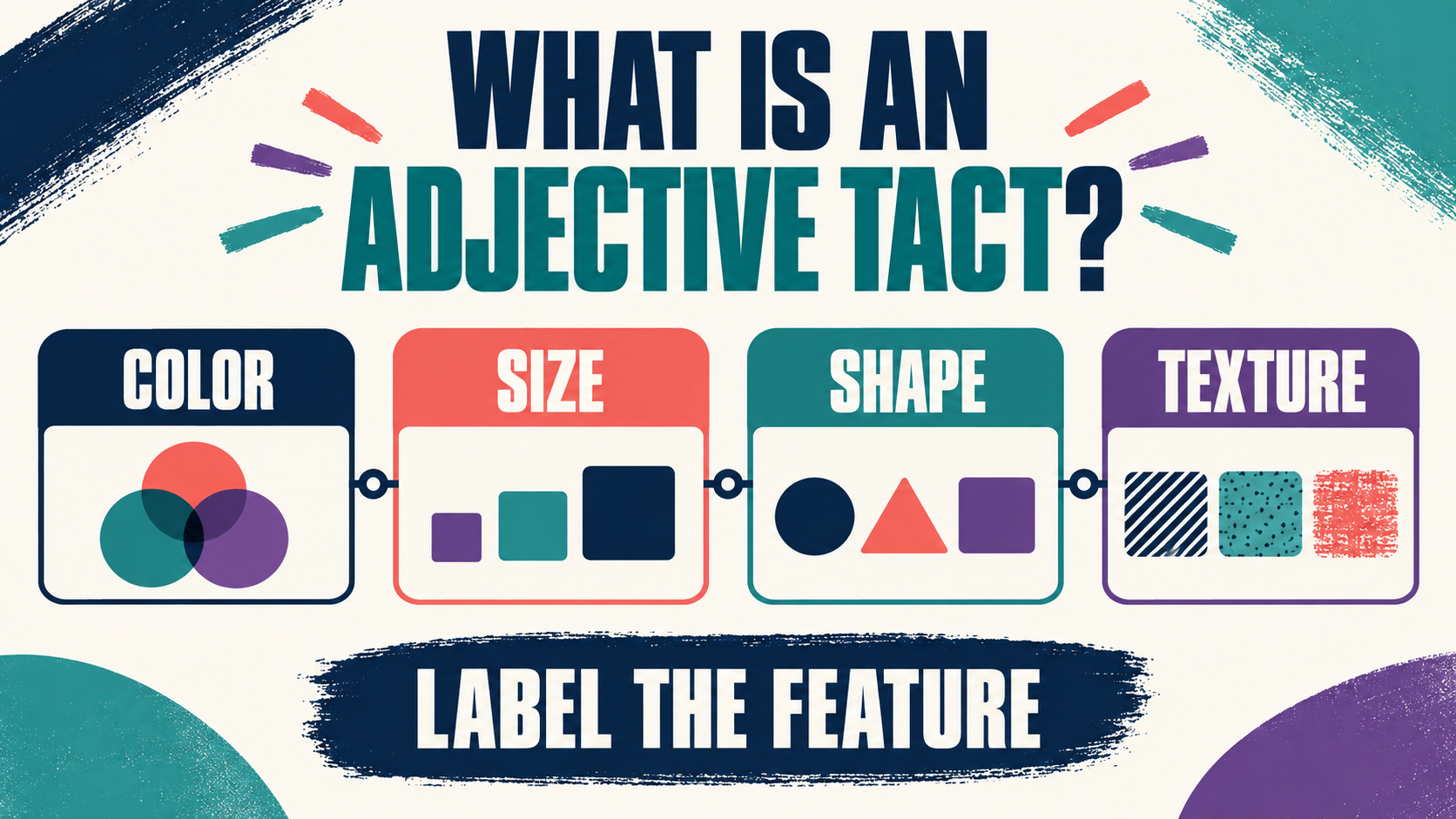
In everyday language, an adjective describes a noun: a red ball, a big cup, a rough towel, or a round plate. In ABA language teaching, “labeling an adjective” should be tied to the stimulus and response conditions. The practitioner needs to specify what the learner sees or experiences, what cue is provided, what response counts, and what consequence follows.
For an expressive adjective tact, the relevant feature is present and the learner labels it. For example, a red block is shown and the learner says, signs, or selects “red” without being asked a question that supplies the verbal answer. The response can be vocal or aided, but the operational definition should say exactly what counts as independent and what level of prompting is allowed.
Adjectives can describe more than visual properties. A learner may label “loud” after hearing a sound, “hot” or “cold” in a safe everyday context, “wet” after touching water when appropriate, or “fast” while observing movement. Safety and consent matter for sensory examples; no one needs to experience discomfort to demonstrate a temperature or texture word.
Tact, Receptive Identification, and Intraverbal: What Is the Difference?
The word alone does not tell you the verbal operant. The antecedent and stimulus control matter:
| Response type | What evokes it | Adjective example |
|---|---|---|
| Expressive tact | A nonverbal feature or event is present. | Seeing a large object and labeling “big.” |
| Receptive identification | A spoken or signed direction names the feature. | Selecting the large object after “Show me big.” |
| Intraverbal fill-in | A verbal question or sentence frame supplies the verbal context. | Completing “The opposite of small is ___” with “big.” |
These response types can support one another, but mastering one does not automatically prove mastery of the others. A learner may select “rough” when asked to show it but not spontaneously label a rough surface. Probe the skill you actually want and record the cue, materials, response mode, and prompt level.
Adjective Labeling Examples for ABA
Begin with features that are easy to observe and meaningful in daily routines. The following examples are starting points, not a required sequence:
- Color: red, blue, green, yellow, black, white, or a color the learner encounters in clothing, food, art, or preferred toys.
- Size: big, small, long, short, tall, or tiny when the comparison is clear and the objects are relevant.
- Shape: round, square, triangle, flat, or curved when the learner can access the objects or symbols.
- Texture: smooth, rough, soft, hard, sticky, or bumpy when the sensory experience is comfortable and optional.
- Speed and sound: fast, slow, loud, or quiet during movement and sound activities with a way to pause.
- Socially useful descriptions: open, closed, full, empty, wet, dry, ready, or broken when the label helps the learner request, solve a problem, or participate.
Contrast examples when the distinction matters. Presenting one red item again and again may produce memorized responding instead of control by color. Vary the item, background, size, position, and speaker while keeping the relevant feature clear. If “big” is always a blue ball and “small” is always a red cup, the learner may respond to the object or color instead of size.
How to Teach Adjective Labels
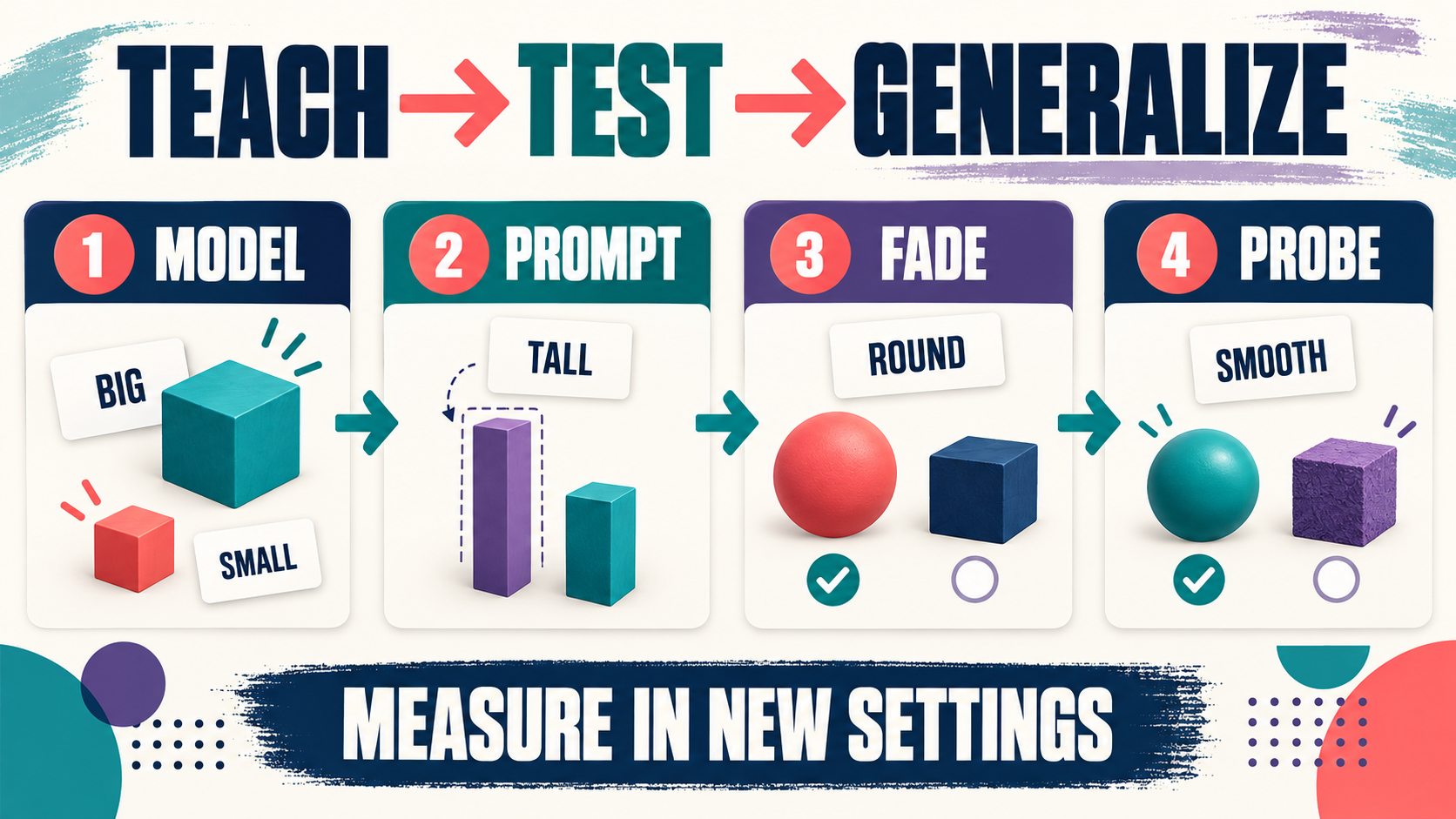
A practical teaching sequence moves from clear examples to flexible use:
- Choose the function: decide whether the first target is an expressive tact, receptive identification, intraverbal response, or a functional communication phrase.
- Define the feature: specify what makes an example and a nonexample, including acceptable communication modes.
- Arrange clear contrasts: use two or more examples that differ on the target feature without adding an accidental cue.
- Model and prompt: provide the least intrusive support likely to produce a successful response, then plan how to fade it.
- Reinforce meaningful communication: connect the adjective to access, information, play, choice, or another natural outcome when possible.
- Probe unprompted responding: separate teaching trials from independent probes so the data show what the learner can do without the prompt.
For example, during snack preparation, an adult may model “cold” for a cold item and then offer a communication opportunity. The learner might say “cold,” select the AAC symbol, or use a reliable sign. The next step is not simply more table trials; it is checking whether the learner can use the word with a different container, person, routine, or reason to communicate.
Prompting, Error Correction, and Fading
Prompting should support access to the correct response without becoming the cue the learner depends on. If the adult always asks “What color is it?” immediately before the learner says “red,” the response may remain tied to that question rather than the color feature. Research on tact generalization has highlighted the importance of testing responses under natural or varied antecedent conditions.
Error correction should be calm, brief, and consistent with the learner’s communication plan. It might include a model, a prompted practice response, and another opportunity with a new example. Avoid turning a language target into a prolonged correction sequence. If errors increase, review the discrimination, the examples, the prompt, the response effort, and whether the learner has a reason to use the word.
Fading can involve reducing verbal prompts, increasing distance from the adult, varying the materials, or waiting briefly before helping. Record which prompt was used so “correct” does not hide a response that required full assistance. A prompted label can be useful progress, but it is not the same data as an independent label.
How to Generalize Adjective Labels
Generalization means the learner uses the adjective with new but relevant examples, people, places, and routines. Plan it deliberately:
- Across exemplars: teach “round” with a ball, plate, wheel, and picture rather than one object.
- Across nonexamples: include objects that are close but do not meet the definition, such as a square block beside a round ball.
- Across response forms: accept speech, AAC, sign, pointing, or selection when each form meets the communication goal.
- Across people and settings: probe with caregivers, teachers, peers, and daily routines when consent and coordination allow.
- Across functions: check whether the adjective is used to comment, request, reject, describe, or solve a problem—not only to answer a drill question.
Do not assume that a correct response in a teaching set has generalized. A review of tact instruction research and a study of tacting actions both support treating generalization as a measured outcome, not an automatic side effect. This is especially important for adjectives because the same feature can appear in many forms and contexts.
How to Measure Progress
Match the measurement to the target. For expressive labeling, record independent correct responses across opportunities and the prompt level for errors or assisted responses. For receptive identification, record the selected item and the arrangement of distractors. For intraverbal fill-ins, record the sentence frame or question because a different verbal cue may evoke a different response.
| Data field | Example | Why record it |
|---|---|---|
| Independent response | 8 of 10 opportunities | Shows performance without the planned prompt. |
| Prompt level | Model, gesture, verbal, or AAC navigation prompt | Shows whether support is fading or the learner is prompt-dependent. |
| Generalization probe | New item, person, or routine | Shows whether the adjective controls the response beyond the teaching set. |
Graph the trend when enough opportunities are available, but interpret the number with context. A high percentage on one repeated item may be less meaningful than a lower percentage across varied daily examples. Also watch for overselectivity: the learner may attend to a color, position, or object identity instead of the adjective feature.
Common Mistakes
- Calling every label a tact: a word’s verbal function depends on the antecedent and consequence, not just its form.
- Using one fixed exemplar: the learner may memorize “red” for one card instead of responding to color.
- Ignoring response mode: rejecting AAC or sign can measure speech production rather than adjective knowledge or functional communication.
- Prompting before the stimulus matters: the learner may answer the adult’s question instead of labeling the feature.
- Skipping nonexamples: without contrast, it is hard to know whether the relevant feature controls responding.
- Assuming generalization: a correct drill response does not prove independent use in daily life.
Commercial adjective-labeling materials can be useful as one source of examples, but a worksheet is not a complete intervention. The team still needs an operational definition, an individualized communication goal, a prompt plan, generalization probes, and a reason the learner will use the adjective.
The BCBA Study Lens
For the BCBA exam, organize an adjective-labeling question around stimulus control and measurement. Ask: What is present? What verbal or nonverbal antecedent is arranged? What response is required? Is the response independent? What consequence follows? Where will the skill be used?
Also separate acquisition from generalization. A learner may acquire “big” with flashcards but not use it to request the bigger cup, describe a toy, or reject a small portion. The stronger plan measures a meaningful response across examples and settings and fades prompts systematically. The current BACB test content outline is the correct source for exam-domain wording. This page is a study aid, not an official curriculum or individualized clinical protocol.
FAQ
What is an adjective tact in ABA?: An adjective tact is a descriptive response evoked by a relevant feature or event, such as saying, signing, or selecting “red” when a red object is present, under an operational definition that specifies what counts.
Is labeling an adjective the same as receptive identification?: No. Receptive identification usually requires selecting or demonstrating the item or feature named by another person. Expressive adjective labeling is a different response arrangement, even when both involve the same word.
How do I know if adjective labels have generalized?: Probe new materials, people, settings, positions, and natural reasons to communicate. Record independent responding and the relevant prompt or verbal cue instead of relying only on repeated teaching trials.
Bottom line: labeling adjectives in ABA is not just memorizing a list of descriptive words. Define the feature, distinguish tacting from receptive and intraverbal responding, accept functional communication modes, fade prompts, and measure use across new examples. If you are reviewing the BCBA concepts behind verbal behavior and data-based teaching, the free BCBA mock exam is an optional practice resource, not an official BACB exam.
Take the Free BCBA Mock Exam
If you want a low-pressure way to check your recall, use the free practice resource below. Take the Free BCBA Mock Exam



