
If you searched for the BACB ACE Provider Handbook, you may be trying to answer one of two different questions: how to become or maintain an Authorized Continuing Education Provider, or how to decide whether a CE event is legitimate before you count it toward your own credential. The handbook matters for both questions, but the checklist is not the same.
Table of Contents
- What is the BACB ACE Provider Handbook?
- Who should use the BACB ACE Provider Handbook?
- What are the two ACE Provider types?
- What changed for the July 1, 2026 requirements?
- How should a BCBA candidate screen an ACE event?
- What counts as participation in an ACE event?
- What should an ACE certificate contain?
- How do you apply to become an ACE Provider?
- How do ACE renewal and records work?
- What mistakes should you avoid?
- BACB ACE Provider Handbook FAQ
Short answer: the current ACE Provider Handbook is the BACB document that explains how Individual and Organization ACE Providers obtain and maintain authorization, design events, document participation, and handle renewals. It does not mean that the BACB has reviewed or endorsed every event offered by a provider. As a BCBA or BCaBA certificant, your practical job is to verify the provider in the BACB registry, check the event information, save complete documentation, and enter the activity in your BACB account.
This guide uses the BACB handbook marked Effective July 1, 2026. Read the live BACB Authorized Continuing Education Providers page and the current ACE Provider Handbook PDF before applying, purchasing an event, or recording CEUs. Table of Contents
What is the BACB ACE Provider Handbook?
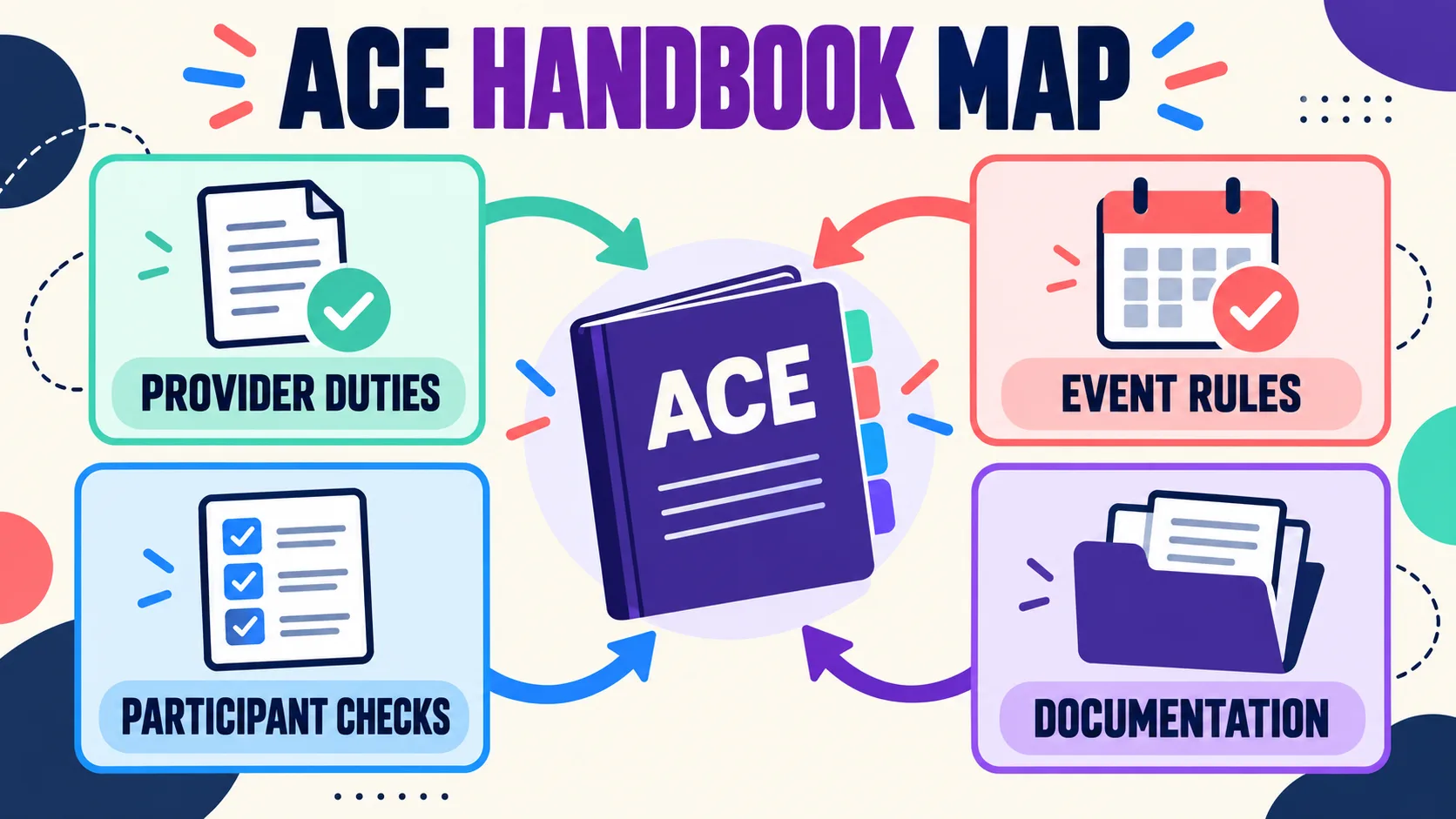
The BACB ACE Provider Handbook is a requirements document for the Authorized Continuing Education program. ACE Providers make Learning continuing education available to BCBA and BCaBA certificants and professional development available to RBT certificants. The handbook covers provider roles, event content, instructors, participation monitoring, documentation, applications, renewals, complaints, and the use of ACE names and logos.
The document is not a catalog of courses and it is not a study guide for the BCBA examination. A BCBA candidate may use it to understand whether a continuing education event is being represented accurately, but the handbook does not replace the BCBA Handbook, the Ethics Code, or the requirements for initial certification. If you are studying for the exam, treat ACE information as credential-maintenance and event-verification context, not as a substitute for the BCBA Test Content Outline.
The most important boundary is authorization versus endorsement. The BACB authorizes a provider to offer qualifying events, but it does not review or approve each individual event’s content. A provider should not market a particular webinar as BACB-approved or BACB-endorsed merely because the provider has ACE status.
Who should use the BACB ACE Provider Handbook?
The handbook serves several readers, but each reader should focus on a different part of the document:
| Reader | What the handbook helps them decide | First action |
|---|---|---|
| BCBA or BCaBA certificant | Whether an event and its documentation appear consistent with ACE requirements | Verify the provider and save the event details |
| RBT certificant | Whether an event offers professional development rather than BCBA/BCaBA Learning CE | Check the current RBT professional-development guidance |
| Individual provider applicant | Whether the applicant, instructor role, content, and records meet the provider framework | Read the full handbook before the initial application |
| Organization or ACE Coordinator | How to assign responsibility, monitor events, keep records, and renew | Confirm the legal entity and coordinator relationship |
That distinction prevents a common mistake: a certificant who is simply attending a CE event does not need to complete the ACE Provider application. The application is for the person or organization that wants BACB authorization to offer ACE events.
What are the two ACE Provider types?
The current handbook identifies Individual ACE Providers and Organization ACE Providers. An Individual ACE Provider is responsible for developing and presenting the provider’s events. That person serves as both the ACE Coordinator and the ACE Instructor, although a co-presenter may assist with part of an event under the required oversight.
An Organization ACE Provider is a recognized legal entity that routinely offers events delivered by different instructors. The organization designates an ACE Coordinator who can make decisions about compliance and serves as the organization’s point of contact with the BACB. The coordinator does not have to teach every event or be present at every event, but remains responsible for the organization’s ACE program.
- Individual and organization providers must follow the current handbook rather than an old application packet.
- Organization providers must be incorporated, registered, or otherwise recognized as legal entities.
- An organization’s ACE Coordinator must be employed by the organization or have a contractual relationship with it.
- Initial applicants and coordinator-change applicants must review the current certification and good-standing qualifications.
- Current coordinators may have transition protections described in the handbook, so do not apply a new-applicant rule to an existing coordinator without checking the version and dates.
What changed for the July 1, 2026 requirements?
The 2026 handbook is not just a re-labeled older PDF. The BACB describes the current version as effective July 1, 2026, and the update clarifies provider responsibilities, event participation, instructor qualifications, marketing language, documentation, and organization changes. If a provider’s website still relies on an older handbook, use the live BACB page to locate the current version.
| Area | What the current handbook makes clear | Why it matters to a learner |
|---|---|---|
| Provider status | Provider authorization is separate from BACB approval of an individual event. | Do not treat a provider badge as a guarantee about every course. |
| Participation | Participants must be present and participating for the entire event; passive login time is not enough. | A self-paced event should explain its active-response method. |
| Instructor information | Public event descriptions must provide instructor qualifications and topic expertise. | You can evaluate the event before paying or registering. |
| Records | Providers must maintain event records and make them available to the BACB upon request. | Keep your own certificate and event evidence in case questions arise later. |
How should a BCBA candidate screen an ACE event?
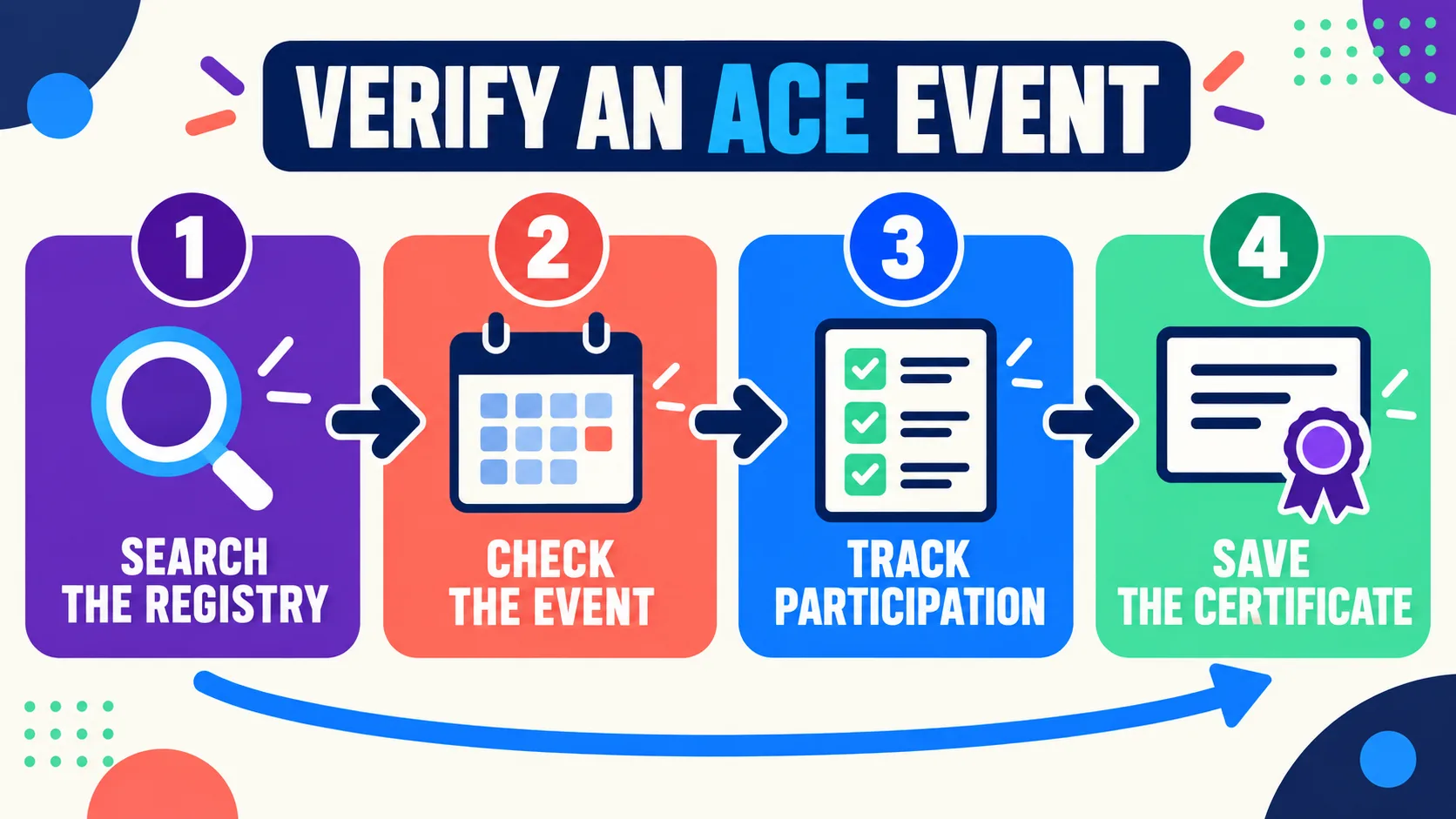
Use the ACE Provider Handbook as a screening framework, not as a promise that the BACB has endorsed a course. Start with the provider, then inspect the event, then plan your records. The BACB ACE Provider Verification Registry is the correct place to verify whether an individual or organization is authorized to offer BCBA/BCaBA Learning CE or RBT professional development.
- Verify the provider: search the provider name or provider number in the BACB registry and check that the status is active.
- Match the audience: confirm whether the event offers Learning CEUs for BCBA/BCaBA certificants or PDUs for RBT certificants.
- Read the objectives: look for clear learning objectives and a topic that goes beyond a vague introductory promise.
- Check the instructor: review the qualifications and subject-matter expertise shown in the public event description.
- Ask how participation is monitored: live events may use active responses, while asynchronous events need meaningful questions or other active responding.
- Confirm the certificate plan: ask when documentation will arrive and whether it will include the event, provider, instructor, modality, and CE category details.
- Save evidence: keep the registration page, syllabus, certificate, and any provider correspondence in one folder.
For example, a recorded webinar that only tracks how long a browser tab remains open does not give you the same confidence as a course that explains its active-response questions and provides complete documentation. The burden is not on the learner to audit the provider’s internal files, but a clear public description is a useful quality signal.
What counts as participation in an ACE event?
The current handbook permits live and online events, including synchronous and asynchronous formats. The format can vary, but the provider must ensure that participants are present and participating for the entire event. A registration record, a sign-in sheet without sign-out, or platform login time alone is not a complete participation measure.
For an asynchronous ACE event, the handbook gives active responding as the key idea. Knowledge questions should evaluate what the learner understood from the event; the handbook specifies at least three questions per CEU or PDU as one example. Codes hidden in a recording or a written statement saying “I engaged” are not equivalent safeguards.
Duration also affects the amount of credit. The current handbook uses 25 minutes of instruction for 0.5 CEU or PDU, with additional credit in 0.5-unit or 1-unit increments. Providers may not round up. A 75-minute event, for example, corresponds to 1.5 CEUs or PDUs under the handbook’s example.
What should an ACE certificate contain?
Learning CE documentation should be issued within 45 days of the event. The format can be a customized certificate or the applicable BACB template, but the record should make the event easy to identify and enter in your BACB account.
- Your name and BACB certification number
- The event completion date or dates
- The ACE Provider’s name and provider number
- The ACE Coordinator’s name
- The event title, including each attended session when a conference has multiple presentations
- The ACE Instructor’s name
- The event modality: in person, online synchronous, or online asynchronous
- The total number of Learning CEUs
- The number of CEUs assigned to the Ethics and Supervision subcategories when applicable
RBT professional-development documentation follows a different form requirement. If you are recording PDUs rather than BCBA/BCaBA Learning CEUs, use the current RBT professional-development instructions and the applicable fillable form. Do not assume that a general CE certificate can be converted into an RBT PDU record.
How do you apply to become an ACE Provider?
Provider applicants should read the entire current handbook first. The application is not a shortcut for learning the event requirements; it is a statement that the applicant can meet them. The basic sequence is:
- Read the current handbook and identify whether you are applying as an Individual or Organization ACE Provider.
- Confirm the applicant or ACE Coordinator meets the current certification, experience, and good-standing requirements.
- For an organization, confirm the legal-entity and employment or contractual relationship requirements.
- Prepare the current initial application and any required leadership attestation.
- Submit the application through the BACB’s stated contact route and pay the applicable nonrefundable processing fee.
- Wait for the BACB’s review and approval email before representing the provider as authorized.
The current handbook lists initial application fees of $100 for Individual Providers and $200 for Organization Providers. Fees, forms, and submission instructions can change, so confirm the live BACB page before paying. The handbook also states that complete applications may take up to two weeks to process; that is a processing estimate, not permission to offer events before approval.
How do ACE renewal and records work?
ACE Provider status requires annual renewal. Renewal may be completed up to 45 days before the provider’s renewal date, and the ACE Coordinator is responsible for the application and payment. Beginning July 1, 2026, organizations must be recognized as legal entities to renew Organization ACE Provider status.
If a provider misses renewal, the handbook describes a 30-day reinstatement period with a late fee. Events may not be offered during that period, and the provider will not appear in the ACE Provider Verification Registry. If the provider does not complete reinstatement, it must apply again as a new provider; status is not retroactive.
Providers also need a records system. The current handbook says ACE records may include event summaries, syllabi, learning objectives, instructor qualification evidence, attendance records, participation-monitoring procedures, certificates, feedback, responses to feedback, marketing materials, and recordings when applicable. The provider must retain the records for three years from the event date and make them available to the BACB upon request.
What mistakes should you avoid?
The same misunderstandings appear repeatedly when people search for the BACB ACE Provider Handbook:
- Confusing ACE Provider authorization with approval of a specific event.
- Using an old handbook or application because it appears in a search result.
- Counting a generic workplace training as ACE Learning CE without verifying the provider and event.
- Accepting a certificate that omits the provider number, modality, instructor, or CE category.
- Assuming platform login time proves participation in an asynchronous course.
- Rounding event minutes up to create extra CEUs or PDUs.
- Mixing BCBA/BCaBA Learning CE documentation with RBT PDU forms.
- Waiting until recertification month to discover that a provider’s status had expired.
If you are studying for the BCBA examination, use the handbook to learn how to verify continuing education—not as a replacement for your exam content outline and coursework. Once your study plan is clear, Take the Free BCBA Mock Exam to find knowledge gaps and decide what to review next.
BACB ACE Provider Handbook FAQ
Does an ACE Provider mean the BACB approved the course?: No. The handbook separates provider authorization from review or approval of an individual event. Verify the provider, read the event information, and keep the documentation.
Do I need to apply as an ACE Provider to earn CEUs?: No. You need to apply only if you want to offer ACE events as an authorized individual or organization provider. A certificant who attends an event should verify the provider and record the resulting documentation. Can online ACE events count?: Yes, online synchronous and asynchronous formats are permitted when the event meets the handbook’s content and participation requirements. Passive login time alone is not enough.
How long should I keep my certificate?: Keep it for your own credential records for as long as your applicable BACB documentation policy requires. The provider’s separate obligation to retain ACE records is three years under the current handbook; your personal recordkeeping should not depend on the provider still having every file.
Bottom line: the BACB ACE Provider Handbook is a compliance and verification document. Use it to understand who may offer ACE events, how participation and documentation should work, and why an ACE badge is not the same as BACB endorsement. Always confirm the current version before you register, apply, renew, or enter CEUs.



