

If you are asking how long does it take to get BCBA supervision hours, the honest answer is a range, not a single number. The BACB sets the total fieldwork requirement and the rules for each supervisory period, but it does not promise that every trainee will finish on the same schedule. Your pace depends on the fieldwork type, the number of qualifying hours you can accrue each month, supervisor availability, your work or practicum schedule, and whether each month is documented correctly.
Table of Contents
- How long does it take to get BCBA supervision hours?
- What actually determines the timeline?
- What do the current BCBA fieldwork rules allow?
- How do you calculate a realistic BCBA supervision-hours pace?
- How do the 2027 rules change the calculation?
- Why do BCBA supervision hours take longer than expected?
- How can documentation protect your timeline?
- What should your month-by-month BCBA fieldwork plan include?
- What mistakes can delay completion?
- BCBA supervision hours FAQ
Short answer: the current BCBA Handbook requires either 2,000 Supervised Fieldwork hours or 1,500 Concentrated Supervised Fieldwork hours. Under the current rules, a trainee may accrue 20 to 130 fieldwork hours in a calendar month. At the maximum mathematical pace, that is about 16 months for 2,000 hours or about 12 months for 1,500 hours. Those are planning calculations, not promised completion dates. A real timeline is often longer because only qualifying behavior-analytic work counts and a month can lose hours when a supervision or documentation requirement is missed.
This guide is based on the BACB BCBA Handbook updated June 2026 and the BACB’s 2027 BCBA Requirements. Always check the live handbook and speak with your qualified supervisor before relying on a timeline.
If your plan includes remote or online fieldwork, review the existing guide on how long does it take to get BCBA supervision hours alongside your supervisor’s recommendations; online access does not remove the same fieldwork and documentation responsibilities. Table of Contents
How long does it take to get BCBA supervision hours?
For most trainees, the useful answer is “as long as it takes to accumulate enough qualifying fieldwork at a sustainable monthly pace.” If you are following the 2,000-hour Supervised Fieldwork path and average 100 qualifying hours per month, the arithmetic is 20 months. If you average 80 hours per month, it is 25 months. For the 1,500-hour Concentrated Supervised Fieldwork path, the same examples are 15 months at 100 hours per month or 19 months at 80 hours per month.
That arithmetic does not include the time needed to find a qualified supervisor, sign a supervision contract, start qualifying coursework, obtain a suitable placement, or repair a month that does not meet the fieldwork requirements. It also does not mean that a full-time job automatically produces 160 or 130 fieldwork hours. Work hours, paid client hours, supervised hours, and qualifying fieldwork hours are different categories.
The BACB says fieldwork must be completed within five continuous years. That is a maximum window, not a recommended pace. A trainee who averages only the monthly minimum may not reach the total before the five-year window closes.
What actually determines the timeline?
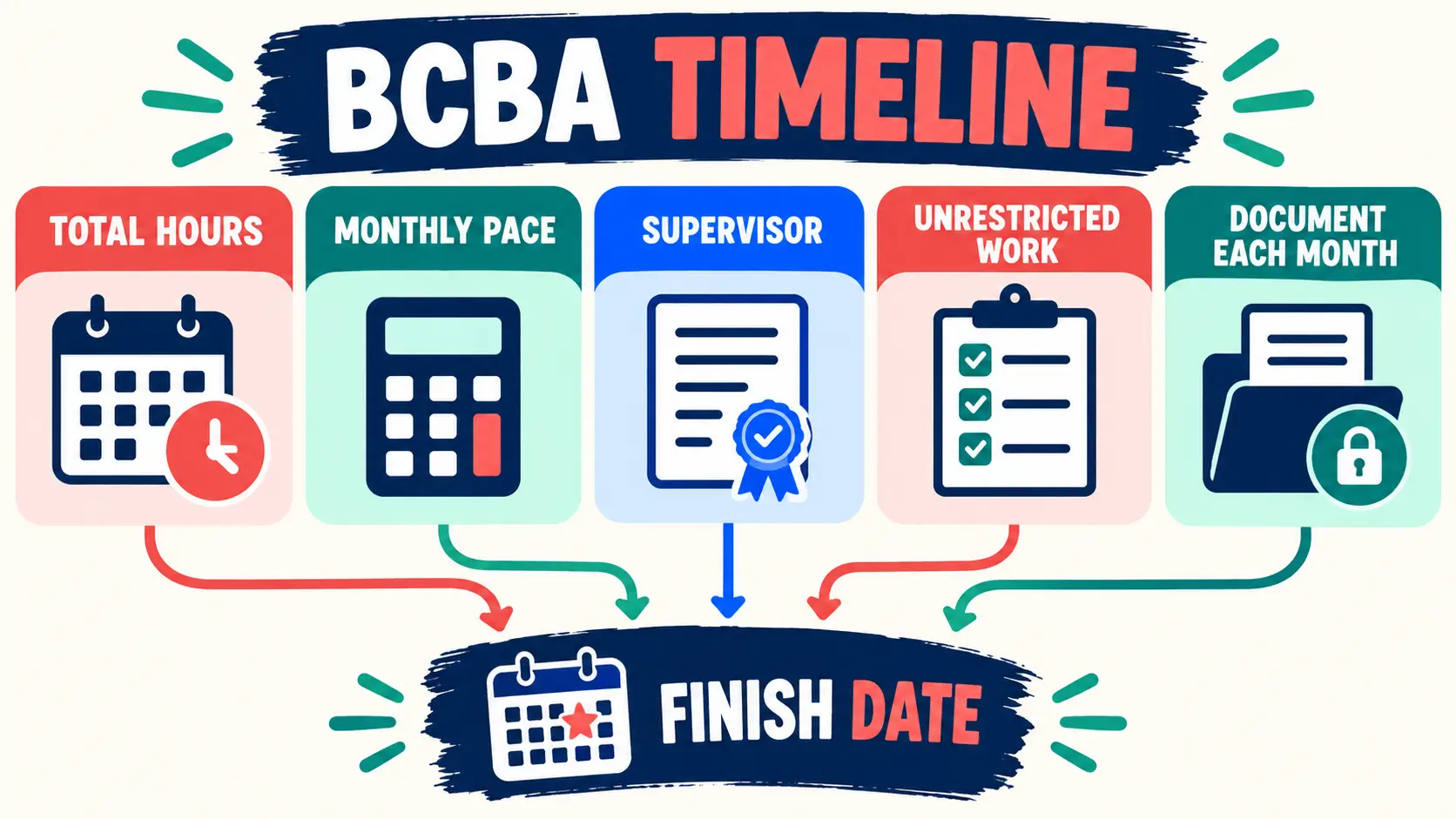
Your timeline is controlled by the intersection of five variables. The total hour target is only the first one. Before you estimate a finish date, ask how many hours your placement can actually generate, which fieldwork type you are using, whether a qualified supervisor can meet the required schedule, how much of your work is unrestricted, and whether your documentation system can show that each month qualifies.
- Fieldwork type: Supervised Fieldwork requires 2,000 hours; Concentrated Supervised Fieldwork requires 1,500 hours but uses a higher supervision percentage under the current rules.
- Monthly opportunity: A placement may offer fewer qualifying hours than your total paid work hours. School, client cancellations, holidays, and staffing changes can reduce the monthly total.
- Supervisor capacity: A supervisor needs time to observe, meet, provide feedback, review records, and maintain the relationship. A supervisor who is technically available but cannot support the required quality may slow the process or create compliance risk.
- Activity mix: At least 60% of overall supervised fieldwork must be unrestricted under the current handbook. Completing many restricted implementation tasks does not automatically create a balanced fieldwork record.
- Monthly compliance: Hours count only when the relevant requirements for the supervisory period are met. A missed observation, inadequate supervision percentage, or incomplete form can make a month require correction.
A good plan therefore uses a range. Build a conservative monthly estimate from your actual schedule, a target pace that leaves room for ordinary interruptions, and a review point every month. Do not base the plan on the maximum allowed hours unless your supervisor and placement can consistently support them.
What do the current BCBA fieldwork rules allow?
The June 2026 BCBA Handbook describes a one-calendar-month supervisory period. The two fieldwork types use the same monthly range but have different supervision and contact expectations. The table below is a planning summary; the full handbook contains additional requirements and exceptions that can affect whether a month qualifies.
| Current requirement | Supervised Fieldwork | Concentrated Supervised Fieldwork |
|---|---|---|
| Total hours to qualify | 2,000 hours | 1,500 hours |
| Supervisory period | 1 calendar month | 1 calendar month |
| Fieldwork hours per month | 20 minimum–130 maximum | 20 minimum–130 maximum |
| Supervision per month | 5% of fieldwork hours | 10% of fieldwork hours |
| Supervisor contacts | 4 contacts per supervisory period | 6 contacts per supervisory period |
| Unrestricted activity | At least 60% of overall supervised fieldwork | |
There is an important planning distinction between the total hours and the supervised portion. On the standard 2,000-hour path, 5% of the total does not mean that a supervisor must watch 100% of your work. It means that the supervised-hours percentage must be satisfied within each relevant supervisory period, along with the other rules. On the concentrated path, the total is smaller but the current supervision percentage is higher.
How do you calculate a realistic BCBA supervision-hours pace?
Start with a monthly average that reflects qualifying fieldwork, not your scheduled employment hours. Then divide the total requirement by that average and round up to a whole month. The calculation is simple, but the input should be conservative.
| Average qualifying hours per month | 2,000-hour path | 1,500-hour path | Planning meaning |
|---|---|---|---|
| 120 | About 17 months | About 13 months | Fast pace; requires a strong placement and reliable supervision |
| 100 | 20 months | 15 months | Useful baseline for full-time, stable fieldwork |
| 80 | 25 months | 19 months | More realistic for a mixed school-and-work schedule |
| 60 | About 34 months | 25 months | Leaves less room before the five-year completion window |
For example, if your schedule produces 92 qualifying hours in one month, do not assume that 92 will be available every month. Look back at several months, identify the lowest reliable pace, and use that number for the first forecast. You can update the forecast after your supervisor confirms that your activities and records are qualifying.
How do the 2027 rules change the calculation?
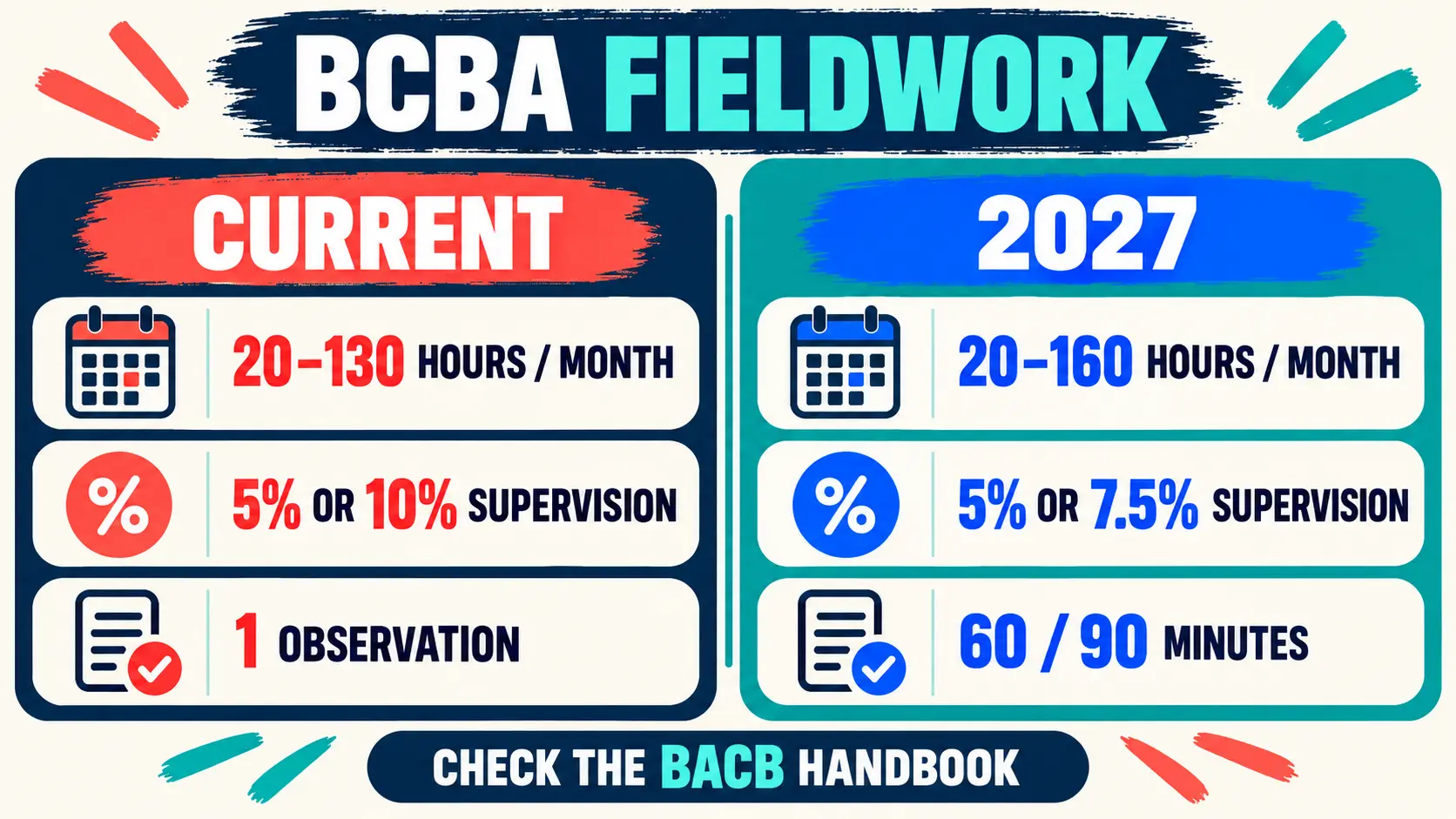
The BACB’s 2027 requirements keep the same total targets—2,000 hours for Supervised Fieldwork and 1,500 hours for Concentrated Supervised Fieldwork—but change several monthly mechanics. The monthly maximum becomes 160 hours. Concentrated supervision changes from 10% to 7.5%. Client observation is expressed as 60 cumulative minutes for Supervised Fieldwork or 90 cumulative minutes for Concentrated Supervised Fieldwork. The 2027 forms are also required for applicants after January 1, 2027.
| Planning item | Current rules | 2027 requirements |
|---|---|---|
| Total hours | 2,000 / 1,500 | 2,000 / 1,500 |
| Monthly range | 20–130 hours | 20–160 hours |
| Concentrated supervision | 10% per supervisory period | 7.5% per supervisory period |
| Client observation | 1 observation per period | 60 / 90 cumulative minutes, depending on fieldwork type |
| Verification forms | Use the applicable current forms | Use the 2027 monthly and final forms |
The 160-hour maximum can reduce the theoretical minimum number of months for a 2,000-hour path to 12.5 months, or about 13 full months, if every month is fully qualifying. That does not mean a trainee should chase the cap. The right ruleset and forms depend on the application timing and the current BACB transition guidance. Before changing a fieldwork plan, ask your supervisor which requirements apply and keep dated records showing your start and application plan.
Why do BCBA supervision hours take longer than expected?
The most common bottleneck is not the calculator. It is the supply of qualifying work. A trainee may be employed full time but have cancellations, administrative time, or duties that do not count as fieldwork. Another trainee may have enough activity but not enough unrestricted opportunities to maintain the required mix.
- Supervisor scheduling: observation and feedback may be delayed when a supervisor has too many supervisees or client responsibilities.
- Placement changes: moving employers, changing clients, or losing a case can interrupt the monthly pace.
- Coursework timing: fieldwork cannot begin until the applicable education and supervision prerequisites are in place.
- Client access: privacy, consent, school rules, or agency policies may limit direct observation.
- Quality corrections: a supervisor may require more training or practice before counting an activity as unrestricted or competent.
Plan with a buffer, and never add activities, alter dates, or label restricted work as unrestricted simply to hit a forecast.
How can documentation protect your timeline?
Use documentation as a monthly control system, not as an end-of-program cleanup project. Before the month closes, compare your hour total, supervision percentage, contacts or observation requirement, activity categories, and signatures with the applicable BACB forms. Ask your supervisor to review unclear entries while the details are still available.
- Keep the signed supervision contract and record the date fieldwork began.
- Log fieldwork by date, setting, client-related activity, and activity category.
- Track unrestricted and restricted hours separately.
- Record supervision contacts, individual versus group supervision, and direct observations.
- Save each monthly verification form with the supervisor’s signature.
- Keep a copy of the final form and any audit log in a secure backup location.
The current handbook says fieldwork records must be retained for at least seven years. That makes a simple, consistent file structure valuable: one folder for the contract, one for monthly forms, one for audit logs, and one for supervisor correspondence. If the BACB updates a form or transition rule, do not overwrite the old record; preserve the original and add a dated note explaining what changed.
What should your month-by-month BCBA fieldwork plan include?
A useful plan has more detail than “collect 100 hours per month.” Write down the weekly schedule, likely unrestricted projects, supervision pattern, observation method, record owner, and what happens if the supervisor or placement becomes unavailable.
At the end of each month, compare actual results with the plan. If you collected fewer hours, update the finish forecast rather than hiding the gap. If you collected more, confirm that the extra hours still fit the applicable maximum and activity rules. Review the next two months early so that a holiday, school break, or client transition does not surprise you.
When you are ready to connect your fieldwork plan with exam preparation, Take the Free BCBA Mock Exam to identify knowledge gaps while your supervised experience is still building. Use practice questions as a supplement to coursework and supervision—not as a replacement for either one.
What mistakes can delay completion?
Most timeline problems are preventable. Watch for these patterns:
- Planning from paid work hours instead of qualifying fieldwork hours.
- Assuming the 1,500-hour path is automatically faster without meeting its higher supervision standard.
- Using the 2027 numbers while still completing records under an older form set, or changing requirements without checking the BACB transition guidance.
- Waiting until the end of the program to discover that a monthly form is missing a signature or required detail.
- Ignoring the 60% unrestricted requirement until the final months.
- Continuing with a supervisor who cannot provide adequate observation, feedback, or documentation.
- Believing a maximum monthly cap is a target that every trainee should reach.
The safest strategy is to create a documented plan with your supervisor, review it every month, and leave time for ordinary interruptions. A slower, compliant month is better than a fast month that cannot be verified.
BCBA supervision hours FAQ
Can I finish 2,000 BCBA hours in one year?: Not under the current 130-hour monthly maximum, because 12 months at 130 hours is 1,560 hours. Under the 2027 160-hour maximum, 12 full months would still be 1,920 hours, so the mathematical minimum is about 13 fully qualifying months. Real schedules usually take longer.
Is the 1,500-hour path always the best choice?: No. Concentrated fieldwork has a smaller total but requires the concentrated supervision standard for the relevant periods. Compare supervisor availability, the quality of the placement, total costs, and the ruleset that applies to your application.
Does every hour I work as an RBT count?: No. Employment hours and qualifying BCBA fieldwork are not interchangeable. The activity must meet the applicable fieldwork requirements, fit the supervision arrangement, and be documented and verified.
What is the fastest safe way to finish?: Build a reliable placement, secure a qualified supervisor early, plan unrestricted activities from the beginning, review every month, and use the correct forms. There is no safe shortcut around the total hours, supervision, activity, observation, and documentation requirements.
Bottom line: use the formula “required hours ÷ sustainable qualifying hours per month,” then add a buffer for placement and documentation changes. The BACB rules define the boundaries; your supervisor, setting, schedule, and record quality determine where your actual timeline lands inside them.



