
If you are searching for a bcba independent fieldwork book, the short answer is this: a good book can help you plan, reflect, and organize your supervised fieldwork, but it is not the official record of your hours. The current BACB Handbook, the applicable fieldwork requirements, your supervisor’s review, and the required verification forms control whether your documentation is complete.
Table of Contents
- Quick Answer: Is a BCBA Independent Fieldwork Book Official?
- What Should a BCBA Independent Fieldwork Book Do?
- What Does the Official Record Control?
- Five Checks Before You Use a Fieldwork Book
- What Does a Practical Fieldwork Documentation Workflow Look Like?
- Common Mistakes That Make a Fieldwork Book Less Useful
- Is a Fieldwork Book the Same as a BCBA Exam-Prep Book?
- Frequently Asked Questions
- Bottom Line
- Take the Free BCBA Mock Exam
That distinction matters because many candidates want one convenient place to record independent fieldwork hours, unrestricted activities, supervision contacts, and questions for the next meeting. A notebook or digital planner can make that work easier. It cannot turn an activity into qualifying fieldwork, replace a supervisor’s judgment, or guarantee that a product will be accepted in an audit.
Use this guide as a buying and workflow checklist. It is not an individualized eligibility decision. Requirements, forms, and transition guidance can change, so the current BACB materials and your supervisor’s instructions take priority over an older book or template.
Quick Answer: Is a BCBA Independent Fieldwork Book Official?
No. A commercial book, planner, spreadsheet, or fieldwork tracker is usually a personal documentation aid. The BACB’s fieldwork guidance tells trainees to create a system that documents the information needed to show compliance, and it cautions readers to check software or curricula rather than assuming a product is endorsed. The product may be useful, but the product itself is not the authority.
- Useful job: give you a repeatable place to plan sessions, record questions, summarize feedback, and notice missing information.
- Official job: the current handbook and fieldwork requirements define what must be met; the appropriate Monthly Fieldwork Verification Form (M-FVF) and Final Fieldwork Verification Form (F-FVF) document the verification process.
- Supervisor job: help determine whether an activity fits the fieldwork requirements, your training goals, and the client context.
- Your responsibility: keep accurate records, review them regularly, and retain the documentation you may need later.
What Should a BCBA Independent Fieldwork Book Do?
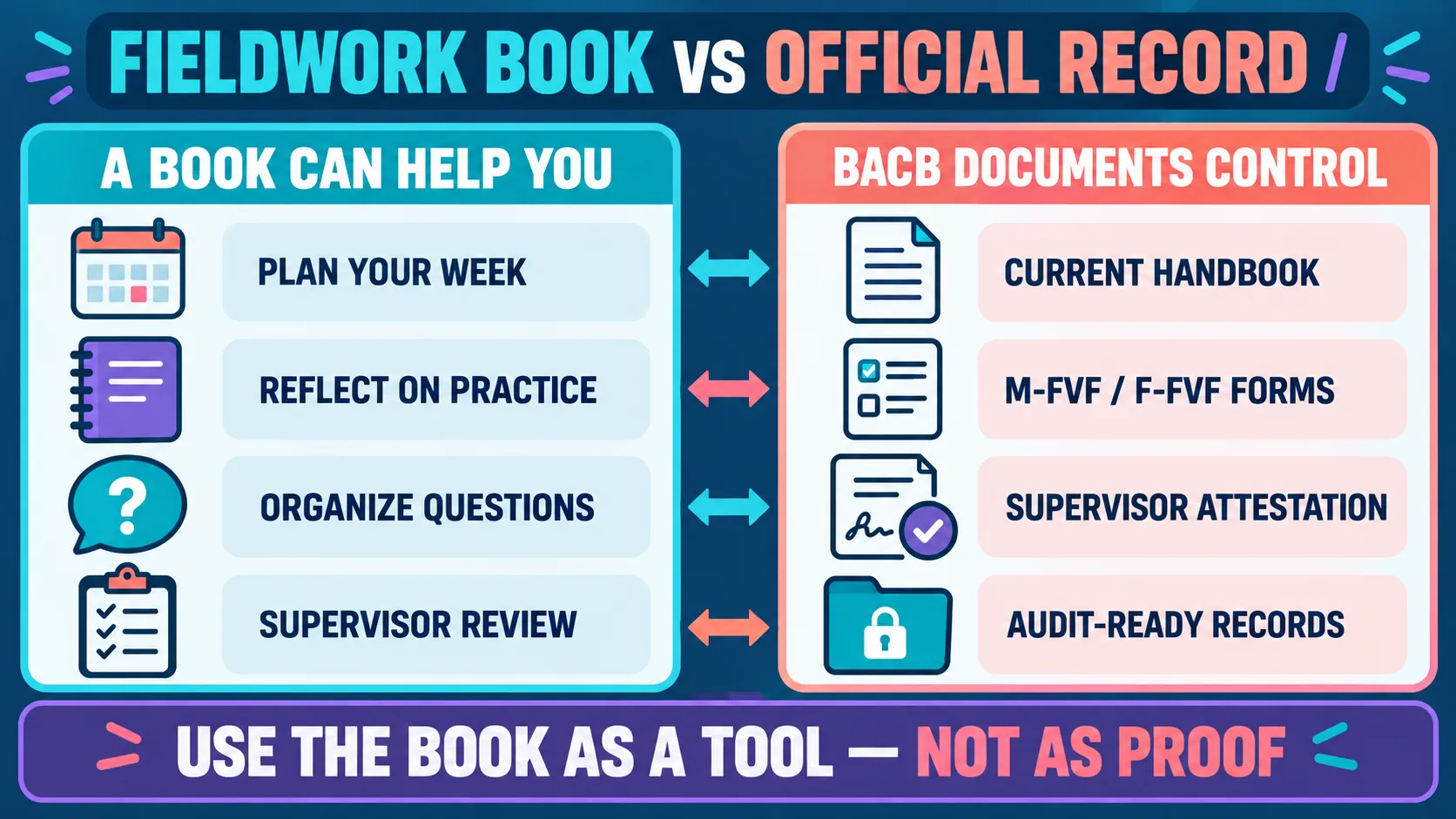
The best fieldwork book is a practical layer between your day-to-day experience and the official documentation system. It should reduce memory gaps without pretending to make the certification decision for you. Before using a book, compare its fields with the current BACB guidance and ask your supervisor whether the layout supports the way your supervision is organized. At a minimum, the layout should make it easy to:
- separate planning notes from the record you submit or retain as official documentation;
- connect an entry to a real client, setting, or supervision question when appropriate;
- capture feedback and a next step instead of only a number of hours; and
- find unfinished questions before the next supervisory meeting.
1. Help you plan the work you actually have: A useful book gives you space to plan a real client-related activity, identify the skill you are practicing, and note what you need to ask during supervision. It should not encourage you to invent simulated client work simply to fill empty pages. The BACB explains that fieldwork must connect to actual clients and that candidates should be cautious about curricula promising that activities will count.
2. Make reflection specific: “Reviewed data” is rarely a helpful reflection by itself. A stronger entry records the question you explored, the data or case material you reviewed, the feedback you received, and the next action you will take. This turns a book into a learning tool instead of a diary of vague tasks.
3. Surface gaps before the end of the month: Use the book to flag missing dates, unclear activity categories, unsigned forms, a supervision question that still needs an answer, or hours that need to be reviewed with your supervisor. A warning in your planner is useful; it is not proof that the gap has been repaired.
What Does the Official Record Control?
The current BCBA Handbook and the BACB’s fieldwork resources are the starting point for deciding what your system needs to capture. The BACB describes ongoing documentation by session and supervision contact, regular review across each supervisory period, and the forms used to verify fieldwork. The exact fields can depend on your fieldwork type and supervision structure, so do not copy a fixed template blindly.
| Resource | What it is for | What it cannot replace |
|---|---|---|
| Fieldwork book or planner | Planning, reflection, reminders, questions, and personal organization. | The current BACB rules, supervisor judgment, or signed verification. |
| BACB Handbook | Current eligibility, fieldwork, documentation, and application guidance. | Your supervisor’s individualized training plan or state licensure advice. |
| M-FVF and F-FVF | BACB verification of the hours and fieldwork completed under the relevant structure. | A book’s informal notes or an unsigned personal spreadsheet. |
| Supervisor review | Feedback on activities, client connection, competence, and documentation quality. | A guarantee that every future entry will count without review. |
For current guidance, start with the BACB’s Fieldwork: Getting It Right resource and the Documenting Fieldwork FAQs. These resources are more reliable than a book that has not been updated for the current requirements or the 2027 transition.
Five Checks Before You Use a Fieldwork Book
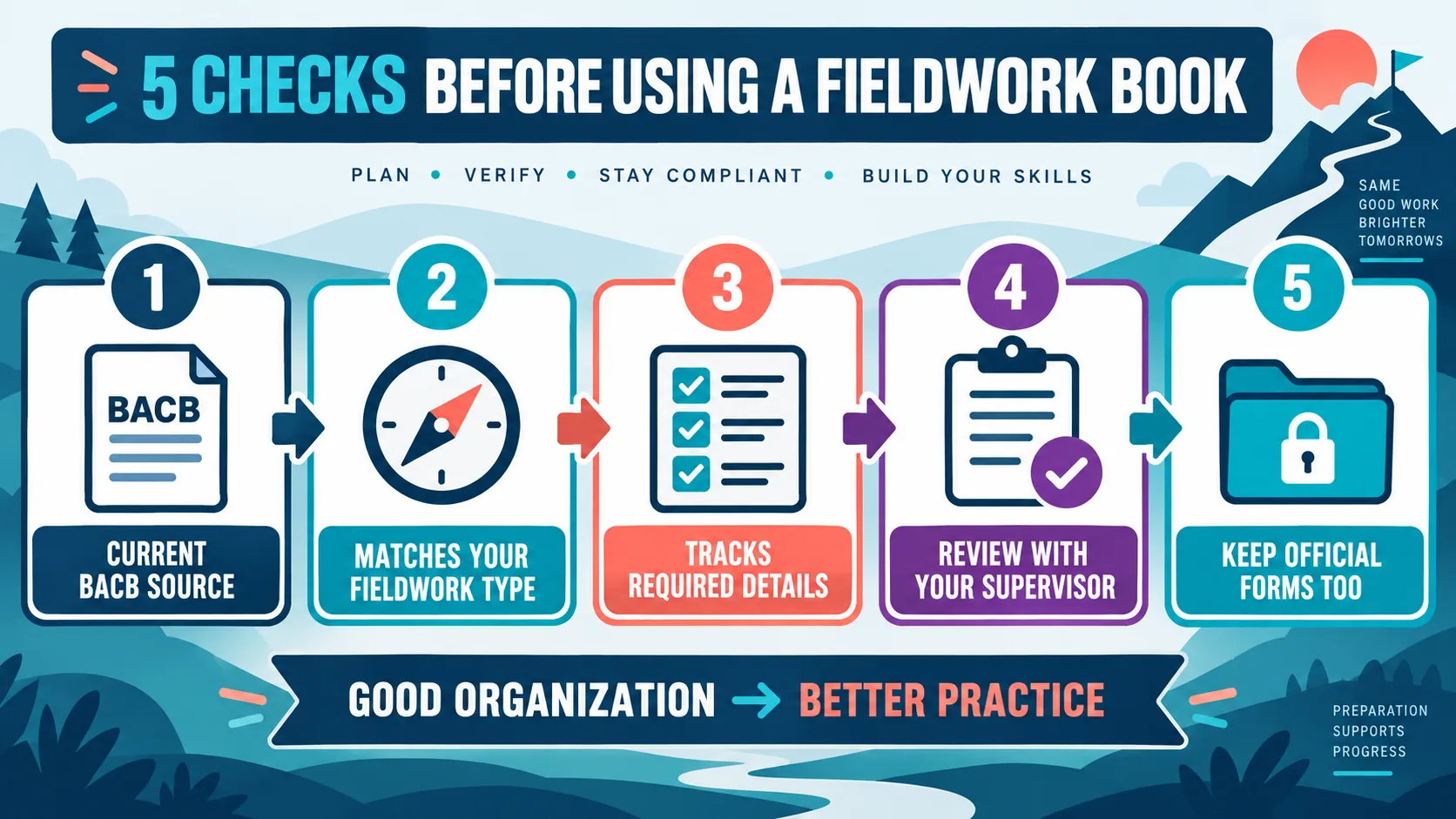
Use these checks before buying a book, downloading a template, or migrating your records. The goal is not to find a product that makes compliance automatic. The goal is to choose a tool that makes accurate, supervisor-reviewed work easier.
- Check the source date. Does the book tell you when it was written and point you to the current BACB Handbook? A recent cover date is not enough if the content does not identify its sources.
- Match the fieldwork type. Does it distinguish the supervision structure and fieldwork type you are actually completing? Avoid a template that treats every candidate’s schedule as identical.
- Track meaningful details. Can you record the date, time, activity, fieldwork category, client or setting context as appropriate, supervisor contact, feedback, and follow-up? Your book should help you remember the details your official system requires, not just total hours.
- Build in supervisor review. Is there a deliberate place to bring questions and review entries? A signature line in a book is not automatically an official attestation, but a review prompt can prevent problems from accumulating.
- Keep official forms separately. Can the book coexist with the current M-FVF, F-FVF, supervision contract, and other records? If the seller says the book alone replaces BACB forms, treat that as a warning sign.
What Does a Practical Fieldwork Documentation Workflow Look Like?
A simple workflow is more valuable than a beautiful book that you stop using after two weeks. Choose one location for the working notes, then reconcile those notes with your official records on a regular schedule.
- Before a session: write the real client-related objective or question you plan to address. Do not pre-label an activity as qualifying before your supervisor has reviewed the context.
- After the session: record what happened while the details are fresh: date, time, activity, data or materials reviewed, and the next question.
- Before supervision: mark entries that need clarification. Bring the book, the relevant data, and the current source documents to the meeting.
- After supervision: summarize the feedback and the action you will take. If an activity should be categorized differently, correct the official record through the process your supervisor uses rather than quietly changing history.
- At the end of the supervisory period: reconcile totals and qualitative notes, complete the appropriate official form with your supervisor, and store the signed record securely.
This process also helps with the difference between restricted and unrestricted activities. A fieldwork book can prompt you to describe the work; it cannot decide the category for every case. When the classification is uncertain, use the current BACB guidance and ask your supervisor. The BACB supervised-fieldwork FAQs also direct trainees back to the handbook and supervisor for activity-specific questions.
Common Mistakes That Make a Fieldwork Book Less Useful
- Buying a template because it promises that all prewritten activities will count.
- Recording only a monthly total instead of the underlying dates, contacts, activities, and feedback.
- Using an old form without checking the current BACB version.
- Keeping the only copy on an employer-controlled computer or in an account you may lose access to.
- Waiting until the final month to ask whether an activity was appropriate.
- Confusing a fieldwork tracker with a certification application, state license, or examination study plan.
The most serious mistake is treating organization as retroactive approval. A clean page can document a problem just as neatly as it documents compliant work. Use the book to make questions visible early, when you and your supervisor can still respond.
Is a Fieldwork Book the Same as a BCBA Exam-Prep Book?
No. A fieldwork book supports experience, documentation, and supervision. A BCBA exam-prep book supports learning and retrieval practice for the examination. They may sit on the same desk, but they answer different questions.
| If you need to… | Use… | Then verify with… |
|---|---|---|
| Organize experiences and questions | A fieldwork book or documentation system | Your supervisor and current BACB guidance |
| Learn exam content and identify weak areas | A structured BCBA study plan and practice questions | The current BACB exam content outline and explanations |
Once your fieldwork system is organized, a short practice set can show whether your study routine is producing usable recall. You can try the free BCBA mock exam as a low-pressure way to identify topics to review. It is practice and feedback, not a prediction of a passing score and not a substitute for the BACB’s official materials.
Frequently Asked Questions
Do I need to buy a BCBA independent fieldwork book?: No. You need a documentation system that captures the information required for your fieldwork and that you can maintain with your supervisor. That system may be a notebook, spreadsheet, software tool, or a book. Choose the format you will use consistently and compare it with the current BACB guidance.
Can a fieldwork book prove my independent fieldwork hours?: It can support your own records, but a book alone does not prove that hours meet the requirements. Verification depends on the applicable rules, documentation, supervision, and official forms. Keep the supporting records and signed forms your supervisor and the BACB require.
Can I use a book published before the 2027 BCBA changes?: Only with caution. The BACB is publishing transition guidance and updated handbook materials, so an older book may use outdated labels, percentages, forms, or timelines. Use the current BACB source as the control document and treat old pages as layout ideas, not rules. What should I do if a book says every activity will count?
Pause before relying on it. Ask how the book handles real-client connection, fieldwork type, supervision, restricted and unrestricted categories, current forms, and supervisor review. Then compare the claim with the BACB BCBA fieldwork resources. No commercial layout can guarantee an activity’s outcome.
Bottom Line
A BCBA independent fieldwork book can be a very practical companion: it can help you plan the week, capture questions, reflect on feedback, and notice missing documentation before a deadline. Its value comes from making good habits easier. Its limit is just as important: it is not the handbook, it is not your supervisor, and it is not official proof by itself.
Choose a current-source-aware tool, review it with your supervisor, keep the official forms and records, and use practice questions separately for exam preparation. That combination gives you a cleaner fieldwork process and a more honest picture of what you still need to study.
Take the Free BCBA Mock Exam
When you are ready to apply the idea, use the free practice resource below for additional feedback. Take the Free BCBA Mock Exam



