
If you are looking for applied behavior analysis certification online, start with one important distinction: an online ABA program is not automatically the same thing as BCBA certification. A graduate degree, a post-master certificate, a standalone behavior-analytic course sequence, and a test-prep course can all use similar marketing language while leading to very different next steps.
Table of Contents
- Applied Behavior Analysis Certification Online: What It Can Mean
- The Four Pieces of a BCBA-Ready Plan
- The 2026–2027 BACB Checkpoint
- How to Evaluate an Online Program
- Compare Online ABA Options Before You Enroll
- Your Application and Verification Checklist
- Red Flags That Should Slow You Down
- Final Takeaway
- Quick Review Checklist
- Take the Free BCBA Mock Exam
The right program should fit your degree history, coursework route, supervised fieldwork plan, and intended BCBA application date. This guide gives you a practical way to compare online options, with special attention to the BACB changes that matter for people planning coursework or an application during the 2026–2027 transition.
Applied Behavior Analysis Certification Online: What It Can Mean
“Online ABA certification” is a search phrase, not a single BACB credential. A school may use it to describe a fully online master’s degree, a graduate certificate for someone who already has a master’s degree, a sequence of behavior-analytic courses, or a short professional-development course. The delivery format tells you where you study; it does not, by itself, prove that you meet BCBA eligibility requirements.
For a future BCBA, the practical question is not simply “Is the program online?” Ask instead: Which requirement does this program satisfy, what remains after graduation, and who will document it? An honest program page should explain its degree level, its behavior-analytic coursework, its fieldwork arrangements, its supervision expectations, and the BACB route its students are using.
For example, an online master’s in applied behavior analysis may combine the graduate degree, behavior-analytic coursework, and supervised experience. A post-master certificate may provide coursework but assume that you already hold a qualifying graduate degree. A test-prep product may help you review the exam but satisfy none of those academic or fieldwork requirements. Treat those as different products, even when their headlines sound similar.
The Four Pieces of a BCBA-Ready Plan
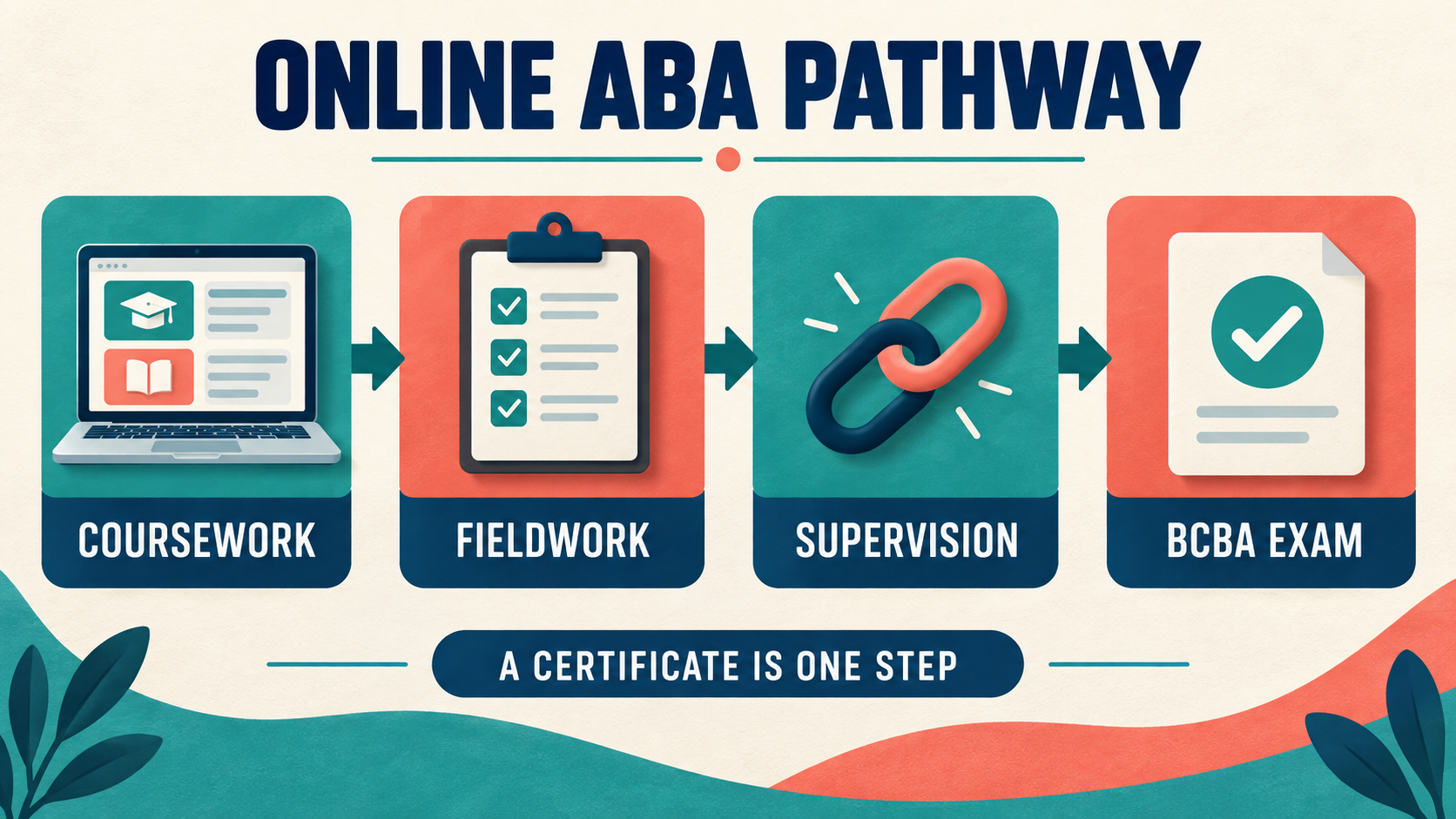
The current BCBA Handbook is the controlling starting point for certification planning. In broad terms, an applicant needs a qualifying degree route, the required behavior-analytic coursework, supervised fieldwork, and a passing examination. The exact pathway and transition rules matter, so use this checklist as a comparison framework rather than as a substitute for reading the handbook.
- Degree. Check whether you need a master’s degree or higher, whether your existing degree can be used, and whether the program itself awards a degree or only a certificate. A certificate can be academically useful without being a graduate degree.
- Behavior-analytic coursework. Ask how the curriculum maps to the requirements in effect when you plan to apply. Do not rely on a generic “BCBA track” label; request the current course list, syllabi, and the program’s process for confirming coursework.
- Supervised fieldwork. Find out whether fieldwork is included, arranged through a practicum, or left entirely to the student. Confirm who can supervise you, where hours can be earned, how hours are documented, and whether the schedule is realistic alongside your job.
- Examination. After the eligibility pieces are documented and approved, you still need to prepare for and pass the BCBA examination. A school’s practice test or review class may help with preparation, but it does not replace an eligibility application or the examination.
| Online option | What it may provide | What you must verify |
|---|---|---|
| Online graduate degree | A master’s degree plus behavior-analytic coursework, and sometimes a practicum or fieldwork support. | Accreditation or recognition, current coursework alignment, fieldwork access, total cost, and graduation timeline. |
| Post-master ABA certificate | Behavior-analytic coursework for someone who already has an eligible graduate degree. | Whether your prior degree qualifies, how the coursework is attested, and where you will complete fieldwork. |
| Standalone course sequence | A defined set of ABA classes that may address the coursework component of a pathway. | Current BACB rules, the program contact, content hours, transcripts, and whether a degree and fieldwork plan are separate. |
| Exam-prep course | Practice questions, review lessons, study planning, and error analysis. | It is preparation only; it does not award a degree, document fieldwork, or create eligibility. |
The 2026–2027 BACB Checkpoint
Online-program research needs an unusually careful date check right now. The BACB Recent and Upcoming Changes page identifies January 1, 2026 as the point when Pathway 2 applications began using a designated program contact for coursework attestation. It also identifies January 1, 2027 as the start of revised BCBA eligibility and maintenance requirements, including changes to degree, coursework, fieldwork, continuing education, and ongoing supervision rules.
That means older pages can be useful background but poor enrollment advice. The ABAI Verified Course Sequence page says the VCS system sunset effective January 1, 2026. For current Pathway 2 planning, ask the school how its program contact will handle the BACB coursework attestation process. A page that only promises a “VCS” without explaining the current process deserves a follow-up question.
The 2027 handbook also changes the way many candidates will evaluate a program. The BACB’s updated BCBA Handbook describes two 2027 pathways and directs applicants to the requirements that apply at the time of application. It also notes that the older Pathways 3 and 4 are no longer offered in the 2027 eligibility requirements. If your online program gives you a graduation or application date near the transition, ask which rules the school is using and get the answer in writing.
This is not a reason to avoid online study. It is a reason to match the program’s documentation process to your timeline. Save the current handbook version, the school’s written pathway guidance, your syllabi, and your fieldwork documents. If the information conflicts, contact the BACB or the program’s designated contact before paying a nonrefundable deposit.
How to Evaluate an Online Program
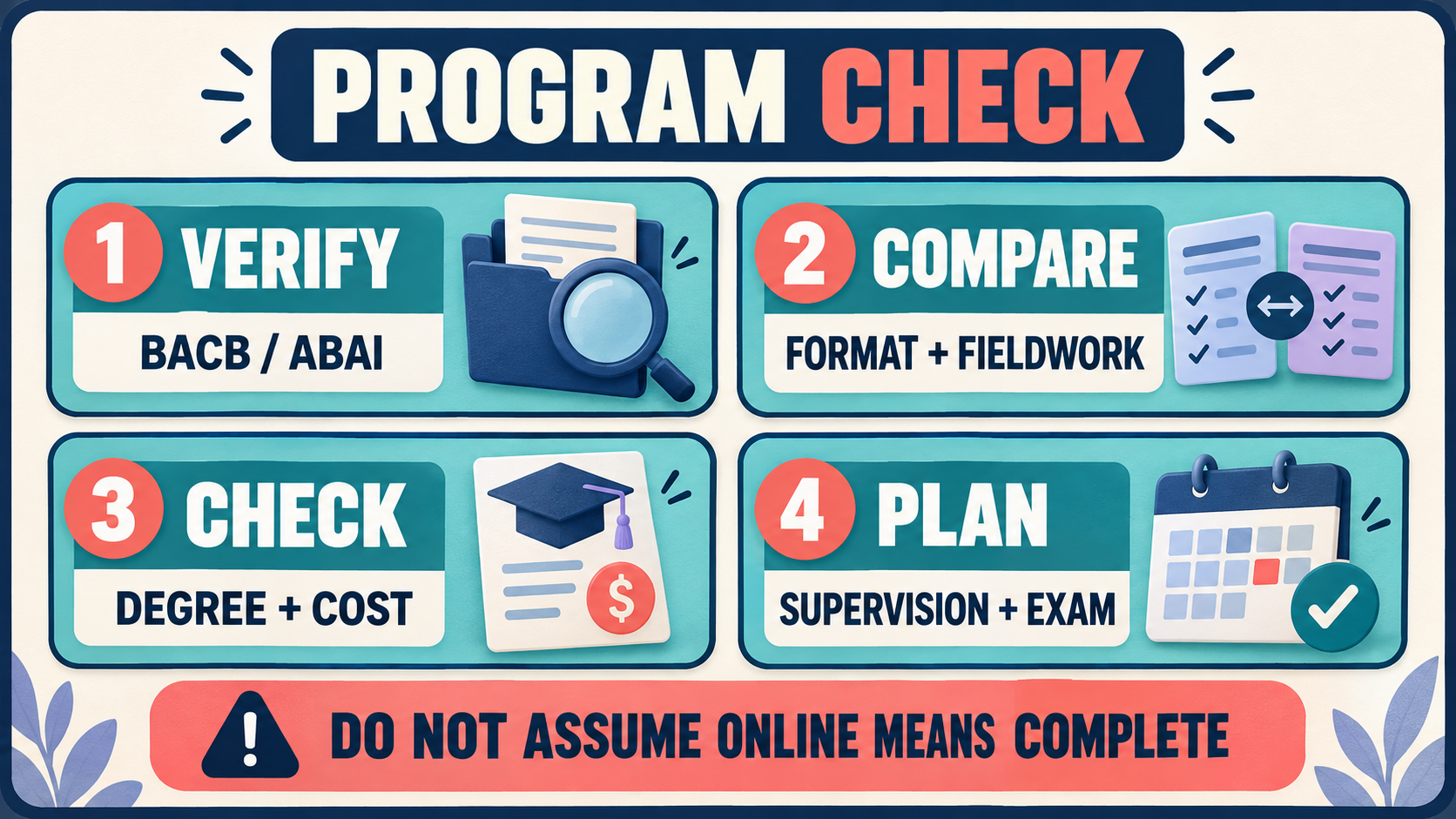
After you identify the type of program you need, evaluate it in the same order a careful admissions counselor should explain it. The goal is to uncover missing pieces before you enroll, not after you have spent a semester and discovered that a course cannot be used in your intended pathway.
1. Verify the institution and program status: Start with the university’s official catalog and the relevant BACB or ABAI information. ABAI explains that accredited and recognized programs can satisfy the degree and coursework eligibility requirements associated with Pathway 1, while current Pathway 2 applicants must follow the BACB process. If a school uses words such as “approved,” “verified,” or “accredited,” ask which organization granted that status, what it covers, and whether the status applies to the exact online program you are considering.
2. Read the curriculum instead of the headline: Download the course list and, when possible, the syllabi. Look for identifiable behavior-analytic content, instructional hours, learning objectives, assessments, and the way the sequence is recorded on a transcript. A course called “special education,” “autism studies,” or “clinical practice” may be valuable but may not substitute for every behavior-analytic content area. Ask the program to show the mapping rather than asking you to infer it from the marketing page.
3. Test the fieldwork promise: “Fieldwork available” can mean a guaranteed practicum, a referral list, or simply permission to arrange your own placement. Ask whether the school has supervisors, whether online students can use a local employer, how often observations occur, and what happens if a placement ends. The 2027 rules make documentation and supervision especially important. A low tuition number is not a bargain if you cannot obtain compliant fieldwork.
4. Calculate the complete cost: Compare tuition, technology fees, books, supervision, travel, application charges, examination fees, and the cost of reducing work hours. Ask whether financial aid applies to the exact certificate or degree, whether the rate can change, and whether a practicum adds credits. Request a written estimate for the full program rather than comparing only the cost per credit.
Compare Online ABA Options Before You Enroll
A simple comparison sheet keeps the decision grounded. Use one row per program and write the answer from an official source, not from a sales call alone.
| Question | Strong evidence | Weak evidence |
|---|---|---|
| Does it fit my degree route? | Written admissions and pathway explanation tied to the current handbook. | “This certificate makes you a BCBA” with no degree or pathway detail. |
| How is coursework verified? | Current program contact, syllabi, transcripts, and an attestation workflow. | An old VCS badge with no 2026 or 2027 process. |
| Where will fieldwork happen? | Named support, supervisor qualifications, placement rules, and documentation examples. | “Students are responsible for finding their own hours” with no guidance. |
| What is the total investment? | A written estimate that includes credits, fees, supervision, materials, and likely completion time. | A low advertised price that excludes practicum, supervision, or required fees. |
Your Application and Verification Checklist
Before you submit an application or deposit, collect these items in one folder:
- The current BACB handbook and the date you reviewed it.
- The program catalog, admissions requirements, course sequence, and representative syllabi.
- A written answer explaining whether the program is Pathway 1 or Pathway 2 and who handles the current coursework documentation.
- Your prior degree transcript and any written evaluation the school or BACB gives you.
- A fieldwork plan naming the setting, supervisor, expected schedule, observation process, and documentation method.
- A complete cost estimate, financial-aid conditions, refund policy, and expected time to completion.
- A personal timeline showing coursework, fieldwork, application, eligibility approval, and examination preparation.
When you contact a program, use specific questions: “Which current BACB requirement does this course satisfy?” is more useful than “Is this BCBA approved?” Ask the same question of two different representatives if the answer is vague. Keep the reply with your enrollment records.
Red Flags That Should Slow You Down
Be cautious when a page promises certification after a short online course, treats exam preparation as eligibility, or implies that a certificate automatically replaces a master’s degree. Another warning sign is a school that cannot explain how online coursework is delivered, how fieldwork is supervised, or what happens under the 2027 requirements.
Also slow down when the page uses an old VCS claim without a current attestation explanation, lists a program as “approved” without naming the approving body, hides the total cost, or promises a guaranteed exam result. A reputable program can explain what it provides and what it does not provide. It should never guarantee that every student will become certified simply by paying tuition.
Final Takeaway
The best applied behavior analysis certification online option is the one that makes the full BCBA pathway visible. Confirm the degree route, behavior-analytic coursework, current documentation process, supervised fieldwork, total cost, and exam timeline before you enroll. For anyone planning around 2026 or 2027, give extra weight to the current BACB handbook and written guidance from the program contact, because older VCS language may no longer describe the process you will use.
Once your eligibility plan is documented, build a separate exam-preparation schedule. A free BCBA mock exam can help you find weak domains and practice timing. It is a study aid, not an official BACB product and not a guarantee of a passing score. For targeted review, use our applied behavior analysis certification online practice questions to apply the concept in exam-style scenarios.
Quick Review Checklist
Use this final checklist to turn applied behavior analysis certification online into exam-ready reasoning. The goal is not to memorize a label in isolation; it is to identify the relevant evidence and explain why the best answer fits the scenario. Key ideas to review:
- State the central definition or decision point for applied behavior analysis certification online in your own words.
- Identify the detail that makes applied behavior analysis certification online different from its closest related ABA term.
- Separate the observable facts in a scenario from assumptions that are not supported by the facts.
- Write one example and one nonexample so you can recognize the concept in a new setting.
Exam application checks:
- Ask what the question is actually requesting before comparing the answer choices.
- Mark the antecedent, response, consequence, or other evidence that supports the selected answer.
- Look for a distractor that describes a related process but does not answer the specific question.
Final self-check:
- Explain how you would verify the interpretation with clear observations or data.
- Change one detail in the scenario and decide whether your answer should change.
- Give a one-sentence rationale that a supervisor or study partner could evaluate.
Take the Free BCBA Mock Exam
If you want a low-pressure way to check your recall, use the free practice resource below. Take the Free BCBA Mock Exam



