
If you are studying operant extinction vs instinctual drift, begin with the mechanism that changed. Operant extinction is a contingency procedure: a response that previously produced reinforcement no longer produces that reinforcer. Instinctual drift—more commonly called instinctive drift in the research literature—is a different phenomenon in which species-typical behavior interferes with a trained operant. The two can both make a trained response look weaker, but they do not describe the same process.
Table of Contents
- What Is the Difference Between Operant Extinction and Instinctual Drift?
- What Is Operant Extinction in ABA?
- What Is Instinctual Drift in Behavior Analysis?
- Operant Extinction vs Instinctual Drift: What Changed?
- How Do You Solve an Operant Extinction vs Instinctual Drift Exam Question?
- What Should a BCBA Check Before Calling It Extinction?
- What Are the Common BCBA Exam Traps?
- Operant Extinction vs Instinctual Drift FAQ
- Take the Free BCBA Mock Exam
That distinction is useful for the BCBA exam and for clinical reasoning. A vignette about a withheld consequence is asking you to identify extinction. A vignette about an animal returning to food-related or species-typical behavior despite continued training may be testing instinctive drift. This guide gives you a clean comparison, an exam decision path, and boundaries for interpreting what the data actually show.
What Is the Difference Between Operant Extinction and Instinctual Drift?
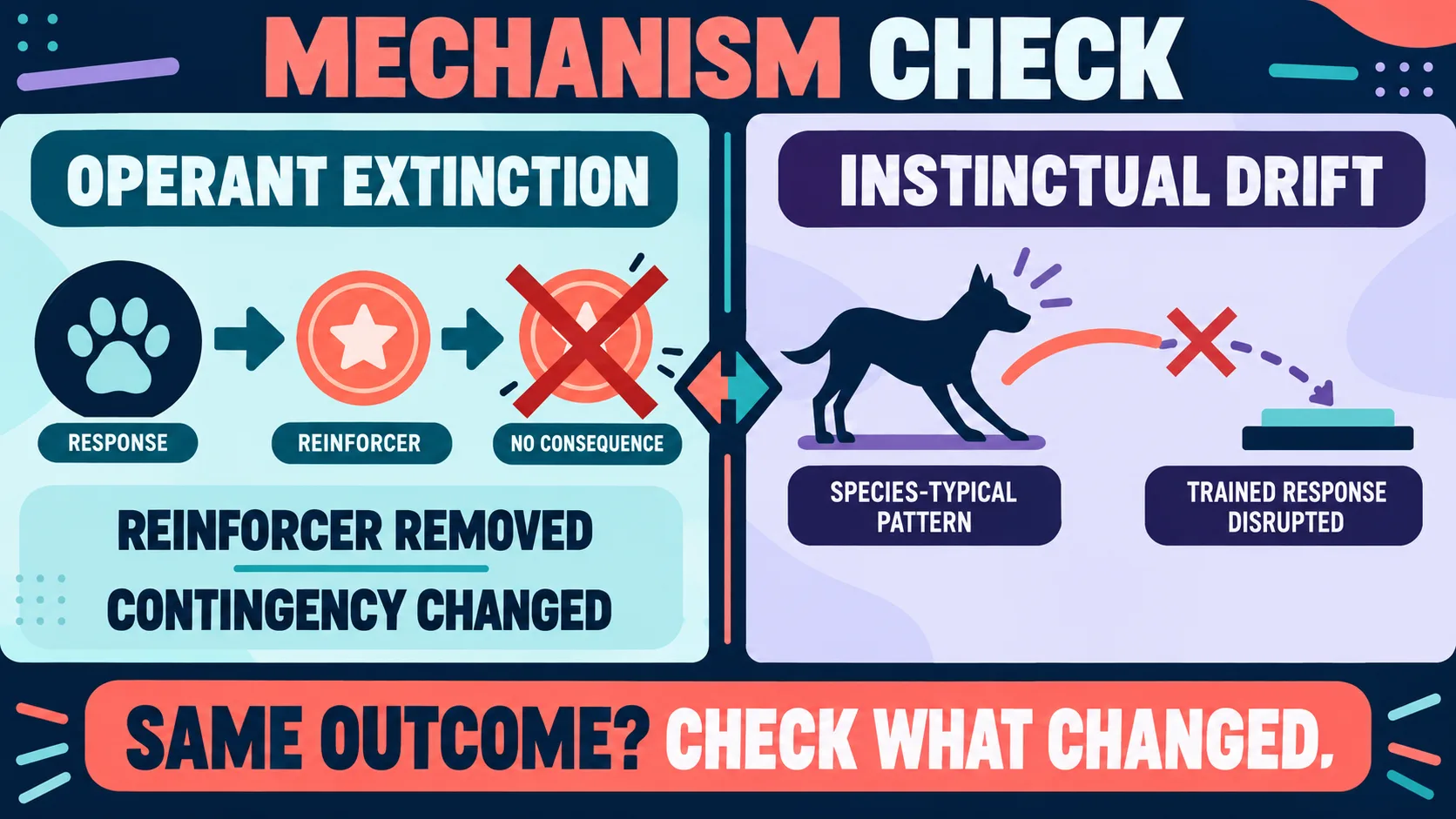
The shortest accurate answer is this: extinction changes the consequence, while instinctual drift describes interference from an innate or species-typical response pattern. In extinction, the analyst identifies a response–reinforcer relation and stops delivering the maintaining reinforcer for that response. The response may decrease, although an extinction burst, response variation, relapse, or other effects can occur. In instinctive drift, the original reinforcement arrangement may still be present, but the organism begins to engage in behavior that is biologically prepared or unusually salient for that species.
- Extinction: ask whether the trained response still produces the consequence that reinforced it.
- Instinctual drift: ask whether a species-typical response is competing with the trained operant.
- Decision rule: name the mechanism only after identifying the contingency and the behavior that was measured.
The wording matters. “The behavior stopped producing reinforcement” points toward extinction. “The animal began performing a species-typical behavior that disrupted the trained sequence” points toward instinctive drift. Do not decide based only on the fact that the trained response became less efficient or less frequent.
What Is Operant Extinction in ABA?
Operant extinction is the discontinuation of reinforcement for a previously reinforced operant. The response must be defined, and the relevant reinforcer must be identified. If a learner’s request previously produced access to a break and the plan consistently stops delivering that break after the target response, the analyst has changed a response–reinforcer contingency. The effect of that change is then evaluated with data.
Extinction is not simply “ignoring.” Ignoring is only an extinction procedure when attention was the consequence maintaining the response and attention is consistently withheld for that response. If the behavior is maintained by escape, tangible access, or automatic reinforcement, ignoring may leave the relevant contingency unchanged. The functional relation—not the appearance of the adult’s action—determines the procedure.
Current extinction research also cautions against treating a decrease as immediate or guaranteed. Extinction is context-sensitive, and responding can return through effects such as spontaneous recovery, renewal, reinstatement, or generalization failure. The review of Pavlovian and operant extinction explains why the term can refer to a procedure, a process, and a behavioral outcome. On an exam, first identify the contingency operation before interpreting the graph.
What Is Instinctual Drift in Behavior Analysis?
Instinctual drift, usually written instinctive drift, is the tendency for an organism’s species-typical behavior to emerge or intrude during an operant training arrangement. The classic Breland and Breland account described animals that initially performed a trained response for food but later engaged in food-related actions that interfered with the trained response. The historical report uses the term “misbehavior of organisms” and describes the drift toward instinctive patterns even when those patterns made reinforcement less efficient.
Instinctive drift is therefore not defined by removing the reinforcer. A food reinforcer may remain available, and the trainer may continue presenting the same arrangement, but the organism’s behavioral repertoire interacts with the task. The result can look like a failure to maintain the operant, a change in topography, or a delay in completing the trained chain.
- The trained arrangement may still be operating.
- A biologically prepared or species-typical pattern becomes more prominent.
- The competing pattern can delay, distort, or interrupt contact with the programmed outcome.
For BCBA study, keep the concept in its proper scope. Instinctive drift is most clearly illustrated in animal-learning examples and is not a diagnosis of a learner’s motivation. It should not be used as a casual explanation for every treatment failure, refusal, sensory response, or change in human behavior. Identify the actual antecedent, consequence, measurement, and learning history before choosing a label.
Operant Extinction vs Instinctual Drift: What Changed?
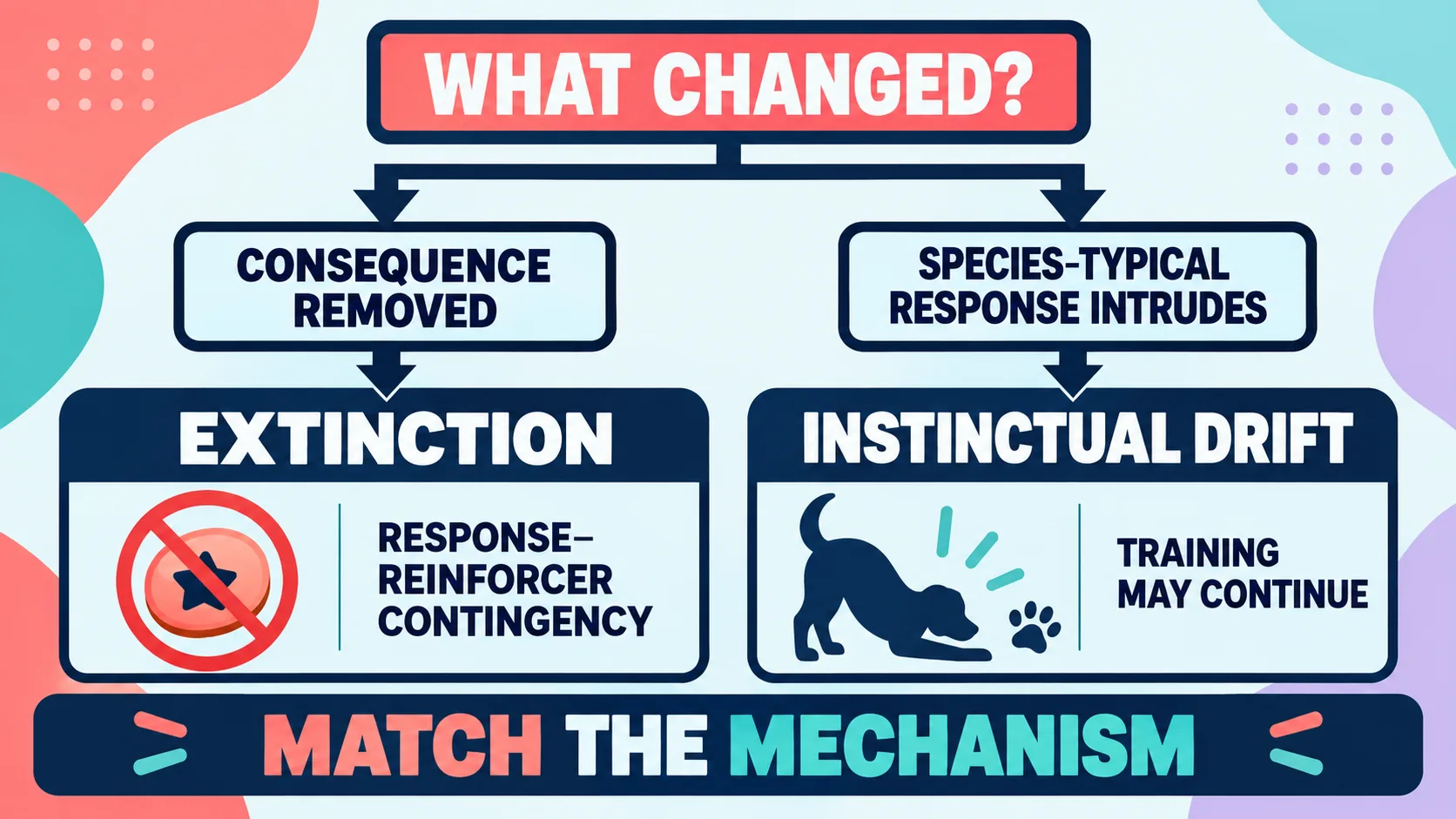
Use the following comparison as a mechanism check rather than a memorization shortcut. The same outcome—less reliable performance of a trained response—can arise from very different operations.
| Feature | Operant extinction | Instinctual drift |
|---|---|---|
| Defining change | The consequence that reinforced the response is discontinued or made noncontingent. | Species-typical behavior intrudes on or competes with the trained operant. |
| Reinforcer | The relevant reinforcer is no longer produced by the target response. | The reinforcer may still be available; the problem is interference with the trained sequence. |
| What to measure | Target-response rate, latency, variability, relapse, and implementation fidelity. | Trained-response completion, competing topography, sequence position, and contact with the reinforcer. |
| Exam clue | “No longer reinforced,” “withheld,” or “does not produce the outcome.” | “Returns to innate behavior,” “species-typical pattern,” or “trained response is disrupted by instinctive actions.” |
Notice that the table does not say instinctive drift is a type of extinction. It is a separate explanation for behavior competing with a trained response. A case could contain both phenomena, but the question must provide evidence for both: for example, the reinforcer is discontinued and a competing species-typical pattern also appears. When only one mechanism is described, choose the narrower supported answer.
How Do You Solve an Operant Extinction vs Instinctual Drift Exam Question?
Read the vignette in an order that protects you from being distracted by the final outcome. The following sequence works well for short scenario questions:
- Identify the trained response. State exactly what the organism or learner was expected to do. Avoid vague labels such as “cooperate” or “perform well.”
- Identify the consequence. What followed the response during baseline or training? Was it attention, escape, food, access to an item, or another event?
- Look for a contingency change. If the response no longer produces the relevant consequence, classify the operation as operant extinction before considering side effects.
- Look for a species-typical competitor. If a biologically prepared pattern intrudes while the training arrangement continues, consider instinctive drift.
- Check the measurement. A lower rate alone does not prove extinction. A new topography alone does not prove drift. Match the conclusion to what was actually recorded.
One common distractor describes an animal that keeps contacting the food but performs a different food-related action instead of the trained response. That is not automatically extinction, because the prompt may never say that food was withheld for the trained response. Another distractor describes a learner whose behavior briefly increases after attention is withheld. That pattern may be an extinction burst, not instinctive drift.
What Should a BCBA Check Before Calling It Extinction?
In applied work, the label should follow assessment and procedural evidence. Before concluding that an intervention includes extinction, check the following:
- Function: What consequence is believed to maintain the behavior, and what evidence supports that hypothesis?
- Operational definition: Can another observer identify the target response and the relevant consequence?
- Fidelity: Was the consequence actually withheld according to the plan, or did staff sometimes deliver it after the response?
- Replacement behavior: Is the learner being taught a safer, efficient response that contacts reinforcement?
- Risk: Could withholding the consequence produce escalation, aggression, self-injury, emotional responding, or other unsafe effects?
- Data: Are rate, latency, duration, variability, and relevant context being measured consistently enough to interpret change?
The BACB’s BCBA Test Content Outline places extinction alongside reinforcement, differential reinforcement, unwanted effects, relapse, and data-based intervention decisions. That exam boundary supports a practical rule: do not recommend or describe extinction as a stand-alone trick. Match the procedure to assessment results, client preferences, contextual fit, safety planning, and the behavior-change goal.
What Are the Common BCBA Exam Traps?
- “The behavior decreased” means extinction. Not necessarily. A response can decrease because of satiation, punishment, illness, schedule change, competing reinforcement, or an unmeasured context change.
- Instinctual drift means the reinforcer stopped working. Drift concerns competition from species-typical behavior; it is not defined as loss of reinforcer value.
- Ignoring always equals extinction. Only when attention was the maintaining reinforcer and the contingency is implemented consistently.
- One unusual response proves drift. The question should describe a stable or meaningful intrusion of a species-typical pattern, not one random variation.
- Extinction and punishment are interchangeable. Extinction withholds a previously reinforcing consequence. Punishment adds or removes a consequence following behavior and produces a decrease; the contingency is different.
Operant Extinction vs Instinctual Drift FAQ
Is instinctual drift the same as extinction?: No. Instinctual drift is the intrusion of species-typical behavior during or after operant training. Extinction is a change in the response–reinforcer contingency. A scenario can include both, but one does not define the other.
What is the fastest exam clue for operant extinction?: Find the consequence that used to follow the response. If the stem says that consequence is no longer delivered contingently, think operant extinction. Then check for possible effects such as a burst, variability, relapse, or recovery.
Why does instinctual drift matter for BCBA candidates?: It reminds you that behavior is shaped by both learning history and the organism’s behavioral repertoire. It is a specialized learning concept, not a shortcut for labeling a human learner’s behavior. Use the evidence in the vignette and avoid extending the term beyond the example it supports.
The exam-ready distinction is simple: extinction asks what happened to the reinforcer; instinctual drift asks whether a species-typical response pattern disrupted the trained operant. Practice separating those mechanisms, the data that would support each conclusion, and the safety and fidelity questions that follow. Our operant extinction vs instinctual drift practice can help you read the contingency rather than guess from the outcome.
Take the Free BCBA Mock Exam
When you are ready to apply the idea, use the free practice resource below for additional feedback. Take the Free BCBA Mock Exam



