
BCBA requirements and preparation If you are looking for an ABA competency assessment study guide, start by clarifying what is being assessed. A supervised skills check, a fieldwork review, an RBT competency assessment, and the BCBA certification examination are not interchangeable. They can share ABA vocabulary, but they use different evidence, forms, and decision standards. A useful guide helps you prepare for the assessment you actually have instead of sending you through a generic list of terms.
Table of Contents
- What This Study Guide Should Clarify
- How to Build a Competency Skill Map
- How to Separate Exam Study From Demonstration Practice
- What the 2027 Transition Changes for Planning
- How to Build a Weekly Preparation Loop
- How to Use Feedback and Documentation
- Common Study-Guide Mistakes
- A Practical ABA Competency Assessment Checklist
- ABA Competency Assessment Study Guide FAQ
- Take the Free BCBA Mock Exam
This guide gives BCBA candidates a practical way to organize skills evidence, exam study, feedback, and the 2027 requirements transition. It does not replace a supervisor’s instructions, a BACB form, or the current BCBA Handbook. For transition timing, compare the BACB 2027 transition guidance with the current requirements page. The BACB’s official materials should control any claim about eligibility, fieldwork, certification, or examination rules. A study guide can structure your preparation; it cannot grant competency or guarantee certification.
What This Study Guide Should Clarify
The phrase “competency assessment” is easy to search and easy to misapply. In the BACB ecosystem, competency language may appear in technician-level assessment materials, supervisor training, fieldwork documentation, or ordinary professional skills discussions. The BCBA certification examination is a separate multiple-choice examination based on the current BCBA Test Content Outline. Before studying, write down the exact assessment name, the assessor, the form or rubric being used, and the date or requirement that controls your situation.
For a BCBA candidate, a competency-focused study guide should answer four questions. What must I be able to explain? What must I be able to demonstrate or document? What evidence will my supervisor or program evaluate? What feedback will change my next practice session? If the guide only gives definitions, it may support recall but will not prepare you to show a skill or explain a decision.
- Scope: identify the current source, task, skill cluster, or rubric instead of relying on an old checklist.
- Performance: describe the observable action that demonstrates the skill.
- Decision quality: explain the controlling facts, alternatives, and limits of the decision.
- Documentation: record what was observed, when it occurred, and what feedback was given.
- Next practice: convert a partial performance into a specific rehearsal or review action.
Do not label an unofficial worksheet as a BACB assessment form. Do not present an original scenario as a real examination item. A responsible guide makes the boundary visible: official materials define requirements, while the guide supplies a study framework and original practice examples.
How to Build a Competency Skill Map
Once the assessment is identified, build a map that connects each target skill to evidence. The map should be short enough to use during a real study session. It should also leave room for a supervisor’s rubric or a program’s required form, because the evidence that matters depends on the assessment context.
| Skill-map field | What to write | Example question |
|---|---|---|
| Target skill | The skill name and the current source or rubric. | Which task or supervisor criterion is this? |
| Observable performance | What the assessor could see or hear. | What would count as a complete demonstration? |
| Decision rationale | The facts, ethical limits, or data that control the choice. | Why is this option appropriate here? |
| Evidence record | Date, context, feedback, and the source used. | Could another qualified reviewer understand what happened? |
| Next rehearsal | One action that should improve the next performance. | What will I practice differently next time? |
Use the map to prepare for reasoning, not to script a clinical interaction. A study example may ask you to identify an operational definition, choose a measurement procedure, or explain why a prompt should be faded. In practice, the correct decision also depends on the client, setting, risk, culture, consent, and professional scope. Keep examples conceptual unless you are working under the required supervision and documentation process.
How to Separate Exam Study From Demonstration Practice
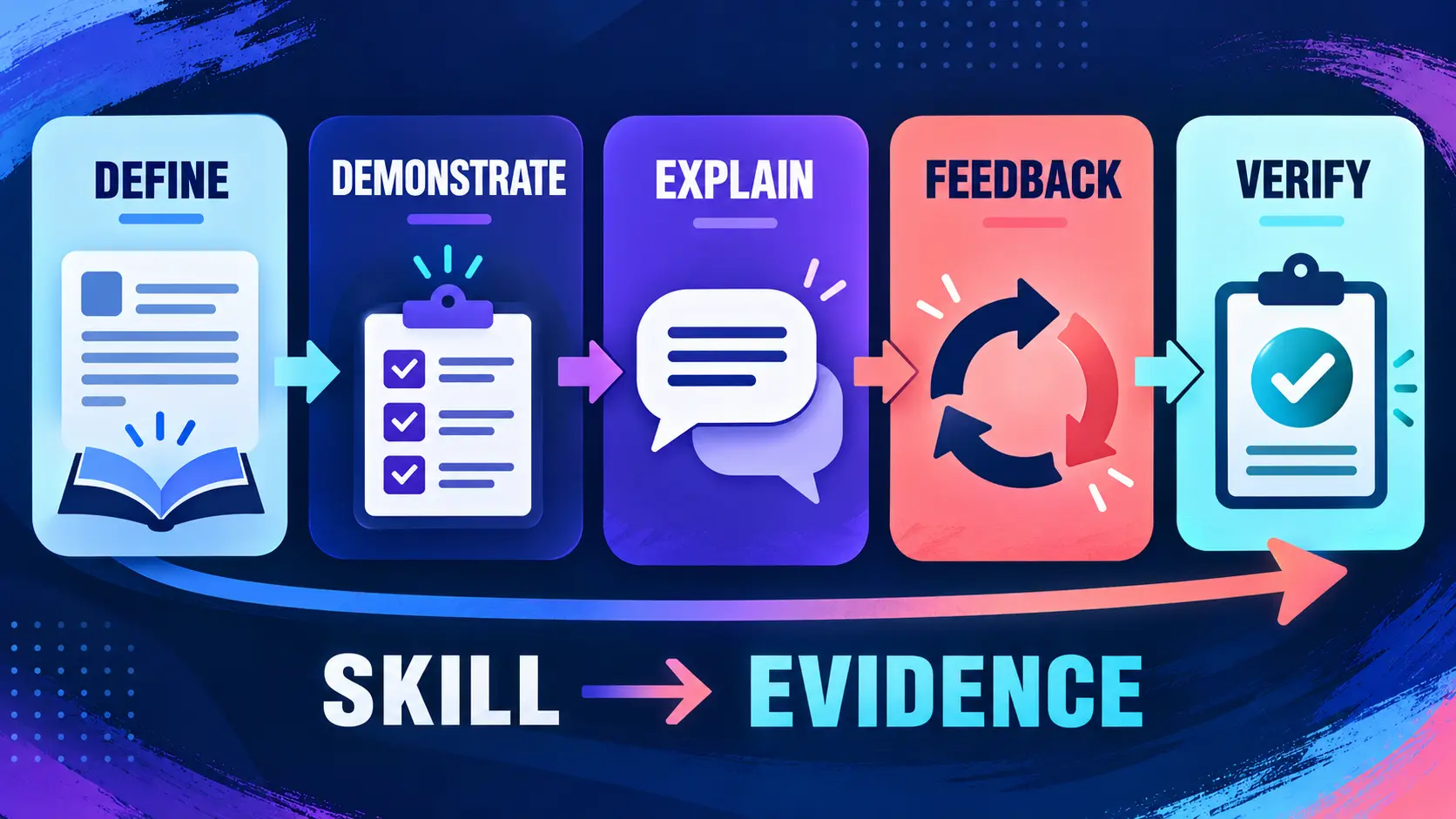
BCBA exam study and competency demonstration can reinforce each other, but they are not the same track. The current BCBA Test Content Outline is a scope map for examination knowledge and skills. A demonstration assessment asks whether a person can perform or explain a defined skill in a particular context. If you study only vocabulary, you may be unable to perform. If you practice only one setting, you may fail to recognize the same principle when the scenario changes.
Build two linked tracks. Track one uses the official outline, source-checked explanations, original scenarios, and mixed practice questions. Track two uses the actual supervisor or program criteria, rehearsal, observation, feedback, and documentation. The shared concept belongs in both tracks, but the evidence is different. A practice question can show reasoning; it does not prove that a person demonstrated a skill with a client or under a program’s assessment procedure.
- Exam track: define, distinguish, interpret, calculate, and select the best answer from a scenario.
- Performance track: prepare, demonstrate, explain, receive feedback, and repeat under the relevant conditions.
- Source track: verify current BACB requirements and ethical guidance before recording a rule or deadline.
- Reflection track: identify what was known, what was performed, and what still needs supervised practice.
For example, a learner may answer a question about preference assessment correctly and still need supervised practice to select, arrange, and interpret an assessment appropriately. The study guide should therefore use different verbs. “Name the assessment” is recall. “Select the assessment based on the stated constraint” is exam application. “Conduct or explain the assessment steps under the approved supervision plan” is performance preparation. Similar content does not mean identical competency.
What the 2027 Transition Changes for Planning
Because the search phrase includes competency assessment and study guide, candidates may also be trying to organize their BCBA pathway. The BACB’s current 2027 requirements materials say that significant eligibility and maintenance changes take effect January 1, 2027. The official transition guidance says applicants who want to use the current requirements must meet them before that date, and those who apply after the change must use the requirements in effect at application.
Do not turn a summary table into personal eligibility advice. Use it as a planning prompt, then compare your situation with the current BACB Handbook, the 2027 requirements document, and the transition guidance. In particular, confirm which pathway, coursework, fieldwork documentation, and application timing apply to you.
| Planning question | What the official source helps you check | Study-guide action |
|---|---|---|
| Which eligibility pathway am I using? | The 2027 requirements describe two pathways beginning January 1, 2027. | Make a source checklist and confirm it with your program advisor. |
| Does my coursework match the applicable standard? | The transition guidance compares content areas, freestanding courses, and instructional hours. | Map each course to the source language; do not rely on a course title alone. |
| How should I document fieldwork? | The transition guidance discusses the requirements and forms connected to the application date. | Track the fields your supervisor tells you to retain and keep documentation consistent. |
| What examination content should I study? | The current BCBA examination is based on the 6th-edition outline; requirements changes do not automatically change the TCO. | Use the current TCO for exam study and watch BACB updates separately. |
Avoid combining old and new numbers in one personal plan without labeling the application path and date. The safest study-guide habit is to write the source date beside every requirement claim and revisit the official page before submitting an application.
How to Build a Weekly Preparation Loop
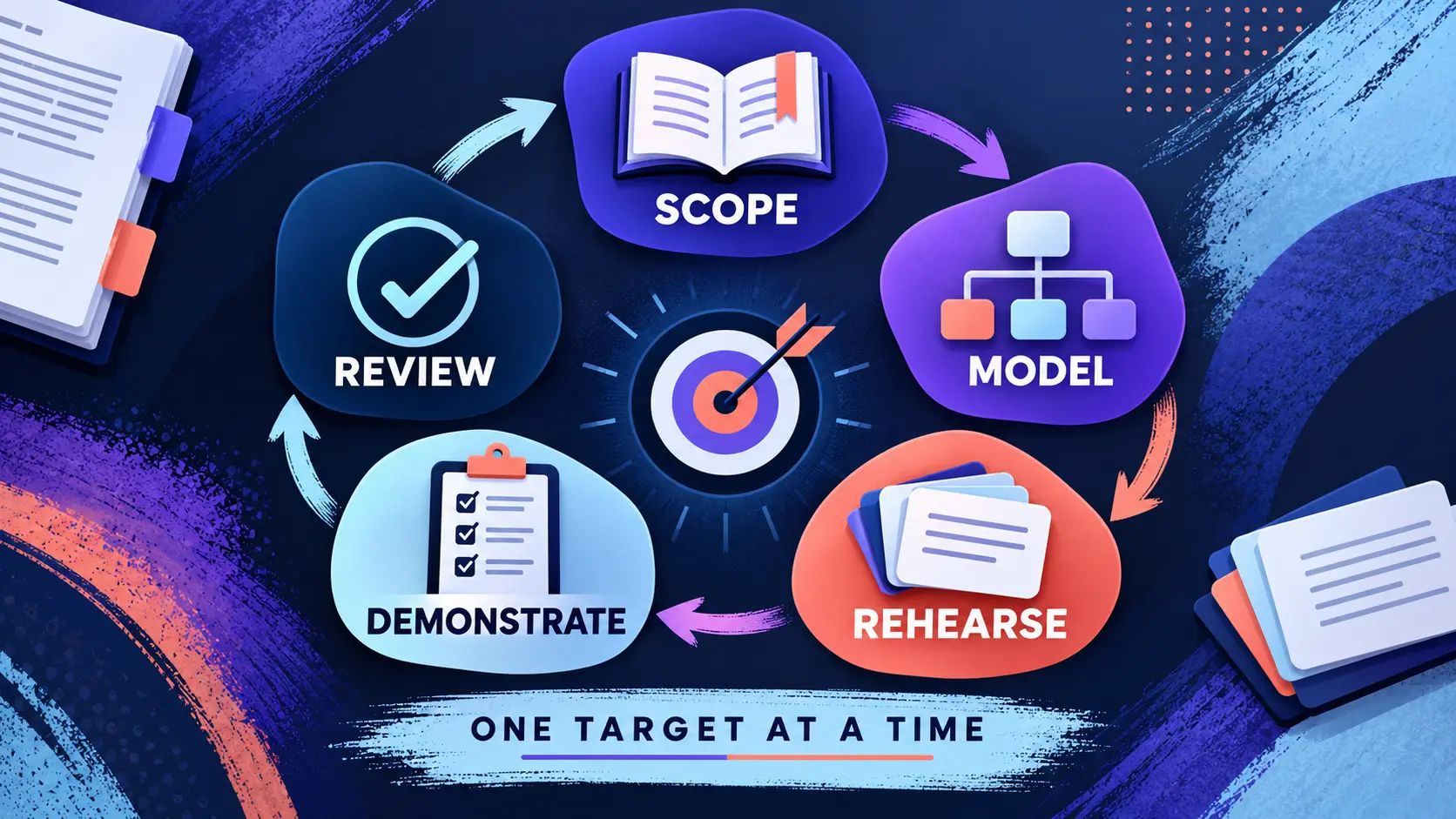
A competency-focused week should alternate learning, demonstration, feedback, and verification. Start with one target rather than trying to prove every skill at once. Read the source, describe what competent performance would look like, rehearse the explanation or decision, and then ask for feedback in the setting that actually controls the assessment.
- Scope: choose one skill and write the current source or rubric next to it.
- Model: review a definition, example, non-example, and relevant ethical or contextual boundary.
- Rehearse: explain the steps aloud or practice the decision with an original scenario.
- Demonstrate: complete the approved performance or observation opportunity with the required supervisor.
- Review: record the feedback and schedule one targeted repeat.
For exam practice, add a short mixed question set after the rehearsal. If you missed a question because you did not know the concept, return to the source. If you knew the concept but selected the wrong alternative, build a discrimination example. If you could explain the answer but could not demonstrate the skill, schedule supervised rehearsal rather than rereading another guide.
How to Use Feedback and Documentation
Feedback is useful when it changes a behavior or decision you can observe. “Study more” is too broad. “State the measurement dimension before choosing the procedure” is actionable. “Explain which source controls the current requirement before quoting a number” is actionable. Add the feedback to the skill map and write the next opportunity where you will test it.
- Record the target: name the skill or question type without adding unrelated goals.
- Record the evidence: note the context, response, prompt level if relevant, and observed result.
- Record the correction: write the specific change requested by the qualified reviewer.
- Record the next test: choose a new example or a repeat condition that can show improvement.
- Record the source: link the current official rule or rubric instead of relying on memory.
Keep documentation factual and secure. Do not put identifying client information into a public study sheet, and do not treat a practice article as permission to implement a procedure without the required training and supervision. A good study guide improves preparation while respecting the limits of the learner’s role.
Common Study-Guide Mistakes
- Confusing assessment types: a BCBA examination, RBT competency assessment, fieldwork review, and skills demonstration have different purposes.
- Using a stale checklist: verify the date and source before accepting a requirement or form name.
- Counting exposure as competence: reading a definition does not show that you can explain or demonstrate the skill.
- Practicing only one example: change the setting, client-neutral details, and controlling clue while keeping the concept clear.
- Recording vague feedback: convert “be more precise” into an observable next response.
- Treating 2027 as an exam rewrite: separate eligibility and maintenance updates from the current exam content outline.
A Practical ABA Competency Assessment Checklist
Before your next study session, confirm that you can answer these questions:
- What exact assessment, rubric, or skill review am I preparing for?
- Which official source or supervisor instruction defines the target?
- Can I state what competent performance would look or sound like?
- Can I explain the controlling clue and the boundary of the decision?
- What evidence will be observed or documented?
- What feedback will I request after the rehearsal?
- What is the single next practice action?
For the examination track, use the current outline and original practice questions to test reasoning after you have organized your skills map. Try the free BCBA mock exam after your ABA competency assessment study guide review, then classify the result as a knowledge, discrimination, application, reading, calculation, or pacing signal. The practice result is feedback about that session—not proof of competency, eligibility, or a passing result.
ABA Competency Assessment Study Guide FAQ
Is a competency assessment the same as the BCBA exam?: No. A competency assessment or skills review evaluates performance under defined conditions, while the BCBA certification examination is a separate multiple-choice examination based on the current BCBA Test Content Outline. Confirm the exact assessment with your supervisor, program, or the current BACB source.
Should a BCBA study guide include 2027 requirements?: It should explain where the transition affects planning, but it should not replace the current BACB requirements documents or Handbook. Label the application date and pathway, verify the source date, and ask your program advisor or supervisor to review your personal situation.
What should I do if I know the answer but cannot demonstrate the skill?: Separate knowledge from performance. Keep the concept review brief, write the missing observable step, rehearse it under the appropriate supervision, and request specific feedback. Then repeat with a new example or condition so the skill is not tied to one memorized script.
Take the Free BCBA Mock Exam
When you are ready to apply the idea, use the free practice resource below for additional feedback. Take the Free BCBA Mock Exam



