

BCBA experimental design and question reasoning If you are searching for a demonstration question ABA explanation, the phrase usually points to a question about showing a functional relation in a single-subject design. It is not a separate BACB certification or an official question label. In study materials, “demonstration” commonly asks whether the design and data demonstrate that a planned change in an independent variable produced a change in behavior.
Table of Contents
- What a Demonstration Question Asks
- How to Identify the Variables
- How Design Logic Demonstrates a Relation
- How Demonstration Differs From Other Research Questions
- How to Work Through an ABA Demonstration Scenario
- How to Study Experimental-Design Questions
- A Demonstration Question ABA Checklist
- Demonstration Question ABA FAQ
- Take the Free BCBA Mock Exam
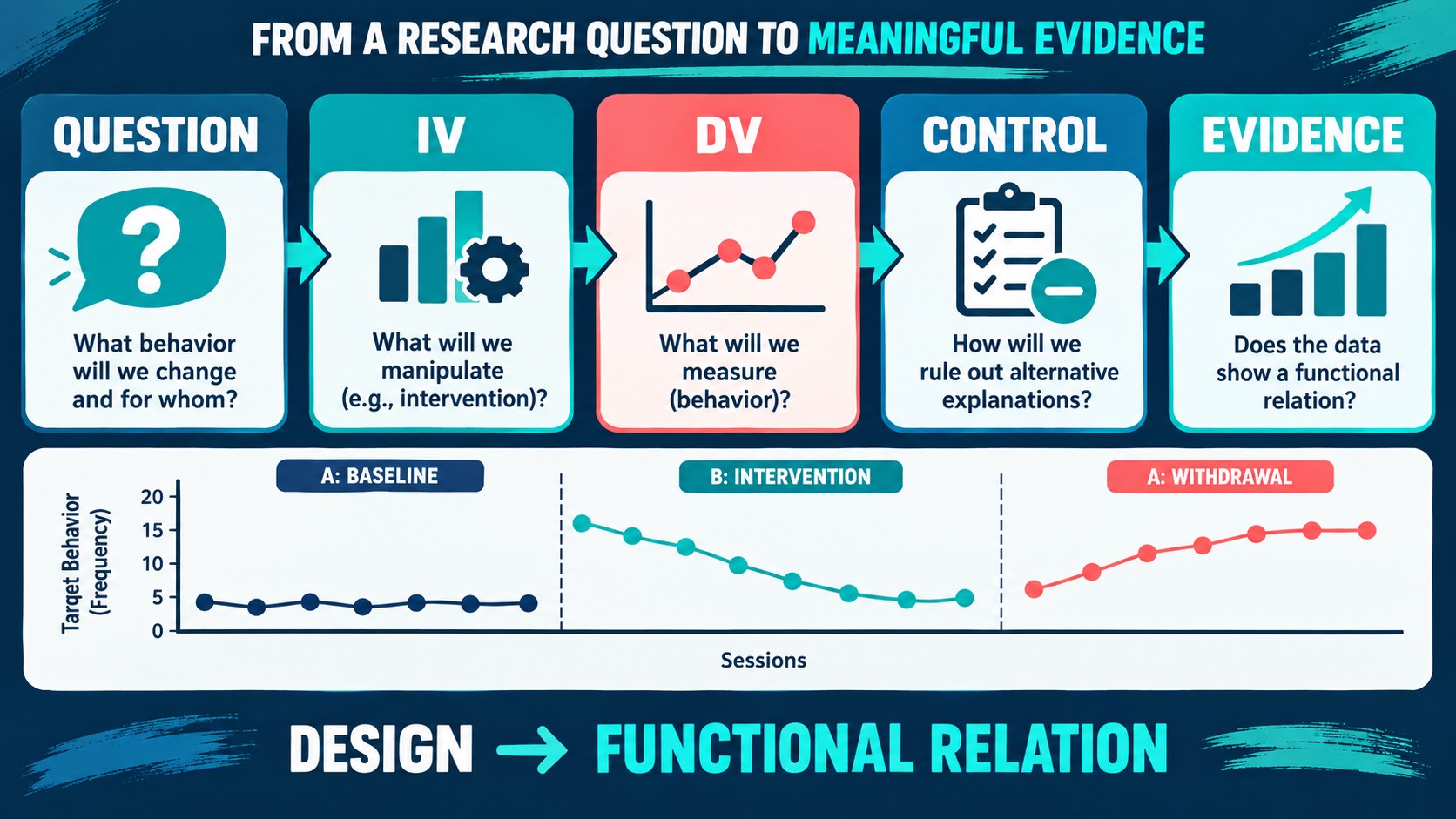
The practical way to answer is to identify the research question, the independent variable, the dependent variable, the control logic, and the evidence shown by the data. The current BCBA Test Content Outline is the source for exam-preparation scope. The BCBA Handbook and current BACB examination information should control policy and preparation claims.
What a Demonstration Question Asks
A demonstration question asks whether the evidence supports a functional relation between a planned intervention or condition and a measured behavior. It is about experimental control, not whether a procedure sounds helpful. A strong answer connects the change in the independent variable to a replicated, predictable change in the dependent variable while considering alternative explanations.
In a study prompt, watch for language such as “showed control,” “demonstrated a functional relation,” “replicated the effect,” or “what feature strengthens the conclusion.” Those phrases point you toward design logic and the pattern of data. They do not mean that any improvement automatically proves the intervention caused the change.
- Research question: what relation or effect is being evaluated?
- Independent variable: what condition is introduced, withdrawn, or changed by the researcher?
- Dependent variable: what observable behavior is measured, and with what dimension?
- Control logic: how does the design rule out history, maturation, or another competing explanation?
- Evidence: what level, trend, variability, immediacy, overlap, and replication pattern is visible?
Keep the wording modest. A demonstration question does not ask you to promise that an intervention will work for every person or setting. It asks what the design and data justify for the conditions studied.
| Prompt clue | What to inspect | Common trap |
|---|---|---|
| Demonstrate a functional relation | Systematic change in the IV and replicated behavior change. | Choosing “the graph went down” without checking control. |
| Strongest experimental evidence | The design’s replication and the pattern across phases or tiers. | Confusing visual appeal with experimental control. |
| Best conclusion | A claim limited to the variables, participant, and conditions studied. | Overgeneralizing beyond the data. |
How to Identify the Variables
Before interpreting a graph, write the variables in plain language. If a prompt says that a behavior analyst changes the schedule of reinforcement and measures the rate of task completion, the schedule is the independent variable and task-completion rate is the dependent variable. The target behavior is not the intervention, and the outcome measure is not the condition being manipulated.
Then check the measurement dimension. A demonstration can be obscured when the outcome is measured inconsistently across phases. Frequency, rate, duration, latency, percentage, and interval-based measures answer different questions. If the prompt changes observation time, rate may be more interpretable than raw frequency. If the prompt concerns time before a response begins, latency is the relevant dimension.
- Underline the condition the researcher controls.
- Circle the observable behavior or outcome.
- Write the measurement dimension and observation context.
- Note when the condition changes and when the behavior changes.
- Ask what alternative explanation the design is intended to reduce.
This routine prevents a common error: selecting an answer because it repeats a familiar ABA term while ignoring what the prompt actually manipulated and measured.
How Design Logic Demonstrates a Relation
Different single-subject designs demonstrate control in different ways. A reversal design can show whether behavior changes when an intervention is introduced and withdrawn, when withdrawal is ethical and feasible. A multiple-baseline design can show replication across behaviors, settings, or participants when withdrawal would be inappropriate. An alternating-treatments design compares rapidly alternated conditions, while a changing-criterion design evaluates whether behavior follows systematic criterion shifts.
The question is not “Which design is always strongest?” The question is “Which design provides the relevant control logic under the stated conditions?” Ethical limits, risk, practicality, stability, and the behavior’s reversibility all matter.
| Design logic | Useful question | Evidence to track |
|---|---|---|
| Reversal | Does behavior change when the condition is introduced and withdrawn? | Replication across phases and appropriateness of withdrawal. |
| Multiple baseline | Does change follow staggered introduction across tiers? | Replication across behaviors, settings, or participants. |
| Changing criterion | Does behavior track systematic criterion changes? | Agreement between criterion shifts and response levels. |
| Alternating treatments | Do outcomes differ reliably across rapidly alternated conditions? | Separation, order, carryover, and clear condition labels. |
How Demonstration Differs From Other Research Questions
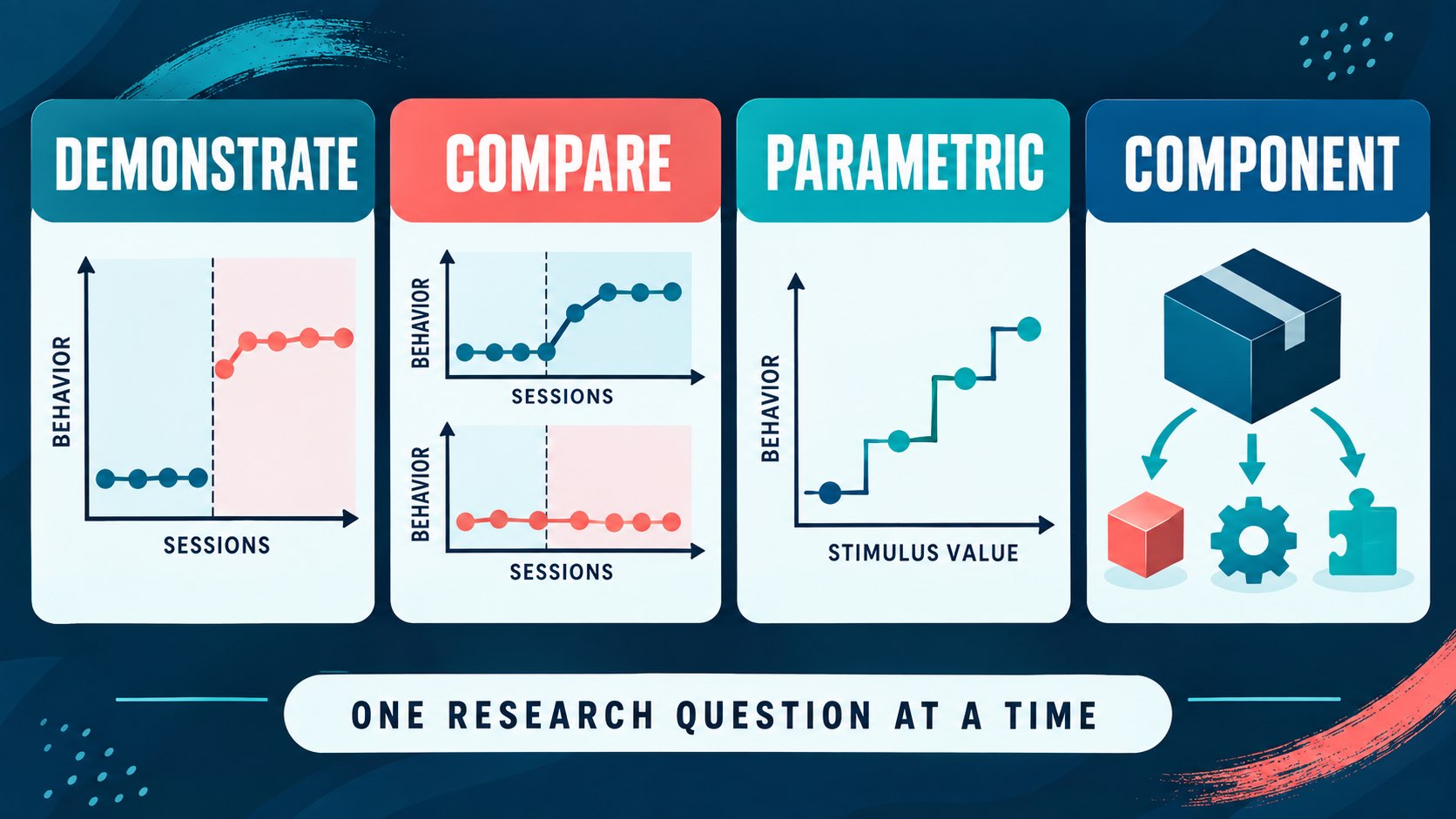
Many learners use “demonstration” as a broad word for any research question. For exam reasoning, separate it from nearby question types. A demonstration question asks whether the intervention or condition produced the behavior change. A comparison question asks how two conditions differ. A parametric question asks how different values of one variable affect behavior. A component question asks which part of a package is responsible for the effect.
- Demonstration: did the planned change produce a reliable functional relation?
- Comparison: which of two or more conditions produces the better outcome?
- Parametric: what happens as one dimension, amount, or value changes?
- Component: which element of a treatment package is necessary or sufficient?
- Generalization: does the change extend across people, settings, stimuli, responses, or time?
The terms can appear together in one research program, but they ask different questions. Identify the comparison or manipulation before choosing a design label. A graph can contain a strong change and still fail to answer the question if the conditions are not distinguished or the data do not replicate the pattern.
How to Work Through an ABA Demonstration Scenario
Imagine a study in which a behavior analyst teaches a self-monitoring routine to three learners. The routine is introduced at different times for each learner, and each learner’s rate of independent task completion increases only after the routine is introduced. The staggered pattern is more informative than a simple before-and-after change because it shows replication across tiers while untreated tiers continue to provide comparison information. To reason through the scenario, ask four questions:
- Did the behavior change in the predicted direction after the independent variable was introduced?
- Did the change occur at different times that matched the staggered intervention?
- Were the measurement and phase conditions comparable enough to interpret?
- What claim is justified without extending beyond the study’s conditions?
A weak explanation says, “The intervention worked because the graph improved.” A stronger explanation identifies the staggered introduction, the replicated phase-linked changes, the measured outcome, and the limits of the conclusion. That is the reasoning a demonstration question is usually testing.
How to Study Experimental-Design Questions
Build a small study set around one design decision at a time. First practice identifying the IV and DV. Next practice matching the design to the ethical or practical constraint. Then interpret a simple graph or data description. Finally, explain why the nearest alternative is less appropriate. This sequence keeps vocabulary from floating free of the research logic.
- Pass one: label the variables and measurement dimension.
- Pass two: identify the control or replication feature.
- Pass three: state the narrowest conclusion supported by the data.
- Pass four: change one surface detail and solve the scenario again.
- Pass five: record the distractor that seemed attractive and why it failed.
Use official BACB materials for scope and current examination guidance. Treat third-party questions as unofficial practice, and check whether a source is using the current outline before you adopt its labels or numbers. A practice score is a diagnostic signal, not a certification decision.
A Demonstration Question ABA Checklist
Before selecting an answer, confirm that you can state:
- What the researcher manipulated.
- What behavior or outcome was measured.
- Which design feature provides control or replication.
- What alternative explanation is reduced.
- What the data justify and what they do not justify.
- Why the closest distractor answers a different research question.
After you work through the framework, try the free BCBA mock exam for demonstration question ABA practice. Review your result by classifying the error as variable identification, design matching, graph interpretation, or conclusion scope. Do not use a mock result as proof of a passing score or professional competence.
Demonstration Question ABA FAQ
Is “demonstration question” an official BACB question type?: Not as a separate certification category. It is a useful study phrase for questions about demonstrating a functional relation and interpreting experimental control. Use the current BCBA Test Content Outline to confirm the official content area and task language.
What is the main clue in a demonstration question?: Look for the relation between a planned change in the independent variable and a replicated change in the measured behavior. Then check the design’s control logic, measurement consistency, and the limits of the conclusion.
Why is a before-and-after change not always enough?: A behavior can change because of history, maturation, measurement changes, or another event. A single before-and-after comparison may not separate those explanations. The appropriate design adds control or replication that matches the research question and ethical conditions.
Take the Free BCBA Mock Exam
When you are ready to apply the idea, use the free practice resource below for additional feedback. Take the Free BCBA Mock Exam



