

A fast, category-based reference for the ABA terms that appear in BCBA exam scenarios, with plain-language meanings, decision cues, and the wording traps that make familiar concepts easy to confuse. If you are searching for an ABA terminology cheat sheet, use it as a retrieval tool—not as a substitute for understanding contingencies, measurement, assessment, ethics, and the current BCBA exam outline. The best sheet helps you recognize a term quickly, then asks what decision the term supports in the scenario.
Table of Contents
- What an ABA Terminology Cheat Sheet Is—and Is Not
- How to Use an ABA Terminology Cheat Sheet
- 50 High-Yield ABA Terms in Six Groups
- Group 1: Foundations and the ABC Contingency
- Group 2: Reinforcement, Punishment, Motivation, and Stimulus Control
- Group 3: Assessment and Behavioral Function
- Group 4: Measurement and Data
- Group 5: Teaching and Behavior-Change Procedures
- Group 6: Design, Ethics, and Professional Reasoning
- Term Pairs That Change the Answer
- Map the Cheat Sheet to the Current BCBA Outline
- A Five-Minute Active-Recall Routine
- Turn Vocabulary Into BCBA Scenario Practice
- Frequently Asked Questions
- Quick Review Checklist
- Take the Free BCBA Mock Exam
The BACB Test Content Outline (6th ed.) and the current BCBA Handbook are the authority for current exam scope. The BACB also maintains the Ethics Code for Behavior Analysts. This page is a study aid: definitions should be checked against your coursework, supervisor, and the official sources.
What an ABA Terminology Cheat Sheet Is—and Is Not
An ABA terminology cheat sheet is a compact reference that puts related concepts next to one another. That layout matters because BCBA questions often test a relationship: whether a consequence increases behavior, whether a measurement captures the dimension named in the question, or whether the evidence supports a description rather than a functional conclusion.
A cheat sheet is not an official BACB glossary, a complete course, or a license to memorize isolated one-line definitions. A term becomes useful when you can identify its place in the contingency, select an observable measure, recognize the relevant assessment, and explain what conclusion the data do—or do not—support.
How to Use an ABA Terminology Cheat Sheet
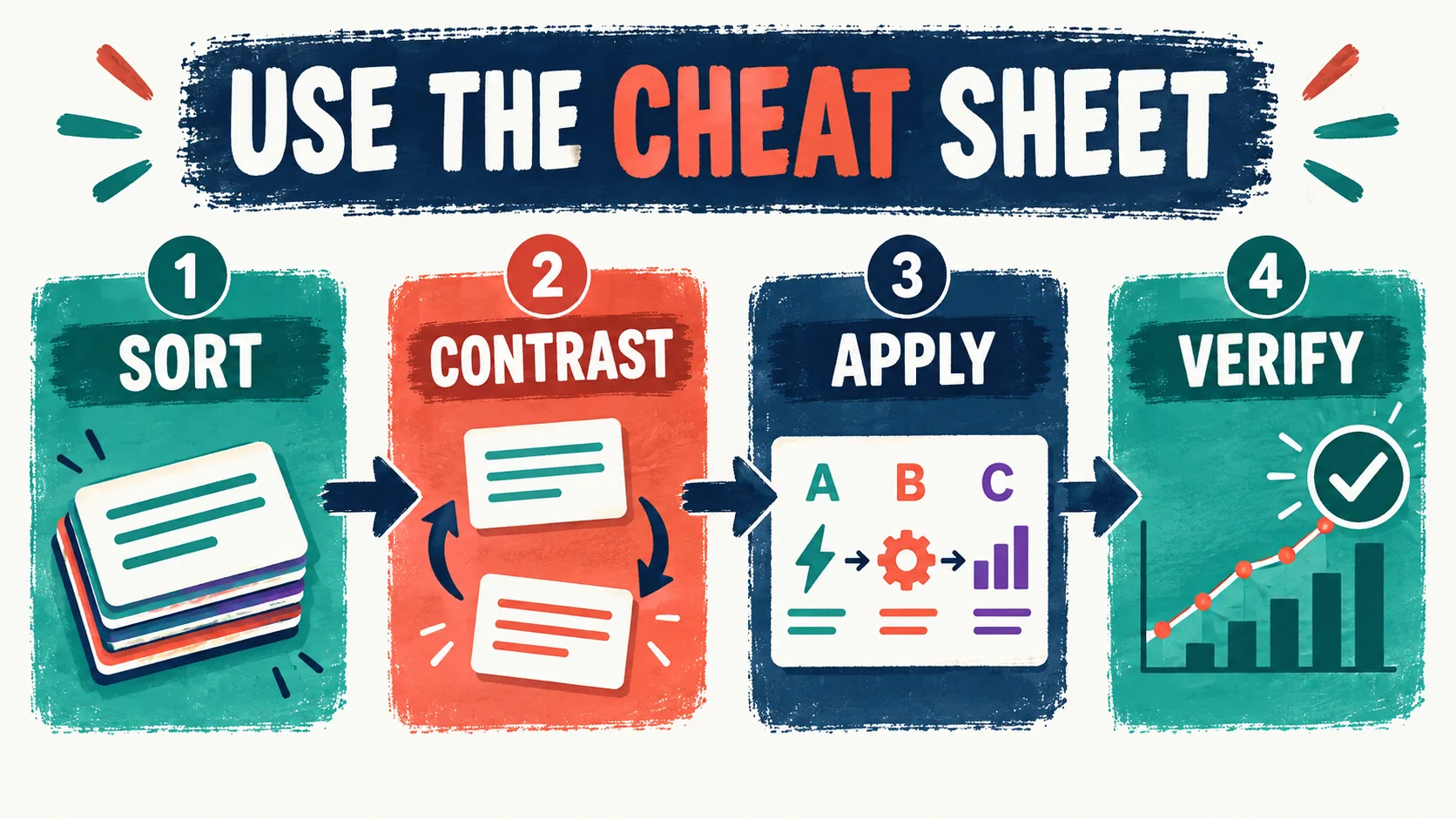
Use the sheet in four passes. First, sort the term into a decision category. Next, contrast it with the term most likely to be confused with it. Then apply it to a short scenario. Finally, verify the answer against the definition, the behavior measured, and the consequence described.
- Sort: Is the question about a contingency, motivation, assessment, measurement, intervention, design, or ethics?
- Contrast: What nearby term sounds plausible but changes the logic—for example, rate versus frequency or reinforcement versus bribery?
- Apply: Rewrite the term using the facts in the stem. Name the antecedent, observable behavior, consequence, and relevant outcome.
- Verify: Ask whether the proposed answer is supported by direct data, an experimental comparison, a report, or only an assumption.
If you cannot use a term in a sentence about what happened before, what the learner did, what followed, and what changed, you have recognized the word but have not learned the concept yet.
50 High-Yield ABA Terms in Six Groups
Group 1: Foundations and the ABC Contingency
| Term | Plain meaning | Exam cue |
|---|---|---|
| 1. Applied behavior analysis (ABA) | Science and practice for socially significant behavior. | Observable behavior, data, meaningful outcomes. |
| 2. Behavior | Observable, measurable activity. | Replace vague labels with actions. |
| 3. Environment | Surrounding events and stimuli. | Ask what changed around responding. |
| 4. Antecedent | Event or condition before a response. | Before does not automatically mean cause. |
| 5. Topography | The observable form of behavior. | What it looks like, not why it occurs. |
| 6. Consequence | Event that follows behavior. | Its effect, not intent, defines function. |
| 7. Three-term contingency | Antecedent–behavior–consequence relation. | Use ABC before choosing an intervention. |
| 8. Operational definition | Observable boundaries and examples for behavior. | Supports measurement and agreement. |
Group 2: Reinforcement, Punishment, Motivation, and Stimulus Control
| Term | Plain meaning | Exam cue |
|---|---|---|
| 9. Reinforcement | Consequence followed by more behavior. | Defined by future behavior, not intent. |
| 10. Punishment | Consequence followed by less behavior. | Positive/negative mean add/remove. |
| 11. Positive reinforcement | Add a stimulus; behavior increases. | Find the added event and later increase. |
| 12. Negative reinforcement | Remove a stimulus; behavior increases. | Escape is not punishment. |
| 13. Positive punishment | Add a stimulus; behavior decreases. | Require evidence of a decrease. |
| 14. Negative punishment | Remove a stimulus; behavior decreases. | Check the actual contingency. |
| 15. Conditioned reinforcer | Reinforcer learned through pairing. | Tokens and praise require learning history. |
| 16. Unconditioned reinforcer | Reinforcer not dependent on that learning history. | Context can still change its value. |
| 17. Motivating operation (MO) | Changes consequence value and related behavior. | Separate value from signal effects. |
| 18. Discriminative stimulus (SD) | Signals reinforcement availability. | Signals a contingency; does not create value. |
Group 3: Assessment and Behavioral Function
| Term | Plain meaning | Exam cue |
|---|---|---|
| 19. Preference assessment | Arranged procedure identifying selected stimuli. | Selection suggests a candidate, not reinforcement. |
| 20. Reinforcer assessment | Tests whether a consequence changes behavior. | Look for behavior-change comparison. |
| 21. Indirect assessment | Reports, interviews, questionnaires, or records. | Useful hypothesis; recall can be biased. |
| 22. Descriptive assessment | Direct observation without arranged contingencies. | Describes; does not demonstrate function. |
| 23. Functional analysis | Experimental test of behavioral function. | Look for arranged conditions and comparison. |
| 24. Function of behavior | Relation helping explain continued behavior. | Topography is what; function is why it persists. |
| 25. ABC data | Record of antecedent, behavior, and consequence. | Record events, not inferred function. |
| 26. Baseline | Measurement before an intervention or comparison. | Supports prediction and later comparison. |
Group 4: Measurement and Data
| Term | Plain meaning | Exam cue |
|---|---|---|
| 27. Frequency | Number of occurrences. | Count alone ignores time. |
| 28. Rate | Frequency per unit of time. | Useful when observation times differ. |
| 29. Duration | How long behavior lasts. | Measures time engaged or in episode. |
| 30. Latency | Time from event to response start. | Delay, not response length. |
| 31. Interresponse time (IRT) | Time between consecutive responses. | Measures response spacing. |
| 32. Percentage | Proportion out of opportunities. | Always identify the denominator. |
| 33. Continuous measurement | Records every occurrence or dimension. | Complete, but resource intensive. |
| 34. Discontinuous measurement | Samples rather than records every instance. | Sampling methods answer different questions. |
| 35. Treatment integrity | Implementation matches the plan. | Weak integrity clouds outcome interpretation. |
Group 5: Teaching and Behavior-Change Procedures
| Term | Plain meaning | Exam cue |
|---|---|---|
| 36. Prompt | Added help that evokes a correct response. | Antecedent support, not consequence. |
| 37. Prompt fading | Systematically reducing prompts. | Natural stimulus should control responding. |
| 38. Shaping | Reinforcing successive approximations. | Response requirement changes gradually. |
| 39. Chaining | Teaching linked steps in sequence. | Forward, backward, and total-task differ. |
| 40. Task analysis | Observable steps of a larger skill. | Description, not teaching procedure. |
| 41. Differential reinforcement | Reinforce one response class selectively. | Identify reinforced and changed responses. |
| 42. Functional communication training (FCT) | Teach communication matched to behavior function. | Replacement must be efficient and functional. |
| 43. Generalization | Response occurs with new stimuli or settings. | Plan transfer; do not assume it. |
| 44. Maintenance | Response continues over time. | Different question from new-setting transfer. |
Group 6: Design, Ethics, and Professional Reasoning
| Term | Plain meaning | Exam cue |
|---|---|---|
| 45. Independent variable | Condition deliberately changed by the analyst. | What is arranged, not measured. |
| 46. Dependent variable | Behavior or outcome measured for change. | Must be operationally defined. |
| 47. Single-case experimental design | Repeated measures with planned conditions. | Look for prediction, verification, replication. |
| 48. Replication | Repeating a condition or effect. | Design logic, not just more observations. |
| 49. Assent | Indication of willingness when legal consent is unavailable. | Does not erase consent or withdrawal. |
| 50. Cultural humility | Ongoing examination, input-seeking, and respectful adaptation. | Active practice, not a checklist. |
Term Pairs That Change the Answer
| Pair | Use the first term when… | Do not substitute it with… |
|---|---|---|
| Preference vs. reinforcer | A learner selects or engages with a stimulus in an arranged preference assessment. | A reinforcer requires evidence that behavior increased after the consequence. |
| Frequency vs. rate | You need the count of responses. | Use rate when observation time differs or response speed matters. |
| Description vs. function | Direct observation shows a pattern among events. | A functional relation needs experimental demonstration, not just a correlation. |
| MO vs. SD | An MO changes consequence value and related behavior. | An SD signals that reinforcement is available for a response. |
| Generalization vs. maintenance | Generalization asks where, with whom, or with what the response occurs. | Maintenance asks whether it continues as time and support change. |
| Prompt vs. reinforcer | A prompt helps evoke the correct response before or during responding. | A reinforcer follows behavior and is defined by an increase in future behavior. |
Map the Cheat Sheet to the Current BCBA Outline
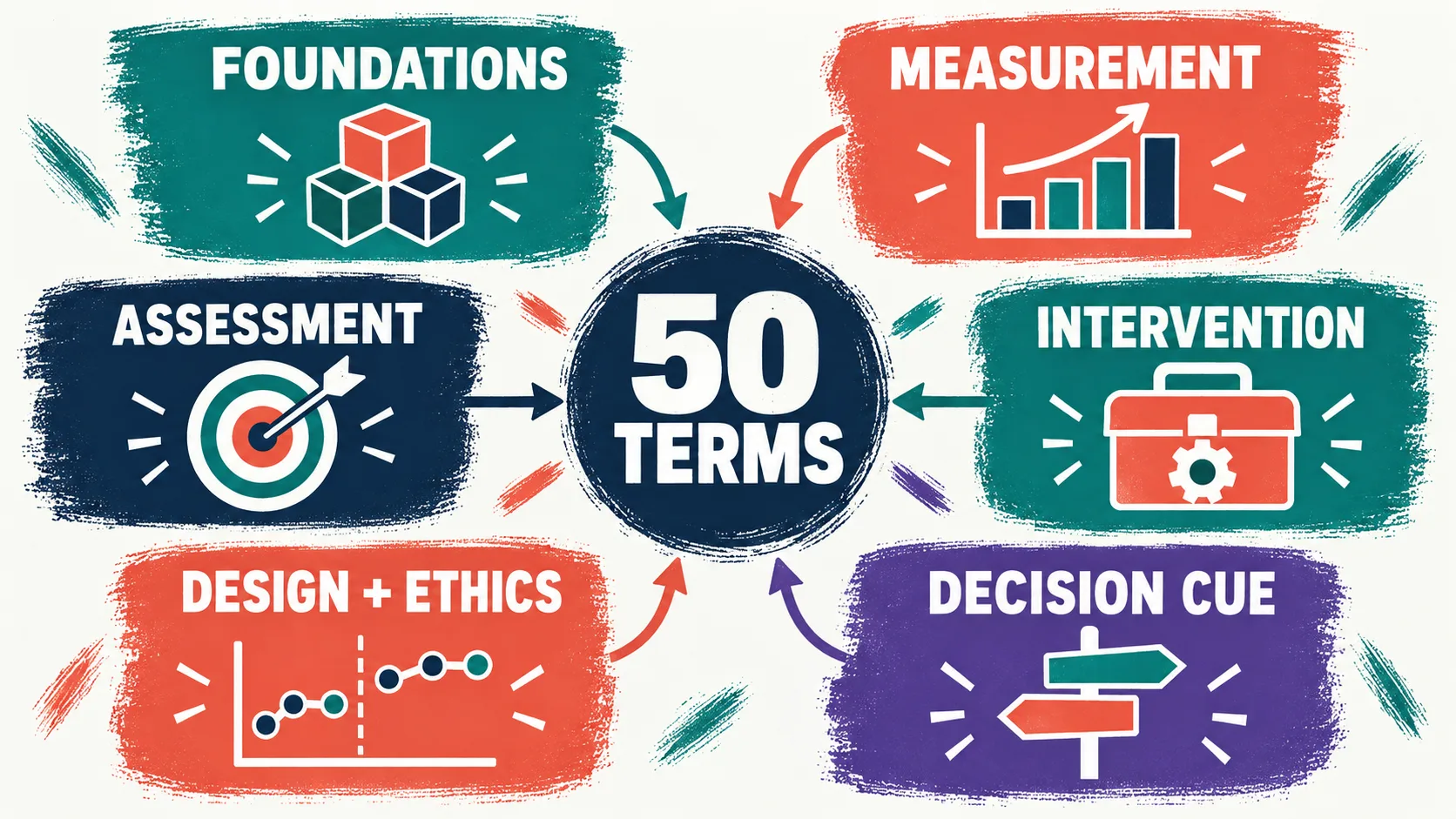
- Foundations and concepts: ABC relations, reinforcement, punishment, motivating operations, stimulus control, and functional relations.
- Measurement and design: operational definitions, dimensions of behavior, continuous and discontinuous measurement, variables, repeated measurement, and replication.
- Assessment: preference, descriptive, and functional assessments; sources of information; and the limits of indirect evidence.
- Behavior change: prompts, fading, shaping, chaining, differential reinforcement, communication training, generalization, and maintenance.
- Ethics and professional practice: assent, confidentiality, cultural humility, competence, collaboration, and protecting the client’s interests.
That map helps you diagnose a missed question. If you knew the definition of “latency” but chose frequency, the problem is measurement selection. If you identified a favorite item as a reinforcer without behavior-change data, the problem is assessment reasoning. If you chose an answer that ignores assent or confidentiality, the problem is professional decision-making—not vocabulary alone.
A Five-Minute Active-Recall Routine
- Write one ABC example and label each part with observable language.
- Explain the difference between positive reinforcement and negative reinforcement without using “good” or “bad.”
- Choose the measurement that fits one behavior: frequency, rate, duration, latency, IRT, or percentage.
- State what a preference assessment can show and what it cannot prove about reinforcement.
- Name one ethical or cultural variable that could change how the assessment or intervention is designed.
Mark each answer as definition, example, or decision. A candidate who can recite a definition but cannot choose a measure or interpret a consequence needs application practice, not another longer word list.
Turn Vocabulary Into BCBA Scenario Practice
For each practice question, underline the behavior, circle the consequence, and write the measurement dimension in the margin. Then ask which evidence the question gives you: a report, a direct observation, a graph, or an experimental comparison. This prevents a familiar term from pulling you toward an answer that the data do not support.
Use the Free BCBA Mock Exam to practice terminology inside assessment, measurement, intervention, and ethics scenarios. Review why each option is right or wrong, then return to this sheet only for the term distinction you missed.
If you want a deeper explanation, continue to the existing site’s applied behavior analysis terms study guide, the ABA definitions guide, or the ABA terminology exam guide. Those resources remain separate from this quick-reference page.
Frequently Asked Questions
Is this ABA terminology cheat sheet an official BACB document?: No. It is an educational study aid. Use the current BACB Test Content Outline, BCBA Handbook, Ethics Code, and your training materials for official requirements and scope. What is the most important ABA terminology distinction?: Start with reinforcement versus preference, description versus function, and frequency versus rate. These pairs force you to connect a label to evidence and measurement.
Can I use a cheat sheet during the BCBA exam?: Do not assume outside notes are permitted. Follow the current examination rules and use a cheat sheet only for preparation unless the BACB explicitly authorizes a resource in the testing environment.
Bottom line: A good ABA terminology cheat sheet is a map from words to decisions. Sort the concept, contrast the neighbor term, apply it to observable facts, and verify the conclusion with the evidence in the scenario.
Quick Review Checklist
Use this final checklist to turn aba terminology cheat sheet into exam-ready reasoning. The goal is not to memorize a label in isolation; it is to identify the relevant evidence and explain why the best answer fits the scenario. Key ideas to review:
- State the central definition or decision point for aba terminology cheat sheet in your own words.
- Identify the detail that makes aba terminology cheat sheet different from its closest related ABA term.
- Separate the observable facts in a scenario from assumptions that are not supported by the facts.
- Write one example and one nonexample so you can recognize the concept in a new setting.
Exam application checks:
- Ask what the question is actually requesting before comparing the answer choices.
- Mark the antecedent, response, consequence, or other evidence that supports the selected answer.
- Look for a distractor that describes a related process but does not answer the specific question.
Final self-check:
- Explain how you would verify the interpretation with clear observations or data.
- Change one detail in the scenario and decide whether your answer should change.
- Give a one-sentence rationale that a supervisor or study partner could evaluate.
Take the Free BCBA Mock Exam
When you are ready to apply the idea, use the free practice resource below for additional feedback. Take the Free BCBA Mock Exam



