
A precise, exam-ready explanation of respondent behavior: what “elicited” means, how respondent conditioning changes the stimulus–response relation, and how to separate respondent from operant behavior in a BCBA-style stem. If you are looking for the definition of respondent behavior, start with the relation between a stimulus and a response—not with whether the response looks emotional, automatic, or easy to control. In applied behavior analysis, respondent behavior is behavior that is elicited by an antecedent stimulus. The stimulus–response relation may be unconditioned or learned through respondent conditioning, but the key exam question is still: what stimulus is evoking the response?
Table of Contents
- What Is the Definition of Respondent Behavior?
- Elicited Does Not Mean “No Learning”
- Respondent Behavior vs Respondent Conditioning
- Respondent vs Operant: What Controls the Response?
- A BCBA Exam Classification Routine
- Where Respondent Concepts Fit in the BCBA Outline
- Respondent Extinction vs Operant Extinction
- Common Definition Traps
- Turn the Definition Into Scenario Practice
- Frequently Asked Questions
- Take the Free BCBA Mock Exam
The current BACB Test Content Outline (6th ed.) places respondent and operant conditioning in the concepts-and-principles material. The BCBA Handbook explains how candidates should prepare against the current outline and examination rules. Use this article as a focused study guide, then verify definitions and professional decisions against official BACB materials, coursework, and supervision.
What Is the Definition of Respondent Behavior?
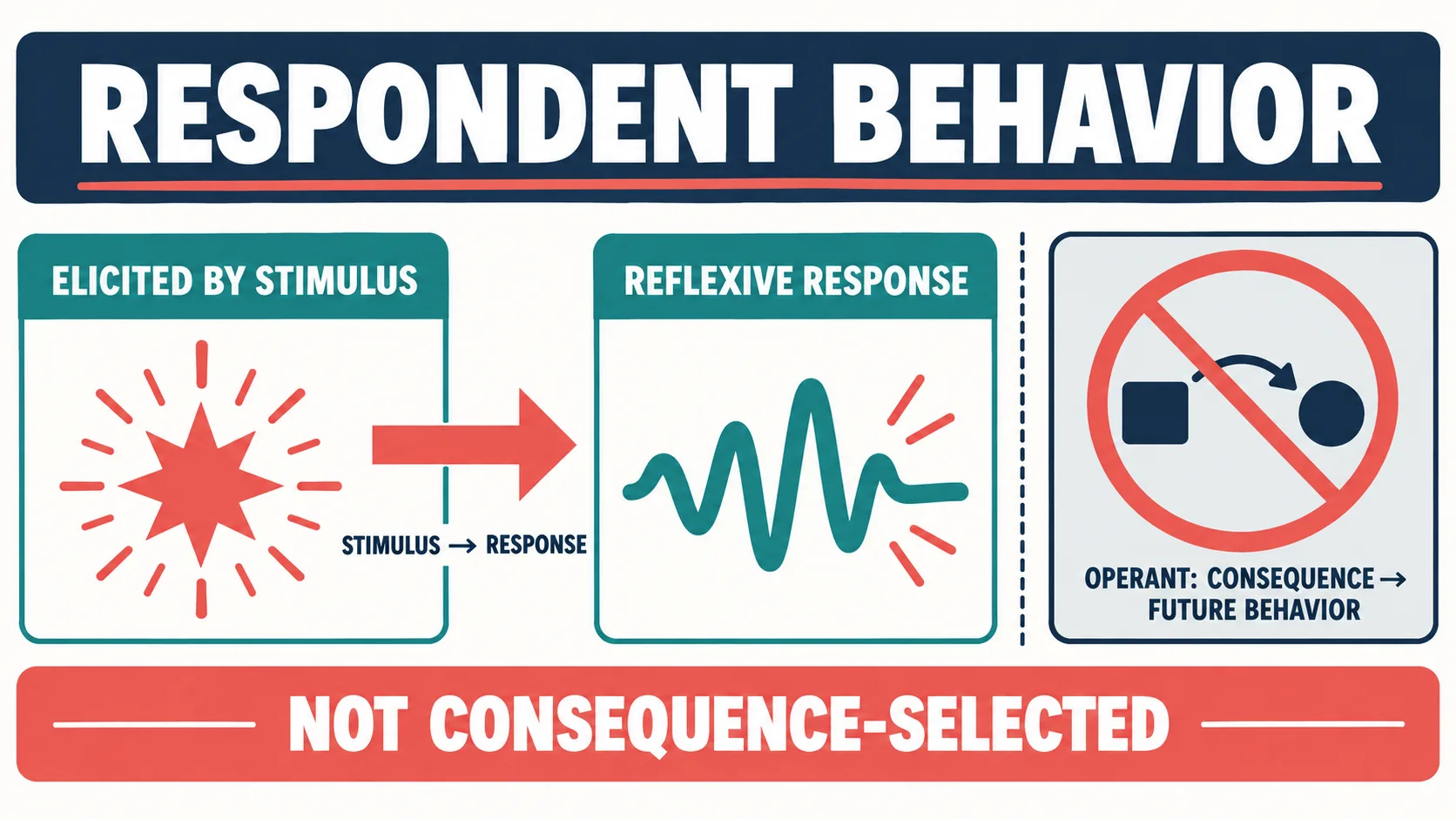
Respondent behavior is behavior elicited by an antecedent stimulus. The response is part of a stimulus–response relation: a stimulus occurs, and that stimulus evokes the response. Common examples include salivating when food is placed in the mouth, blinking when an object moves toward the eye, or a learned fear response to a stimulus that has been paired with an aversive event.
“Elicited” is the important word. It tells you that the immediate controlling relation is an antecedent stimulus that evokes the response. It does not mean that the person has no learning history, that the response is unimportant, or that the person has no choice in any broader sense. It also does not mean that every response described as automatic is respondent. On an exam, use the events in the stem rather than a casual label such as “involuntary.”
A useful precision is to distinguish reflexive or respondent responding from a mentalistic explanation. Saying that a loud sound elicited a startle response identifies an observable relation. Saying that the learner “felt unsafe” may be clinically meaningful in conversation, but it does not by itself identify the behavioral relation the question is testing. The strongest answer names the stimulus, the response, and whether the relation is unconditioned or conditioned.
Elicited Does Not Mean “No Learning”
Respondent behavior can be unconditioned or conditioned. An unconditioned response is elicited by an unconditioned stimulus without requiring that particular pairing history. For example, food in the mouth can elicit salivation. A bright puff of air can elicit blinking. These examples help illustrate the relation, but the BCBA exam may ask about the learning process that gives a previously neutral stimulus the ability to elicit a response.
A conditioned response is also respondent behavior when it is elicited by a stimulus that acquired its function through respondent conditioning. If a neutral sound is repeatedly paired with food, the sound may later elicit salivation. The response is learned, but it remains respondent because the sound now evokes the response. Learning history changes the stimulus function; it does not automatically turn the response into operant behavior.
This is a frequent wording trap. “Learned” does not equal “operant,” and “automatic” does not equal “unconditioned.” Ask two separate questions: first, what history changed the stimulus function? Second, what event is currently controlling the response? A learned stimulus can currently elicit a respondent response.
Respondent Behavior vs Respondent Conditioning
Respondent behavior names the behavior or response. Respondent conditioning names the learning process through which a stimulus acquires the ability to elicit that response. Keeping those labels separate makes it easier to read a scenario. The question may ask you to identify the response, the stimulus, the conditioning procedure, or the element that changed during pairing.
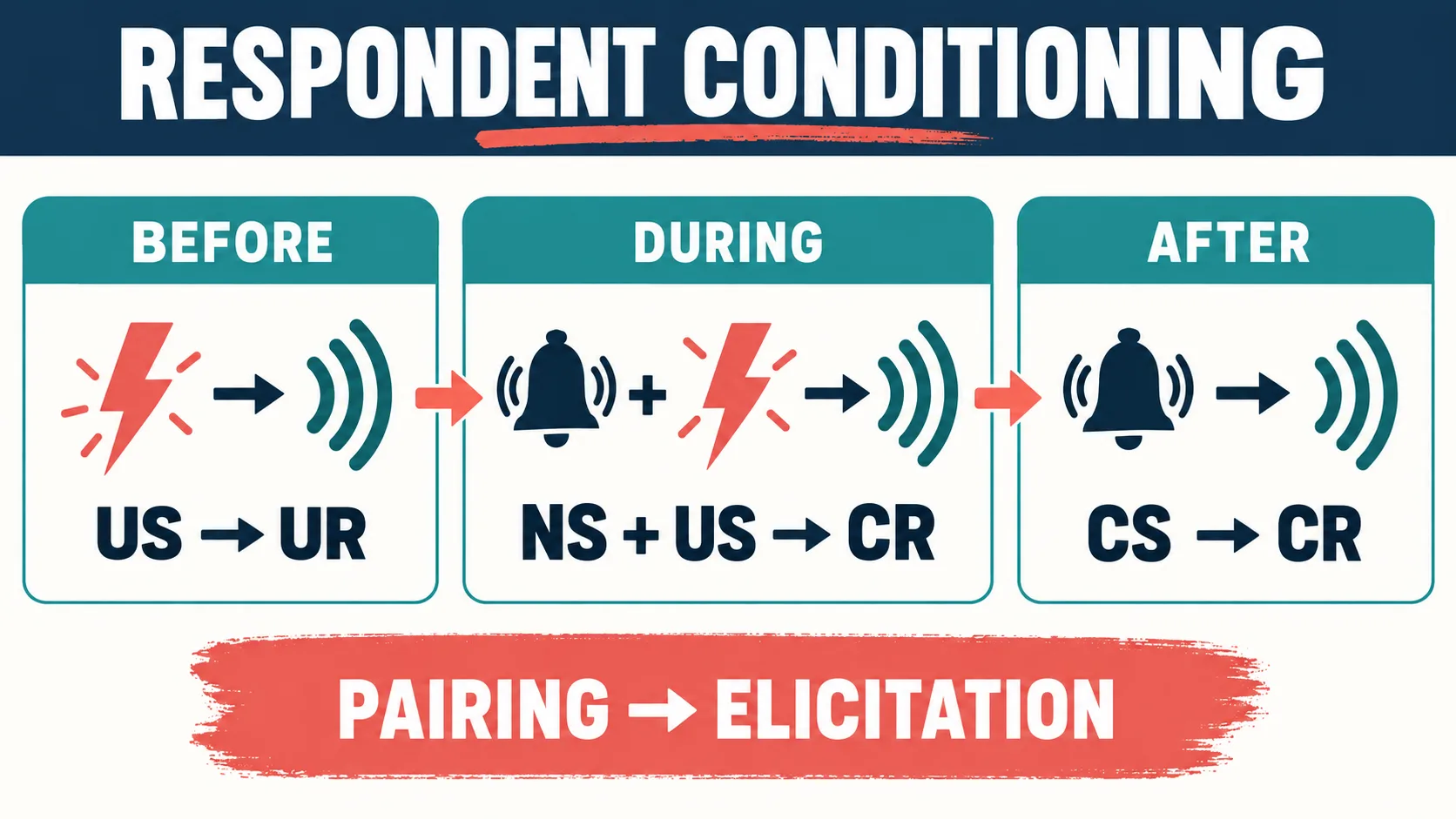
Use the following notation as a study map. Before conditioning, an unconditioned stimulus (US) elicits an unconditioned response (UR). A neutral stimulus (NS) does not reliably elicit the target response. During conditioning, the NS is paired with the US. After repeated pairings, the former neutral stimulus becomes a conditioned stimulus (CS), and the CS elicits a conditioned response (CR).
- Before pairing: US → UR; NS does not reliably elicit the target response.
- During pairing: NS + US occur in a planned temporal relation.
- After pairing: CS → CR; the new stimulus function is demonstrated by the evoked response.
The notation is not a substitute for observing the actual events. It is a way to keep the roles straight. The US and UR describe the unconditioned relation; the CS and CR describe the learned relation. If an item asks what happened to the neutral stimulus, the answer concerns a change in stimulus function. If it asks what the learner did when the sound occurred, the answer may be the conditioned respondent behavior.
Respondent vs Operant: What Controls the Response?
Respondent and operant behavior can occur in the same episode, so do not classify a response only from its topography. A person may cry when an alarm suddenly sounds and then press a button to stop the alarm. The cry may be respondent if the alarm elicits it; pressing the button may be operant if its future frequency changes because it produces a consequence. The relevant controlling relation can differ across responses.
| Question to ask | Respondent behavior | Operant behavior |
|---|---|---|
| What immediately controls the response? | An antecedent stimulus elicits the response. | A consequence has selected or maintains the response under relevant conditions. |
| What does the stem emphasize? | A stimulus appears and a reflexive or conditioned response follows. | A response produces access, escape, attention, or another consequence that changes later responding. |
| What learning history matters? | Unconditioned relations or stimulus pairings can change what elicits the response. | Reinforcement or punishment changes the probability, rate, or other dimension of behavior. |
| What is the safest exam wording? | “Elicited by” or “evoked by” the stimulus described. | “Followed by” a consequence that changes future behavior. |
The table is a classification aid, not a claim that one response can never enter a different contingency. Always analyze the specific response and the specific events. If the question gives only a stimulus–response sequence, do not invent a consequence-based function. If it gives repeated consequence data, do not ignore that evidence just because the response also has a reflexive-looking form.
A BCBA Exam Classification Routine
When a scenario uses the word “respondent,” work through the stem in order. This keeps a familiar term from making you skip the evidence.
- Underline the response. Write exactly what occurred: blinked, salivated, startled, cried, approached, pressed, or another observable action.
- Circle the immediate antecedent. Identify the stimulus that appeared before the response and ask whether the stem says it elicited or evoked the response.
- Look for a pairing history. Decide whether the stimulus was unconditioned or acquired its function after being paired with another stimulus.
- Search for consequence evidence. If a consequence changed later responding, the question may be testing an operant relation rather than the topography of the response.
- Match the answer to the question. A stem asking for the response is different from one asking for the conditioning process, stimulus class, or extinction procedure.
For example, suppose a child hears a tone that was repeatedly paired with a startling sound and then covers their ears. The tone is functioning as a CS, covering the ears is the CR, and the relation is respondent. If the child later learns to hand an adult a “break” card because doing so ends a difficult task, handing over the card is analyzed as operant behavior maintained by escape. The same learner can show both relations in one setting.
Where Respondent Concepts Fit in the BCBA Outline
Respondent and operant conditioning are not isolated vocabulary trivia. They support broader BCBA reasoning about antecedent control, stimulus functions, learning history, assessment, and behavior-change procedures. The official outline should be the starting point for deciding what the current exam can test.
- Concepts and principles: distinguish elicited and emitted behavior, stimulus functions, respondent conditioning, operant conditioning, and the role of consequences.
- Assessment and measurement: describe the response and its context before making a functional claim; measure the dimension named by the scenario.
- Intervention selection: select procedures that match the controlling relation rather than applying a generic reinforcement explanation to every response.
- Professional practice: use current BACB requirements, protect client interests, and avoid presenting an educational definition as individualized clinical advice.
The BACB’s Ethics Code hub is a reminder that technical fluency and professional responsibility belong together. A correct classification on a practice question does not authorize a learner to design or change a client’s treatment without appropriate competence, supervision, consent, and context.
Respondent Extinction vs Operant Extinction
Extinction is another place where the controlling relation matters. In respondent extinction, the conditioned stimulus is presented without the stimulus that previously established its eliciting function. Over repeated experiences, the conditioned response may decrease. In operant extinction, a previously reinforced response no longer produces the reinforcer that maintained it, so responding may decrease over time.
| Feature | Respondent extinction | Operant extinction |
|---|---|---|
| What is withheld? | The US is no longer paired with the CS. | The reinforcer no longer follows the operant response. |
| What relation changes? | The CS gradually loses its ability to elicit the CR. | The response–reinforcer relation is weakened. |
| What exam trap appears? | Calling a conditioned response “reinforced” simply because it is learned. | Calling any decrease extinction without identifying the missing reinforcer. |
Neither form of extinction means that the response can never return. Context changes, spontaneous recovery, renewal, or other learning history may affect later responding. For exam purposes, first identify which relation is being weakened; then consider the pattern the question describes.
Common Definition Traps
- Trap: “Respondent means involuntary.” Better: identify the eliciting stimulus and the response relation. “Involuntary” is too broad to classify the case by itself.
- Trap: “Any behavior caused by an antecedent is respondent.” Better: determine whether the antecedent stimulus evokes the response or signals a consequence for an operant response.
- Trap: “Learned behavior is operant.” Better: conditioned respondent behavior is learned through stimulus pairing and can remain elicited.
- Trap: “A consequence is always the reinforcer.” Better: reinforcement requires evidence that the relevant behavior increased in the future.
- Trap: “The response and the conditioning procedure are the same thing.” Better: the response is behavior; conditioning describes how a stimulus function changed.
- Trap: “One label describes the whole episode.” Better: analyze each response and relation separately when respondent and operant behavior occur together.
Turn the Definition Into Scenario Practice
Use the definition as a decision tool. For each practice question, write three short notes: stimulus, response, and history or consequence. Then label the relation as elicited, consequence-selected, or not yet determined. If the stem does not provide enough evidence, the most defensible answer may be the one that avoids an unsupported functional claim.
For targeted practice, try the Free BCBA Mock Exam and review the explanation after each item. When you miss a question, record whether the error was a definition error, a stimulus-function error, a consequence error, or a failure to read what the stem actually asked. That turns a single practice item into a reusable study cue.
Keep this new definition-focused page separate from the site’s existing respondent-behavior examples and respondent-versus-operant comparison resources. The goal here is not to replace those pages; it is to answer the narrower definition query with a stimulus map, classification routine, and extinction boundary.
Frequently Asked Questions
What is the definition of respondent behavior in ABA?
Respondent behavior is behavior elicited by an antecedent stimulus. The relation may be unconditioned or conditioned through stimulus pairing. Is respondent behavior always unconditioned?
No. A conditioned response is still respondent when a learned stimulus elicits it. “Conditioned” describes learning history, not an operant consequence relation.
What is the fastest way to distinguish respondent from operant behavior?
Ask whether the stem emphasizes a stimulus eliciting the response or a consequence changing future responding. Then analyze the specific response rather than its appearance. Is respondent conditioning the same as respondent behavior?
No. Respondent behavior is the response; respondent conditioning is the learning process that gives a stimulus a new ability to elicit a response. What should I memorize for a BCBA question?
Memorize the distinction, then practice applying it: US/UR, NS, CS/CR, elicited versus emitted, and the difference between respondent and operant extinction.
Bottom line: To answer a question about the definition of respondent behavior, find the stimulus–response relation first. Name what is elicited, identify whether pairing created a conditioned stimulus, and check whether the stem instead gives evidence of consequence-selected operant behavior.
Take the Free BCBA Mock Exam
When you are ready to apply the idea, use the free practice resource below for additional feedback. Take the Free BCBA Mock Exam



