

How to evaluate a preference assessment questionnaire PDF, what fields it should contain, and when questionnaire information must be followed by direct observation or a structured preference assessment. If you are looking for a preference assessment questionnaire PDF, start with an important distinction: a PDF is a form, not a complete assessment procedure. A questionnaire can help a caregiver, learner, teacher, or staff member describe possible interests, choices, dislikes, routines, and access conditions. It cannot by itself prove that an item will function as a reinforcer.
Table of Contents
- What Is a Preference Assessment Questionnaire PDF?
- Questionnaire, Interview, and Direct Assessment Are Different
- What a Useful Questionnaire Should Include
- How to Use Questionnaire Results
- A Preference Is Not Automatically a Reinforcer
- When to Choose a Direct Preference Assessment
- Privacy, Consent, and Safety Checks
- How to Evaluate a PDF Before Using It
- How This Appears on the BCBA Exam
- Practice Preference-Assessment Questions
- Frequently Asked Questions
- Quick Review Checklist
- Take the Free BCBA Mock Exam
Use the current BCBA Handbook and your organization’s privacy and clinical procedures for the governing requirements. This guide is educational and does not replace supervisor judgment, informed consent, individualized assessment, or medical and safety review.
What Is a Preference Assessment Questionnaire PDF?
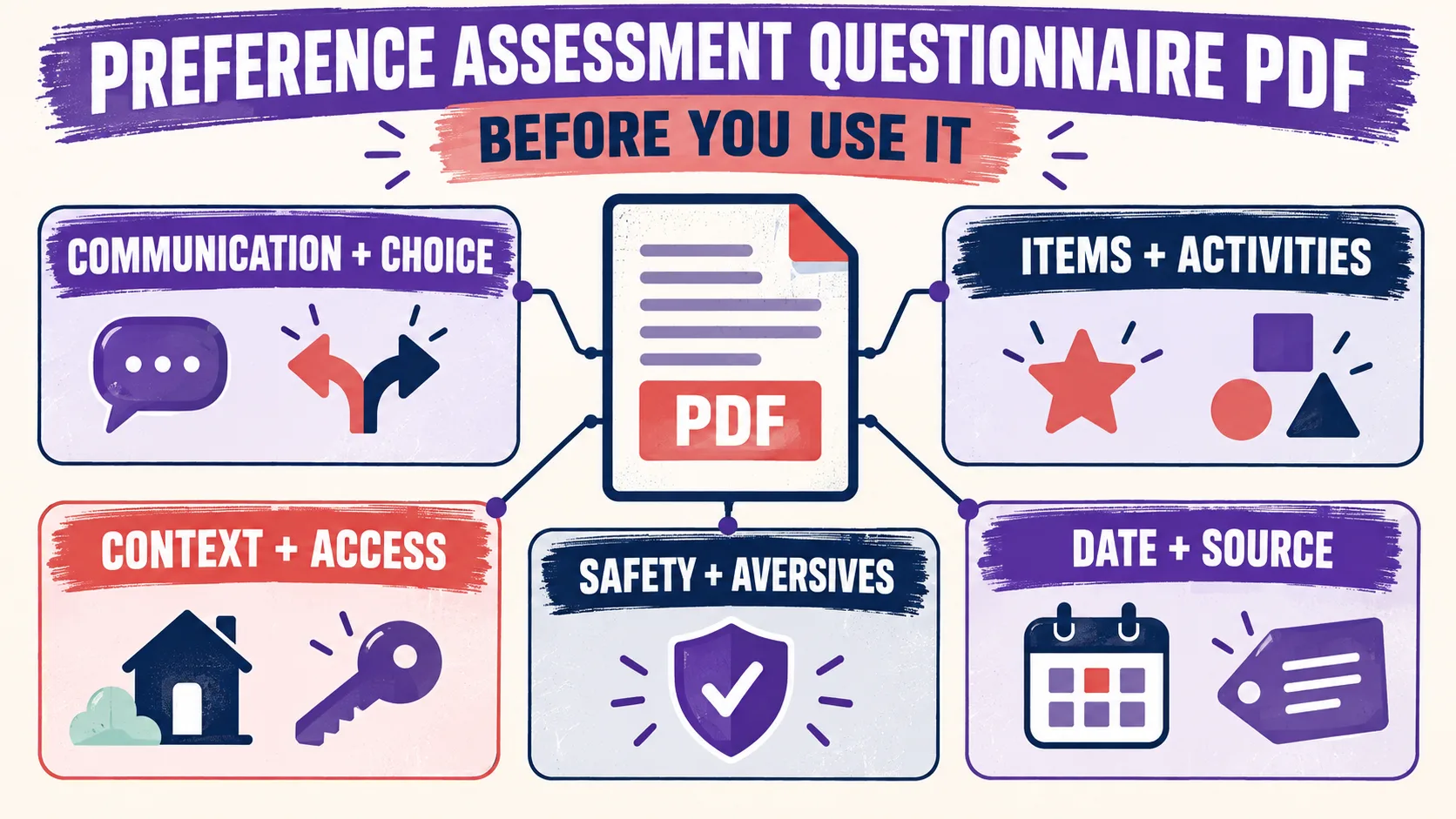
A preference assessment questionnaire PDF is a printable or fillable set of questions used to gather indirect information about items, activities, interactions, foods, sensory experiences, routines, and conditions that a learner may prefer or avoid. It may be completed by the learner when appropriate, a caregiver, a teacher, or another person with relevant experience.
Its best use is hypothesis generation. The answers help a behavior analyst create a reasonable pool of stimuli and decide what to observe next. They can also reveal practical constraints: allergies, dietary restrictions, cultural preferences, schedules, communication methods, accessibility needs, and situations that produce distress.
There is no single questionnaire PDF that is automatically correct for every learner or setting. A form should be adapted to the person, reviewed for permission and privacy, and paired with direct evidence when a treatment or reinforcement decision depends on it.
Questionnaire, Interview, and Direct Assessment Are Different
These terms are related but should not be used as if they describe the same procedure:
- Questionnaire: a written or digital set of prompts completed by someone who reports what the learner may like, dislike, choose, or avoid.
- Interview: a conversation that allows follow-up questions, examples, clarification, and discussion of context.
- Direct preference assessment: an observation or structured arrangement in which the learner’s behavior toward available stimuli is measured.
- Reinforcer assessment: a test of whether a consequence actually increases a target behavior under specified conditions.
A questionnaire can be efficient and respectful, especially when the learner cannot reliably communicate a preference in a particular format. It may also be inaccurate, outdated, or influenced by another person’s assumptions. Direct assessment adds behavioral evidence, but it still requires a suitable procedure, safety planning, assent or consent as applicable, and interpretation in context.
What a Useful Questionnaire Should Include
Before downloading or designing a preference assessment questionnaire PDF, check whether it collects enough information to guide a safe next step. A long list of toys is less useful than a short form that captures choice, context, access, and change over time.
| Questionnaire field | What it helps you learn | Follow-up check |
|---|---|---|
| Communication and choice | How the learner shows approach, refusal, selection, requests, and changes of mind. | Can the response format be accessed without prompting or pressure? |
| Items and activities | Possible tangible, edible, social, sensory, movement, leisure, or technology options. | Are the options available, safe, affordable, and appropriate for the setting? |
| Context and schedule | When the learner chooses, how long engagement lasts, and what conditions change the choice. | Could deprivation, fatigue, illness, novelty, or recent access affect the report? |
| Aversives and safety | Sounds, textures, foods, people, environments, allergies, and other conditions to avoid. | Has the team reviewed medical, dietary, sensory, and risk information? |
| Date and source | Who supplied the information, when it was collected, and what version of the form was used. | Is the information recent enough to guide today’s decision? |
How to Use Questionnaire Results
Use the form as the first step in a small assessment cycle:
- Collect multiple perspectives. When appropriate, compare learner report, caregiver report, teacher input, and recent observation rather than treating one person’s list as fact.
- Build a candidate pool. Select a manageable set of items or activities that are safe and realistically available.
- Check assent and choice. Explain or arrange the activity in a way the learner can understand, and honor refusal or withdrawal according to the plan.
- Observe engagement. Measure approach, selection, duration, latency, requests, refusal, or other behavior that answers the assessment question.
- Update the list. Preferences can change with satiation, context, novelty, access, development, and learning history.
Do not copy every reported favorite into a reinforcement schedule. Instead, record the hypothesis, test the most relevant options, and use the data to make a proportionate decision.
A Preference Is Not Automatically a Reinforcer
A learner may select or enjoy an item without that item increasing a target behavior when delivered as a consequence. Conversely, an item that is not selected in a questionnaire may become useful after pairing, under a different context, or when the learner’s motivation changes. Preference assessment identifies potential reinforcers; a reinforcer assessment asks whether behavior changes.
This distinction matters on the BCBA exam and in practice. If a question says that a caregiver reports a favorite activity, the report supports a hypothesis. It does not prove that the activity will function as reinforcement for a particular response, schedule, or learner state.
When to Choose a Direct Preference Assessment
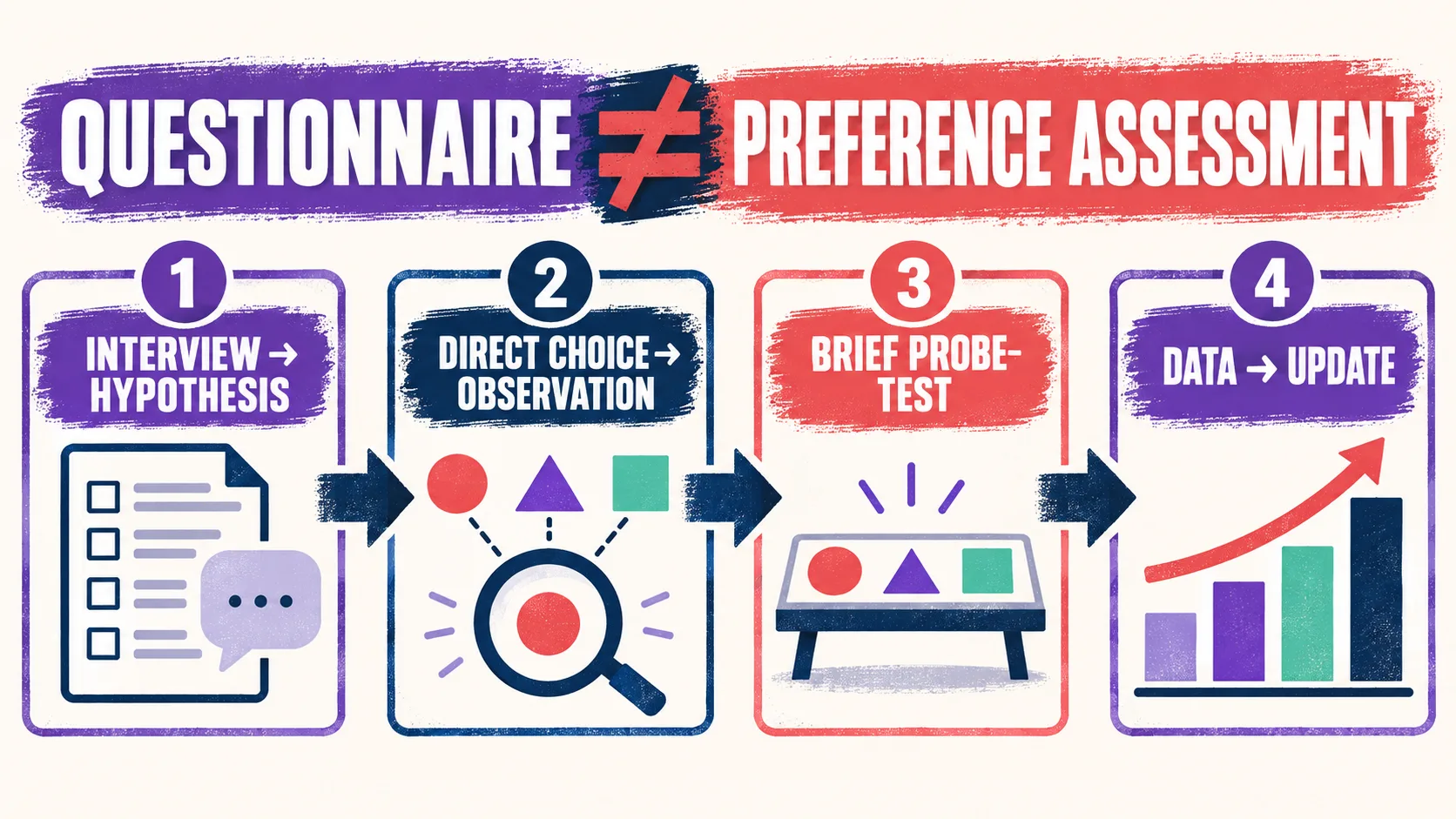
Choose a direct procedure when the decision requires behavioral evidence, when reports disagree, when preferences are changing quickly, or when the learner’s behavior can provide a meaningful choice. The procedure should match the learner and the question.
| Possible approach | Useful when | Watch for |
|---|---|---|
| Free operant observation | The learner can move among available options and natural engagement is informative. | Position, novelty, effort, and access can influence duration. |
| Single-stimulus | You need to observe approach or engagement with one option at a time. | A refusal may reflect the presentation or current condition, not a permanent dislike. |
| Paired choice | The learner can make a choice between two presented options. | The number of items and repeated trials affect time and interpretation. |
| Multiple-stimulus arrangement | You want a ranked set from several options and the learner can scan or select. | Replacement rules, repeated access, and response effort must be defined. |
For procedure-specific study, use the existing site’s pages on free-operant preference assessment, MSWO preference assessment, and the broader ABA preference assessment guide. This page stays focused on evaluating and using the questionnaire PDF.
Privacy, Consent, and Safety Checks
A downloadable form can create privacy risk if it asks for more identifying information than the clinical purpose requires. Use a client code or approved identifier in study copies, store the completed form in the authorized record system, and do not upload identifiable information to an unapproved template site or public drive.
Review food allergies, choking risk, sensory sensitivities, medical restrictions, cultural considerations, and environmental hazards before presenting an option. A “favorite” reported by another person is not permission to provide it. Follow the consent, assent, supervision, and safety procedures that apply to the setting.
How to Evaluate a PDF Before Using It
- Does the PDF name its purpose, intended user, and date or version?
- Does it distinguish reported preference from observed choice and reinforcement?
- Does it allow open-ended answers rather than forcing a narrow toy list?
- Does it include aversives, access conditions, dietary or medical cautions, and communication needs?
- Does it explain how to score or summarize responses, or clearly say that it is only an interview aid?
- Is the source identifiable, permission to use it clear, and the file free from unnecessary tracking or personal-data requests?
A visually attractive worksheet can still be clinically weak. Prefer a transparent form that tells you what information it gathers and what it does not establish.
How This Appears on the BCBA Exam
Exam questions may present a questionnaire result as if it were a final answer. Look for the difference between indirect report and direct observation, the learner’s ability to communicate a choice, the need to assess medical or safety variables, and whether the item was actually shown to increase behavior.
A reliable sequence is: define the question → gather safe indirect information → select a matched direct procedure → measure behavior → interpret in context → update the plan. Avoid choosing a reinforcer solely because an adult listed it as a favorite or because it appeared at the top of a form.
Practice Preference-Assessment Questions
After a missed question, write down the source of the information, the assessment type, the behavior measured, the safety constraint, and the decision supported by the data. This makes “questionnaire versus preference assessment” a reasoning distinction rather than a vocabulary flashcard. Use the Free BCBA Mock Exam to practice preference assessment, reinforcement, measurement, and assessment-selection questions. Review the explanation, then return to the procedure details instead of memorizing the answer letter.
Frequently Asked Questions
Is there one official preference assessment questionnaire PDF?: No. Forms vary by learner, setting, purpose, and organization. A PDF is a data-collection format, not a universal validated procedure. Can a questionnaire identify a reinforcer?: It can identify potential reinforcers and generate hypotheses. Only behavior change under relevant conditions can show whether a consequence functions as reinforcement. What should a questionnaire ask about?: Include communication and choice, items and activities, context, access, aversives, safety or dietary restrictions, the information source, and the date. Can I use a free PDF from the internet?: You can review it as a possible interview aid, but check its source, permission, privacy, instructions, and clinical fit before using it with a learner. Bottom line: Use a preference assessment questionnaire PDF to organize safe, respectful hypotheses. Then verify those hypotheses with an individualized procedure and observable data.
Quick Review Checklist
Use this final checklist to turn preference assessment questionnaire pdf into exam-ready reasoning. The goal is not to memorize a label in isolation; it is to identify the relevant evidence and explain why the best answer fits the scenario. Key ideas to review:
- State the central definition or decision point for preference assessment questionnaire pdf in your own words.
- Identify the detail that makes preference assessment questionnaire pdf different from its closest related ABA term.
- Separate the observable facts in a scenario from assumptions that are not supported by the facts.
- Write one example and one nonexample so you can recognize the concept in a new setting.
Exam application checks:
- Ask what the question is actually requesting before comparing the answer choices.
- Mark the antecedent, response, consequence, or other evidence that supports the selected answer.
- Look for a distractor that describes a related process but does not answer the specific question.
Final self-check:
- Explain how you would verify the interpretation with clear observations or data.
- Change one detail in the scenario and decide whether your answer should change.
- Give a one-sentence rationale that a supervisor or study partner could evaluate.
Take the Free BCBA Mock Exam
When you are ready to apply the idea, use the free practice resource below for additional feedback. Take the Free BCBA Mock Exam



