
If you searched for an aba mock exam free, the most useful question is not simply “What score did I get?” It is “What should this result change in my study plan?” A free mock can give you a starting point, expose weak content areas, and show whether your pacing is realistic. It cannot certify that you are ready, predict a BACB result, or replace official exam information.
Table of Contents
- What an ABA Mock Exam Free Result Can Actually Tell You
- Choose a diagnostic or a full-length practice test
- Use the three-pass free-mock study cycle
- Read score, domain pattern, and pacing together
- Turn missed questions into an error log
- Choose targeted drills, a full mock, or a reset
- Build a seven-day plan after the first attempt
- Check current BACB boundaries before test day
- FAQ and the next practice step
- Take the Free BCBA Mock Exam
Short answer: take the free test under a defined condition, record your score and timing, review every uncertain item, classify the error pattern, and schedule one specific next study block. Use a short free quiz as a diagnostic. Use a longer timed simulation only when you are ready to practice stamina. Then retest after studying instead of repeatedly taking free tests without changing what you do next.
What an ABA Mock Exam Free Result Can Actually Tell You
A free BCBA-style mock is most valuable as a measurement tool for your current study process. It shows how you respond to applied questions, how often you change an answer, which content areas repeatedly create uncertainty, and whether your timing collapses near the end. Those observations are more actionable than a single percentage because they point to a next behavior: review a definition, practice discriminating two similar concepts, or rehearse answering at a steadier pace.
Do not confuse a practice result with the official BCBA examination result. The BACB states that the current examination assesses the BCBA Test Content Outline (6th ed.) and recommends reviewing that outline, the Ethics Code for Behavior Analysts, and training materials. A commercial or free mock is an independent preparation product. It should not claim to contain live, recalled, or retired BACB items unless the source explicitly authorizes that claim.
| A free mock can show | It cannot prove | Your next move |
|---|---|---|
| Which questions felt uncertain or required guessing | That you will receive the same content or score on the live exam | Review the reasoning and record the exact distinction you missed |
| A pattern across domains or question types | That one overall percentage is an official pass line | Choose a targeted study block rather than repeating the same quiz |
| Whether your pace is stable from beginning to end | That an untimed quiz measures test-day stamina | Add timed practice only when the underlying concepts are ready |
Choose a diagnostic or a full-length practice test
Search results for “free BCBA mock exam” mix several products: a short diagnostic, a domain quiz, a mini mock, and a full-length timed simulation. They are not interchangeable. A short test answers, “Where should I start?” A full-length test answers, “Can I sustain careful decisions under a long clock?” Before you click Start, identify which question the format is designed to answer.
| Format | Best use | Do not use it to |
|---|---|---|
| Short diagnostic | Find an initial content or confidence pattern quickly | Declare yourself ready for a four-hour sitting |
| Domain mini-test | Practice one weak area after reviewing the underlying concept | Compare its percentage directly with a full exam result |
| Full-length timed mock | Rehearse sustained pacing, attention, and review decisions | Use it before you know how to learn from missed items |
The current BACB handbook describes a four-hour examination with 185 multiple-choice questions: 175 scored and 10 unscored. Every question has four possible answers and one correct answer. That official format is a reference point for pacing, not a reason to assume that every free product mirrors the live form. Read the practice product’s question count, timer, feedback rules, and domain reporting before interpreting its result.
- Check whether the test is a short diagnostic, domain set, or full-length simulation.
- Record whether feedback appears after each item or only after submission.
- Note whether the product reports an overall score, domain pattern, pacing, or only correct answers.
Use the three-pass free-mock study cycle
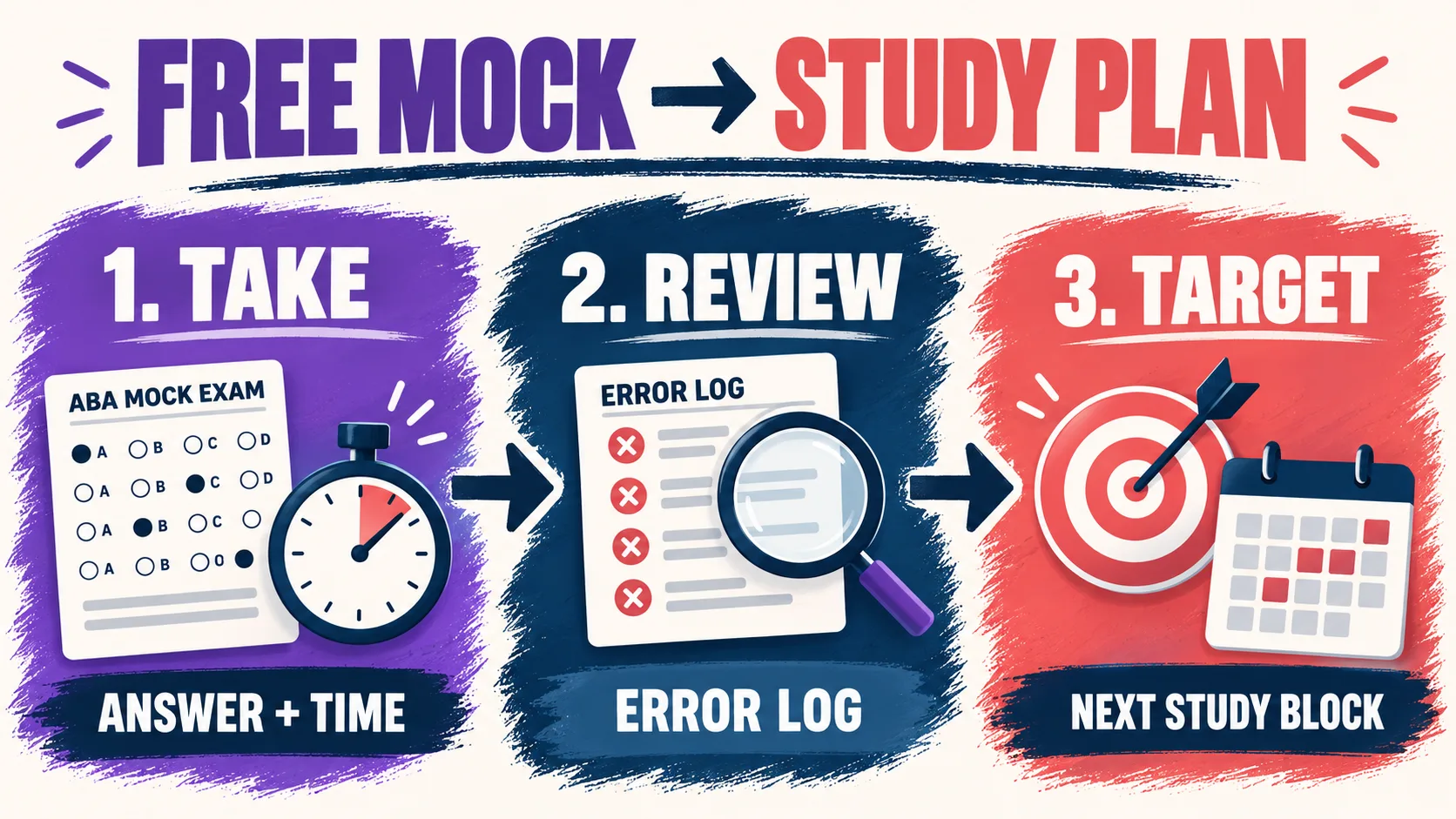
Run the practice test as a small learning experiment. Keep the conditions simple enough to repeat, but record enough information to explain the result. The cycle below is intentionally different from a landing page: it tells you what to do before, during, and after the free mock so the click leads to a useful plan.
- Pass one—take: choose a quiet block, remove notes, note the start time, and answer without searching for help.
- Pass two—review: revisit every wrong, guessed, or slow answer. Write why the best option fits and why the tempting option does not.
- Pass three—target: select one study action for the next block, such as a measurement comparison, an ethics scenario review, or a timed domain drill.
If the platform gives immediate explanations, do not rush past them to chase a higher score. If the platform withholds explanations until submission, finish the attempt first and then review in one uninterrupted block. Either way, separate “I knew the concept” from “I recognized the answer after seeing the explanation.” Those are different learning outcomes.
Read score, domain pattern, and pacing together
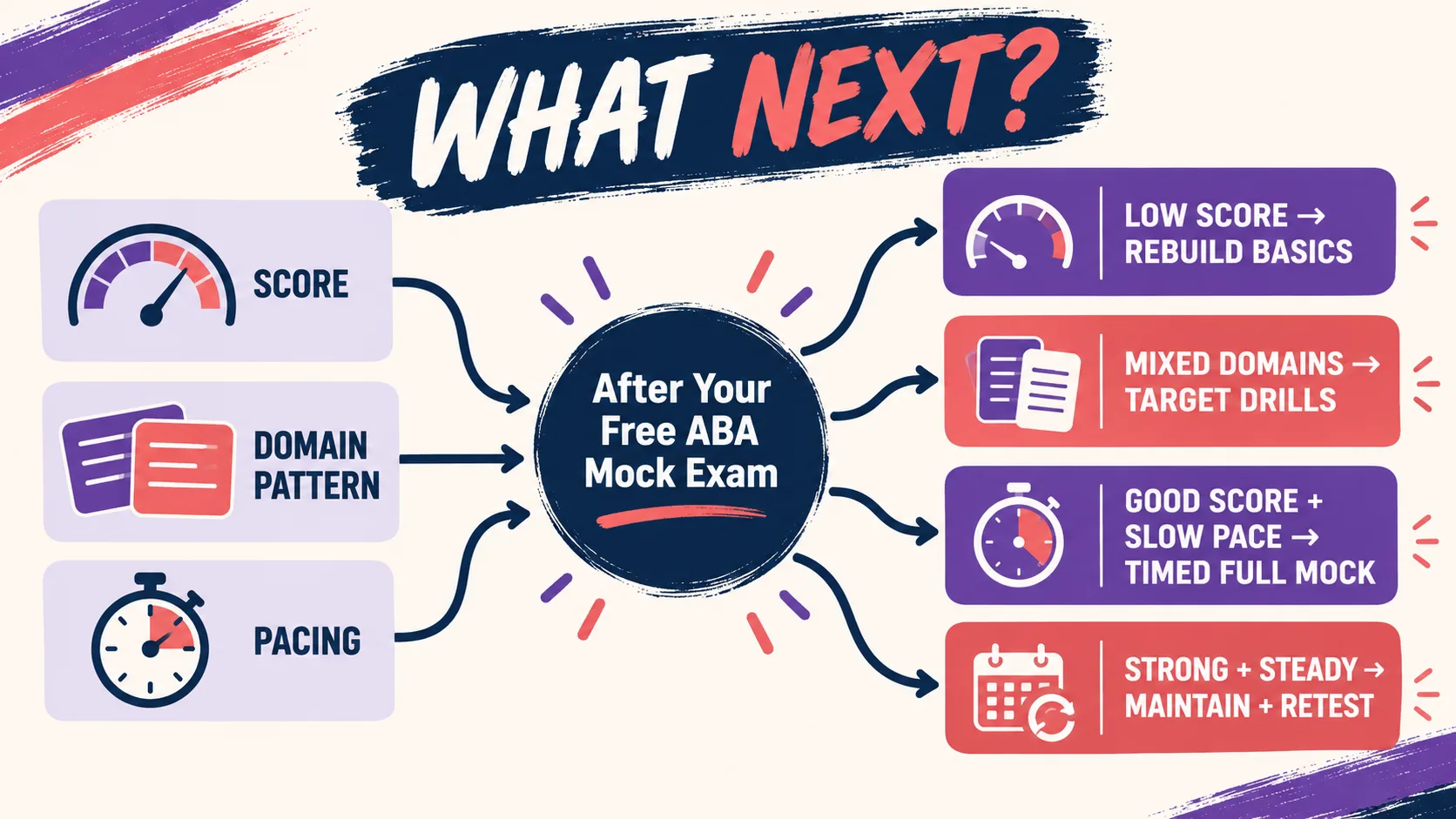
A single score hides the reason for the result. A stronger review reads three signals together: accuracy, content pattern, and pacing. For example, a moderate score with stable timing suggests a different plan from a high score earned by guessing quickly, or a high first-half score followed by rushed final questions. The result is a decision aid, not a personal label.
| Signal | What to inspect | Useful interpretation |
|---|---|---|
| Accuracy | Correct, incorrect, and guessed items | A correct guess is still a review item, not secure knowledge |
| Domain pattern | Repeated misses in a content area or distinction | Study the concept and its application before taking another full mock |
| Pacing | Time per item, late-session rush, and review behavior | A knowledge plan and a stamina plan may both be needed |
| Confidence | Items you changed or answered between two choices | Practice discriminating the exact feature in the stem |
Keep your language behavioral and observable. Instead of writing “I am bad at ethics,” write “I selected the option that protected rapport but overlooked the client’s best interest.” Instead of “I panic on measurement,” write “I confused duration with latency when the stem asked for elapsed time before a response.” A precise description gives you a teachable next step.
Turn missed questions into an error log
An error log prevents a free test from becoming disposable content. Record the question number or topic, your selected option, the best answer, and the reason for the decision. Do not copy confidential live BACB questions or imply that a commercial practice item is an official item. Use original practice wording and your own concise explanation.
- Concept gap: you cannot state the definition or boundary without looking it up.
- Discrimination gap: you know both terms but selected the wrong one when the stem changed a key feature.
- Application gap: you know the definition but cannot select the best action in a scenario.
- Reading gap: you missed a qualifier such as “most directly,” “first,” “best,” or “least.”
- Pacing gap: the answer may be correct, but the time cost made later decisions rushed.
- Confidence gap: you changed a correct answer without a new fact supporting the change.
Choose the category that explains the response, not the category that feels most dramatic. A low score caused by one unfamiliar domain calls for focused instruction. A decent score with many slow answers calls for timed decision practice. A correct answer reached by guessing calls for verification before you count it as mastered.
Choose targeted drills, a full mock, or a reset
Use the evidence from the error log to select the next resource. This is where a free mock can create a conversion without becoming a hard sell: the candidate should understand why a different practice format would help. A short, topic-focused drill is usually a better next step than buying or taking another full simulation when the problem is one concept.
| Your evidence | Next resource | Success check |
|---|---|---|
| One or two repeated concept gaps | Targeted notes, examples, and a small domain drill | Explain the distinction and apply it to a new scenario |
| Mixed domains with stable timing | A structured study block across the two weakest areas | Fewer guesses and a clearer rationale on the retest |
| Good accuracy but late-session rushing | Timed sets and then a full-length simulation | Finish with a deliberate review buffer, not a panic sprint |
| Unclear result because conditions were loose | Retake a short diagnostic under consistent conditions | A result that can be compared with the first attempt |
When you are ready, you can start the site’s aba mock exam free practice as a low-pressure checkpoint. Review the score and explanations, then decide whether targeted practice or a longer paid simulation fits your evidence. The page’s free experience is practice and feedback; it is not BACB approval or a promise of a passing result.
Build a seven-day plan after the first attempt
A small plan is easier to follow than a vague promise to “study more.” Use the first attempt to define one primary weakness and one process weakness. Keep the plan narrow enough that the next retest can show whether the intervention helped.
- Day 1: finish the error log and sort misses into concept, discrimination, application, reading, pacing, or confidence.
- Day 2: review the weakest concept and write a two-sentence explanation in your own words.
- Day 3: complete a short targeted set and explain each answer without looking at the key first.
- Day 4: practice a second domain or a paired distinction that caused confusion.
- Day 5: run a timed set, recording pace and late-session decision quality.
- Day 6: review only the errors and guesses from the week; do not start a random content marathon.
- Day 7: retest with a comparable format and compare the pattern, not only the percentage.
Stop and adjust the plan if the same error repeats after a review. Re-reading the same paragraph is not evidence of learning. Change the activity: explain the distinction aloud, create two contrasting scenarios, answer a new item, or ask a qualified supervisor or instructor for clarification within their role.
Check current BACB boundaries before test day
Use the current BACB BCBA Handbook for the official exam format, preparation recommendations, application boundaries, and test-security rules. The handbook says the examination is based on the BCBA Test Content Outline (6th ed.) and that the result is based on overall performance rather than a separate pass line for each content area. A practice platform may report a percentage or domain breakdown, but that report is its own feedback system.
If you are planning around the 2027 transition, check the BACB’s 2027 requirements notice directly. The notice says significant changes take effect January 1, 2027, and that a complete application—including payment and required documents—must be received by December 31, 2026 to be reviewed under the current 2022 requirements. A free mock exam does not preserve an application date and does not change which requirement set applies to you.
- Verify the current handbook and Test Content Outline before making a format claim.
- Keep commercial practice questions separate from confidential BACB exam content.
- Do not use a practice score as an official pass prediction.
- Check the date-sensitive 2027 application notice if your eligibility timeline crosses the transition.
FAQ and the next practice step
Is a free ABA mock exam enough to pass the BCBA exam? No single free test can establish that. It can reveal a starting pattern and provide feedback. Use the result to plan study, then use additional practice and official BACB materials appropriate to your eligibility and timeline.
Should I take a free mock exam before studying? A short diagnostic can be useful before studying because it gives you a baseline. A full-length simulation is usually more useful after you have enough content knowledge to learn from the timing and review demands.
What score should I aim for? Do not treat an independent practice percentage as the BACB’s official passing standard. Track accuracy, domain pattern, guesses, and pace, and use the current BACB handbook for official exam information.
How often should I repeat a free mock? Repeat only when you have changed something meaningful—such as targeted review, a pacing routine, or a new error-log method. Otherwise, a second attempt may measure memory of the questions rather than improved reasoning.
Bottom line: an aba mock exam free result becomes valuable when it changes your next study action. Take the test honestly, review the reasoning, classify the error pattern, choose the narrowest useful next step, and retest under comparable conditions. That approach gives you better information and a clearer path to the next practice resource.
Take the Free BCBA Mock Exam
A useful next step is to apply this idea in a fresh set of BCBA-style practice questions and review the feedback. Take the Free BCBA Mock Exam



