

A practical guide to ABA interview questions and answers for BCBA, RBT, and ABA candidates who want to sound specific, ethical, and ready for real work. If you are preparing for ABA interview questions and answers, memorizing definitions is only the beginning. Hiring teams usually want to hear how you think: how you define behavior, connect an intervention to function, use data, protect client welfare, collaborate with caregivers and staff, and respond when the facts are incomplete.
Table of Contents
- ABA Interview Questions and Answers: What Employers Are Testing
- Use a Four-Part Answer Framework
- Common ABA Interview Questions and Answers
- Technical Questions: Define, Apply, Measure
- Case Scenarios: Make Your Reasoning Observable
- Ethics, Scope, and Client-Welfare Questions
- Teamwork, Supervision, and Feedback Questions
- The Five-Part Interview Question Map
- How to Rehearse Without Sounding Scripted
- Questions to Ask the Employer
- Credential and Scope Checks
- Frequently Asked Questions
- Quick Review Checklist
- Take the Free BCBA Mock Exam
The strongest answer is not the longest answer. It is a short, concrete explanation that connects a principle to a situation, an observable action, and a way to evaluate whether the plan helped. Use this guide to prepare examples without pretending that one script fits every BCBA, RBT, behavior technician, school, clinic, or payer environment. Scope note: This is an educational interview-preparation guide, not employment, clinical, legal, or ethical advice for a particular case. Verify current credential, supervision, licensure, and employer requirements with the appropriate official or organizational source.
ABA Interview Questions and Answers: What Employers Are Testing
ABA interviews vary by role, but the underlying decision is similar: can this candidate turn training into safe, observable, team-based practice? An RBT or behavior technician may be asked about following a plan, recording data, responding to feedback, and staying within supervision. A BCBA may be asked about assessment, program design, supervision, caregiver collaboration, clinical judgment, and how they respond to an ethical concern. Interviewers are often listening for five signals:
- Precision: You define behavior and procedures in observable terms rather than relying on labels such as “noncompliant” or “manipulative.”
- Application: You can move from a concept to a realistic example without claiming that one procedure works for everyone.
- Measurement: You can explain what you would record, how you would review it, and what would cause you to consult or change course.
- Professional judgment: You recognize scope, supervision, assent, confidentiality, and client-welfare boundaries.
- Collaboration: You can communicate with caregivers, teachers, technicians, and supervisors without turning disagreement into blame.
Use a Four-Part Answer Framework
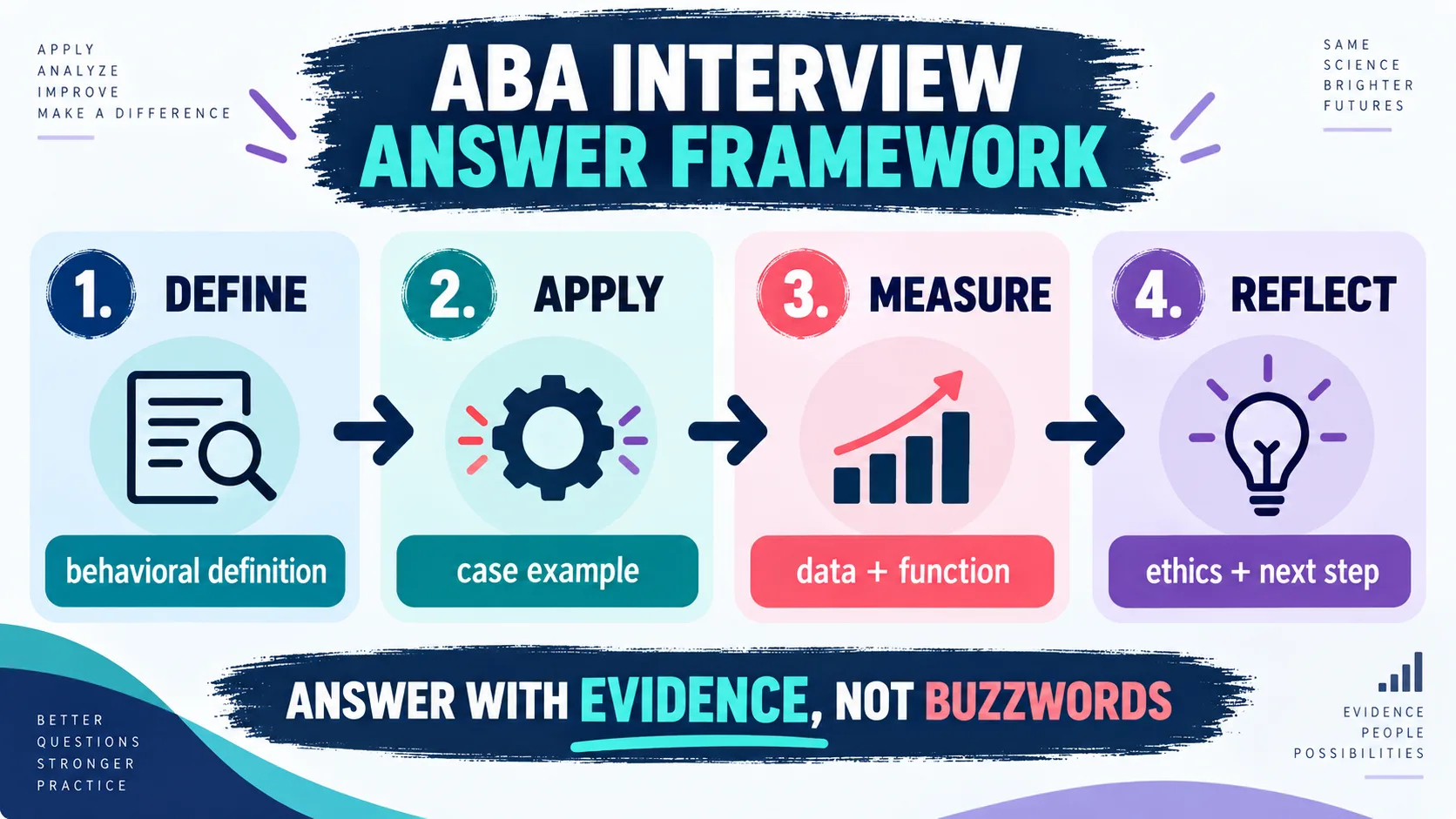
For most technical or scenario-based ABA interview questions, use a four-part structure: define, apply, measure, reflect. It is short enough for an interview and specific enough to prevent a vague answer.
| Part | What to say | Example prompt |
|---|---|---|
| Define | Give the behavior-analytic meaning in plain language and state what the term does not mean. | “What is reinforcement?” |
| Apply | Use a fictional or de-identified example that shows the antecedent, response, and consequence. | “Give an example from practice.” |
| Measure | Name the relevant measure, decision rule, or data-review step. | “How would you know it worked?” |
| Reflect | Add the ethical, collaborative, or scope-aware next step and acknowledge limits. | “What if the plan is not effective?” |
Common ABA Interview Questions and Answers
Prepare a one-minute answer for each question below, then a two-minute version with a specific example. Keep client details fictional or de-identified. Your goal is to show a repeatable way of thinking, not to recite a perfect speech.
| Question | Answer direction | Avoid |
|---|---|---|
| Why do you want to work in ABA? | Connect your motivation to observable learning, respectful collaboration, and continued skill development. | Promises that you will “fix” a person or uses only generic passion language. |
| How do you build rapport? | Describe pairing, preference information, learner choice, predictable interaction, and data-informed adjustment. | Treats rapport as a trick for obtaining compliance or ignores assent. |
| How do you handle a difficult session? | Start with safety and the written plan, describe what was observed, contact the supervisor, document, and review the next step. | Blames the learner, improvises outside scope, or hides the event. |
| How do you use data? | Name the operational definition, measurement system, fidelity check, review pattern, and decision owner. | Says “I collect data” without explaining what the data changes. |
| How do you respond to feedback? | Give a real example of receiving, clarifying, practicing, and checking whether performance improved. | Claims never to make mistakes or treats supervision as criticism. |
Technical Questions: Define, Apply, Measure
Technical questions often sound like “What is an SD?”, “What is the difference between reinforcement and punishment?”, “How would you define behavior?”, or “What is a functional assessment?” Answer in plain language first. Then give one short example and one boundary.
For an operational definition, you could say: “I would describe the response in observable, measurable terms, specify when it starts and stops, and test whether two trained observers could agree on examples and nonexamples.” If asked about reinforcement, add that the consequence must increase the future probability of the behavior; something being pleasant or intended as a reward is not enough.
Case Scenarios: Make Your Reasoning Observable
Scenario prompts are an opportunity to show a decision sequence. Use this order:
- Clarify the referral question and define the target response.
- Check immediate safety, dignity, assent, and the limits of your role.
- Review the current plan, baseline, data quality, and relevant context.
- State the hypothesis or decision you can support, without overclaiming causation.
- Describe the least intrusive, function-consistent next step within the plan and your scope.
- Explain what you would measure, who you would consult, and when you would review.
If asked what you would do when a learner refuses a task, do not assume the refusal is a character trait or automatically escalate demands. Explain how you would follow the plan, check communication and choice opportunities, review the antecedent and consequence pattern, prioritize safety, and consult the BCBA or supervisor when the response is outside your role. The interviewer is listening for calm, evidence-based reasoning.
Ethics, Scope, and Client-Welfare Questions
Ethics questions may include confidentiality, conflicts of interest, gifts, social media, dual relationships, cultural responsiveness, assent, documentation, or what to do when you disagree with a plan. The BACB Ethics Code resources are the appropriate official starting point for current standards; do not rely on an old screenshot or an interview blog as the final authority.
A strong answer identifies the client-welfare issue, protects privacy, consults the correct supervisor or organizational channel, documents facts rather than accusations, and escalates when the concern is not resolved. If you are asked about a situation outside your credential or training, say that directly and explain how you would obtain supervision. That is safer than performing confidence. Do not share real client names, diagnoses, addresses, school names, photographs, or case details during an interview. Replace them with a fictional label and describe only the information needed to explain your reasoning.
Teamwork, Supervision, and Feedback Questions
ABA work is rarely isolated. Prepare examples of collaborating with a caregiver, teacher, technician, speech-language professional, or supervisor. A useful story names the shared goal, each person’s role, the communication method, the data or observation that informed the conversation, and what changed after the team agreed on a next step.
If asked how you handle disagreement, avoid saying that you would simply “follow orders” or “do what feels right.” Explain how you would listen, restate the concern, separate facts from interpretations, review the written plan or source, request supervision or consultation, and document the decision. For a BCBA role, include how you would make the final plan understandable to the people implementing it and how you would monitor treatment integrity.
The Five-Part Interview Question Map
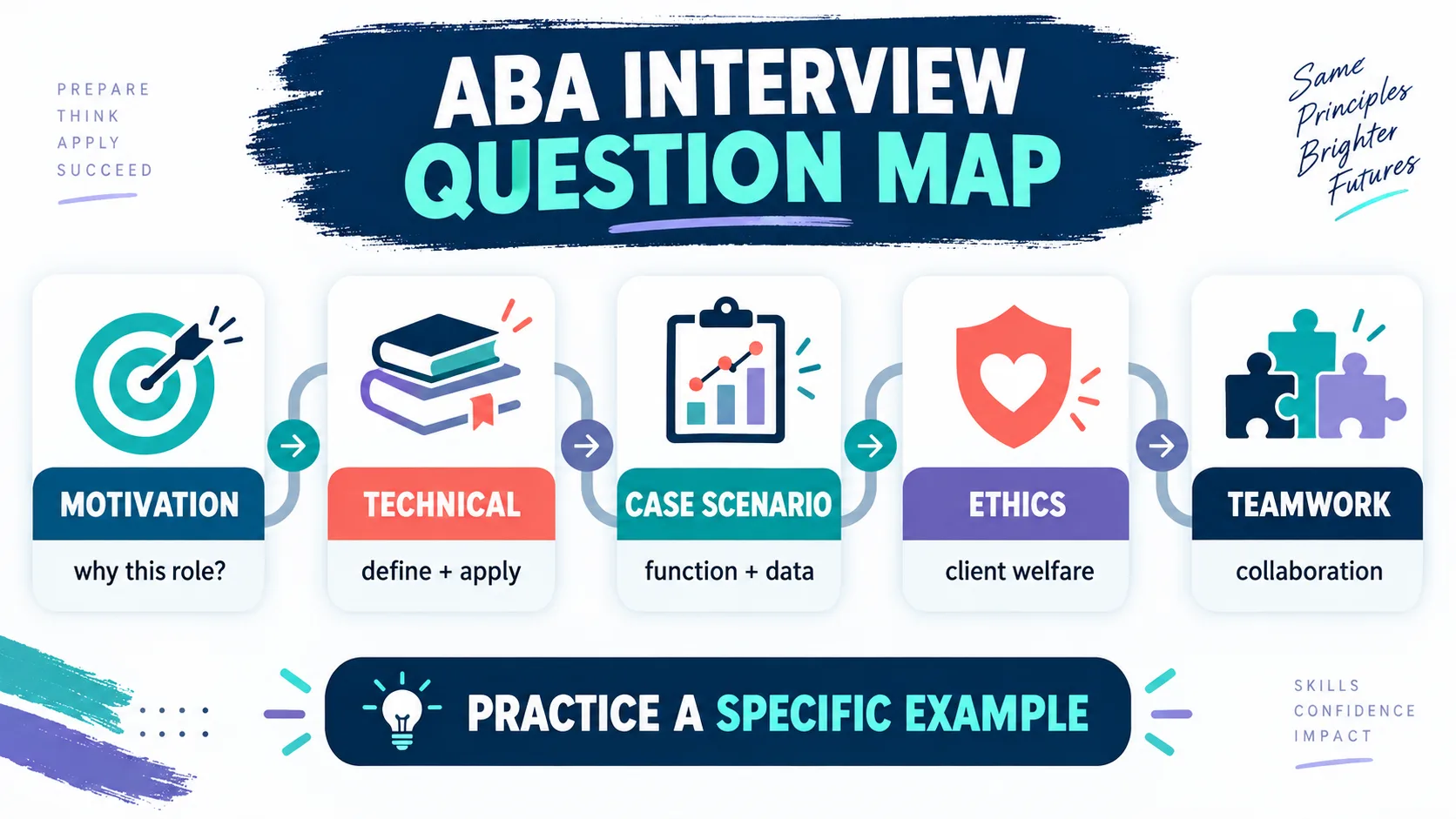
Use the map below to organize practice. It keeps your preparation from becoming a random list of flashcards.
| Question family | Practice prompt | Proof to prepare |
|---|---|---|
| Motivation | Why this role, population, or setting? | A specific reason connected to learning, dignity, teamwork, or growth. |
| Technical | Define and apply a core ABA concept. | Definition, example, nonexample, and measurement choice. |
| Case scenario | What would you do when the plan is not working? | Safety check, data review, consultation, and review rule. |
| Ethics | How would you handle a boundary or privacy concern? | Current source, scope-aware action, documentation, and escalation path. |
| Teamwork | How do you communicate disagreement or feedback? | A de-identified story showing listening, role clarity, and follow-through. |
How to Rehearse Without Sounding Scripted
Write five experience cards, not five speeches. For each card, record the context, the observable problem, your role, the action you took, the data or feedback you used, the result, and what you would improve. Then practice answering the same story from different angles. One data-collection story can answer questions about accuracy, teamwork, feedback, and problem solving if you explain the relevant part honestly.
Use a timer. Aim for 45–75 seconds for a direct definition and 90–150 seconds for a scenario. Pause before answering a complex prompt, ask a clarifying question when needed, and say when you would consult a supervisor. Strong candidates do not need to know every answer instantly; they need a safe way to find, verify, and act on the answer.
Questions to Ask the Employer
An interview is also your chance to evaluate the role. The existing BCBA interview question guide focuses on questions candidates can ask an employer. Ask about caseload, supervision access, training, data systems, caregiver expectations, scheduling, travel, documentation time, crisis procedures, clinical review, and how ethical concerns are handled.
Credential and Scope Checks
Before accepting a role, verify what the employer expects from your credential, degree, supervision, fieldwork, and state practice authority. The BACB BCBA resource page is an official place to start for current certification information. State licensure, employer policies, payer rules, and job duties may add requirements; treat a job title as a prompt to verify, not as proof of authority.
For study, separate interview preparation from exam preparation. Review concepts actively, practice applied scenarios, and use a full mock exam to test pacing and retrieval. The Free BCBA Mock Exam can be a useful checkpoint for concept gaps. It is practice data, not an official BACB result and not a guarantee of interview performance.
Frequently Asked Questions
What are the most common ABA interview questions?: Common prompts ask why you want the role, how you build rapport, how you define and measure behavior, how you respond to a difficult session, how you use data, how you handle feedback, and how you protect client welfare. BCBA interviews may add assessment, supervision, program design, and ethical-decision scenarios.
How should I answer an ABA interview question if I lack experience?: Be direct about your experience level, then use coursework, supervised practice, volunteer work, or a fictional scenario to show your reasoning. Explain what you would do within your scope, what you would measure, and when you would seek supervision. Do not invent client outcomes.
Should I memorize ABA interview answers?: Memorize a structure and a few truthful experience cards, not a script. Interviewers may change the setting or add a safety, ethics, or data detail. A flexible define-apply-measure-reflect structure helps you answer the actual question.
What should I say about a client during an interview?: Use a fictional or de-identified example and share only the minimum information needed to explain the professional decision. Never share names, addresses, photographs, school identifiers, or confidential records.
How can I connect ABA interview preparation to the BCBA exam?: Practice explaining concepts in applied scenarios, then check your retrieval with exam-style questions. Interview preparation emphasizes communication and professional judgment; exam preparation also requires coverage, pacing, and test-specific practice. They support each other but are not interchangeable.
Bottom line: The best ABA interview questions and answers show a calm chain of reasoning: define the behavior, apply the principle, measure what matters, protect client welfare, and collaborate within scope. Prepare specific examples, verify current requirements, and let your evidence—not buzzwords—carry the answer.
Quick Review Checklist
Use this final checklist to turn aba interview questions and answers into exam-ready reasoning. The goal is not to memorize a label in isolation; it is to identify the relevant evidence and explain why the best answer fits the scenario. Key ideas to review:
- State the central definition or decision point for aba interview questions and answers in your own words.
- Identify the detail that makes aba interview questions and answers different from its closest related ABA term.
- Separate the observable facts in a scenario from assumptions that are not supported by the facts.
- Write one example and one nonexample so you can recognize the concept in a new setting.
Exam application checks:
- Ask what the question is actually requesting before comparing the answer choices.
- Mark the antecedent, response, consequence, or other evidence that supports the selected answer.
- Look for a distractor that describes a related process but does not answer the specific question.
Final self-check:
- Explain how you would verify the interpretation with clear observations or data.
- Change one detail in the scenario and decide whether your answer should change.
- Give a one-sentence rationale that a supervisor or study partner could evaluate.
Take the Free BCBA Mock Exam
When you are ready to apply the idea, use the free practice resource below for additional feedback. Take the Free BCBA Mock Exam



