
ABA for beginners should start with a way of thinking, not a pile of abbreviations. Learn to observe what happens, define behavior clearly, measure what matters, teach a meaningful skill, and review the data before changing the plan.
Table of Contents
- What Does ABA for Beginners Actually Mean?
- Where Should a Beginner Start?
- How Does the ABC Model Organize Observation?
- Which ABA Concepts Come First?
- How Does Reinforcement Work?
- Why Do Data and Measurement Matter?
- Why Do Generalization and Maintenance Matter?
- What Should Ethical ABA Look Like?
- How Can You Learn ABA Without Memorizing Terms?
- What Changes for a BCBA Exam Learner?
- What Belongs on an ABA Beginner Checklist?
- How Should You Choose Your Next Resources?
- ABA for Beginners FAQ
Applied behavior analysis can sound technical because the field uses precise words for everyday learning processes. A beginner does not need to memorize every procedure on the first day. You need a reliable map for asking better questions, respecting the learner, and separating what you observed from what you guessed. This guide is educational; it is not a treatment plan, diagnosis, or substitute for qualified supervision. Table of Contents
What Does ABA for Beginners Actually Mean?
ABA means applying the science of behavior to socially meaningful goals. The BACB describes behavior analysis as focusing on behavior, the circumstances surrounding it, and the consequences that influence what happens next. For a beginner, that means looking for observable patterns instead of labeling a person as “unmotivated,” “defiant,” or “not ready.” A useful description identifies what the person did, when it happened, and what followed.
- Observe: describe the event in terms another person could see or hear.
- Define: write a clear operational definition that separates the target from similar actions.
- Measure: choose data that match the question, such as frequency, duration, latency, or percentage correct.
- Teach: arrange practice, prompts, reinforcement, and feedback around a useful goal.
- Review: use the pattern in the data to decide whether to continue, adjust, or reassess.
Where Should a Beginner Start?
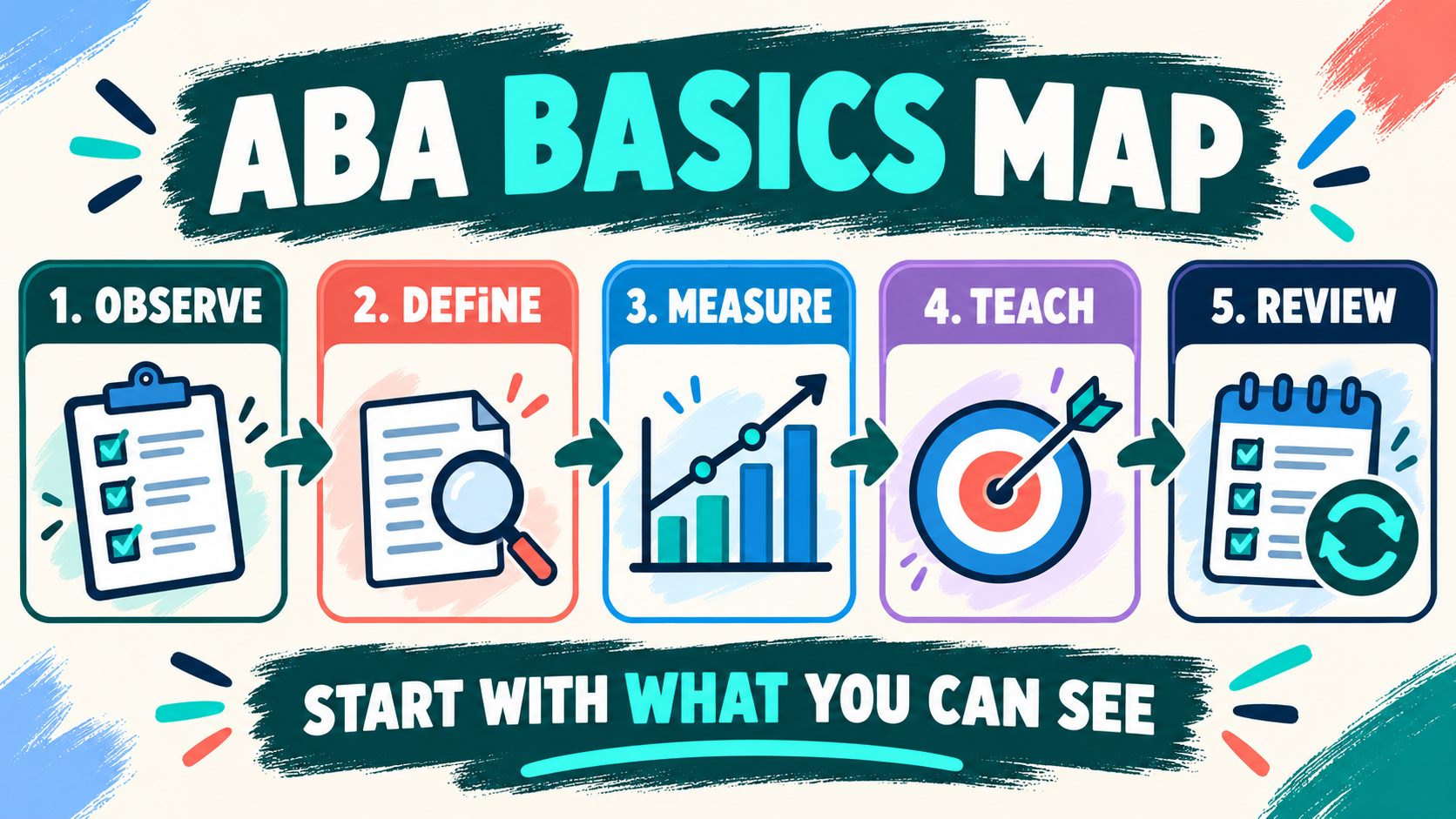
Start with the five-part map shown above: observe, define, measure, teach, and review. It keeps a new learner from jumping directly to procedure names. For example, “use reinforcement” is incomplete advice until you know which behavior should increase, what consequence is valuable to this learner, how the consequence will be delivered, and how you will know whether the behavior changed.
How Does the ABC Model Organize Observation?
The ABC model describes an antecedent, a behavior, and a consequence. The antecedent is what occurs before the response and may set the occasion for it. The behavior is the observable action. The consequence is what follows and may affect the future likelihood of that behavior. ABC recording is a way to organize observation; it is not proof of function from one incident.
| Part | Beginner question | Example |
|---|---|---|
| Antecedent | What happened immediately before? | A teacher presented a difficult worksheet and said, “Start with problem one.” |
| Behavior | What did the person do that could be counted or timed? | The student pushed the worksheet away and said, “No.” |
| Consequence | What happened immediately after? | The worksheet was removed and the teacher offered a break. |
Which ABA Concepts Come First?
Learn concepts in connected groups rather than isolated flashcards. The strongest first set explains how behavior is described, how consequences affect future responding, and how skills transfer across people and settings. The goal is not to use jargon to sound clinical. The goal is to make your description more precise.
- Behavior: an action that can be observed and measured, not a personality trait.
- Reinforcement: a consequence that increases the future probability of a behavior.
- Punishment: a consequence that decreases the future probability of a behavior; ethical and least-restrictive decision-making still matters.
- Prompt: an added cue that helps a learner respond correctly and should be planned for fading when appropriate.
- Shaping: reinforcing successive approximations toward a target response.
- Generalization: using a learned skill with different people, materials, examples, or settings.
- Maintenance: continuing to use a skill after teaching intensity or support changes.
How Does Reinforcement Work?
Reinforcement is about behavior change, not bribery and not moral approval. A reinforcer is identified by its effect on a specific response. If a learner requests a break and then receives a short, agreed-upon break, requesting may become more likely in the future. Whether that consequence is reinforcing must be checked with data and with attention to the learner’s preferences and assent.
Beginners often confuse positive and negative reinforcement with good and bad. “Positive” means something is added; “negative” means something is removed. Both can increase behavior. Positive reinforcement might add praise or access to a preferred activity after a target response. Negative reinforcement might remove a difficult demand after an appropriate communication response. Neither label tells you whether a procedure is automatically ethical or appropriate. When considering reinforcement, ask:
- What exact behavior is expected, and can the learner tell when the opportunity is available?
- What consequence is meaningful to this person rather than merely convenient for the provider?
- Is the response effort reasonable, and can the learner contact reinforcement quickly while learning?
- What data will show whether the target behavior is increasing and whether another behavior is being suppressed?
- How will the learner use the skill when the original reward, prompt, or therapist is not present?
Why Do Data and Measurement Matter?
Data protect a beginner from two opposite mistakes: changing a plan after one unusual session and continuing a plan because it feels familiar. Pick a measurement system that matches the behavior. Frequency may fit a discrete response, duration may fit how long an episode lasts, latency may fit time to begin, and percentage correct may fit skill acquisition. A measurement label is only useful when its definition is consistent.
| Question | Possible measure | Watch out for |
|---|---|---|
| How often did the response occur? | Frequency or rate | Different observation lengths can make raw counts misleading. |
| How long did the event last? | Duration | A count does not show whether episodes were brief or prolonged. |
| How accurately was the skill completed? | Percentage correct or opportunities mastered | Changing the prompt level can change what “correct” means. |
Why Do Generalization and Maintenance Matter?
A skill learned at a table with one therapist is not automatically a skill used at home, school, work, or in the community. Generalization means the learner responds across relevant variations, while maintenance means the response continues over time. Build those outcomes into teaching instead of treating them as a lucky bonus at the end.
- Vary materials and examples while keeping the core response clear.
- Practice with more than one person when that matches the learner’s life.
- Move from highly prompted practice toward natural cues and realistic routines.
- Check whether the skill remains useful after the schedule, setting, or support changes.
For beginners, the practical question is simple: “Where will this skill matter next?” If the answer is only “during this lesson,” the plan needs a stronger transfer step. Generalization should still be individualized; adding random variation is not automatically helpful if it makes the task confusing or ignores the learner’s priorities.
What Should Ethical ABA Look Like?
Ethics is not an advanced topic saved for the end of training. The BACB Ethics Code for Behavior Analysts is designed around client, applicant, and certificant protection. A beginner should learn to notice dignity, assent, informed participation, privacy, competence, cultural responsiveness, and the difference between a socially meaningful goal and a goal chosen only because it makes adults more comfortable.
Ethical practice also means staying within your role. A beginner may observe, study, or support a plan under the direction of qualified professionals, but should not independently design treatment, change a safety procedure, or make a clinical claim without the required training and supervision. If a learner communicates refusal or distress, that information is part of the context—not an obstacle to ignore.
- Ask whether the goal improves access, communication, safety, autonomy, participation, or another meaningful outcome.
- Use the least intrusive effective support and monitor unintended effects.
- Include the learner and caregivers in decisions in a way they can understand.
- Protect private information and avoid describing a person by a behavior label.
- Seek supervision when the question exceeds your competence or authority.
How Can You Learn ABA Without Memorizing Terms?
Use a three-column study note for every new concept: definition, decision, and example. The definition tells you what the term means. The decision tells you what feature would make it the best answer in a scenario. The example shows how it looks in context. Add one nonexample so you can discriminate it from a close term. Then use a short retrieval cycle:
- Close the notes and explain the concept in plain language.
- Classify a new scenario without looking at the answer.
- Explain why the tempting alternatives do not fit.
- Change one fact in the scenario and decide whether the answer changes.
- Record the error pattern and choose the next review activity.
What Changes for a BCBA Exam Learner?
If your goal is BCBA certification, use beginner ABA learning as a foundation, then connect it to the current BACB Test Content Outline and your training materials. The outline is the boundary of what the exam assesses; it is not a complete textbook. Learn each domain through definitions, examples, data decisions, ethics decisions, and application scenarios.
Keep certification requirements separate from introductory content. The BACB Handbook, examination information, and current transition materials control eligibility, application, fieldwork, and appointment questions. A social post or an old study guide cannot override those documents. If your timeline crosses the 2027 requirements transition, verify the rule that applies to your pathway and testing date rather than assuming that every older resource is still current.
For exam practice, ABA for beginners practice questions should be used as a reasoning exercise: identify the observable facts, name the task demand, compare the distractors, and record what you will review next. A practice score is feedback, not proof of eligibility or a guarantee of passing.
What Belongs on an ABA Beginner Checklist?
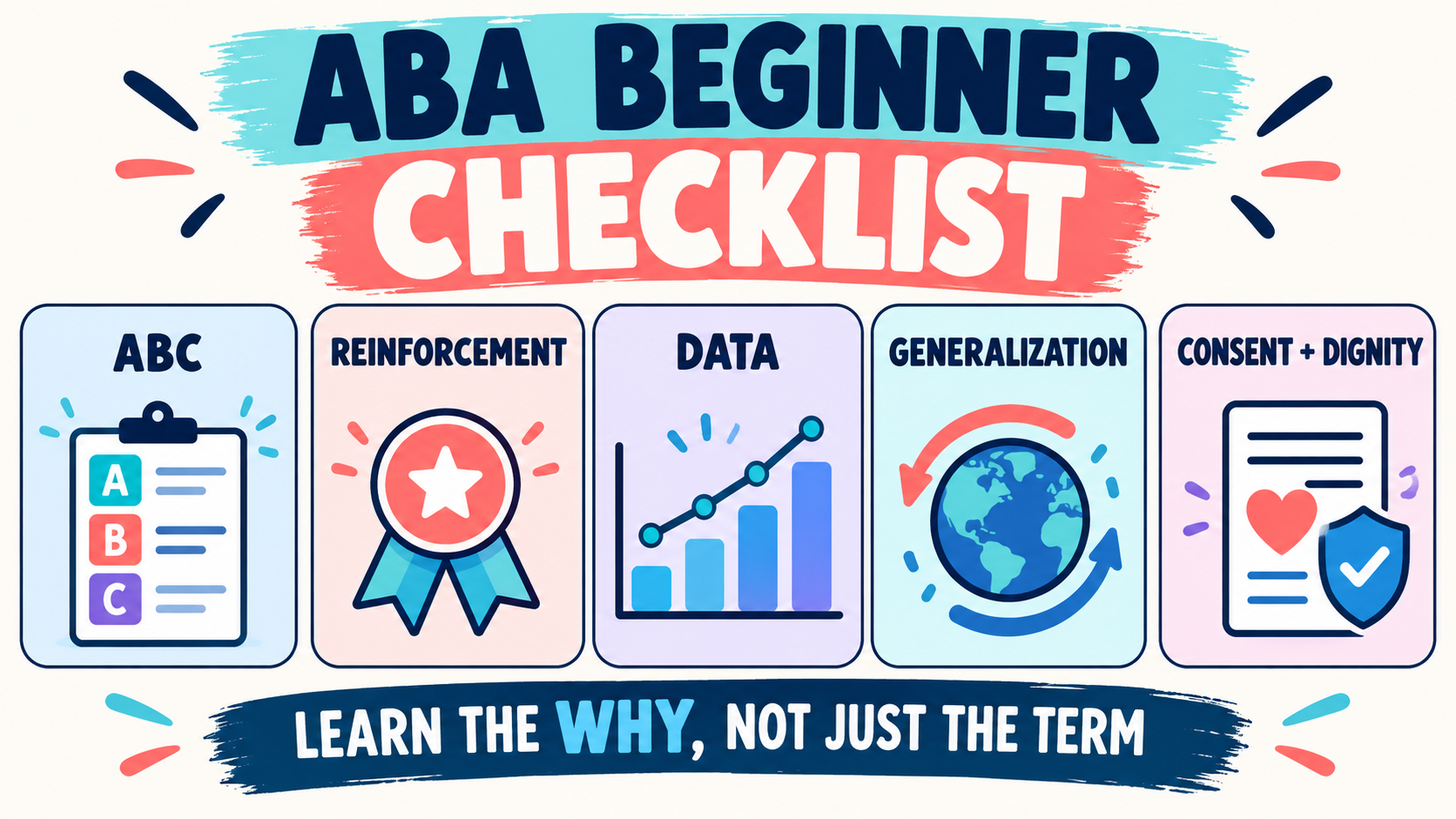
Use the checklist above when you are deciding whether you understand a concept well enough to apply it. You do not need to know every advanced procedure before you can begin. You do need to know what you observed, what you are measuring, what outcome matters, and who should supervise the next decision.
- ABC: can you identify what happened before, what the person did, and what followed?
- Reinforcement: can you explain the behavior effect rather than calling every preferred item a reward?
- Data: can you choose a measure that matches the question and describe its limitations?
- Generalization: can you name where, with whom, and when the skill should transfer?
- Consent and dignity: can you explain why the goal matters to the learner and how participation is respected?
- Supervision: can you identify what you are qualified to do and when to ask a trained professional?
How Should You Choose Your Next Resources?
Start with resources that show their definitions, sources, scope, and update date. The BACB’s About Behavior Analysis overview is a useful orientation, while the current BACB Ethics Code information belongs in any professional learning path. Add textbooks, coursework, supervision, or practice tools that explain why an answer fits rather than only giving a vocabulary list.
- Prefer: current definitions, observable examples, citations, and explicit limits on what the resource can decide.
- Prefer: practice that includes answer rationales and asks you to discriminate between similar concepts.
- Be cautious: with promises of guaranteed outcomes, one-size-fits-all programs, or advice that ignores learner preferences.
- Be cautious: with old task lists, unsourced social-media summaries, and “quick fixes” presented as clinical direction.
For a low-pressure next step, Take the Free BCBA Mock Exam when you are studying for the credential. Use your result to choose a review topic, not to label yourself or another learner. If you are not pursuing BCBA certification, keep the same observe–define–measure–teach–review framework and select training appropriate to your role.
ABA for Beginners FAQ
Is ABA only used for autism?: No. ABA principles are applied in multiple areas, including education, health, organizational behavior management, public health, and support for autistic people and people with other developmental disabilities. The appropriate goal, provider, and safeguards depend on the person and setting.
What should I learn first in ABA?: Begin with observable behavior, the ABC sequence, reinforcement, measurement, prompting, generalization, and ethical participation. Practice describing a real routine without guessing motives. Then connect those basics to supervised training and the official requirements for your role.
Do I need to memorize every ABA abbreviation?: No. Learn the meaning and decision rule first. A term is useful when you can identify it in a new scenario, distinguish it from a related term, and explain what data would support your conclusion.
Can a beginner create an ABA treatment plan?: A beginner should not independently design or change clinical treatment without the education, supervision, authorization, and local requirements that apply. You can learn the framework, collect information within your role, and bring clear questions to a qualified supervisor.
What is the best way to study ABA for the BCBA exam?: Use the current official outline as your map, learn concepts actively, practice mixed scenarios, analyze distractors, and let error patterns change the next study block. Keep exam preparation separate from eligibility decisions and verify current BACB documents for your timeline.
Bottom line: The most useful ABA for beginners path is not “memorize more terms.” It is to observe carefully, define precisely, measure honestly, teach meaningful skills, respect the learner, and review evidence before making the next decision.



