

A practical, source-aware framework for turning an ABA company idea into a working plan for scope, demand, staffing, credentialing, cash flow, and a safer launch. If you searched for an ABA company business plan, you probably need more than a generic outline. An ABA company has to coordinate scope, state rules, payer enrollment, supervision, documentation, staffing, and delayed reimbursement. A mission and revenue target are not enough if the operating dependencies remain untested.
Table of Contents
- What an ABA Company Business Plan Must Do
- The Six Core Blocks of an ABA Practice Plan
- Build the Payer and Cash-Flow Model Before You Forecast Growth
- Use a 90-Day Validation Sequence
- A One-Page Working Template
- Common ABA Business-Plan Mistakes
- Choose the Next Practical Step
- Frequently Asked Questions
- Quick Review Checklist
- Take the Free BCBA Mock Exam
This guide gives you a usable structure for an ABA practice, whether you are planning a solo BCBA service, a home-based team, a consultation company, or a clinic. Treat it as a planning framework—not legal, tax, licensing, insurance, billing, or financial advice. Verify the rules that apply to your entity, state, payer mix, and service model with qualified professionals before you spend money or serve clients.
Important boundary: No business plan can guarantee payer approval, client volume, profitability, or a launch date. The purpose of the plan is to expose assumptions early, assign evidence to each assumption, and make the next decision safer.
What an ABA Company Business Plan Must Do
A useful plan connects four questions that are often written separately:
- Who will you serve? Define the population, age range, referral problem, service setting, geography, and the families or organizations you can realistically reach.
- What will you deliver? Describe assessment, treatment, caregiver training, consultation, supervision, or other services without implying authority or competence you do not have.
- How will the work operate? Map roles, supervision, scheduling, documentation, privacy, incident response, billing, and quality review before you add volume.
- What must be true financially? Model startup spending, fixed costs, variable delivery costs, payer timing, payroll, denials, taxes, reserves, and a realistic break-even scenario.
Recent ABA startup guides consistently put credentialing, billing, staffing, compliance, and cash-flow readiness near the center of the launch sequence. That is a useful correction to the common temptation to begin with a logo, a lease, or a software stack. Your business plan should show the dependency between those decisions. For example, a projected caseload is not enough if the people needed to deliver it cannot be hired, supervised, credentialed, scheduled, or paid during the reimbursement delay.
The Six Core Blocks of an ABA Practice Plan
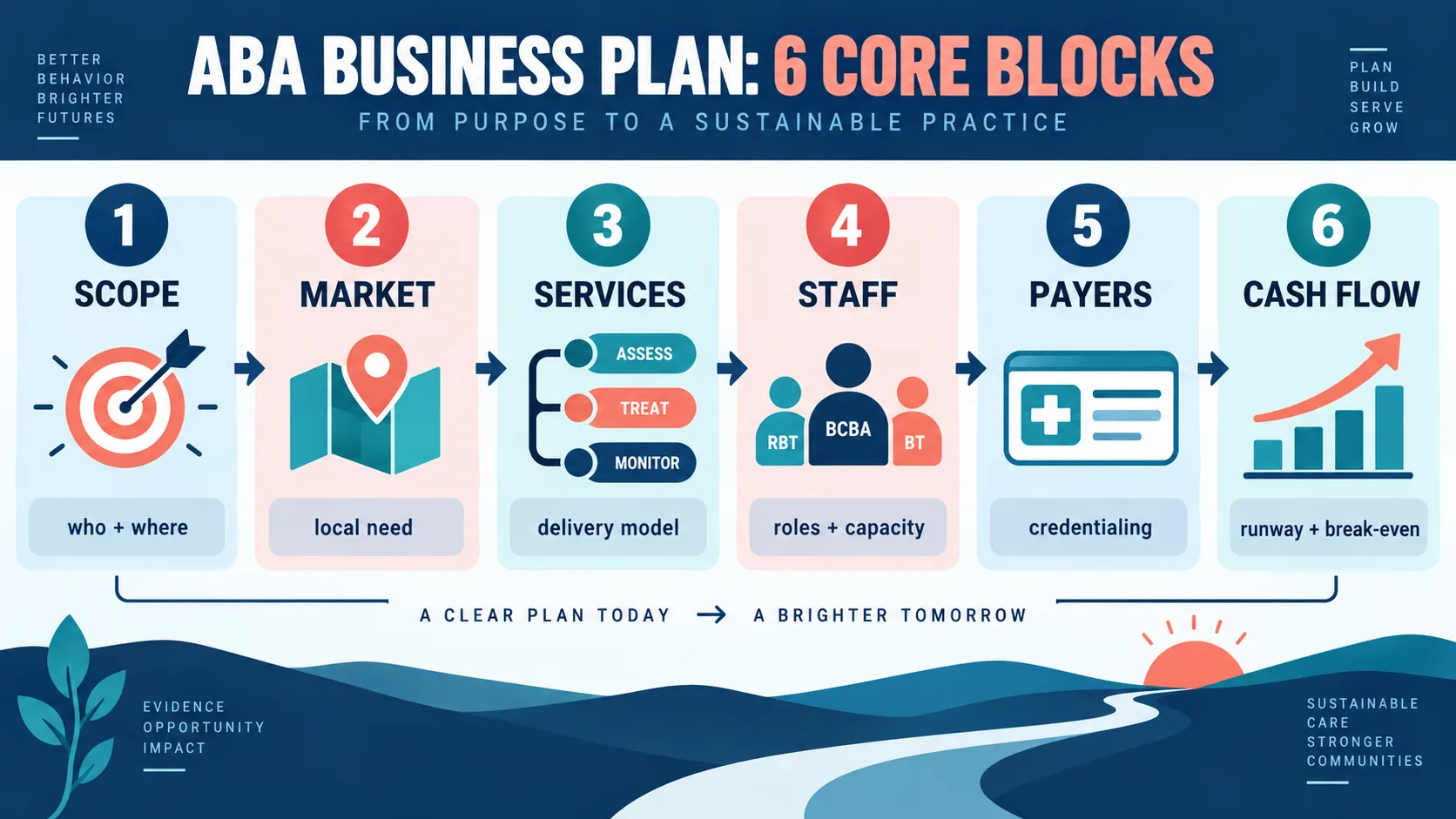
Use the following six blocks as the backbone of your ABA practice business plan. Each block should contain an assumption, the evidence you have, the owner of the decision, and the next verification date. This turns the document into a control panel instead of a one-time pitch.
| Plan block | What to write | Evidence to collect |
|---|---|---|
| 1. Scope | Population, settings, service boundaries, referral-in and referral-out rules, and the clinical problem you intend to solve. | Certification, license, permit, insurance, competency, and supervision requirements that apply to your location and model. |
| 2. Market | A narrow description of local demand, referral sources, payer mix, competitors, access gaps, and the families you can actually reach. | Local referral conversations, payer directories, wait-list signals, competitor service pages, and a documented reason your offer is different. |
| 3. Services | The service model, intake criteria, assessment path, treatment planning, caregiver involvement, review cadence, and discharge or referral-out path. | Sample workflows, consent and documentation requirements, expected authorization steps, and a clear description of what is not offered. |
| 4. Staff | Roles, qualifications, supervision capacity, hiring order, onboarding, competency checks, coverage, and a caseload limit. | Job descriptions, pay assumptions, recruitment channels, supervisor availability, training plan, and a safe ratio or capacity rule. |
| 5. Payers | Self-pay, commercial insurance, Medicaid, contracts, credentialing, authorization, claims, denials, and the time between service and payment. | Written payer guidance, credentialing checklist, NPI/CAQH tasks where applicable, rate assumptions, and a claims test plan. |
| 6. Cash flow | Startup costs, monthly fixed and variable costs, payroll timing, reserve target, owner compensation assumptions, and break-even cases. | Quotes, payroll estimates, billing-cycle assumptions, reserve calculation, denial scenario, and an accountant-reviewed model. |
Do not write these blocks as six unrelated essays. Connect them with dependencies. If your plan says “serve 20 clients,” show which payer types, authorizations, clinicians, supervision hours, documentation workflow, and cash reserve make that number possible. If one dependency is unknown, mark it as an open question instead of burying it in optimistic prose.
Build the Payer and Cash-Flow Model Before You Forecast Growth
Many ABA companies look profitable on paper because the plan counts authorized service hours but forgets the timing of credentialing, claims, denials, payroll, cancellations, and unpaid administrative work. Separate the model into three layers:
- Capacity: How many billable and nonbillable hours can each role safely support? Include supervision, treatment planning, caregiver training, meetings, travel, documentation, cancellations, and quality review.
- Revenue: What is the source of the revenue, what must happen before it can be billed, what is the expected allowed amount, and how long can payment take? Use conservative cases instead of one blended rate.
- Cash: What must be paid before revenue arrives? Include payroll, rent or travel, software, insurance, credentialing, professional services, taxes, equipment, refunds, and a reserve for denials or delayed claims.
A simple scenario table is more useful than a single “year one revenue” number:
| Scenario | Assumption to stress-test | Decision it supports |
|---|---|---|
| Conservative | Slower credentialing, partial caseload, cancellations, delayed claims, and higher support costs. | How much reserve is required and when hiring must pause. |
| Base case | Evidence-backed referral volume, realistic ramp, normal payer timing, and the planned staffing sequence. | What must be true for the operating plan to work without overextending capacity. |
| Expansion | More referrals, additional staff, more settings, or another payer only after quality and billing controls hold. | Which measurable gate must be met before growth is safe. |
Credentialing and payer assumptions need their own evidence trail. A startup checklist from Raven Health, for example, organizes the path from credentialing to billing, staffing, and compliance. An ABA credentialing roadmap from ABA Practice Services discusses NPI, CAQH, payer applications, and timing. Those resources are useful research inputs, but they do not replace the payer’s written rules or the requirements in your jurisdiction. Put the source and the date beside each assumption in your working plan.
For the provider-identity portion of the plan, start with the CMS National Provider Identifier guidance and the CAQH provider information. For certification boundaries, use the current BACB handbook. These links do not tell you what your specific payer or state will approve; they show which authority owns each part of the question.
Use a 90-Day Validation Sequence
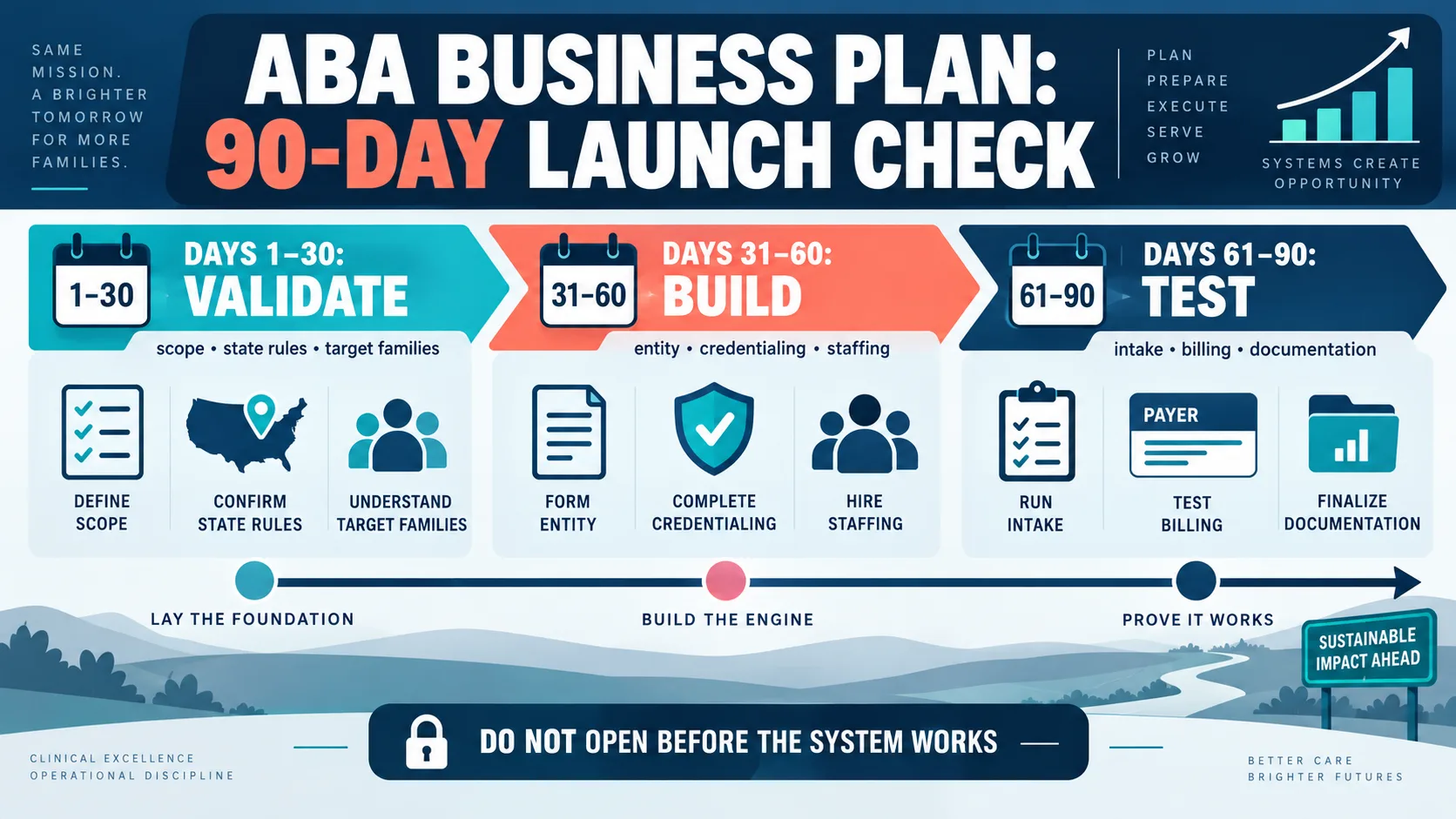
A 90-day sequence is a planning device, not a promise that every ABA practice can open in 90 days. The longest dependency—often licensing, credentialing, contracting, staffing, or a facility requirement—may extend the schedule. The point is to validate the plan in an order that prevents expensive rework.
| Window | Validation work | Exit evidence |
|---|---|---|
| Days 1–30: Validate | Confirm service scope, state and payer questions, target families, referral channels, competitor gaps, and the conservative cash model. | A written scope statement, open-question log, documented demand signals, and a reserve estimate reviewed by the right professionals. |
| Days 31–60: Build | Form the appropriate business structure with advice, begin credentialing and contracting work, draft hiring and supervision systems, and choose only the tools needed for the first workflow. | A dependency tracker, role/capacity plan, payer checklist, privacy and documentation workflow, and a named owner for each open task. |
| Days 61–90: Test | Run a mock intake, authorization check, schedule, note review, supervision record, claim workflow, denial response, and incident escalation exercise. | A completed test case, documented defects, corrected workflow, and a go/no-go decision tied to evidence. |
The setup guide on this site covers the wider clinical, operational, privacy, supervision, and billing checklist. Use that resource when you move from planning into implementation. Keep this business-plan page focused on the decisions, assumptions, evidence, and gates that determine whether the implementation plan is viable.
A One-Page Working Template
If a full plan feels overwhelming, start with one page and expand only where a decision needs evidence. Use these headings:
- Practice thesis: “We will provide [service] to [population] in [setting/geography] because [documented need].”
- Scope boundary: What is in scope, what requires referral, and what depends on a license, payer, credential, or supervisor?
- First-client pathway: How does a referral move from inquiry to consent, assessment, authorization, treatment, review, and discharge?
- Capacity rule: How many cases can each role support while protecting supervision, documentation, and clinical quality?
- Revenue and cash: What pays the practice, when can it be billed, when might it be paid, and how much reserve covers the gap?
- 90-day gates: Which evidence must exist before the next commitment, hire, lease, payer application, or expansion step?
For each line, add four small fields: assumption, source/evidence, owner, and review date. That structure makes the plan maintainable when a payer changes its portal, a state rule changes, a hire falls through, or referral volume differs from the forecast.
Common ABA Business-Plan Mistakes
- Starting with volume: A target caseload is not a capacity plan. Model supervision, documentation, cancellations, and clinical review.
- Using one reimbursement number: Rates, authorization rules, payer mix, and payment timing vary. Use scenarios and label every assumption.
- Confusing certification with authority: A BCBA credential does not automatically settle state licensure, entity, payer, facility, or employment requirements.
- Buying software before mapping the workflow: Tools should support a tested intake-to-payment and record-protection process, not replace it.
- Ignoring the reserve: Credentialing, contracting, claims, denials, and payroll can create a long gap between effort and cash.
- Writing a plan once: Make it a monthly operating document with evidence, owners, dates, risks, and decisions—not a static PDF that no one updates.
Choose the Next Practical Step
If you are still deciding whether to launch, first complete the scope statement, conservative cash model, and dependency tracker. Then review the ABA practice setup checklist to translate the plan into clinical, operational, privacy, supervision, and billing controls. If your business plan is part of a personal BCBA certification plan, you can also use the Free BCBA Mock Exam as a separate study checkpoint. It is not a business viability test, an official BACB result, or a guarantee of certification.
Frequently Asked Questions
What should an ABA company business plan include?: Include scope, target market, services, staffing and supervision capacity, payer and credentialing dependencies, operations, risk controls, startup and monthly costs, cash-flow scenarios, and measurable launch gates. The plan should show how those parts depend on one another.
Is an ABA company business plan the same as a startup checklist?: No. A startup checklist lists tasks. A business plan explains the service model, evidence, stress-tested numbers, and conditions required before proceeding. Use the checklist as implementation support.
How much money does it take to start an ABA practice?: There is no universal number. It depends on the state, entity, setting, payer mix, staffing model, equipment, insurance, credentialing, billing, rent or travel, and the reserve needed while claims are delayed. Build a local conservative model and have the legal, tax, insurance, and financial assumptions reviewed by qualified professionals.
Should a BCBA start with a clinic or a smaller practice?: That is a model and risk decision, not a universal recommendation. Compare the scope, demand, capital, staffing, supervision, facility, payer, and compliance requirements for each option. A smaller model may reduce some fixed commitments, but it still needs safe clinical and administrative systems.
Can a 90-day plan guarantee that an ABA practice will open?: No. Ninety days is a validation sequence in this guide, not a guaranteed opening date. Credentialing, licensing, contracting, hiring, construction, and local requirements may take longer. Set the launch date after the longest dependency has evidence and the test workflow works.
Bottom line: The strongest ABA company business plan is a living decision system. Define the service boundary, validate demand, model payer and cash timing, build staffing and supervision capacity, test the first-client workflow, and expand only when the evidence supports the next commitment.
Quick Review Checklist
Use this final checklist to turn aba company business plan into exam-ready reasoning. The goal is not to memorize a label in isolation; it is to identify the relevant evidence and explain why the best answer fits the scenario. Key ideas to review:
- State the central definition or decision point for aba company business plan in your own words.
- Identify the detail that makes aba company business plan different from its closest related ABA term.
- Separate the observable facts in a scenario from assumptions that are not supported by the facts.
- Write one example and one nonexample so you can recognize the concept in a new setting.
Exam application checks:
- Ask what the question is actually requesting before comparing the answer choices.
- Mark the antecedent, response, consequence, or other evidence that supports the selected answer.
- Look for a distractor that describes a related process but does not answer the specific question.
Final self-check:
- Explain how you would verify the interpretation with clear observations or data.
- Change one detail in the scenario and decide whether your answer should change.
- Give a one-sentence rationale that a supervisor or study partner could evaluate.
Take the Free BCBA Mock Exam
When you are ready to apply the idea, use the free practice resource below for additional feedback. Take the Free BCBA Mock Exam



