

What is Antecedent Manipulation? A Core Proactive Strategy
Antecedent manipulation refers to altering environmental conditions or stimuli that occur before a behavior to influence its likelihood. This proactive approach focuses on prevention rather than reaction, making it a cornerstone of ethical and effective applied behavior analysis practice.
Table of Contents
- What is Antecedent Manipulation? A Core Proactive Strategy
- Applied Examples of Antecedent Manipulation
- Antecedent Manipulation on the BCBA Exam
- Quick-Reference Checklist for Implementation
- Summary and Key Takeaways
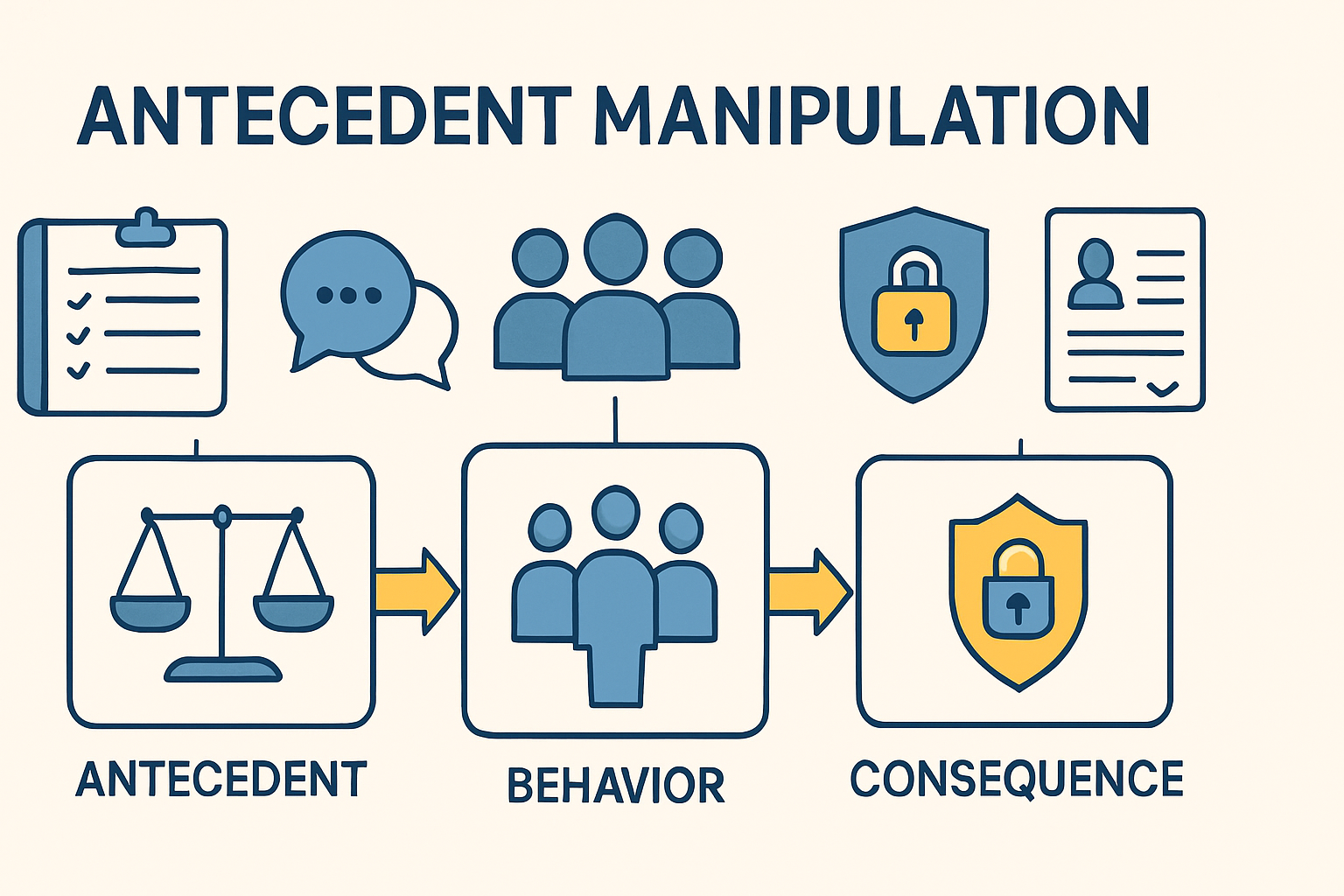
Unlike consequence-based interventions that respond to behavior after it occurs, antecedent strategies work by modifying the three-term contingency at its starting point. This approach aligns with the principle that prevention is often more efficient and less intrusive than remediation.
Definition and Key Characteristics
Antecedent manipulation involves systematically changing environmental variables that precede target behaviors. These changes can include presenting or removing discriminative stimuli, altering motivating operations, or modifying setting events that establish the context for behavior.
- Presenting SDs: Adding discriminative stimuli that signal reinforcement availability
- Altering MOs: Changing establishing or abolishing operations to affect reinforcer value
- Modifying setting events: Adjusting contextual factors like physical environment or routines
- Removing triggers: Eliminating stimuli that typically evoke problem behavior
Antecedent vs. Consequence: The Critical Distinction
Understanding the difference between antecedent and consequence interventions is essential for both clinical practice and exam success. Antecedent strategies occur before behavior, while consequence strategies happen after behavior.
This distinction matters because confusing these categories represents a common exam trap. When reviewing intervention options, ask yourself: “Does this change happen before or after the target behavior?” This simple question can help you correctly identify antecedent manipulations.
Applied Examples of Antecedent Manipulation
Real-world applications demonstrate how antecedent strategies work within the ABC framework. Each example shows how modifying environmental conditions can prevent problem behavior or increase desired responses.
Example 1: Reducing Elopement by Modifying the Setting
A child frequently elopes during classroom transitions. The ABC analysis reveals: Antecedent = loud, crowded hallway; Behavior = runs away; Consequence = escape from noise. The hypothesized behavioral function is escape.
The BCBA implements antecedent manipulation by using a visual schedule with transition warnings and having the child leave two minutes early to use a quiet hallway. This modification changes the setting event (crowded hallway) before the elopement occurs.
Example 2: Increasing Task Engagement with an EO
A client rarely initiates puzzle play during free time. Assessment shows: Antecedent = puzzles always available and assembled; Behavior = no initiation; Consequence = no engagement. The function appears to be access to completion.
The intervention involves keeping one puzzle piece separate (creating an establishing operation for completion). This manipulation increases the value of puzzle completion, making initiation more likely before the behavior occurs.
Example 3: Preventing Aggression by Altering Antecedent Stimuli
During shared tablet time, a student becomes aggressive. The ABC pattern: Antecedent = non-preferred game loaded; Behavior = hitting peer; Consequence = adult attention and game change. The function is access to preferred activity.
The antecedent manipulation uses a choice board allowing game selection before starting. This eliminates the trigger (non-preferred game) and provides control over the antecedent condition, preventing aggression before it occurs.
Antecedent Manipulation on the BCBA Exam
Understanding how antecedent strategies appear on the BCBA exam is crucial for success. These concepts connect directly to Task List items and appear in various question formats that test both knowledge and application.
Linking to the Task List and Common Question Stems
Antecedent manipulation relates to several BACB Task List items, particularly in Domain B (Concepts and Principles). Key areas include B-10 (defining and providing examples of stimulus control) and B-12 (defining and providing examples of motivating operations).
Common exam questions might ask: “Which intervention represents an antecedent strategy?” or “The BCBA decides to manipulate the MO to increase task completion. This is an example of…” These questions test your ability to distinguish proactive interventions from reactive ones.
Common Exam Traps and How to Avoid Them
Several predictable traps can derail exam performance on antecedent manipulation questions. Being aware of these patterns helps you navigate tricky scenarios more effectively.
- Consequence confusion: Selecting reinforcement or punishment when asked for antecedent strategies
- EO/AO mix-up: Confusing establishing operations with abolishing operations
- Setting event oversight: Missing subtle environmental factors that function as antecedents
- Timing errors: Failing to recognize that the intervention occurs after behavior has started
To avoid these traps, use a mental checklist: 1) Does the intervention occur before behavior? 2) Does it change environmental conditions? 3) Does it affect the likelihood of behavior occurring?

Quick-Reference Checklist for Implementation
This practical checklist helps you evaluate whether an intervention qualifies as antecedent manipulation and guides implementation decisions in clinical practice.
- Identify target behavior and its typical antecedents through functional behavior assessment
- Analyze three-term contingency to pinpoint where changes can occur
- Select appropriate manipulation based on behavioral function and environmental factors
- Modify SDs, MOs, or setting events before behavior occurs
- Monitor effectiveness through ongoing data collection and analysis
- Adjust as needed based on behavioral response and environmental changes
Summary and Key Takeaways
Antecedent manipulation represents a proactive approach to behavior change that emphasizes prevention over reaction. By modifying environmental conditions before behavior occurs, practitioners can reduce problem behaviors and increase desired responses more efficiently.
Key points to remember include the distinction between antecedent and consequence strategies, the importance of functional assessment in selecting appropriate manipulations, and the various types of environmental changes that qualify as antecedent interventions. For comprehensive exam preparation, review related concepts like motivating operations and discriminative stimuli.
When studying for the BCBA exam, practice identifying antecedent manipulations in various scenarios and distinguish them from consequence-based interventions. This skill not only helps with exam questions but also enhances your clinical decision-making in real-world practice. For additional authoritative information, consult the BACB website and peer-reviewed journals on applied behavior analysis.


