What is an Alternating Treatment Design?
An Alternating Treatment Design (ATD) is a single-subject experimental design used to compare the effects of two or more independent variables on a single dependent variable. This design allows practitioners to rapidly evaluate which intervention produces better outcomes without requiring an extended baseline phase.
Table of Contents
- What is an Alternating Treatment Design?
- Applying the ATD: Worked ABA Examples
- Alternating Treatment Design on the BCBA® Exam
- ATD Quick-Reference Checklist
- Summary and Key Takeaways
- References
The core purpose is to make direct, within-subject comparisons between different treatment approaches. This makes it particularly useful when you need to determine which of several potential interventions will be most effective for a specific client.
Core Definition and Purpose
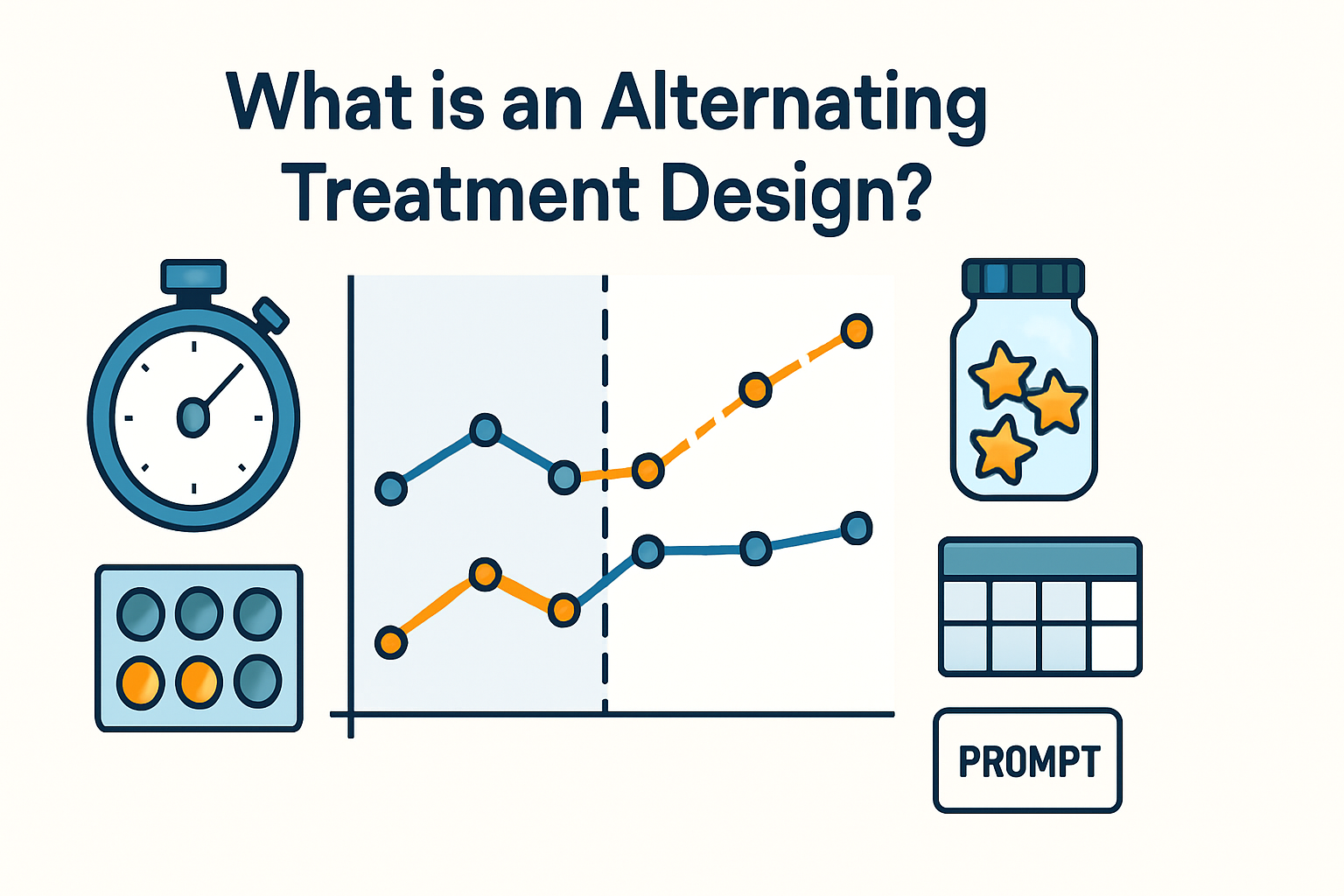
The Alternating Treatment Design formally involves the rapid alternation of two or more conditions to compare their effects. Each condition represents a different independent variable, while the same dependent variable is measured across all conditions. This approach is especially valuable when you need to identify the most effective intervention quickly.
The design’s primary strength lies in its ability to demonstrate experimental control through the differential effects of the alternating conditions. When one condition consistently produces better results than another, you can confidently attribute those differences to the specific interventions being compared.
Key Characteristics and Logic
Several distinctive features define the ATD and differentiate it from other single-subject designs:
- Rapid alternation of conditions, often within the same session or across consecutive sessions
- Counterbalancing of condition order to control for sequence effects and carryover
- Absence of a traditional baseline phase, though baseline data may be collected concurrently
- Clear separation of data paths for each condition on the graph
- Within-subject comparison that controls for individual differences
Applying the ATD: Worked ABA Examples
Understanding how to implement an Alternating Treatment Design requires seeing it in action. These practical examples demonstrate how ATD can be applied to real-world ABA scenarios.
Example 1: Comparing Prompting Strategies
Scenario: Teaching a 7-year-old child with autism to wash hands independently. The practitioner wants to compare two prompting strategies to determine which leads to faster skill acquisition.
Independent Variable A: Least-to-Most prompting (waiting 5 seconds, then providing minimal verbal prompt, then gestural prompt, then partial physical guidance)
Independent Variable B: Graduated Guidance (immediate physical guidance that fades as the child demonstrates correct movements)
Dependent Variable: Percentage of handwashing steps completed independently per session
The hypothesized function of the target behavior (handwashing difficulty) might be escape from difficult tasks. The ATD would alternate between the two prompting strategies across sessions, with data showing which approach yields higher independent performance. Counterbalancing would ensure that morning sessions don’t always use one strategy.
Example 2: Evaluating Reinforcement Schedules
Scenario: Increasing on-task behavior for a student during independent work time. The BCBA wants to compare two token reinforcement schedules.
Independent Variable A: Fixed Ratio 2 (FR2) token reinforcement – student earns a token after every 2 minutes of on-task behavior
Independent Variable B: Variable Ratio 3 (VR3) token reinforcement – student earns tokens on average every 3 minutes of on-task behavior
Dependent Variable: Minutes of on-task behavior per 20-minute session
The behavior’s function could involve either automatic reinforcement from task completion or socially-mediated reinforcement from teacher attention. The ATD would alternate reinforcement schedules across days, with data revealing which schedule maintains higher levels of on-task behavior. This comparison helps identify the most efficient reinforcement strategy for this specific student.
Alternating Treatment Design on the BCBA® Exam
The Alternating Treatment Design frequently appears on the BCBA exam, often testing your ability to identify appropriate design selection and interpret results correctly. Understanding common exam traps is crucial for success.
Common Exam Traps and How to Avoid Them
Several recurring pitfalls can trip up even well-prepared candidates:
- Confusing ATD with Multi-Element Design: While similar, ATD specifically compares interventions, while MED often compares conditions (like presence/absence of a specific antecedent)
- Forgetting counterbalancing requirements: Exam questions often test whether you recognize the need to control for sequence effects
- Misidentifying baseline presence: ATD typically doesn’t have a traditional baseline phase, though it may include baseline data collection
- Over-interpreting small differences: The exam expects you to recognize when data paths aren’t clearly differentiated
- Missing within-subject comparison: Remember that ATD compares conditions within the same individual, not between individuals

Practice Exam-Style Prompts
Consider these scenario-based questions to test your understanding:
A BCBA wants to compare the effects of two different antecedent interventions on elopement behavior. She implements visual schedules on Monday, Wednesday, and Friday, and uses transition warnings on Tuesday and Thursday. What experimental design is she using?
When examining an ATD graph showing two data paths that frequently cross and show similar levels of responding, what conclusion should you draw about the compared interventions?
If a practitioner alternates between DRA and DRO interventions but always implements DRA in morning sessions and DRO in afternoon sessions, what methodological concern exists?
ATD Quick-Reference Checklist
Use this actionable checklist for both implementing an ATD and answering exam questions correctly:
- Identify the comparison: Are you comparing two or more interventions/conditions?
- Check for rapid alternation: Conditions should alternate quickly (within or across sessions)
- Verify counterbalancing: Ensure condition order is randomized or systematically varied
- Examine data separation: Look for clear, non-overlapping data paths on the graph
- Confirm single DV: The same dependent variable must be measured across all conditions
- Assess experimental control: Determine if differential effects are clearly demonstrated
- Consider sequence effects: Watch for carryover or order effects that could confound results
- Evaluate practical significance: Beyond statistical differences, consider clinical importance
Summary and Key Takeaways
The Alternating Treatment Design is a powerful tool for comparing interventions within single-subject research. Its rapid alternation of conditions allows for efficient evaluation of treatment effectiveness without extended baselines.
Key points to remember include the importance of counterbalancing to control for sequence effects, the clear separation of data paths needed to demonstrate experimental control, and the design’s specific application for within-subject comparisons. For BCBA exam preparation, focus on distinguishing ATD from similar designs like the Multi-Element Design and recognizing when baseline data collection might still occur within an ATD framework.
Mastering this design requires both conceptual understanding and practical application skills. Practice interpreting ATD graphs and designing hypothetical studies to solidify your knowledge. For more information on single-subject designs, visit our guide on single-subject experimental designs and learn about independent and dependent variables in ABA research.
References
Complete BCBA Exam Prep
Turn this topic into exam-day practice
Practice concepts in context with five full-length 6th Edition mock exams, two bonus practice exams, a 6th Edition study guide, and key-term flashcards—all in one $120 USD package.
Get the $120 All-in-One Prep Pack
Review everything included on the product page before ordering. No pass guarantee is implied.