
If you searched for the BACB fieldwork checklist and tip sheet, you are probably trying to turn a long fieldwork process into a repeatable control system. The current BACB checklist is useful for that purpose, but it is not a substitute for the current handbook, your supervision contract, or the required verification forms. Use the checklist to confirm that each stage is planned, documented, reviewed, and stored.
Table of Contents
- In This Guide
- What the BACB Fieldwork Checklist and Tip Sheet Is For
- What to Check Before, During, and After Fieldwork
- How the Checklist Connects to Fieldwork Records
- A Practical Monthly Review Method
- How to Handle the 2022-to-2027 Transition
- Common BACB Fieldwork Checklist Mistakes
- Frequently Asked Questions
- Quick Review Checklist
- Take the Free BCBA Mock Exam
The official checklist and tip sheet was updated in June 2026. Because BACB requirements can depend on the requirement edition that applies to your application, always compare your copy with the current BACB BCBA fieldwork resources before you begin or change a fieldwork plan.
In This Guide
What the BACB Fieldwork Checklist and Tip Sheet Is For
The checklist is a planning and quality-control aid for supervised fieldwork. It helps you ask whether the basic conditions are in place, whether the hours and activities are being recorded in a usable way, and whether the documents will still make sense when a supervisory relationship or fieldwork period ends. It does not independently approve a supervisor, decide whether a specific activity qualifies, or replace a form that BACB currently requires.
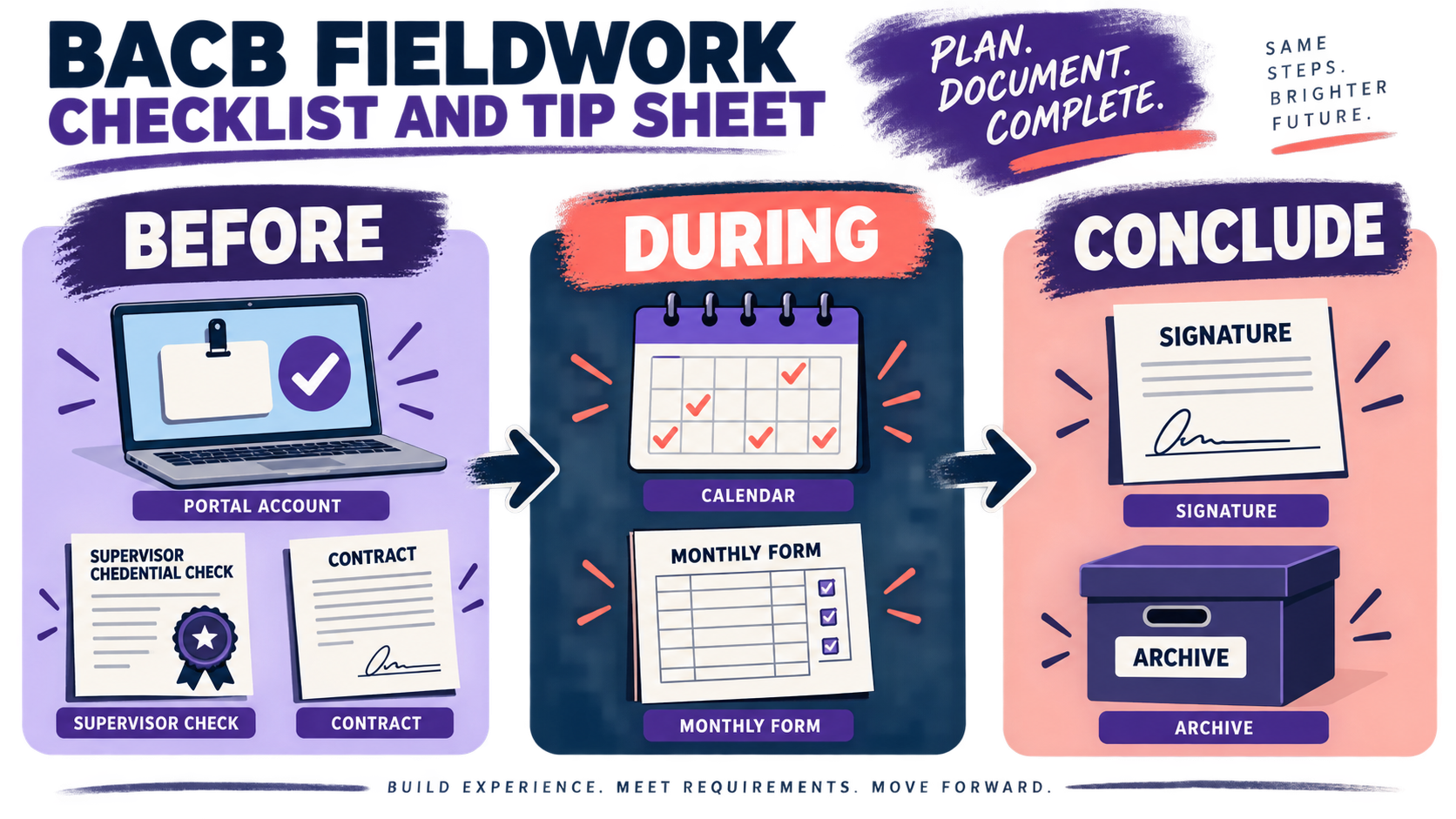
| Stage | Main question | Evidence to keep |
|---|---|---|
| Before fieldwork | Can this plan start under the applicable requirements? | Portal account, course timing, supervisor check, contract, and storage plan |
| During fieldwork | Can each supervisory period be reconstructed and reviewed? | Activity records, hours, supervision notes, monthly verification, and signatures |
| Concluding or changing arrangements | Do the totals and signatures close cleanly? | Final verification, contract amendments, reconciliation notes, and secure archive |
A helpful way to read the checklist is as a sequence of decisions rather than a form to complete once. If a supervisor changes, an organization changes, or a requirement edition changes, revisit the relevant decision and save the reason for your choice.
What to Check Before, During, and After Fieldwork
The checklist’s strongest value is its timing. A problem found before hours accumulate is usually easier to correct than a problem discovered when an application is almost ready.
Before you start: First, make sure you can access the BACB portal with a stable personal email address. Then identify the coursework or other eligibility step that allows fieldwork to begin under your applicable pathway. The current checklist also directs candidates to verify the supervisor’s status and qualifications in the BACB Certificant Registry, and to confirm that the supervision relationship is direct and appropriately structured.
Next, complete a supervision contract for each fieldwork arrangement. Do not rely on a verbal agreement or a generic school document that does not describe the actual relationship. If multiple supervisors work within one organization, determine how the arrangement will be represented and who must review or sign the documentation. Finally, decide where records will live. A personal, secure, backed-up system is safer than leaving the only copy on a work computer that you may lose access to.
During fieldwork: Plan the monthly range before you begin counting hours. The current checklist includes 2027 planning tables and identifies a monthly minimum of 20 hours and a monthly maximum of 160 hours for the fieldwork options shown there. The total-hour target and the maximum time to complete it also depend on the pathway and requirement edition. Treat those numbers as a planning reference, not as permission to classify every available work activity as fieldwork.
Keep a running record of dates, hours, activity categories, supervision contacts, and the evidence that supports each entry. Review whether your activities reflect the required mix instead of waiting until the end of the month to discover that every entry looks alike. Discuss ambiguous activities with your supervisor while the context is still available. The checklist is much more useful when it triggers a conversation than when it becomes a stack of unchecked boxes.
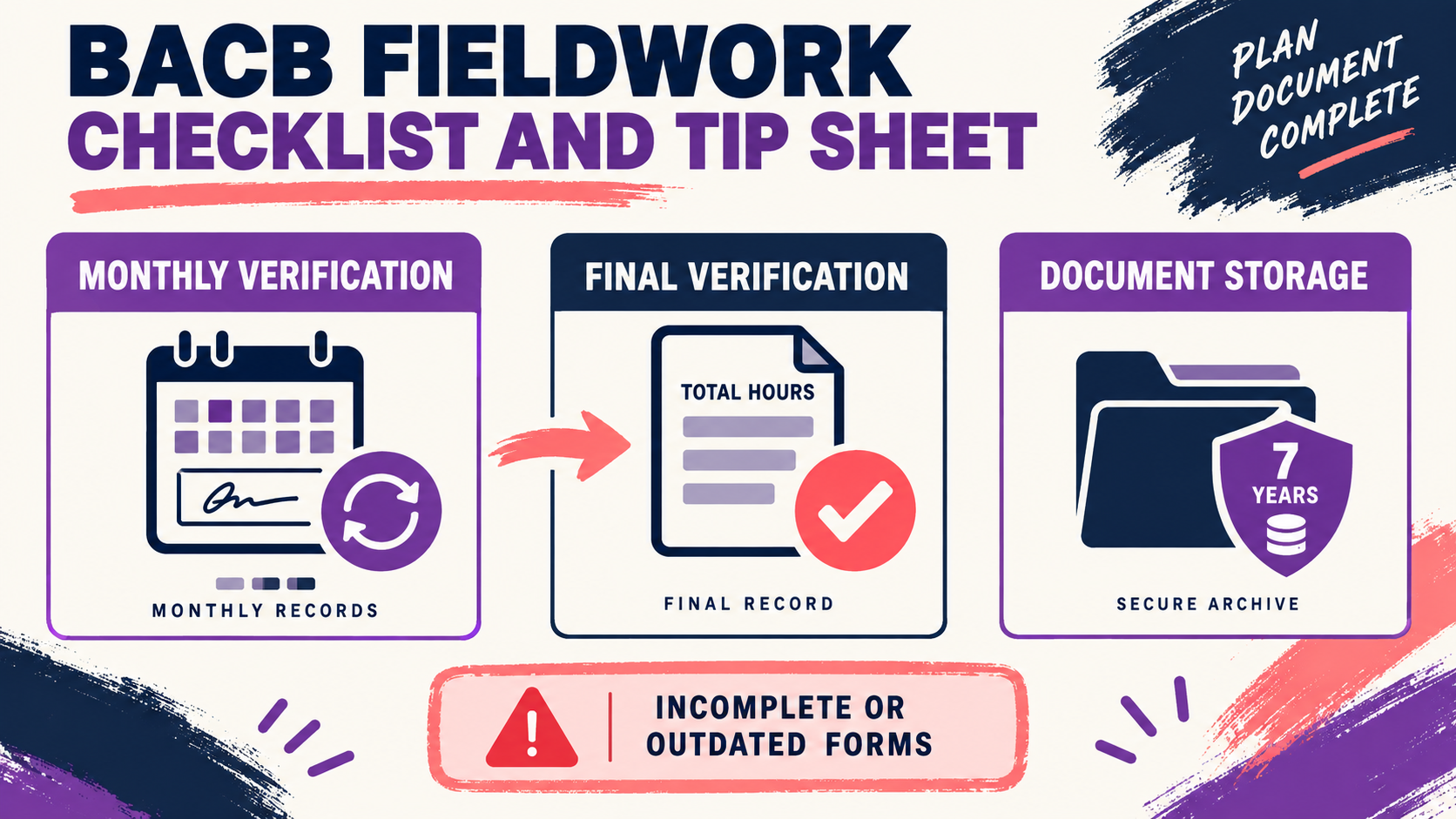
When a period or relationship ends: Close the period promptly. Check that names, BACB IDs, dates, hours, and signatures match the accounts and records used elsewhere. The current guidance emphasizes completing the applicable Monthly Fieldwork Verification Form for each supervisory period and the applicable Final Fieldwork Verification Form when the relationship or fieldwork arrangement concludes. A supporting tracker can help you prepare, but it does not automatically replace the official verification document.
How the Checklist Connects to Fieldwork Records
The word “checklist” can create confusion because several documents may sit beside one another. A clean system gives each document a different job. The BACB documentation FAQ explains the shared responsibility for tracking and reviewing fieldwork; the checklist turns that responsibility into checkpoints.
| Document or tool | What it does | What it cannot do alone |
|---|---|---|
| Fieldwork Checklist and Tip Sheet | Prompts planning, review, documentation, and transition decisions. | It does not approve your individual activity or replace current forms. |
| Supervision contract | Defines the relationship, responsibilities, and arrangement before services begin. | It does not prove that every later hour was correctly documented. |
| Monthly verification | Closes a supervisory period with the required hours and signatures. | It does not repair missing source records or an invalid supervision setup. |
| Final verification | Summarizes the completed arrangement and closes the relationship. | It cannot make a total exceed what the underlying monthly records support. |
| Personal tracker | Makes gaps visible while work is happening. | It is not automatically an official BACB verification form. |
Use the official Documenting Fieldwork Hours resource when you need the BACB’s current explanation of the documentation system. A third-party template may show familiar field labels, but it cannot establish whether the version is accepted for your application.
A Practical Monthly Review Method
Instead of checking the whole file at random, use a short review at the same time every month. The goal is not to create more paperwork; it is to catch a mismatch while it can still be explained.
- Reconcile the calendar. Compare the dates of service, supervision contacts, and recorded hours. Flag any period that appears to overlap another arrangement or exceeds the applicable monthly limit.
- Reconcile the activity record. Scan for enough context to explain what was done, who was involved, and how the activity relates to the fieldwork plan. A number without context is hard to defend later.
- Reconcile the supervision evidence. Confirm that meetings, observations, feedback, and required supervision characteristics are represented in the record. Ask the supervisor about uncertain classifications before signing.
- Reconcile the form. Check the current form version, legal name, BACB ID, dates, totals, and signatures. Do not wait until the final application to discover that a field is blank.
- Reconcile the archive. Save the signed record, related contract or amendment, and any clarification in the same secure folder. Keep a simple index so you can locate one month without opening every file.
For example, imagine a tracker showing 128 hours for a month, but the monthly verification form shows 118 because ten hours were moved to a different category during review. That is not automatically a crisis. It is a reconciliation item: record the reason, make the source notes and verification agree, and preserve the final signed version. The checklist helps you notice the discrepancy; your supervisor and the applicable BACB guidance determine how it should be resolved.
How to Handle the 2022-to-2027 Transition
Search results about the checklist often mix 2022 and 2027 terminology. Do not assume that a document titled “2027” applies simply because it is newer, and do not assume that an older form is wrong simply because it is older. Your application pathway, the date you began accruing fieldwork, and the requirement edition that governs your case matter.
Use the current BACB 2027 requirements page and the current fieldwork resource hub to identify the applicable transition rules. Then label your internal folder with the requirement edition and the form version. If a supervisor changes during the transition, keep the original records, the new contract or amendment, and a short note explaining which form family was used for which period.
The checklist is especially valuable here because it prompts you to check the requirement edition, not just the arithmetic. A spreadsheet can add hours perfectly and still point to the wrong form or an incomplete supervision arrangement.
Common BACB Fieldwork Checklist Mistakes
- Using a downloaded template as the authority. A template host can help you recognize terminology, but the BACB resource hub and handbook control current requirements.
- Checking only the total hours. Hours are one part of the record. Dates, activity categories, supervision, signatures, and the applicable version also matter.
- Waiting for the final form to fix monthly gaps. A final verification summarizes a record; it does not create missing evidence.
- Keeping the only copy at work. Employment changes can remove access to documents. Use a secure personal archive consistent with privacy and workplace rules.
- Treating every checklist box as a one-time task. Revisit the checklist when the supervisor, organization, requirement edition, or fieldwork arrangement changes.
Frequently Asked Questions
Is the checklist the same as the Monthly Fieldwork Verification Form?: No. The checklist is a planning and review aid. The monthly verification form is the document used to close the applicable supervisory period under the current BACB process.
Does the checklist approve my fieldwork activities?: No. It helps you identify questions to discuss with the qualified supervisor and compare your records with the applicable requirements. It cannot turn an otherwise nonqualifying activity into qualifying fieldwork.
How long should I keep the records?: Follow the current BACB instructions and your professional, employer, and privacy obligations. The current checklist instructs candidates to retain fieldwork documentation for at least seven years, so build an archive that can preserve signed records and related agreements for that period.
Can I use a spreadsheet as my fieldwork checklist?: A spreadsheet can be a helpful companion tracker, especially for dates, hours, and missing signatures. It should not be treated as a replacement for the current BACB forms or the official checklist and tip sheet.
Should I prepare for the BCBA exam while organizing fieldwork?: Yes, but keep the tasks separate. Fieldwork documentation protects your eligibility record; exam practice measures your readiness for test questions. After your documentation review is organized, you can use the free BCBA mock exam as a separate practice step. It does not provide supervision, approve hours, or guarantee certification.
The best use of the BACB fieldwork checklist and tip sheet is continuous quality control: verify the setup before starting, review records during each supervisory period, close forms promptly, and archive the evidence securely. Start with the current BACB version, mark the requirement edition that applies to you, and ask your supervisor about any activity or form question before it becomes a final-application problem.
Quick Review Checklist
Use this final checklist to turn bacb fieldwork checklist and tip sheet into exam-ready reasoning. The goal is not to memorize a label in isolation; it is to identify the relevant evidence and explain why the best answer fits the scenario. Key ideas to review:
- State the central definition or decision point for bacb fieldwork checklist and tip sheet in your own words.
- Identify the detail that makes bacb fieldwork checklist and tip sheet different from its closest related ABA term.
- Separate the observable facts in a scenario from assumptions that are not supported by the facts.
- Write one example and one nonexample so you can recognize the concept in a new setting.
Exam application checks:
- Ask what the question is actually requesting before comparing the answer choices.
- Mark the antecedent, response, consequence, or other evidence that supports the selected answer.
- Look for a distractor that describes a related process but does not answer the specific question.
Final self-check:
- Explain how you would verify the interpretation with clear observations or data.
- Change one detail in the scenario and decide whether your answer should change.
- Give a one-sentence rationale that a supervisor or study partner could evaluate.
Take the Free BCBA Mock Exam
If you want a low-pressure way to check your recall, use the free practice resource below. Take the Free BCBA Mock Exam



