
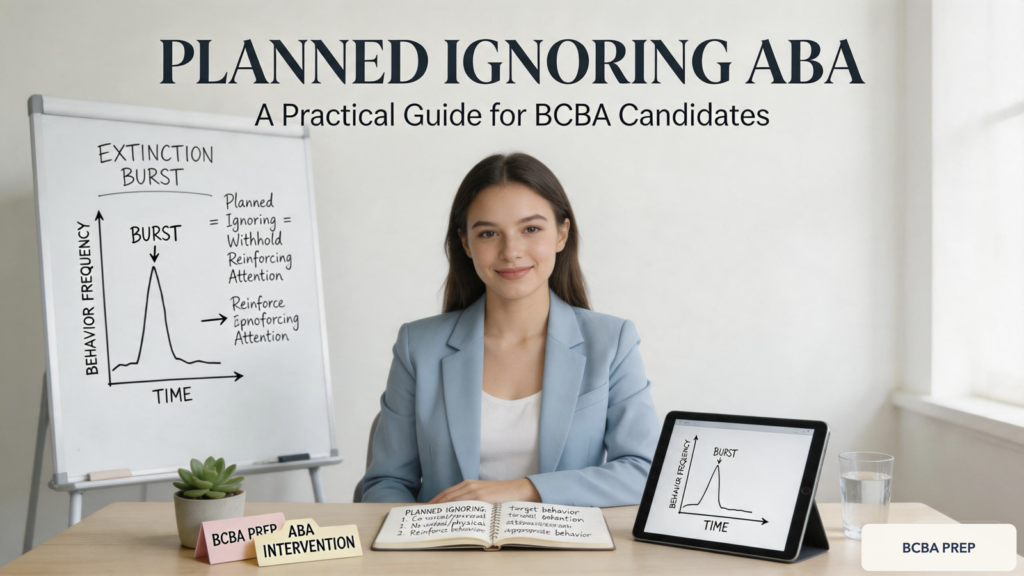
What Is Planned Ignoring in ABA?
Planned ignoring ABA is a behavior reduction procedure that involves withholding social reinforcement—such as eye contact, verbal responses, or physical proximity—contingent on a target behavior. It is a form of extinction specifically designed for behaviors maintained by social attention. Unlike everyday ignoring, planned ignoring is a deliberate, data-driven strategy implemented consistently across all staff and settings.
Table of Contents
- What Is Planned Ignoring in ABA?
- Planned Ignoring Examples with ABC Analysis
- When Is Planned Ignoring Appropriate?
- Exam Relevance: Common Traps and How to Avoid Them
- Quick Reference Checklist for Implementing Planned Ignoring
- Summary: Planned Ignoring as a Behavior Reduction Strategy
Core Definition and Key Components
Planned ignoring is not ignoring the person; it is ignoring the behavior. The key components include:
- Functional assessment confirming attention as the maintaining variable.
- Withholding all forms of social attention (verbal, facial, gestural).
- Consistent implementation by all team members to avoid accidental reinforcement.
- Combined with differential reinforcement of appropriate behavior (e.g., DRA) for ethical and effective outcomes.
How It Differs from Other Extinction Procedures
Extinction procedures are matched to the function of behavior. Escape extinction involves blocking or preventing escape from demands, while sensory extinction masks or alters the sensory consequence of automatically reinforced behavior. Planned ignoring is unique because it targets attention-maintained behavior only. Misapplying it to escape or automatic functions will not reduce the behavior and may inadvertently reinforce it.
Planned Ignoring Examples with ABC Analysis
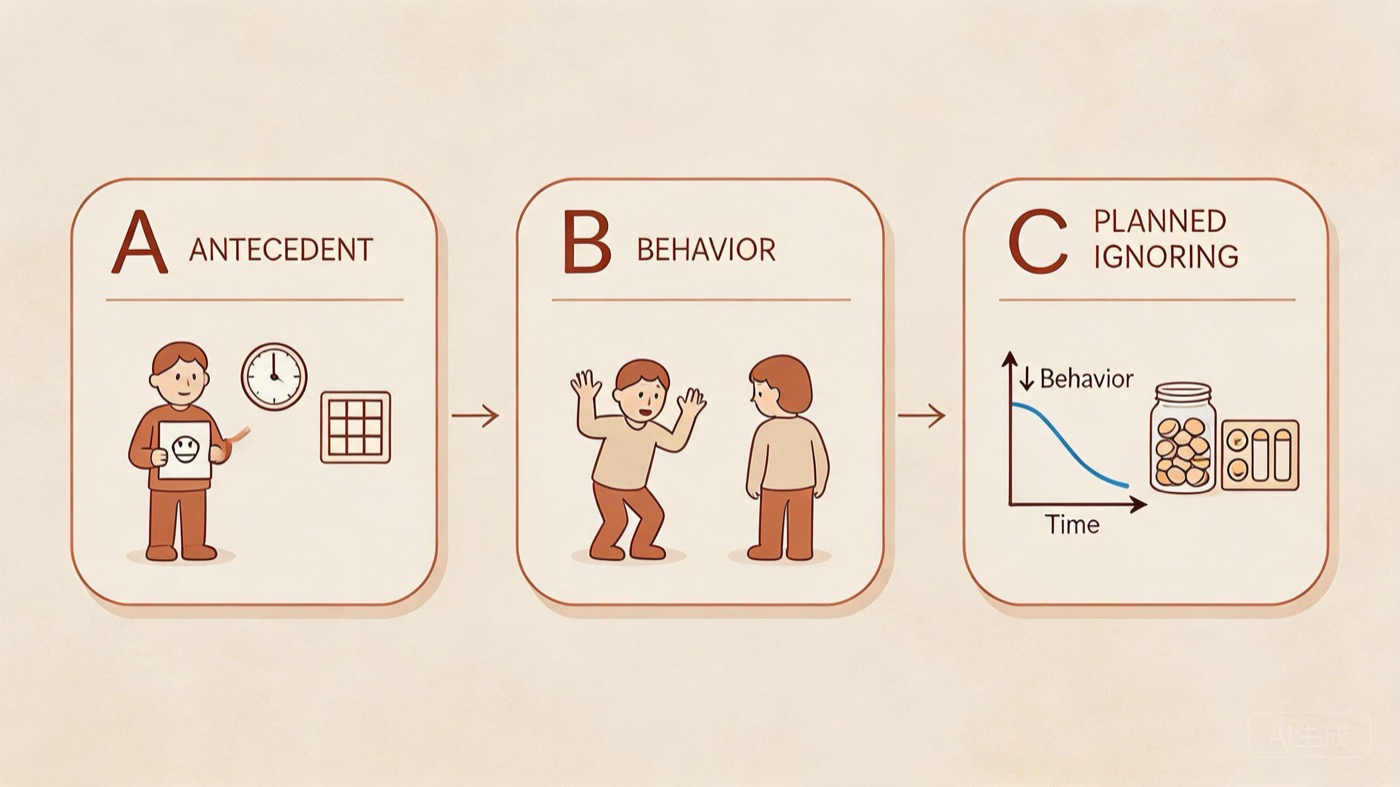
Example 1: Whining for Teacher Attention
- Antecedent: Student is given independent work demand. The teacher is working with another student.
- Behavior: Student whines audibly.
- Consequence: Teacher looks away, does not speak, and does not make eye contact. After 5 seconds of quiet, teacher provides praise for working quietly.
- Outcome: Whining decreases across sessions. Function: attention.
Example 2: Tantrum in a Supermarket
- Antecedent: Child asks for a toy; parent says no.
- Behavior: Child falls to floor, screams, and cries.
- Consequence: Parent turns away, does not talk, and continues walking slowly. After child calms, parent provides neutral instruction (e.g., “Let’s go to the car”).
- Outcome: Tantrum duration shortens over trips. Function: parental attention.
Example 3: Inappropriate Comments in a Group Home
- Antecedent: Staff leading a discussion group. Client makes off-topic, sexually explicit jokes.
- Behavior: Client says joke, looks around for reaction.
- Consequence: Staff and peers do not laugh, do not look at client, and continue the discussion. After 10 seconds of appropriate behavior, staff make eye contact and ask a relevant question.
- Outcome: Inappropriate comments decrease. Function: peer/staff attention.
When Is Planned Ignoring Appropriate?
Functional Assessment Must Confirm Attention-Maintained Behavior
Planned ignoring is ethical only when a functional behavior assessment (FBA) identifies attention as the reinforcer. It is not appropriate for behaviors maintained by automatic reinforcement (e.g., hand-flapping, self-stimulatory behavior) or escape (e.g., task refusal). For dangerous behaviors—such as aggression, self-injury, or property destruction—planned ignoring must never be used because it does not address safety.
Extinction Burst and Spontaneous Recovery
When planned ignoring is first implemented, you may see an extinction burst—a temporary increase in behavior frequency, intensity, or duration. For example, a child who whines may escalate to screaming before the behavior extinguishes. Spontaneous recovery is the reappearance of the behavior after a period of extinction. Both phenomena are common exam questions and require staff training to maintain fidelity.
Exam Relevance: Common Traps and How to Avoid Them
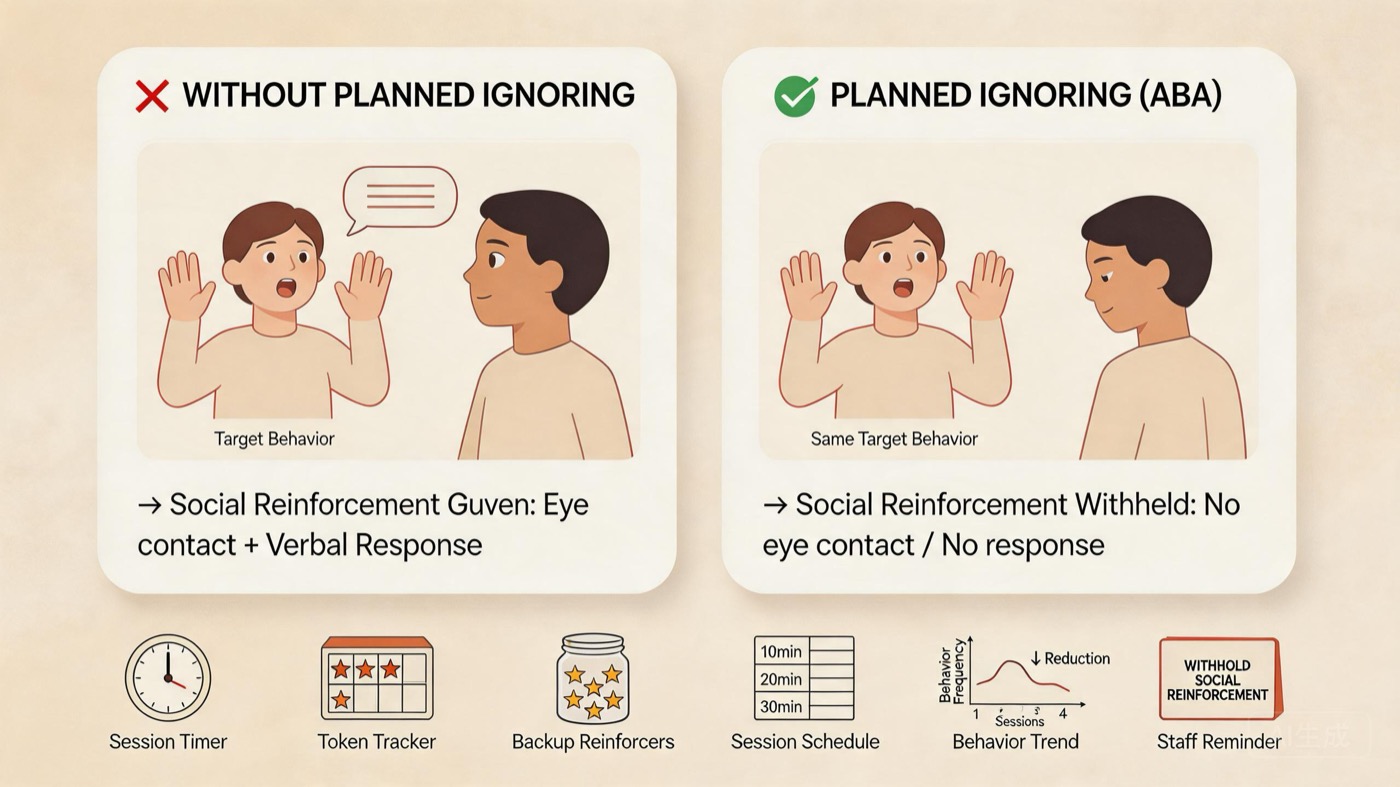
Trap 1: Using Planned Ignoring for Escape-Maintained Behavior
If a behavior is maintained by escape from demands, ignoring it will not reduce the behavior—it may even reinforce avoidance because the task continues to be removed. Differentiate functions: if behavior occurs during demand situations, consider escape extinction instead.
Trap 2: Inconsistent Implementation
The partial reinforcement effect makes intermittently reinforced behaviors harder to extinguish. If staff sometimes attend to the behavior (e.g., a teacher gives a reprimand after ignoring for 10 seconds), the behavior becomes more resistant to extinction. Consistency across all staff and settings is critical.
Trap 3: Ignoring Dangerous Behaviors
Planned ignoring is never appropriate for aggression, self-injury, or property destruction. These behaviors require safety plans and function-based interventions (e.g., functional communication training). On the exam, a scenario with dangerous behavior and planned ignoring as an answer choice is typically wrong.
Trap 4: Failing to Reinforce Alternative Behavior
Planned ignoring alone is often insufficient. Combine it with differential reinforcement (e.g., DRA, DRI) to teach and strengthen an appropriate replacement behavior. This makes the intervention more ethical and durable.
Quick Reference Checklist for Implementing Planned Ignoring
- ☐ Confirm through FBA that the behavior is attention-maintained.
- ☐ Ensure the behavior is not dangerous (no aggression, SIB, or destruction).
- ☐ Train all staff to withhold all attention (eye contact, words, gestures, sighs).
- ☐ Plan for extinction burst and spontaneous recovery; include in staff training.
- ☐ Implement a differential reinforcement procedure for a replacement behavior (e.g., DRA for requesting attention appropriately).
- ☐ Collect data to monitor progress and fidelity of implementation.
- ☐ If no improvement after a reasonable time, reassess function.
Summary: Planned Ignoring as a Behavior Reduction Strategy
Planned ignoring is a powerful extinction-based intervention for attention-maintained behavior. It must be grounded in a functional assessment, implemented consistently, and paired with differential reinforcement of appropriate behavior. Common exam traps include applying it to the wrong function, inconsistent use, and ignoring dangerous behaviors. By mastering these concepts, you will be prepared for BCBA exam questions that present scenarios involving attention-seeking behavior. For additional practice, check out our differential reinforcement guide and take a free BCBA mock exam to test your knowledge. Always refer to the BACB Ethics Code for ethical guidelines.


