
What Is Behaviour Skills Training (BST)?
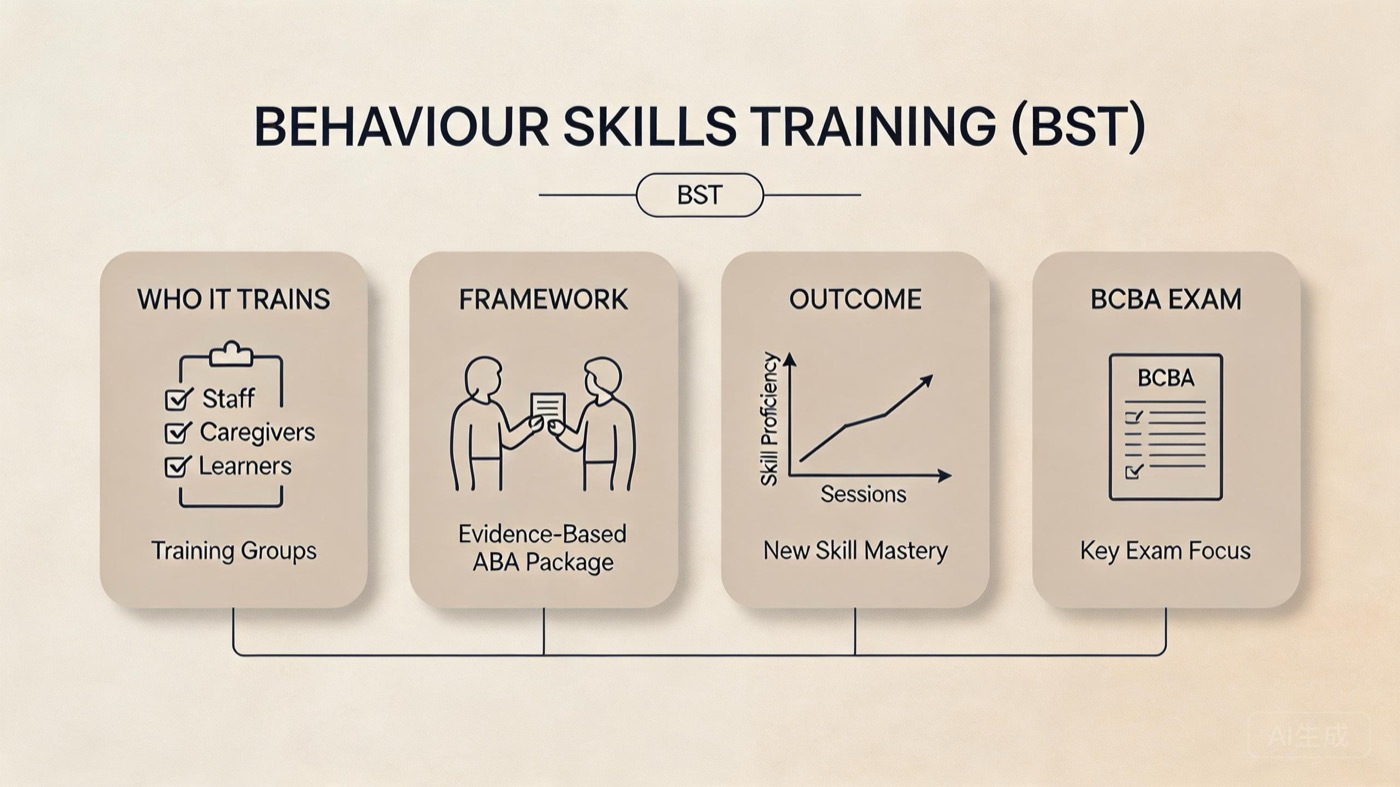
Behaviour skills training is an evidence-based teaching package used to train staff, caregivers, and learners in new skills. For the BCBA exam, understanding BST is essential because it appears in many questions about staff training and skill acquisition. BST is defined as a structured approach that combines four core components to ensure skill mastery.
Table of Contents
- What Is Behaviour Skills Training (BST)?
- Behaviour Skills Training in Action: BCBA Exam Examples
- Exam Relevance: Why BST Appears on the BCBA Test
- Quick Study Checklist for BST
- Summary and Next Steps
The power of behaviour skills training lies in its active teaching model. Unlike passive instruction, BST requires the learner to practice and receive feedback, which increases the likelihood of correct performance in real-world settings.
The Four Steps of BST
- Instruction: The trainer provides a clear, concise description of the target skill and the rationale for using it. Written or verbal instructions set the stage for learning.
- Modeling: The trainer demonstrates the correct performance of the skill while the learner observes. Modeling should be accurate and include examples of what to do and what not to do when relevant.
- Rehearsal: The learner practices the skill in a role-play or simulated setting. Rehearsal is critical because it allows the learner to try the skill before using it in a natural environment.
- Feedback: The trainer provides immediate, specific praise for correct steps and constructive guidance for errors. Feedback should be delivered until the learner meets a predetermined mastery criterion.
Behaviour Skills Training in Action: BCBA Exam Examples
Applying BST to real-world scenarios is a common exam skill. Here are two examples that illustrate how BST is used to teach specific behaviors. Each example includes a hypothesized function to connect BST to functional assessment.
Example 1: Teaching a Parent to Use DRA
A BCBA needs to teach a parent to implement differential reinforcement of alternative behavior (DRA) for a child’s attention-seeking behavior. The hypothesized function of the child’s behavior is attention. The BCBA uses BST as follows:
- Instruction: Explain DRA verbally and provide a written summary. Describe how the parent will ignore the problem behavior and reinforce a replacement behavior (e.g., asking for attention appropriately).
- Modeling: The BCBA demonstrates the procedure with the child, showing how to withhold attention for whining and provide immediate attention when the child says ‘excuse me.’
- Rehearsal: The parent practices with the BCBA acting as the child. The BCBA simulates whining and appropriate requests.
- Feedback: The BCBA praises the parent for waiting 3 seconds before responding and suggests a better phrasing for the praise statement. Practice continues until the parent meets 100% accuracy on a procedural checklist.
Example 2: Training a Classroom Aide on DTT
A classroom aide needs to learn to run discrete trial training (DTT) for a student who engages in escape-maintained behavior. The aide has no prior experience with ABA. The BCBA implements BST:
- Instruction: Provide a one-page DTT task analysis and explain the rationale for errorless teaching.
- Modeling: The BCBA runs three trials with the student, demonstrating correct prompt fading and reinforcement delivery.
- Rehearsal: The aide runs a series of trials while the BCBA observes. The aide practices both the teaching steps and how to respond to escape behaviors (e.g., using a most-to-least prompt hierarchy).
- Feedback: The BCBA provides specific feedback: ‘Great job delivering the prompt immediately. Next time, try to wait 2 seconds before providing the reinforcer.’ The aide continues until achieving 90% correct on three consecutive sessions.
Exam Relevance: Why BST Appears on the BCBA Test
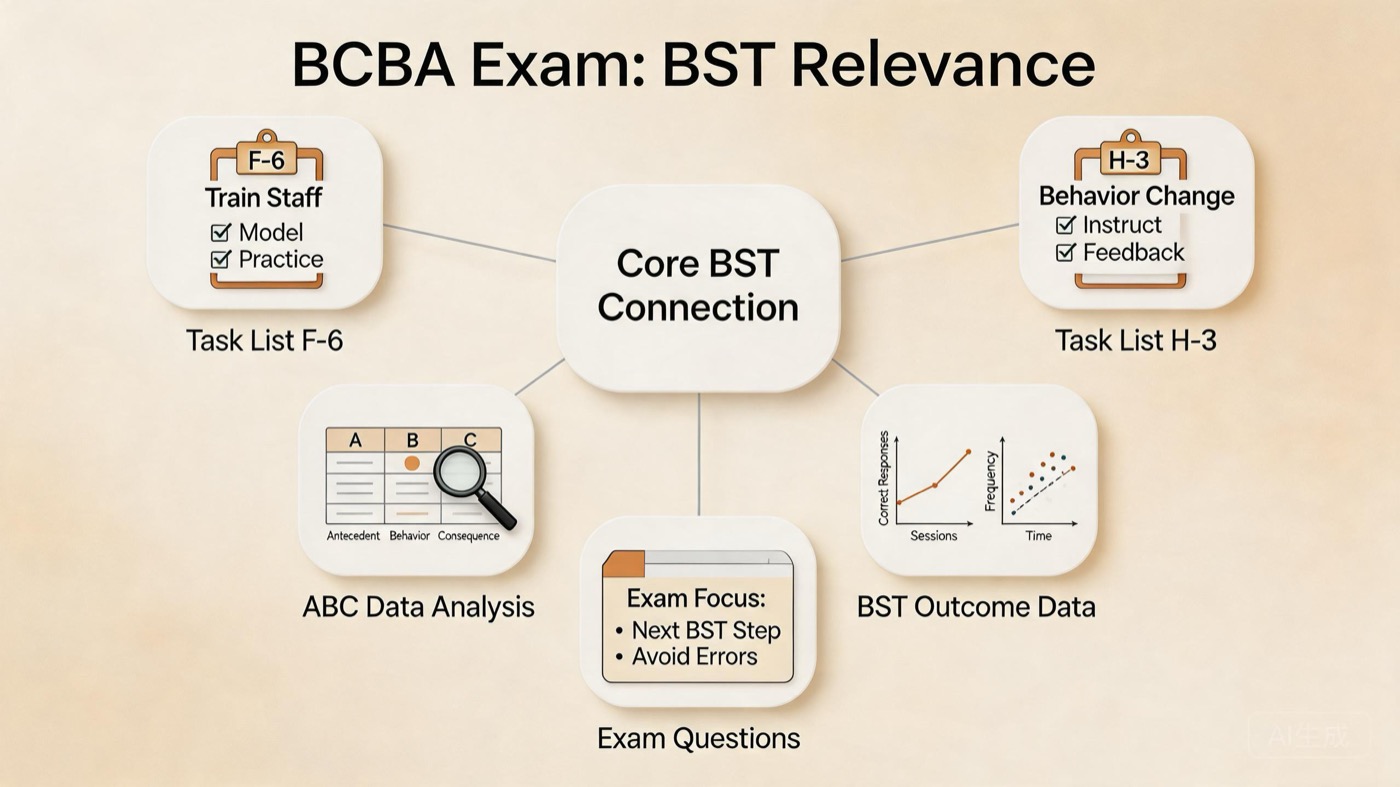
The BCBA task list includes several items directly related to BST, such as training staff (e.g., F-6) and using behavior-change procedures (e.g., H-3). Exam questions often ask you to identify the next step in a BST sequence or describe how to modify feedback for a trainee. You may be given a scenario and asked to choose which component is missing.
Common Exam Traps to Avoid
Knowing common mistakes can save you points. Look out for these pitfalls:
- Confusing BST with modeling alone: BST requires all four steps. An answer that only mentions modeling is incomplete.
- Incomplete feedback: Feedback must be specific, immediate, and include both praise and correction. Vague feedback like ‘good job’ is not enough.
- Missing performance criteria: BST continues until the learner meets a predetermined criterion. Stopping after a fixed number of sessions, regardless of performance, is incorrect.
- Skipping rehearsal: Some questions imply that instruction and modeling are sufficient. Remember that rehearsal is the practice component that ensures active engagement.
Quick Study Checklist for BST
Use this checklist to reinforce your understanding before the exam. Each item is an action you should be able to perform.
- Define BST and its four components from memory.
- Identify the function of behavior in a BST scenario.
- Sequence the steps correctly when given a scrambled list.
- Recognize incomplete BST in a vignette (e.g., missing feedback).
- Specify mastery criterion appropriate to the skill being taught.
- Differentiate BST from other training methods (e.g., behavioral skills training vs. written instruction alone).
Summary and Next Steps
Behaviour skills training is a four-step process (instruction, modeling, rehearsal, feedback) used to teach new skills effectively. On the BCBA exam, you will encounter BST in questions about staff training, parent training, and skill acquisition. Remember to look for the complete package, especially the rehearsal and feedback components. Avoiding common traps and using the checklist will help you answer BST questions with confidence.
To further solidify your knowledge, try our BCBA mock exam practice questions focused on BST. Also, review the BCBA exam prep guide for more study tips. For official standards, visit the BACB website at BACB.



