

What Is Single Subject Design?
In applied behavior analysis, single subject design is a research methodology where each participant serves as their own control. Unlike group designs that compare averages across subjects, single subject designs track individual behavior over time, allowing clinicians to evaluate the effects of an intervention on a single person. This approach is fundamental to ABA and appears frequently on the BCBA exam.
Practice this concept
Table of Contents
- What Is Single Subject Design?
- Common Single Subject Design Types for the BCBA Exam
- ABA Worked Examples: Applying Single Subject Design
- Why Single Subject Design Matters for the BCBA Exam
- Quick Checklist: Single Subject Design Essentials
Key Characteristics of Single Subject Design
Every single subject design shares several core features. Understanding these will help you identify the design used in any scenario.
- Baseline and treatment phases: Behavior is measured repeatedly during baseline (no intervention) and then during the intervention phase. The letter A typically represents baseline, and B represents treatment.
- Repeated measures: Data are collected continuously across phases to detect patterns in level, trend, and variability.
- Intra-subject replication: The effect is demonstrated by replicating the intervention within the same individual (e.g., ABAB design) or across multiple baselines.
Common Single Subject Design Types for the BCBA Exam
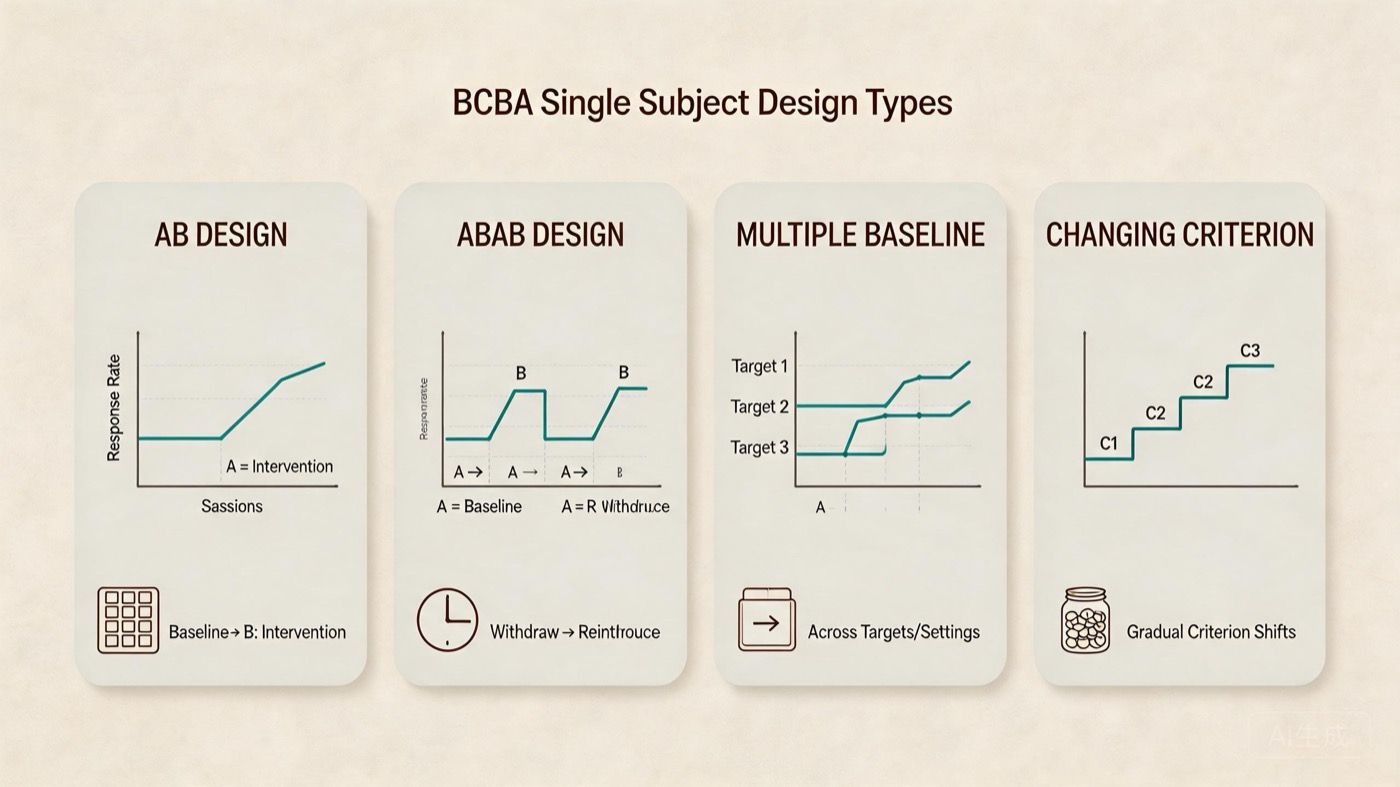
The BCBA exam tests your ability to distinguish between several single subject designs. Each has specific features and appropriate applications. Below are the four most common ones you need to know.
ABAB (Reversal) Design
In an ABAB design, the intervention is introduced, withdrawn, and then reintroduced. For example, a BCBA implements a DRA procedure to reduce self-injurious behavior maintained by escape. The design demonstrates experimental control by showing that behavior improves during B phases and worsens during A phases. Reversal designs are powerful but not appropriate when the behavior cannot be safely reversed (e.g., aggression that might escalate).
Multiple Baseline Design
When reversal is not feasible, a multiple baseline design is used. The intervention is introduced at different times across behaviors, settings, or participants. For instance, teaching mands across three school settings: the intervention is applied to Setting 1 first, then later to Settings 2 and 3. If behavior changes only after the intervention in each setting, experimental control is demonstrated. Multiple baseline designs avoid the ethical concerns of reversal.
Alternating Treatments Design
This design involves rapidly alternating two or more conditions to compare their effects. For example, comparing DRO versus DRI for aggression: each session uses a different treatment, and the order is counterbalanced. The alternating treatments design does not require a baseline withdrawal and is ideal for comparing interventions quickly.
Changing Criterion Design
In this design, the criterion for reinforcement changes stepwise over time. For example, a token economy to increase on-task behavior: the required number of on-task minutes gradually increases from 5 to 10 to 15. The changing criterion design is useful for shaping behaviors that are already in the learner’s repertoire but need to increase in duration, frequency, or accuracy.
ABA Worked Examples: Applying Single Subject Design
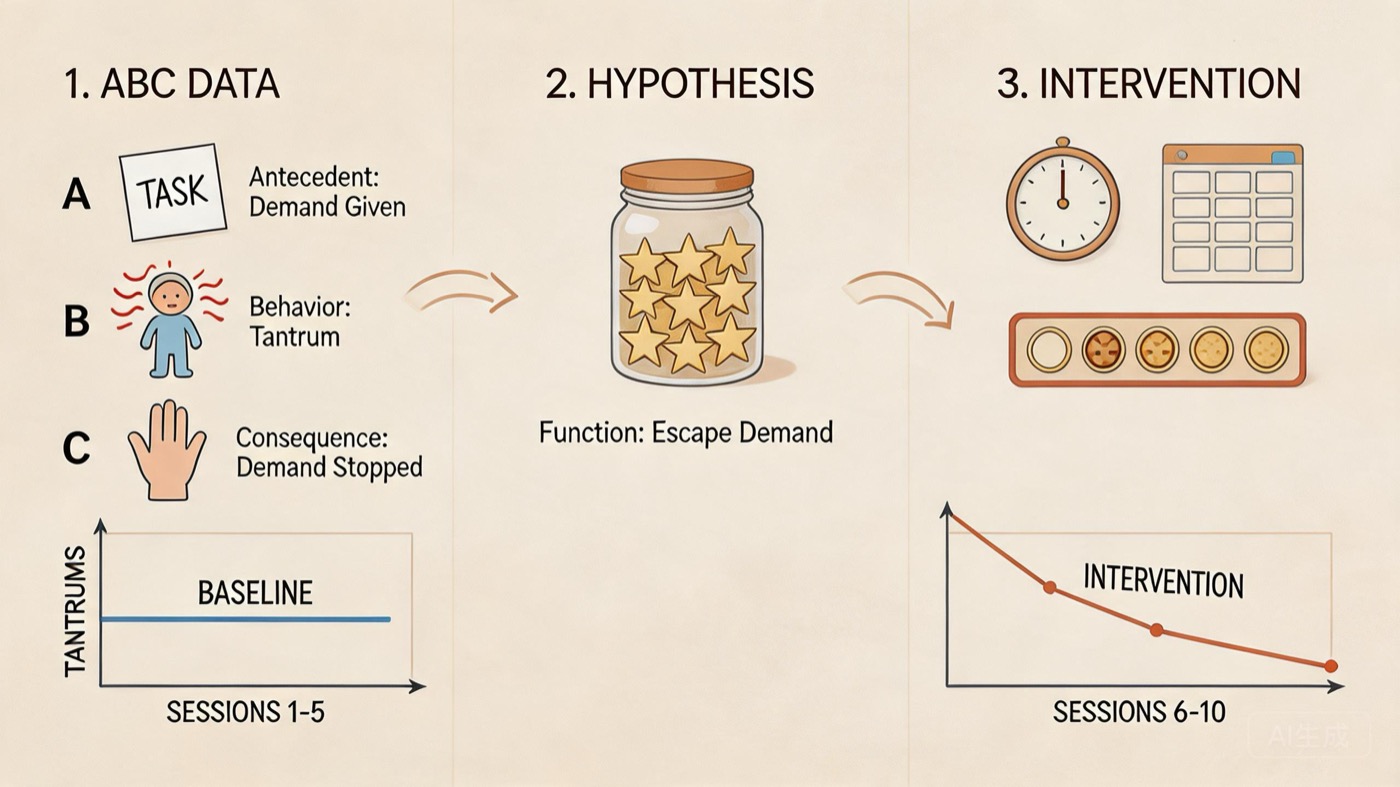
Applying single subject design to real scenarios helps solidify your understanding. Below are three examples with ABC data and hypothesized function.
Example 1: Reducing Tantrums with Differential Reinforcement
Target behavior: tantrums. ABC data show that tantrums often occur when demands are presented, and the behavior is followed by removal of the demand. Hypothesized function: escape from demands. A BCBA implements an ABAB design with DRA: during B phases, the child is taught to request a break (functional communication training) and tantrums decrease. Reversal of the treatment leads to increased tantrums, confirming experimental control.
Example 2: Increasing On-Task Behavior Using a Token Economy
Target behavior: on-task behavior during math worksheets. ABC data reveal that the child earns tokens for correct responses, but off-task behavior is sometimes followed by teacher attention (possible dual function). However, the primary hypothesized function is tangible (token access). A changing criterion design is used: the criterion for earning tokens starts at 2 minutes of continuous on-task behavior, then increases to 4, 6, and 8 minutes across phases. The child’s on-task behavior tracks the changing criteria.
Example 3: Comparing Prompting Strategies for Skill Acquisition
Target: independent manding (requesting a preferred item). Conditions: full verbal prompt versus partial physical prompt. An alternating treatments design is used: sessions are randomly assigned to each prompt type. Data show that the partial physical prompt leads to faster acquisition of independent mands. The design allows a direct comparison within the same learner.
Why Single Subject Design Matters for the BCBA Exam
The BCBA exam emphasizes data-based decision-making and internal validity. Single subject designs are the foundation of ABA research and practice. Knowing them well helps you answer questions about experimental control, replication, and interpretation of graphed data.
Common Exam Traps
- Mistaking multiple baseline for reversal: Remember that multiple baseline does not withdraw treatment; it staggers implementation.
- Confusing internal and external validity: Single subject designs prioritize internal validity through repeated measures and replication, not large sample sizes.
- Ignoring baseline stability: A stable baseline is required before introducing an intervention; otherwise, changes may be due to extraneous variables.
Exam Strategy Tips
- Identify the design by looking at phase labels (A, B, C) and the pattern of intervention introduction.
- Check for replication: ABAB designs replicate within subject; multiple baseline replicates across baselines.
- Match the design to the research question: reversal for demonstrating control, multiple baseline for irreversible behaviors, alternating treatments for comparing interventions.
Quick Checklist: Single Subject Design Essentials
Use this checklist for last-minute review before the exam.
- Define the baseline phase (A) and ensure stability before introducing intervention.
- Choose the design based on the behavior’s reversibility and the research question.
- Apply repeated measures across all phases to track level, trend, and variability.
- Look for replication to confirm experimental control.
- Consider ethical implications: avoid reversal designs for dangerous behaviors.
- Practice interpreting graphs: identify phase changes, data patterns, and potential confounds.
To deepen your understanding of experimental control and internal validity, explore our guide on variable dependency and experimental control in ABA. For more on graphing and visual analysis, see graphing and visual analysis in ABA. The BACB website also provides official resources on experimental design standards.
Complete BCBA Exam Prep
Turn this topic into exam-day practice
Practice concepts in context with five full-length 6th Edition mock exams, two bonus practice exams, a 6th Edition study guide, and key-term flashcards—all in one $120 USD package.
Get the $120 All-in-One Prep Pack
Review everything included on the product page before ordering. No pass guarantee is implied.



