

Defining Internal and External Validity in ABA
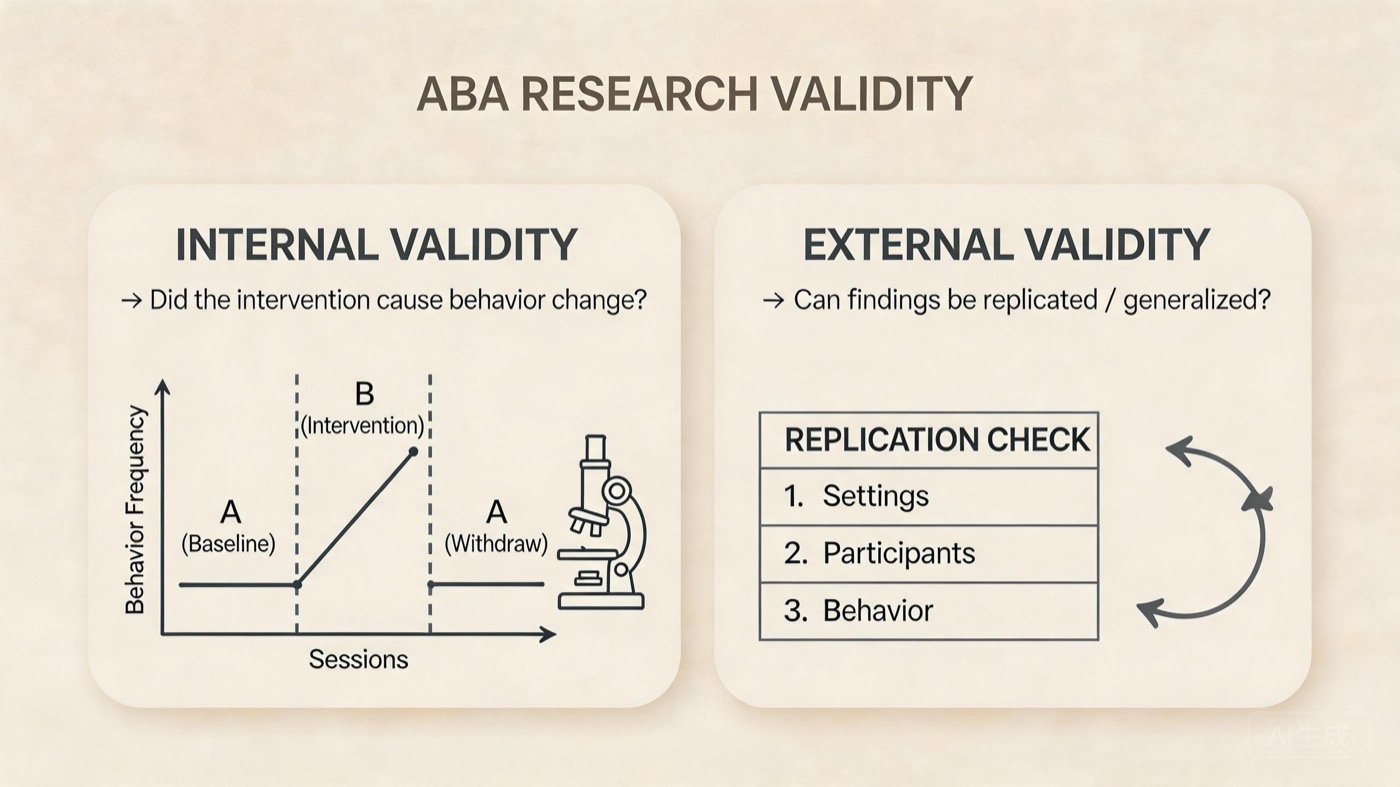
In applied behavior analysis, the concepts of internal and external validity are central to evaluating the trustworthiness and usefulness of research findings. Internal validity asks: Did the intervention truly cause the behavior change? External validity asks: Can these results be replicated with different people, settings, or behaviors? For BCBA candidates, mastering these distinctions is essential for interpreting studies and designing effective interventions.
Table of Contents
- Defining Internal and External Validity in ABA
- Why the BCBA Exam Tests Validity Concepts
- Threats to Internal Validity with ABA Examples
- Threats to External Validity with ABA Examples
- ABA Worked Examples: Internal vs External Validity
- Quick Checklist for BCBA Exam Success
- Summary: Internal and External Validity in ABA Research
- References
Internal Validity Defined
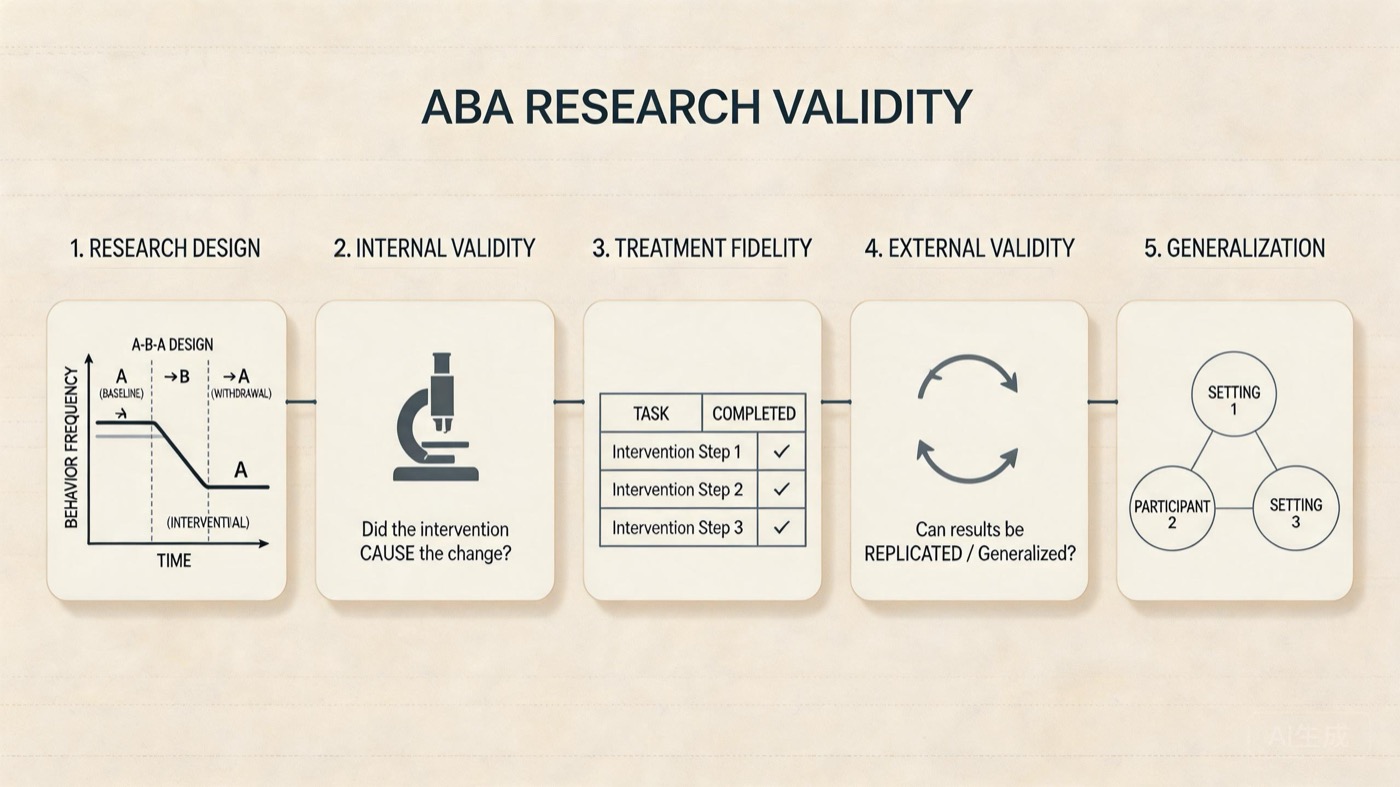
Internal validity refers to the degree of confidence that the independent variable (IV) caused changes in the dependent variable (DV). In ABA, this means we can attribute a reduction in challenging behavior to the intervention, not to extraneous variables. For example, if a DRA intervention reduces aggression, high internal validity means we are confident the DRA, not some other factor, produced the change.
External Validity Defined
External validity refers to the extent to which findings can be generalized across participants, settings, behaviors, and time. For instance, will the same DRA intervention work for a different learner or in a classroom instead of a clinic? High external validity allows practitioners to apply evidence-based practices broadly.
These two types of validity often trade off: tightly controlled experiments (high internal validity) may lack generalizability, while naturalistic studies (high external validity) may have more confounds.
Why the BCBA Exam Tests Validity Concepts
The BACB task list includes experimental design and measurement, and exam questions frequently ask you to identify threats to validity or choose the best design to control for them. Understanding internal and external validity helps you evaluate single-subject designs like multiple baseline or reversal designs. Common exam scenarios present a study summary and ask, ‘What is the biggest threat to internal validity?’ or ‘How could external validity be improved?’ Being able to spot these issues quickly is a key skill for the test.
Threats to Internal Validity with ABA Examples
Several threats can compromise internal validity. Below are the most relevant ones for ABA practice, each with a concrete example.
History
History refers to events outside the intervention that occur during the study. Example: A school-wide positive behavior support program is implemented while a DRO intervention is in place. A reduction in problem behavior may be due to the school program, not the DRO. (Hypothesized function: attention.)
Maturation
Maturation involves natural developmental changes. Example: A child’s nighttime tantrums decrease over time as they naturally develop better self-regulation. The intervention (bedtime fading) may erroneously receive credit.
Instrumentation
Instrumentation refers to changes in measurement tools or observers. Example: Observer drift leads to inconsistent recording of behavior. Use interobserver agreement (IOA) to monitor and control this threat.
Selection Bias
Selection bias occurs when groups are not equivalent before intervention. Example: Comparing a treatment group of highly motivated parents with a control group of less motivated parents. Differences in outcome may reflect initial differences, not the intervention.
Threats to External Validity with ABA Examples
Even if a study has strong internal validity, its findings may not generalize. Here are common external validity threats in ABA.
Participant Characteristics
An intervention effective for a 5-year-old with autism may not work for a 12-year-old with the same diagnosis. Participant age, skill level, and learning history influence generalizability.
Setting and Context
A token economy effective in a quiet clinic may fail in a noisy classroom. Setting features like distractions, staff ratios, and routines affect outcomes.
Behavioral Contrast and Reactivity
Reactivity (e.g., Hawthorne effect) occurs when participants behave differently because they know they are being observed. This limits generalization to natural conditions. Behavioral contrast refers to behavior changes in non-intervention settings when a contingency is introduced elsewhere.
ABA Worked Examples: Internal vs External Validity
Work through these two examples to solidify your understanding.
Example 1: Reducing Aggression in a Clinic
ABC: Antecedent = demand, Behavior = aggression, Consequence = escape from task. Function: escape. The study uses a multiple baseline across three participants in a controlled clinic. Internal validity is strong because the design demonstrates a functional relation. However, external validity is limited because only three participants were included, and the setting was highly controlled.
Example 2: Increasing Compliance in a Classroom
ABC: Antecedent = instruction, Behavior = compliance, Consequence = praise. Function: attention. Internal validity is threatened by maturation (students may become more compliant as the semester progresses). External validity is high if the intervention is replicated across different classrooms and teachers.
Quick Checklist for BCBA Exam Success
- Differentiate between internal and external validity in scenario questions.
- Identify common threats: history, maturation, instrumentation, selection bias.
- Recognize how single-subject designs control for threats (e.g., multiple baseline controls for history).
- Evaluate external validity by asking: Were diverse participants, settings, and behaviors included?
- Practice with mock questions from single-subject experimental designs.
Summary: Internal and External Validity in ABA Research
Understanding the balance between internal and external validity is crucial for BCBA success. In single-subject designs, internal validity is prioritized through repeated measurement and experimental control. However, external validity is achieved through systematic replications across participants and settings. When studying for the BCBA exam, practice identifying threats in research vignettes and consider how design choices affect both types of validity. For more on research fundamentals, check our guide on independent and dependent variables in ABA.



