
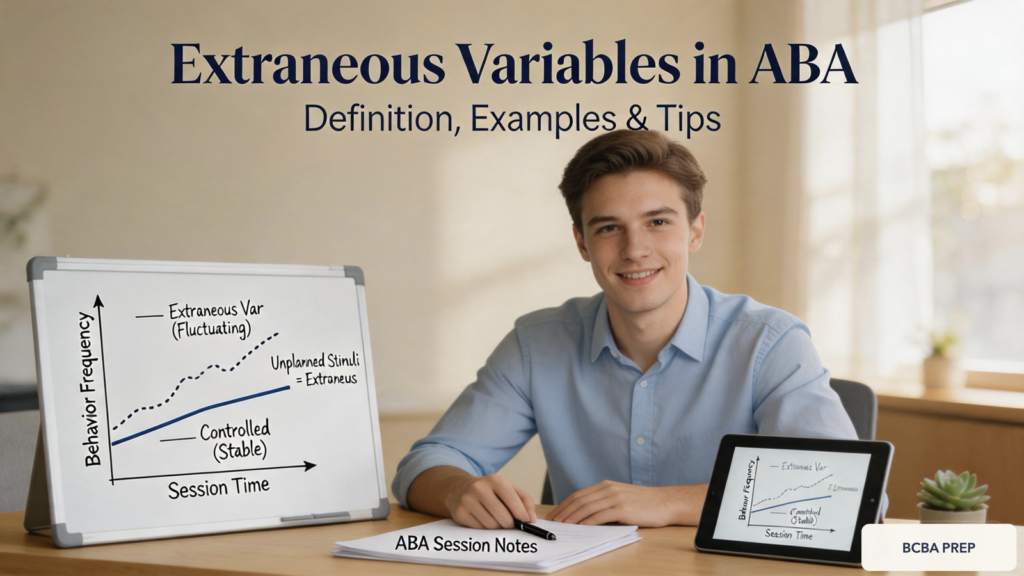
What Is an Extraneous Variable?
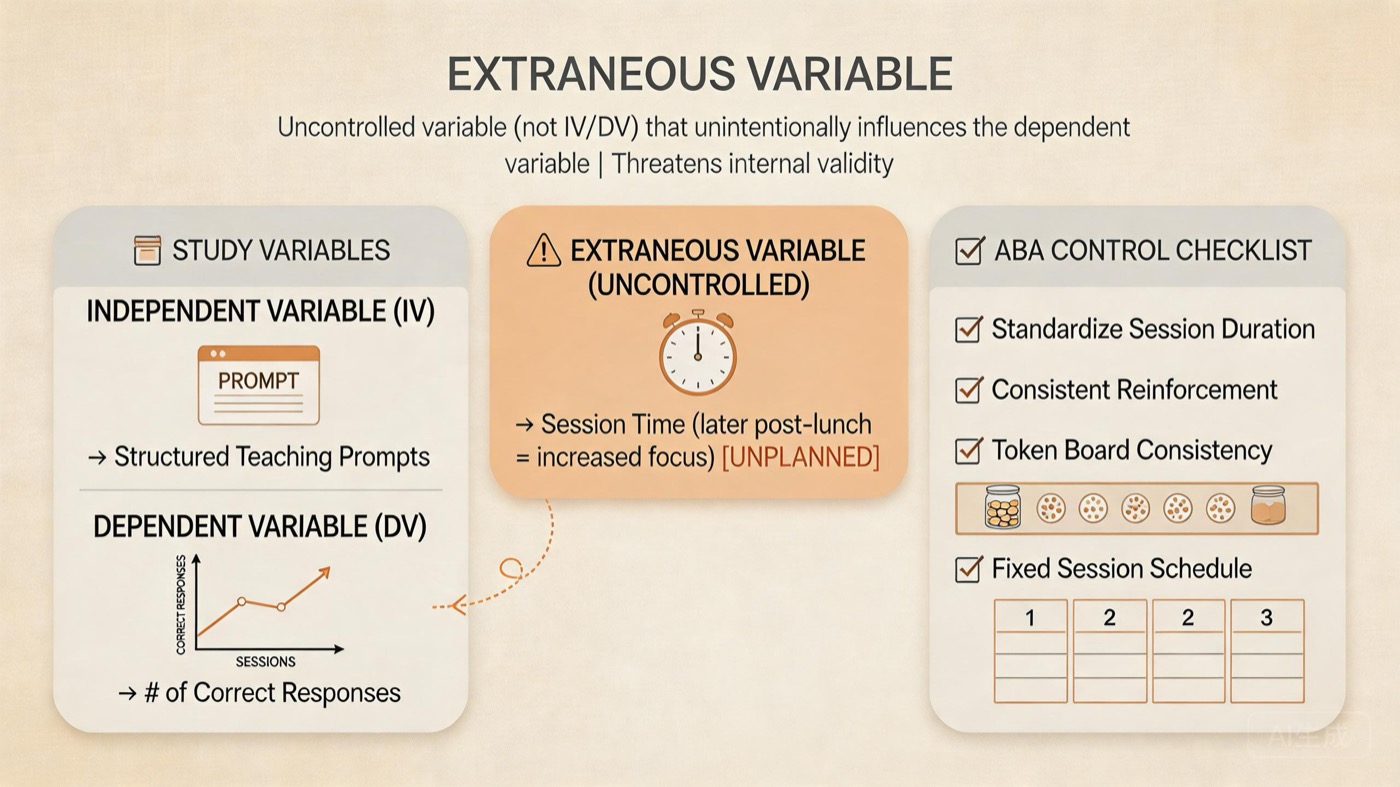
An extraneous variable is any variable that is not part of the independent variable (IV) or dependent variable (DV) in a study but that may unintentionally influence the DV. In ABA research, extraneous variables threaten internal validity by introducing alternative explanations for behavior change. For example, if you implement a token economy to increase task completion, and sessions are run at different times of day, the time of day becomes an extraneous variable. If not controlled, it could affect the results.
Table of Contents
- What Is an Extraneous Variable?
- Extraneous vs. Confounding Variables: What’s the Difference?
- Real ABA Examples of Extraneous Variables
- How to Identify and Control Extraneous Variables: Tips for the BCBA Exam
- Quick Checklist: Controlling Extraneous Variables in ABA Research
- Summary: Why Understanding Extraneous Variables Matters for Your BCBA Exam
Key Characteristics of Extraneous Variables
- Not part of the study design: They are not the IV or DV but are present in the environment.
- Can affect the DV: They may increase or decrease the dependent variable, obscuring the true effect of the IV.
- May be controlled or uncontrolled: Some can be eliminated or held constant; others are harder to manage.
- Common in single-subject designs: In ABA, extraneous variables often appear as changes in setting, therapist, or materials.
Extraneous vs. Confounding Variables: What’s the Difference?
A confounding variable is a specific type of extraneous variable that actually changes systematically with the IV, making it impossible to determine which variable caused the change in the DV. In contrast, an extraneous variable is any unwanted influence, whether or not it is correlated with the IV. For the BCBA exam, remember that all confounding variables are extraneous, but not all extraneous variables are confounding.
Example: Confounding Variable in an ABA Study
Imagine an ABC design where the IV is a token economy (introduced in phase B) and the DV is on-task behavior. If the token economy is always run by a preferred therapist and baseline sessions by a non-preferred therapist, therapist preference becomes a confounding variable. It changes at the same time as the IV, so you cannot tell whether the token economy or the therapist caused the increase in on-task behavior.
Real ABA Examples of Extraneous Variables
Below are three examples using the ABC format to illustrate how extraneous variables can threaten experimental control. Each includes a hypothesized function and a control strategy.
Example 1: Time of Day in a Token Economy
A-B-C: IV = token economy, DV = task completion, extraneous = time of day. Baseline sessions (A) are run in the morning, intervention sessions (B) are run in the afternoon. The client is more alert in the morning, so improved task completion may be due to time, not the token economy. Control: Counterbalance session times across phases or hold time constant.
Example 2: Therapist Behavior During DTT
A-B-C: IV = discrete trial teaching with prompts, DV = correct responses, extraneous = therapist’s tone of voice. The therapist uses a warm tone during intervention but a neutral tone during baseline. Control: Use a procedural fidelity checklist to ensure therapist behavior is consistent across conditions.
Example 3: Classroom Noise During Functional Communication Training
A-B-C: IV = FCT intervention, DV = mands per session, extraneous = noise level from hallway construction. During intervention, noise is high, which may reduce mands. Control: Schedule sessions during quiet times, or measure noise and use it as a covariate in analysis.
How to Identify and Control Extraneous Variables: Tips for the BCBA Exam
When studying for the BCBA exam, you need to recognize common extraneous variables and know how to control them. Here are strategies that frequently appear on test items.
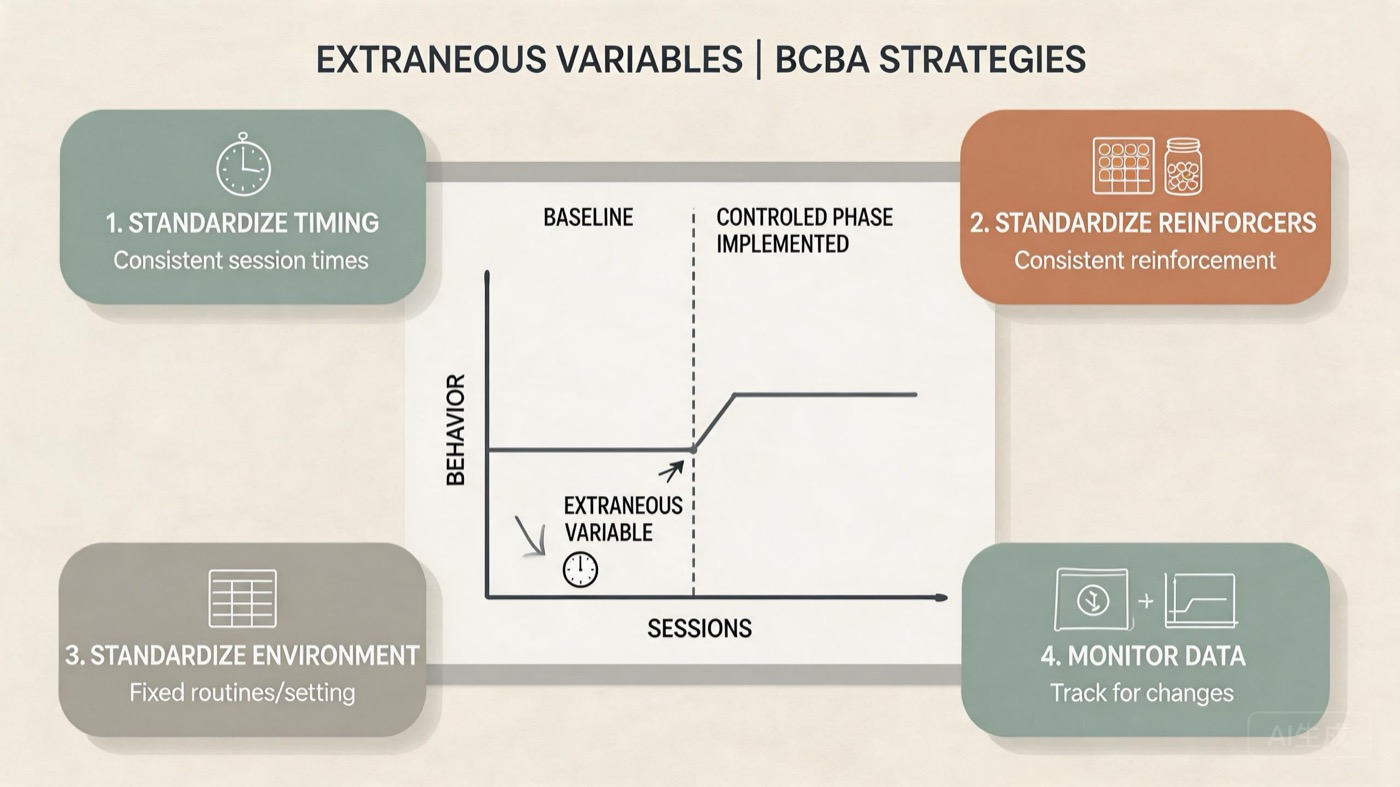
- Standardize procedures: Use scripts, checklists, and consistent materials across conditions.
- Counterbalance: Alternate the order of conditions to distribute extraneous variables evenly.
- Random assignment: When using group designs, randomly assign participants to groups.
- Repeated measurements: In single-subject designs, multiple data points help detect extraneous influences.
- Baseline logic: A stable baseline allows you to predict future behavior, making extraneous changes more noticeable.
Common Exam Traps to Avoid
Many students miss points because they confuse extraneous and confounding variables. Watch out for these pitfalls.
- Trap 1: Thinking all extraneous variables can be eliminated. In reality, some can only be controlled or monitored.
- Trap 2: Ignoring participant variables (e.g., fatigue, motivation) as extraneous variables.
- Trap 3: Assuming that any variable that changes during the study is automatically confounding. It is only confounding if it changes systematically with the IV.
- Trap 4: Overlooking environmental variables like temperature or noise, especially in educational settings.
Quick Checklist: Controlling Extraneous Variables in ABA Research
Use this checklist to quickly review key strategies before the exam or when designing a study.
- Identify potential extraneous variables: List all variables besides the IV that could affect the DV.
- Hold conditions constant: Keep setting, time, materials, and staff the same across phases.
- Measure and monitor: Track extraneous variables to see if they change (e.g., note session times, therapist mood).
- Use design controls: Apply counterbalancing, random assignment, or alternating treatments designs.
- Check procedural fidelity: Ensure the IV is implemented as planned; low fidelity is an extraneous variable.
Summary: Why Understanding Extraneous Variables Matters for Your BCBA Exam
Extraneous variables are a core threat to experimental control and internal validity in ABA research. On the BCBA exam, you will be asked to identify them, distinguish them from confounding variables, and propose ways to control them. Mastering this topic helps you design better interventions and interpret study outcomes accurately. For more practice, review our experimental design guide. To deepen your understanding, refer to the BACB’s Behavior Analyst Certification Board resources on research methods.


