
Introduction: The Acronym Every Behavior Analyst Must Know
If you’re preparing for the BCBA exam, you’ve likely asked yourself: what does BCBA stand for? The answer is more than just a label—it defines your future role and responsibilities. BCBA stands for Board Certified Behavior Analyst, a certification granted by the Behavior Analyst Certification Board (BACB). This article breaks down the acronym, clarifies how the BCBA differs from other credentials, and shows how understanding this role sharpens your exam performance.
Table of Contents
- Introduction: The Acronym Every Behavior Analyst Must Know
- What Does BCBA Stand For? A Simple Definition
- Why the BCBA Credential Matters for Your Exam Prep
- Applying the BCBA Definition: Real ABA Examples
- Quick Checklist: Confirming Your Understanding of BCBA
- Summary and Next Steps for Your BCBA Exam Journey
By the end, you’ll have a clear grasp of what the BCBA credential means and how it appears on the test. Let’s start with a simple definition.
What Does BCBA Stand For? A Simple Definition
BCBA is an acronym for Board Certified Behavior Analyst. Each word carries weight:
- Board Certified means you have met rigorous standards set by the BACB, including graduate-level coursework, supervised fieldwork, and a passing score on the certification exam.
- Behavior refers to the science of behavior analysis—the study of how environmental events influence actions.
- Analyst describes a practitioner who assesses behavior, designs interventions, and evaluates outcomes independently.
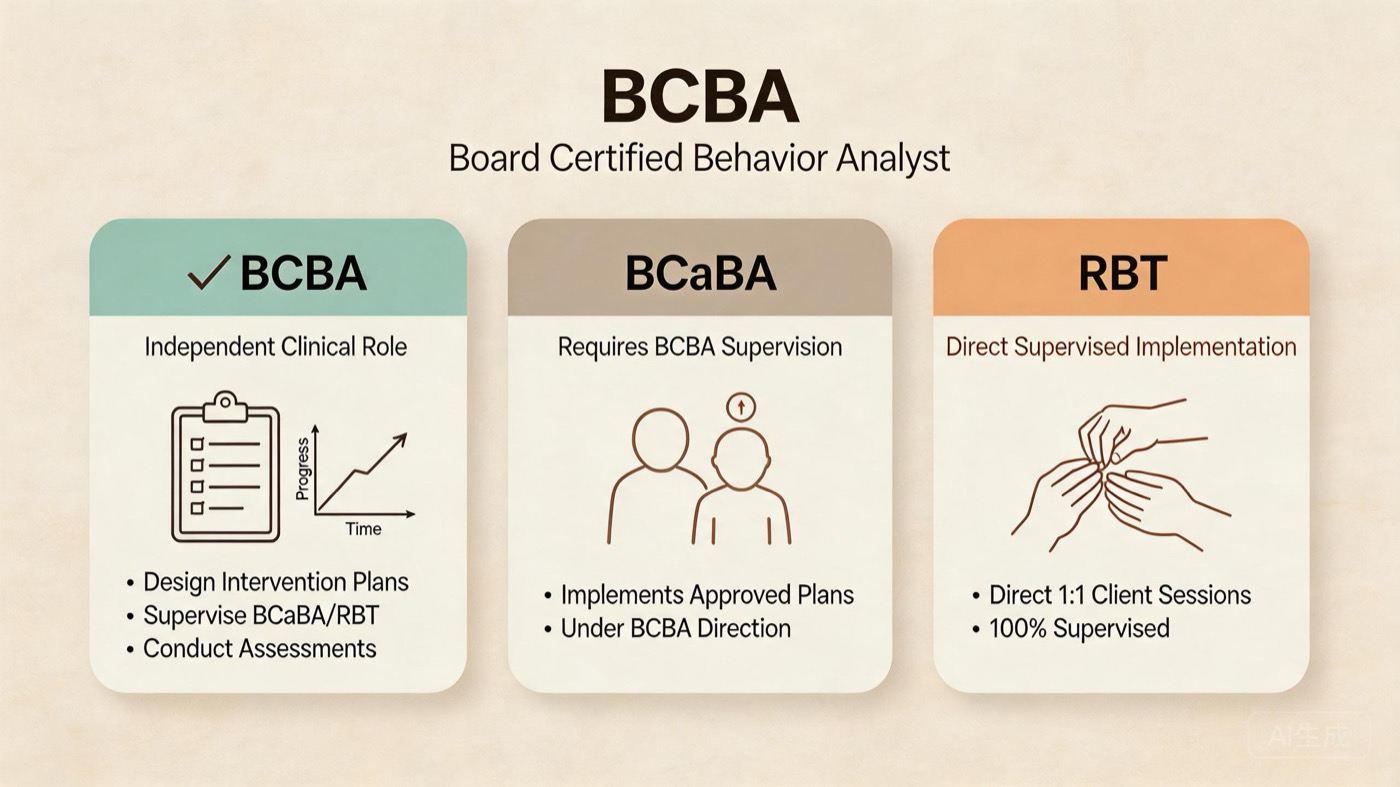
Board Certified Behavior Analyst: The Full Meaning
A BCBA is an independent practitioner who can conduct functional behavior assessments, create behavior intervention plans, supervise RBTs and BCaBAs, and ensure ethical practice. Unlike entry-level roles, the BCBA takes full responsibility for client outcomes and program oversight.
How BCBA Differs from BCaBA and RBT
Many exam questions test your ability to distinguish these roles. Here’s a quick comparison:
- BCBA: Independent practice; designs and supervises interventions; requires master’s degree + exam.
- BCaBA: Works under BCBA supervision; can implement but not design programs; requires bachelor’s degree + exam.
- RBT: Direct service provider; implements plans under BCBA/BCaBA supervision; requires high school diploma + competency assessment.
On the exam, watch for questions about who can sign off on a behavior plan—that’s the BCBA. Confusing BCBA with BCaBA is a common error.
Why the BCBA Credential Matters for Your Exam Prep
Understanding the BCBA role directly boosts your exam performance. Many task list items assume you are acting as a BCBA.
Exam Relevance: How the BCBA Role Appears on the Test
Questions often present scenarios and ask you to choose the best action for a BCBA. For example:
- Behavior assessment: How would you conduct a functional analysis?
- Intervention design: Which reinforcement schedule should you implement?
- Ethics: What do you do when a client’s rights are violated?
These items require you to think like a BCBA. If you internalize the BCBA’s responsibilities, you’ll answer more accurately. For more on task list areas, see our BCBA exam prep guide.
Common Traps: Misinterpreting the BCBA Scope
A frequent exam trap is confusing the BCBA’s scope with that of a BCaBA or RBT. For instance:
Sample question: Who is responsible for designing a behavior intervention plan for a client with severe self-injury?
- A) RBT
- B) BCaBA
- C) BCBA
- D) Teacher
The correct answer is BCBA. BCaBAs can assist but cannot independently design plans. RBTs implement only. Remember: the BCBA is the lead analyst.
Applying the BCBA Definition: Real ABA Examples
Seeing the BCBA role in action helps solidify your understanding. Below are two examples using the ABC (Antecedent-Behavior-Consequence) model.
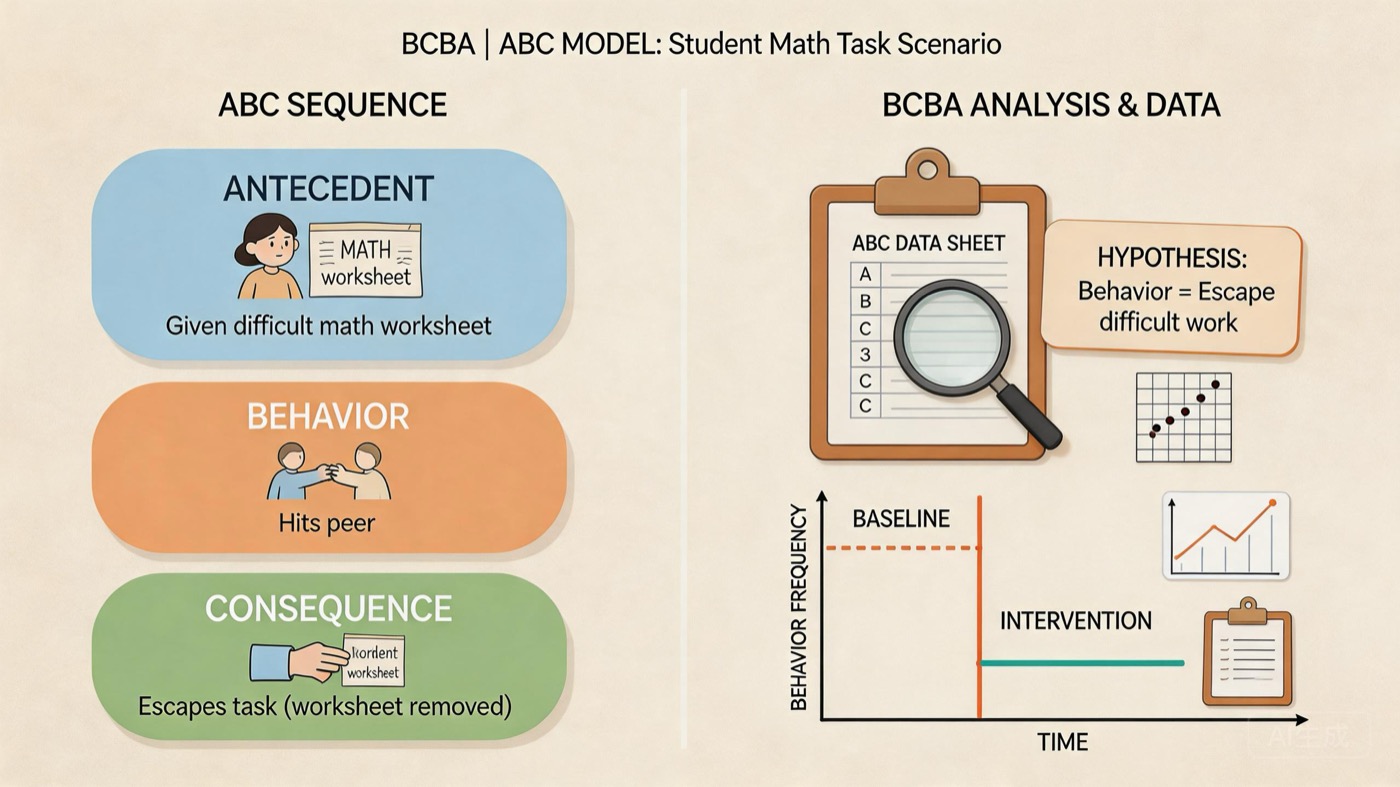
Example 1: Decreasing Aggression in a Classroom
Scenario: A student hits peers when given a difficult math worksheet.
- Antecedent: Teacher hands out worksheet.
- Behavior: Student hits peer.
- Consequence: Teacher removes worksheet and sends student to calm-down corner.
- Hypothesized function: Escape from task demand.
The BCBA conducts a functional behavior assessment and implements Functional Communication Training (FCT), teaching the student to request a break instead of hitting. The BCBA also redesigns the task to reduce difficulty and monitors progress.
Example 2: Increasing Communication
Scenario: A child with autism cries when a preferred toy is visible but out of reach.
- Antecedent: Toy is placed on a shelf.
- Behavior: Child cries.
- Consequence: Parent hands toy to child.
- Hypothesized function: Tangible access.
The BCBA teaches the child to mand (request) using a picture card or vocalization. The crying behavior is placed on extinction, and the mand is reinforced. Over time, the child learns a socially appropriate way to request items.
For more exam-relevant examples, check out our functions of behavior guide.
Quick Checklist: Confirming Your Understanding of BCBA
Use this checklist to self-assess your grasp of the BCBA credential:
- I can explain what BCBA stands for in one sentence.
- I can list three responsibilities unique to a BCBA (e.g., design BIP, supervise RBTs, conduct FBAs).
- I can differentiate BCBA, BCaBA, and RBT on scope and supervision.
- I recognize that exam questions often place me in the BCBA role.
- I can identify the function of behavior in an ABC example.
If you checked all five, you’re on track. If not, review the definitions and examples above.
Summary and Next Steps for Your BCBA Exam Journey
Now you know exactly what the acronym stands for: Board Certified Behavior Analyst. This role is central to applied behavior analysis and to every exam question you’ll face. By understanding the BCBA’s scope, you avoid common traps and approach scenarios with confidence.
Ready to apply your knowledge? Explore our free BCBA mock exam practice questions to test your skills. For official information on certification requirements, visit the BACB website. Good luck with your studies!



