

What Is Applied Behavior Analysis (ABA)?
Applied Behavior Analysis, or ABA, is a scientific approach to understanding and changing socially significant behavior. According to the BACB and Cooper, Heron, & Heward, the ABA definition rests on a set of core dimensions that distinguish it from other therapies. At its heart, ABA focuses on observable behavior, environmental events, and systematic intervention to produce meaningful improvement.
Table of Contents
- What Is Applied Behavior Analysis (ABA)?
- ABA Definition in Action: Contrived and Naturally Occurring Examples
- Why the ABA Definition Matters for the BCBA Exam
- ABA Definition Quick Checklist: Are You Ready?
- Summary and Next Steps for BCBA Candidates
The Four Components of ABA Definition
In your BCBA exam prep, you will encounter the seven dimensions of ABA, often summarized as A-B-A-T-C-E-G. Each dimension is a critical feature of any ABA program. Here they are with brief examples:
- Applied: The behavior targeted must be socially significant, such as improving communication skills in a child with autism.
- Behavioral: The behavior itself is measured, not labels or intentions. For instance, counting the frequency of hand-raising instead of saying “participates more.”
- Analytic: The intervention demonstrates a functional relationship between the environment and behavior. Example: showing that praise increases the rate of on-task behavior.
- Technological: Procedures are described clearly enough to be replicated. Think of a detailed prompting hierarchy in a written protocol.
- Conceptually Systematic: Interventions are grounded in behavioral principles, like using reinforcement rather than a vague “reward system.”
- Effective: The intervention produces practical, meaningful change. For example, reducing aggression to near-zero levels in a classroom.
- Generality: The behavior change lasts over time and appears in different settings. A greeting skill learned in the clinic should also occur at home.
How ABA Differs from Other Behavioral Approaches
Unlike cognitive-behavioral therapy, which targets internal thoughts, ABA exclusively focuses on observable behavior and environmental variables. Discrete trial training (DTT) is a structured ABA method, while naturalistic teaching embeds learning in everyday routines. Both fall under the ABA umbrella because they adhere to the dimensions above.
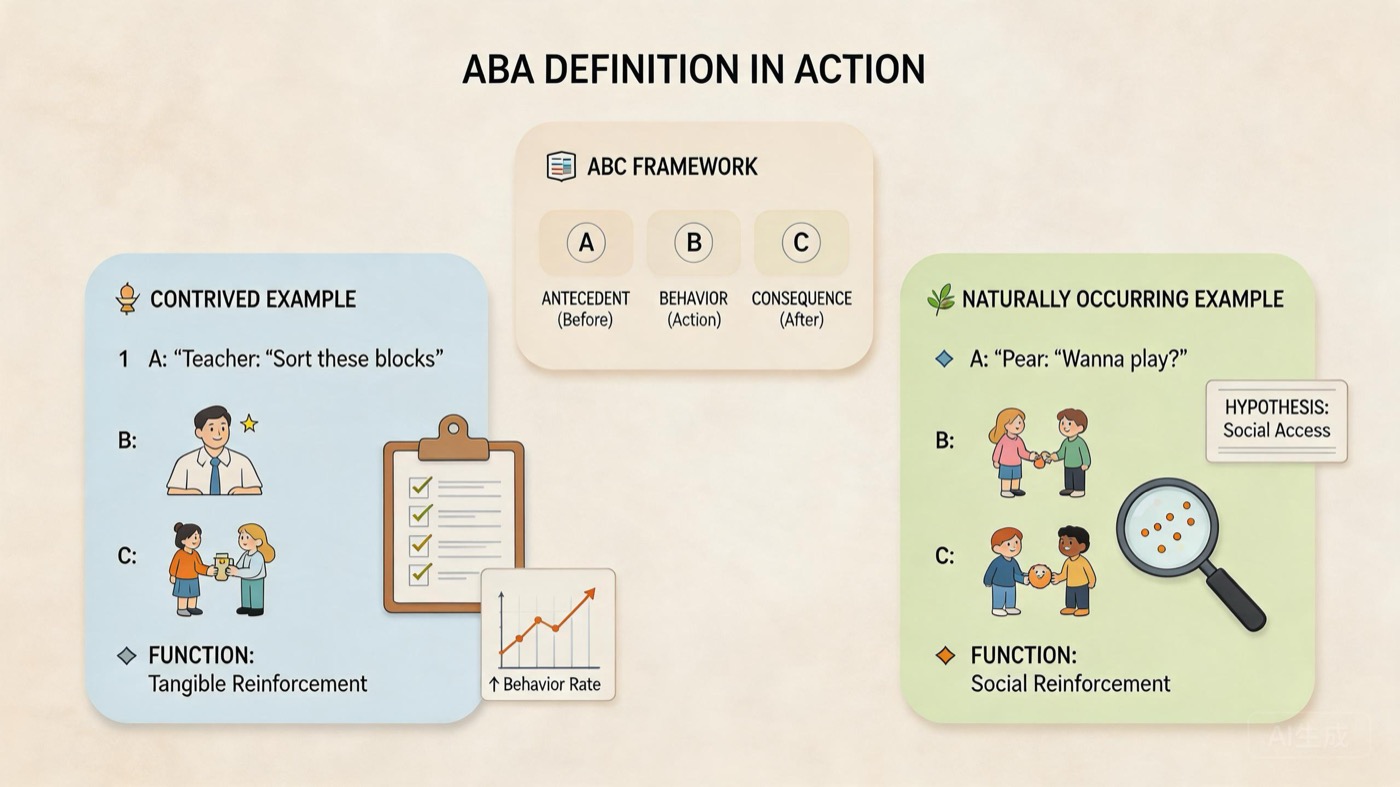
ABA Definition in Action: Contrived and Naturally Occurring Examples
Seeing the ABA definition applied to real cases helps solidify the concepts for the exam. Each example below includes the ABC (antecedent-behavior-consequence) sequence and a hypothesized function. Notice how the seven dimensions appear in practice.
Example 1: Reducing Aggression in a Preschool Classroom
Antecedent: Teacher asks the child to clean up toys. Behavior: The child hits the teacher. Consequence: The teacher removes the task and redirects the child to a quiet area. Function: Escape from demand. This illustrates the analytic dimension (the consequence maintains the behavior) and effectiveness (reducing aggression over time).
Example 2: Increasing Verbal Greetings in a Job Training Setting
Antecedent: A coworker enters the room. Behavior: The trainee says “hello.” Consequence: The coworker smiles and says “hi” back. Function: Social positive reinforcement. This highlights the behavioral dimension (counting greetings) and generality (greeting co-workers across shifts).
Example 3: Toe Walking Reduction in a Child with Autism
Antecedent: The child walks across the room. Behavior: Toe walking. Consequence: A gentle verbal reminder to walk flat-footed. Function: Automatic (sensory) or social attention. The analytic component appears via measurement (steps with heel strike) and effectiveness (decreasing toe walking episodes).
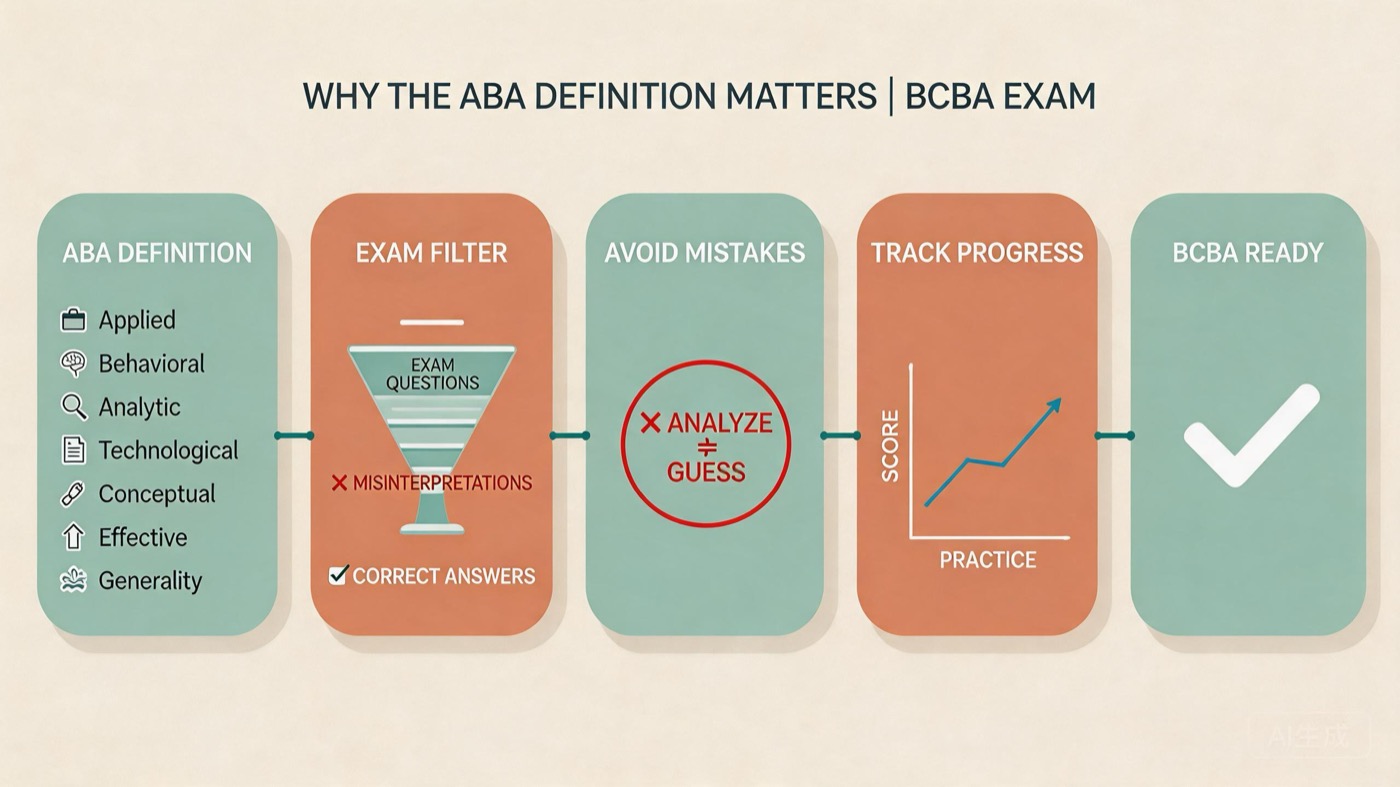
Why the ABA Definition Matters for the BCBA Exam
On the BCBA exam, understanding the ABA definition is crucial because many questions test whether you can identify or apply the seven dimensions. Common misinterpretations lead to wrong answers. Use the definition as a filter to eliminate distractors.
Common Exam Traps: Misreading the Seven Dimensions
A frequent mistake is confusing “analytic” with “conceptually systematic.” For example:
- Trap 1: An answer says “The intervention was based on the principle of positive reinforcement.” This illustrates conceptually systematic, not necessarily analytic. Analytic requires demonstrating a functional relation.
- Trap 2: “The behavior change continued after the intervention ended.” This is about generality, not effectiveness. Effectiveness is about the degree of change, not maintenance.
How to Use the Definition to Eliminate Wrong Answers
When you see a multiple-choice item, ask: Does this option meet all seven dimensions? If it fails even one—like describing a technique that is not technological or not effective—it is not a complete ABA answer. This strategy quickly narrows choices.
ABA Definition Quick Checklist: Are You Ready?
Use this binary checklist to test your understanding of the ABA definition. Each item should be a “yes” before you feel exam-ready.
- Can you name all seven dimensions from memory?
- For each dimension, can you give a one-sentence example?
- Can you identify which dimension is missing from a brief scenario?
- Can you contrast ABA with a non-behavioral approach like cognitive therapy?
- Can you walk through an ABC example and label each component?
- Do you understand why “analytic” requires experimental control, not just correlation?
- Can you distinguish between effectiveness and generality?
Summary and Next Steps for BCBA Candidates
The ABA definition is more than a memorized list—it is the foundation of every intervention you will design. The seven dimensions (applied, behavioral, analytic, technological, conceptually systematic, effective, generality) ensure that ABA stays scientific and impactful. For the BCBA exam, practice applying these dimensions to case examples and use them to filter answer choices.
Related Concepts to Study Next
Deepen your knowledge by exploring behavior, environment, reinforcement, and measurement. Review our guide on the 7 dimensions of ABA for additional examples, or check out the official BACB BACB website for the latest task list. Consistent application of the ABA definition will sharpen your clinical judgment and exam performance.



