
What Is Overcorrection in ABA?
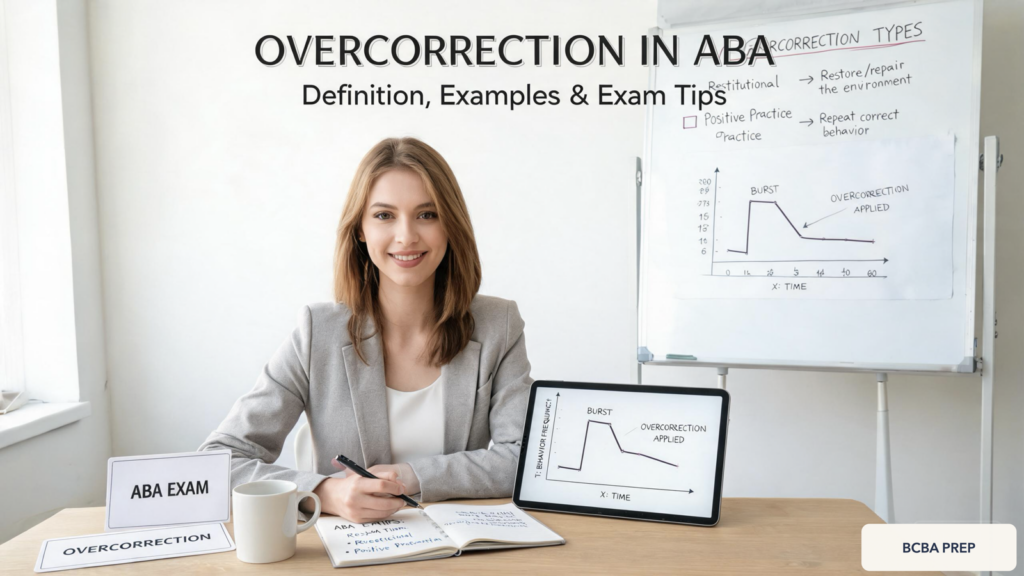
Overcorrection is a behavior reduction procedure that requires an individual to correct the environmental effects of their inappropriate behavior and/or practice an appropriate alternative behavior. It is classified under positive punishment because the learner is required to engage in effortful behavior following the unwanted response. Overcorrection is typically used to decrease behaviors that are harmful, disruptive, or socially inappropriate while simultaneously teaching a replacement skill.
Table of Contents
- What Is Overcorrection in ABA?
- Overcorrection in Action: Worked Examples with ABC Analysis
- Why Overcorrection Matters on the BCBA Exam
- Quick Checklist for Applying Overcorrection
- Key Takeaways
Two Types of Overcorrection
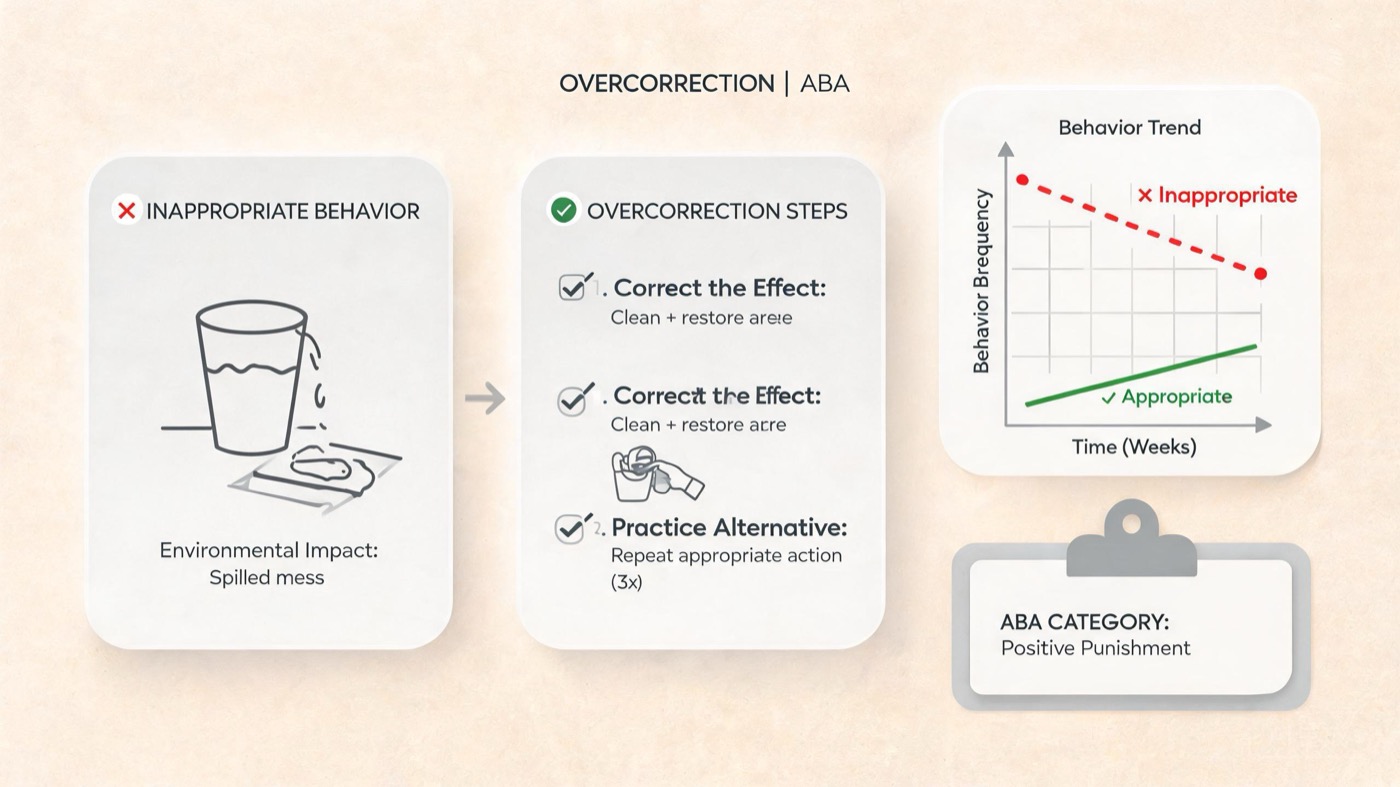
There are two primary forms of overcorrection: restitutional and positive practice. Understanding the difference is essential for both intervention design and the BCBA exam.
- Restitutional overcorrection requires the learner to restore the environment to a state better than it was before the behavior occurred. For example, if a child spills a drink, they must clean the entire table, not just the spill. This type focuses on repairing damage and engaging in extra effort to discourage future occurrences.
- Positive practice overcorrection involves repeatedly practicing a correct or appropriate behavior after an error. For instance, if a student runs in the hallway, they must walk back and forth between two points five times. This type emphasizes repeated practice of the desired behavior to increase its future likelihood.
Both types are often combined. For example, after property destruction, the learner may first restore the area (restitutional) and then practice appropriate toy play (positive practice). BCBA exam questions frequently ask you to identify which type of overcorrection is being applied based on the description.
Overcorrection in Action: Worked Examples with ABC Analysis
Applying an ABC analysis (Antecedent-Behavior-Consequence) helps clarify the function of behavior and the role of overcorrection. Below are three realistic scenarios that illustrate how overcorrection is implemented in practice.
Example 1: Restitutional Overcorrection for Property Destruction
Antecedent: A child with autism is asked to transition from a preferred activity (iPad) to a non-preferred task (math worksheet).
Behavior: The child throws all toys off the shelf.
Consequence (Overcorrection): The child must pick up every toy, return them to the shelf in an organized manner, and additionally wipe down the shelf. The hypothesized function is escape from demands. The extra cleaning effort serves as punishment, reducing the likelihood of future throwing.
Example 2: Positive Practice for Aggression
Antecedent: A peer takes a toy from a preschooler.
Behavior: The preschooler hits the peer.
Consequence (Overcorrection): The preschooler is guided to practice gentle touching (e.g., patting the peer’s arm) five times with verbal praise for appropriate contact. The hypothesized function is access to the toy (or social positive reinforcement). Positive practice teaches an alternative, appropriate behavior while punishing aggression through repeated effort.
Example 3: Combining Both Types for Off-Task Behavior
Antecedent: During independent work, a student is given a math worksheet.
Behavior: The student leaves their seat and wanders around the room.
Consequence (Overcorrection): First, the student must return all materials to their correct places (restitutional). Then, the student practices sitting in their chair with appropriate posture for 2 minutes (positive practice). The hypothesized function is sensory stimulation or escape from task difficulty. This combined approach both restores the environment and practices the desired behavior.
On the BCBA exam, you may be asked to identify the type of overcorrection or to design an overcorrection procedure given a target behavior. Remember that overcorrection should always be implemented with ethical considerations, including obtaining informed consent and monitoring for side effects such as aggression or escape-maintained behaviors.
Why Overcorrection Matters on the BCBA Exam
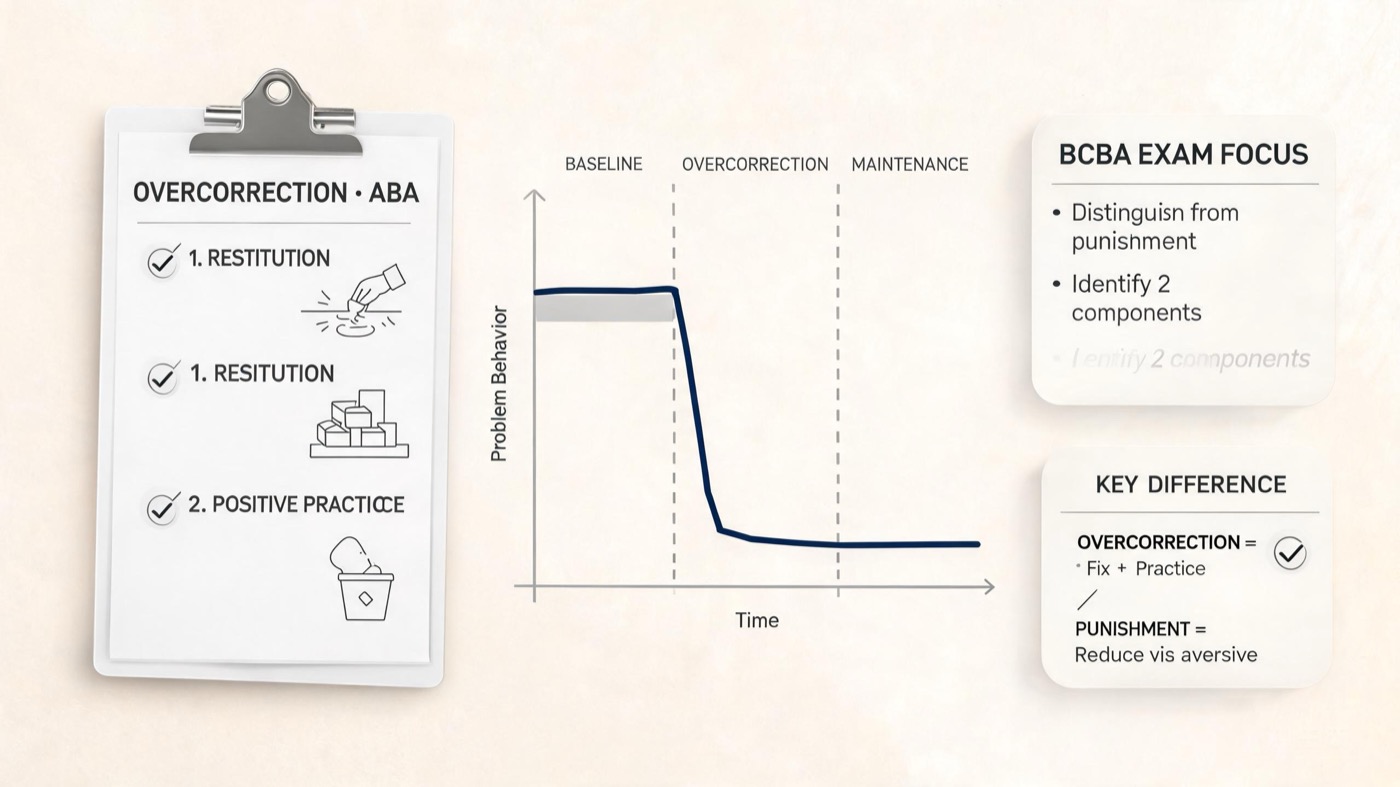
Overcorrection frequently appears on the BCBA exam under behavior reduction procedures. The exam tests your ability to distinguish overcorrection from other punishment procedures and to identify its components. You are expected to know the two types, when to use each, and how to evaluate its effectiveness. Additionally, you must recognize ethical and practical limitations of overcorrection.
Common Exam Traps
- Confusing overcorrection with negative punishment: Overcorrection involves requiring effortful behavior (positive punishment), not removing a stimulus. If the consequence is that the learner loses a token or time-out, that is negative punishment, not overcorrection.
- Overlooking ethical guidelines: Overcorrection should be used only after function-based interventions and reinforcement-based strategies have been attempted. The BACB Ethics Code requires that punishment procedures be justified and monitored.
- Misidentifying as punishment when it’s a decelerative procedure: Overcorrection is indeed a punishment procedure, but some exam items may describe it as a ‘decelerative procedure’ without using the word ‘punishment’. Be familiar with the terminology: overcorrection is a positive punishment intervention that decreases behavior.
- Confusing positive practice with overcorrection’s educational component: Some questions may ask whether positive practice is teaching or punishment. Remember that it serves both functions: it punishes the inappropriate behavior through effort and teaches a replacement skill.
Quick Checklist for Applying Overcorrection
Use this checklist when designing or evaluating overcorrection procedures. It aligns with best practices and exam expectations.
- Identify the function of the target behavior through FBA. Overcorrection is most effective for behaviors maintained by automatic reinforcement or escape, but it can be used across functions.
- Select the type: restitutional (environmental repair) or positive practice (repeated correct behavior), or a combination.
- Ensure the overcorrection is directly related to the behavior. For example, if a child makes a mess, cleaning is related; if the child is aggressive, practicing gentle touch is related.
- Determine the duration or number of repetitions (e.g., clean for 5 minutes, practice 10 times). The effort should be sufficient to be punishing but not overly lengthy to avoid ethical concerns.
- Provide immediate feedback during the overcorrection procedure. Guide the learner physically or verbally to ensure correct performance.
- Monitor for side effects such as aggression, crying, or escape behaviors. If observed, modify or discontinue the procedure.
- Combine with reinforcement for appropriate behaviors to increase the overall effectiveness of the intervention.
Key Takeaways
- Overcorrection is a positive punishment procedure that reduces undesired behavior by requiring effortful correction or practice.
- There are two types: restitutional (repairing environment beyond the original state) and positive practice (repeatedly practicing a correct behavior).
- ABC analysis helps identify the function of behavior and ensures overcorrection is applied appropriately.
- On the BCBA exam, watch out for traps that confuse overcorrection with negative punishment or overlook ethical requirements.
- Use the quick checklist to implement overcorrection correctly and to answer application questions effectively.
For more detailed guidance on behavior reduction procedures, explore our positive punishment ABA guide and review the ethics of punishment in ABA. Additionally, the BACB Ethics Code provides official standards for using punishment-based interventions.
Complete BCBA Exam Prep
Turn this topic into exam-day practice
Practice concepts in context with five full-length 6th Edition mock exams, two bonus practice exams, a 6th Edition study guide, and key-term flashcards—all in one $120 USD package.
Get the $120 All-in-One Prep Pack
Review everything included on the product page before ordering. No pass guarantee is implied.



