

What Does It Mean to Pass the Big ABA Exam?
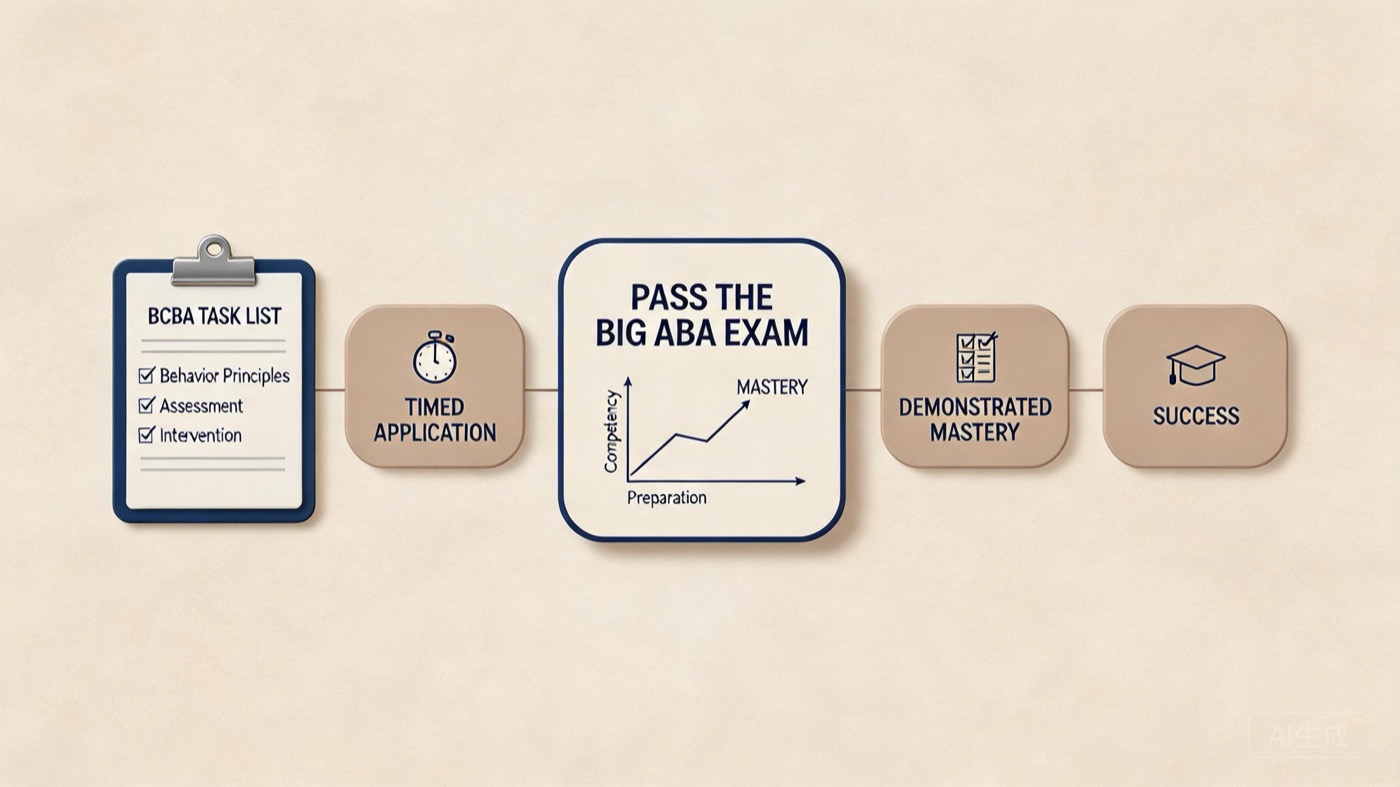
Passing the Big ABA exam means demonstrating mastery of the BCBA task list and applying behavior-analytic concepts under timed conditions. This exam is rigorous, but with the right approach, you can succeed.
Table of Contents
- What Does It Mean to Pass the Big ABA Exam?
- Study Strategies Grounded in ABA Principles
- Practice with Mock Exams: More Than Just Questions
- Common Exam Traps and How to Avoid Them
- Quick Checklist for Exam Day
- Summary: Your Roadmap to Pass the Big ABA Exam
- References
The exam consists of 160 multiple-choice questions covering topics like measurement, assessment, intervention, and ethics. You have 4 hours to complete it. A scaled score of 400 or higher is required to pass. Understanding the structure helps you focus your study efficiently. For many test-takers, the sheer volume of content can feel overwhelming. However, breaking the material into manageable chunks and applying behavioral principles to your own study habits transforms the process from stressful to systematic. Remember, this exam is not just a test of knowledge but also of endurance and strategy under pressure. By approaching preparation with the same analytical rigor you use in client interventions, you can significantly improve your odds.
Exam Overview and Structure
The Big ABA exam is divided into content areas weighted by the BACB. Key areas include behavior change procedures, experimental design, and professional conduct. You must prepare across all domains, as questions are drawn from the entire 6th Edition Task List. For a detailed breakdown, check out our guide on the BCBA 6th Edition exam blueprint. Understanding weights can help prioritize study time—for example, if behavior change procedures carry the most weight, allocate more hours there. But don’t neglect ethics and supervision, as these areas often contain tricky application questions that can make or break your score.
Study Strategies Grounded in ABA Principles
Use the same behavior-analytic principles you study to shape your own preparation. This approach makes studying more effective and reinforces your learning simultaneously. By treating your study behavior as the target behavior you want to increase, you can select interventions accordingly. For instance, if you struggle to maintain focus, consider using a token economy where each 30-minute study block earns a token toward a larger reward, like a favorite show or treat. This self-management tactic mirrors intervention plans you’ll write as a BCBA.
Shaping Your Study Behavior
Start with short study sessions of 15 minutes and gradually increase duration as you maintain focus. Reward yourself after each successful session with a preferred break or snack. This shaping process builds stamina and consistency over time. For example, week one: 15-minute sessions with immediate reinforcement. Week two: 20-minute sessions. Week three: 25 minutes. By the fourth week, you should be comfortable with 50-minute blocks followed by 10-minute breaks. This gradual increase prevents burnout and establishes a positive reinforcement history with studying—something many test-takers lack after hours of passive reading.
Chaining Study Tasks for Efficiency
Break down study sessions into smaller steps: read a chapter, take notes, quiz yourself, review mistakes. Use a chaining procedure to complete each step before moving on. This reduces overwhelm and ensures thorough coverage of material. A practical example: start with a forward chain. First, read the chapter summary (step 1). Once mastered, add reading the body (step 2). Then add note-taking (step 3). Finally, add self-quizzing (step 4). Before you know it, you’re completing the entire chain fluently. This technique is especially helpful for dense topics like automatic reinforcement or matching law, where conceptual understanding builds sequentially.
Practice with Mock Exams: More Than Just Questions
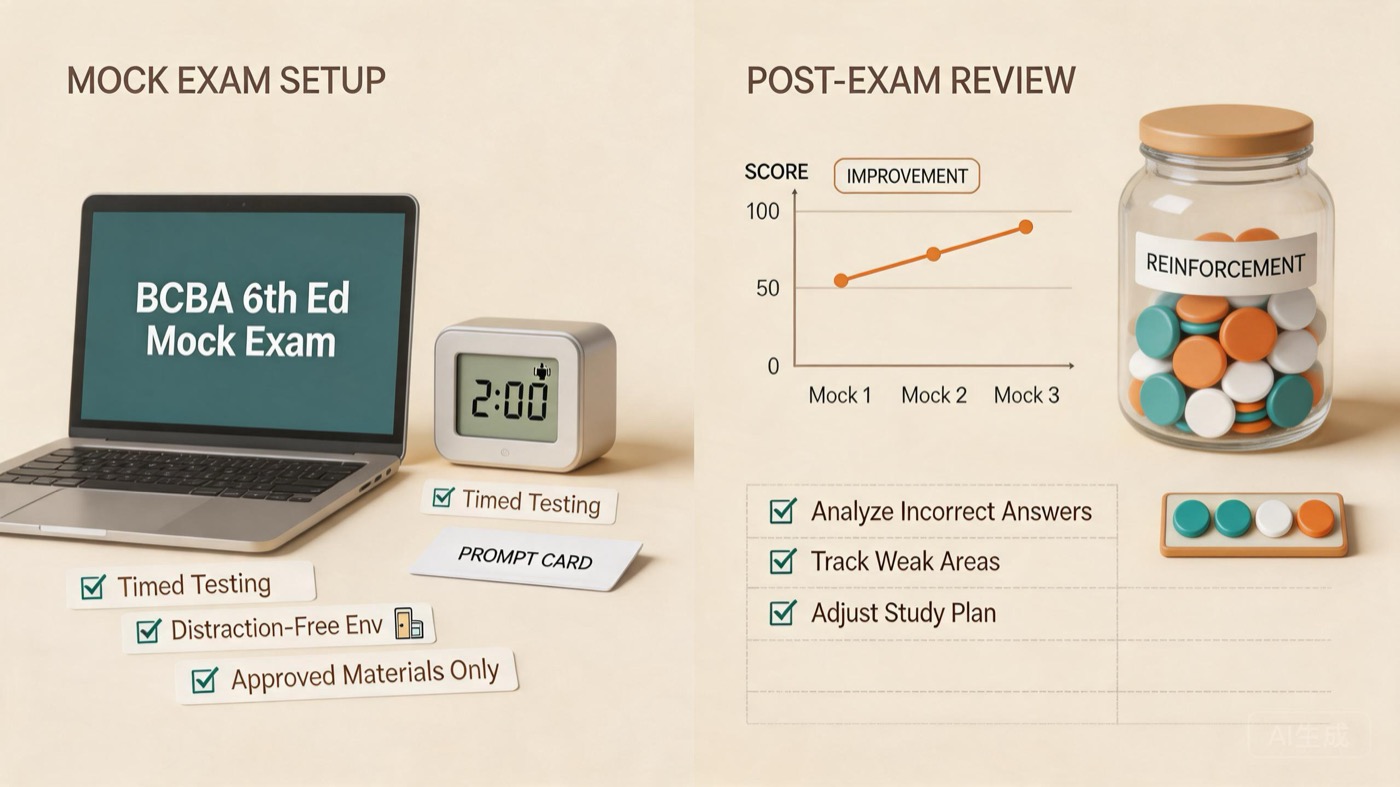
Mock exams are a cornerstone of effective preparation, but their value extends far beyond just getting questions right or wrong. They serve as a diagnostic tool, a fluency builder, and a desensitization protocol for test anxiety. When used systematically, mock exams can double your retention compared to re-reading alone. Below, we expand on two crucial aspects: simulating conditions and error analysis.
Simulating Exam Conditions
Take full-length mock exams under conditions that mirror the real test: timed, no interruptions, with only allowed materials. This reduces anxiety and improves your time management. Use a reliable BCBA mock exam designed for the 6th edition. Simulating the environment also helps you identify pacing issues. For example, if you find yourself spending 3 minutes on a single question, flag it and move on. With practice, you’ll learn to allocate approximately 1.5 minutes per question, reserving time at the end for flagged items. Additionally, take mock exams in a quiet room with minimal distractions; if you typically study with music, skip it during mocks to approximate test center conditions.
Error Analysis Using ABC Data
After each mock exam, analyze your incorrect answers. Identify patterns: Did you confuse operant vs. respondent? Misapply reinforcement schedules? Use ABC data (Antecedent-Behavior-Consequence) to understand why you chose wrong answers. For instance, antecedent: you see a question about variable ratio schedules. Behavior: you answer “post-reinforcement pause” (which is a fixed ratio pattern). Consequence: you lose a point. The function of the error might be due to confusing ratio vs. interval or fixed vs. variable. Adjust your study plan accordingly—maybe create a discrimination training flashcard set where you sort schedule types by their key features. This data-driven approach transforms errors into learning opportunities. Aim to reduce your error rate by 10% each week by targeting specific areas identified in your analysis.
Common Exam Traps and How to Avoid Them
Many candidates fall into predictable traps. Recognize these patterns to avoid losing points. In addition to the traps below, be wary of questions that ask for the “most ethical” response; these often require you to prioritize client dignity over convenience. Also, watch for double negatives in stem questions—e.g., “Which is NOT an example of negative punishment?” Slow down and read carefully.
Operant vs. Respondent Confusion
- Operant behavior is controlled by consequences (reinforcement/punishment). Example: A child requests a toy and gets it; requesting increases.
- Respondent behavior is elicited by antecedent stimuli (reflexes). Example: A loud noise elicits a startle response.
- Mnemonic: Operant = Operating on the environment; Respondent = Responding automatically.
- Exam tip: If the question mentions a conditioned stimulus (CS) or unconditioned stimulus (US), it’s respondent. If it mentions consequence delivery, it’s operant.
Reinforcement Schedule Misapplication
- Fixed Ratio (FR): Reinforcement after a set number of responses (e.g., FR5). Produces high rate with a post-reinforcement pause.
- Variable Ratio (VR): After an average number of responses (e.g., VR5). Produces high and steady rate.
- Fixed Interval (FI): Reinforcement after a set time (e.g., FI5 min). Scalloped pattern.
- Variable Interval (VI): Average time (e.g., VI5 min). Low to moderate steady rate.
- Exam tip: Visualize the cumulative record: FR has a break-and-run pattern; VR has constant rate; FI has a scallop; VI has a low steady slope. Many test questions ask you to identify the schedule based on the pattern.
Quick Checklist for Exam Day
- Get adequate sleep the night before; avoid cramming. Sleep consolidates memory.
- Eat a balanced meal before the exam; bring snacks if allowed (e.g., granola bar, water).
- Arrive early to reduce stress; know the location and traffic patterns.
- Read questions carefully; watch for negative phrasing (e.g., “except,” “not”). Underline key words.
- Use process of elimination; guess if unsure—no penalty for wrong answers. Eliminate obviously wrong choices first.
- Manage time; plan to spend about 1.5 minutes per question; flag difficult items for review. Use the review feature.
- Bring required identification and authorization number; double-check test center policies.
For more exam day tips, read our BCBA test question strategies guide.
Summary: Your Roadmap to Pass the Big ABA Exam
To pass the Big ABA exam, combine ABA-based study strategies (shaping, chaining) with rigorous mock exam practice. Avoid common traps by understanding operant vs. respondent and reinforcement schedules. Use exam day checklists to stay calm and focused. With systematic preparation and consistent effort, you can achieve certification. Start your journey with our BCBA exam prep guide. Remember, every BCBA once sat where you are—persistence and strategic study are your best tools.


