

IOA in ABA: What is Interobserver Agreement (IOA) in ABA?
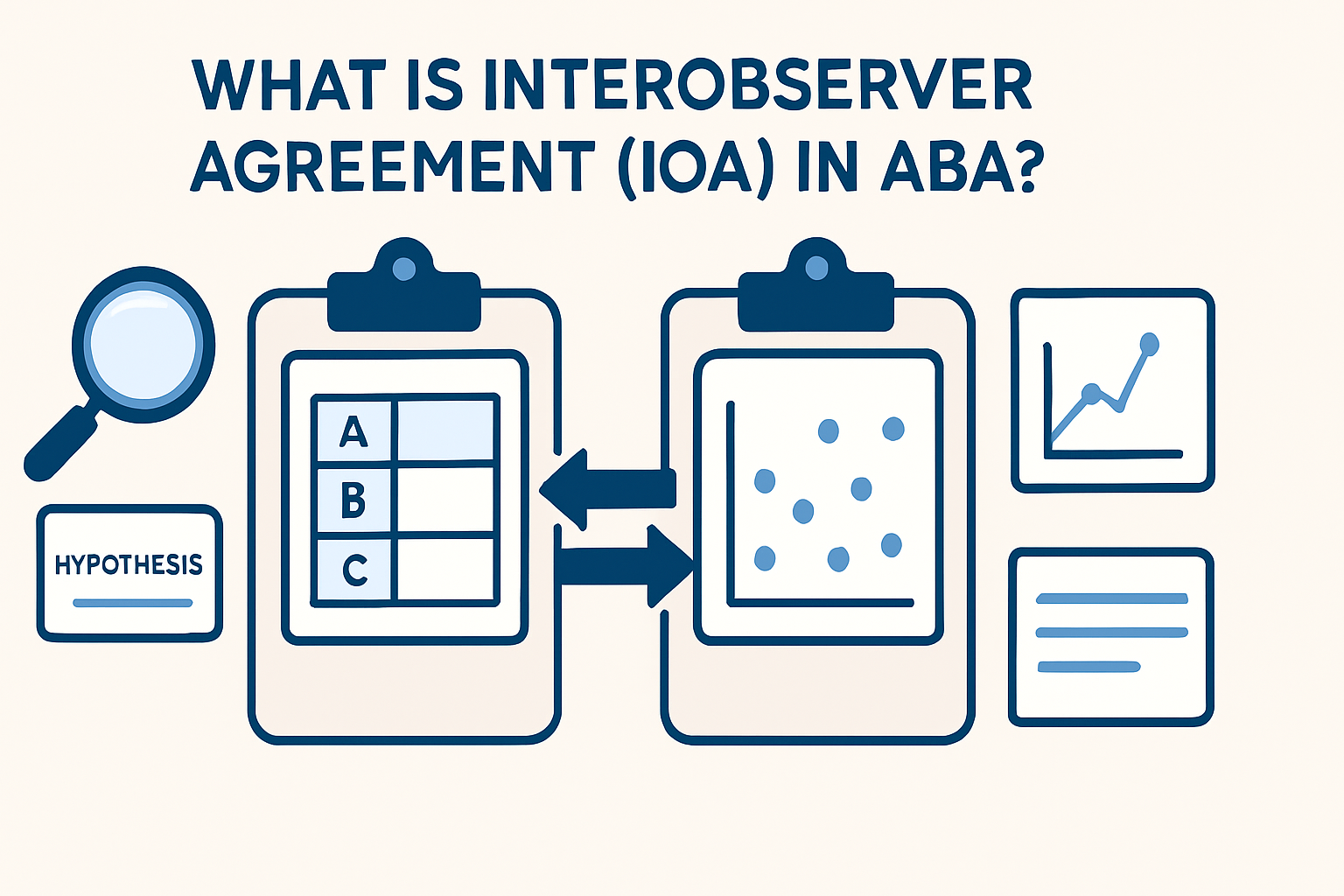
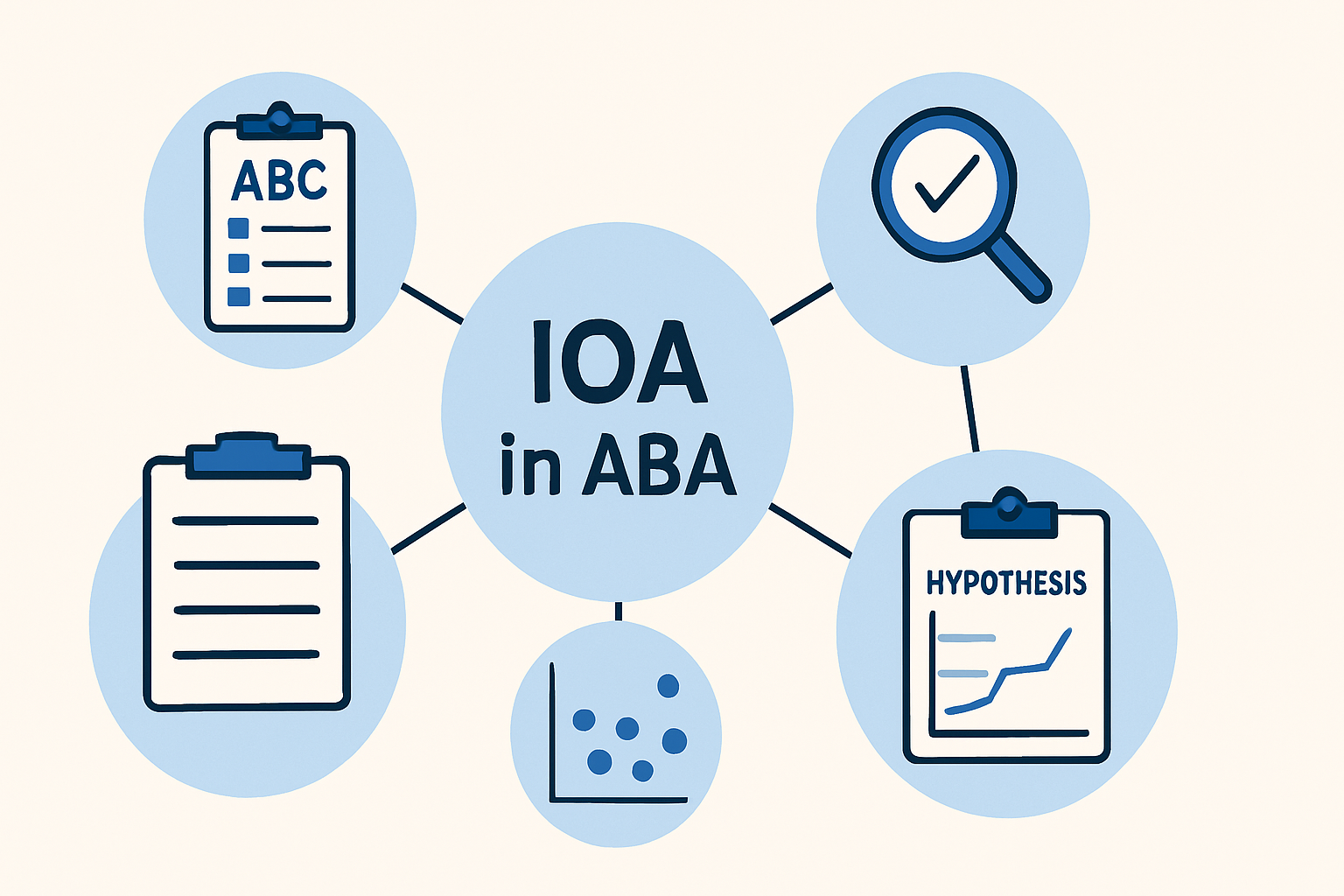
Interobserver Agreement (IOA) represents the degree of consistency between two or more independent observers measuring the same behavioral events. This fundamental measurement concept ensures that the data you collect accurately reflects what actually occurred during observation sessions.
Table of Contents
- IOA in ABA: What is Interobserver Agreement (IOA) in ABA?
- How to Calculate IOA: Formulas and Worked Examples
- IOA on the BCBA Exam: Common Traps and How to Avoid Them
- Quick Checklist for Implementing IOA
- Summary: The Role of IOA in Ethical and Effective Practice
- References
When IOA scores are high, you can trust that your measurement system is reliable and that treatment decisions based on this data are valid. Low agreement signals potential problems with your operational definitions, observer training, or data collection procedures.
The Core Definition and Purpose
IOA quantifies how often independent observers agree on the occurrence or non-occurrence of target behaviors. Its primary purpose is to establish measurement reliability, which directly impacts the internal validity of your behavior-analytic conclusions.
Regular IOA checks help detect observer drift, where observers gradually change how they apply operational definitions over time. They also ensure that treatment decisions—like modifying interventions or declaring mastery—are based on trustworthy data rather than measurement error.
Key Terms You Must Know
- Observer drift: Gradual changes in how observers apply operational definitions, potentially reducing measurement accuracy over time.
- Calibration: The process of training observers to apply operational definitions consistently before data collection begins.
- Internal validity: The extent to which changes in the dependent variable can be attributed to the independent variable rather than measurement error.
- Operational definition: A clear, objective description of the target behavior that specifies exactly what to count or measure.
How to Calculate IOA: Formulas and Worked Examples
Different measurement systems require different IOA calculation methods. Matching the right formula to your data collection procedure is essential for accurate reliability assessment.
Total Count IOA for Frequency Data
Use this method when recording frequency counts of discrete behaviors. Calculate by dividing the smaller count by the larger count, then multiplying by 100.
Example: Two observers record hand-raising during a 10-minute session. Observer A counts 12 instances, Observer B counts 10. Calculation: (10 ÷ 12) × 100 = 83.3% agreement. This meets the typical 80% benchmark for acceptable reliability.
Mean Count-Per-Interval IOA for Duration or Rate
This method works well for duration recording or rate data collected in intervals. Calculate agreement for each interval, then average across all intervals.
Example: Two observers record tantrum duration per 1-minute interval over 5 intervals. If they agree on 4 out of 5 intervals (80% per interval), the mean agreement is 80%. This approach provides a more granular reliability check for longer observation periods.
Trial-by-Trial IOA for Discrete Trial Data
Essential for skill acquisition data where each trial has a clear correct/incorrect outcome. Compare observers’ records trial by trial, then calculate the percentage of trials with agreement.
Example: Two observers record correct/incorrect responses on 10 discrete trials. If they agree on 9 trials, IOA = (9 ÷ 10) × 100 = 90%. This method ensures precise measurement of learning progress and intervention effectiveness.
IOA on the BCBA Exam: Common Traps and How to Avoid Them
Exam questions about IOA often test your ability to apply concepts correctly in practical scenarios. Understanding these common pitfalls will help you navigate tricky questions successfully.
Choosing the Wrong Formula
The most frequent error involves mismatching calculation methods with data collection procedures. Remember that different measurement systems require specific IOA formulas.
- Trap: Using total count IOA for interval data
- Solution: Match the IOA formula to the original measurement system
- Example: Use interval IOA for partial-interval recording data
- Example: Use total duration IOA for duration recording data
Misinterpreting Acceptable Levels
While 80% is the typical benchmark, context matters. For low-rate behaviors or critical treatment decisions, higher agreement may be necessary.
- Trap: Assuming 70% IOA is always acceptable
- Solution: Recognize that 80% minimum is standard practice
- Remember: For low-frequency behaviors, aim for 90% or higher
- Consider: The behavior’s complexity and consequences of measurement error
Overlooking the ‘Why’ Behind IOA
Don’t just memorize calculation steps—understand the purpose. IOA questions ultimately test whether you can ensure data are reliable enough for treatment decisions.
- Trap: Focusing only on calculation mechanics
- Solution: Frame questions through the lens of data reliability
- Ask: “Are these data trustworthy enough to make a clinical decision?”
- Connect: IOA to the BACB Ethics Code requirement for valid assessment
Quick Checklist for Implementing IOA
Use this actionable summary for both clinical practice and exam preparation. Each item represents a critical step in ensuring measurement reliability.
- Establish clear operational definitions before data collection begins
- Train observers to calibration criteria (typically 90% agreement)
- Collect IOA data during at least 20-25% of observation sessions
- Calculate IOA using the method matching your measurement system
- Maintain 80% or higher agreement for reliable data
- Address low IOA through retraining or definition refinement
- Document IOA procedures and results in clinical records
Summary: The Role of IOA in Ethical and Effective Practice
Interobserver Agreement serves as the foundation for trustworthy measurement in applied behavior analysis. Without reliable data, even the most sophisticated interventions cannot be evaluated accurately.
IOA directly supports ethical practice by ensuring treatment decisions rest on valid assessment. The BACB Ethics Code explicitly requires behavior analysts to use measurement procedures that yield valid data, making IOA implementation both a clinical necessity and an ethical obligation.
For BCBA candidates, mastering IOA concepts means understanding both the calculations and their purpose. This knowledge connects to broader themes in the seven dimensions of ABA, particularly the emphasis on technological procedures and effective interventions. When you implement proper IOA procedures, you’re not just following a technical requirement—you’re ensuring that your work produces meaningful, reliable outcomes for clients.
Remember that IOA represents just one aspect of comprehensive measurement validity. For a complete understanding of assessment procedures, explore our guide on assessment in ABA, which covers the full range of tools and techniques for gathering meaningful behavioral data.
References
Complete BCBA Exam Prep
Turn this topic into exam-day practice
Practice concepts in context with five full-length 6th Edition mock exams, two bonus practice exams, a 6th Edition study guide, and key-term flashcards—all in one $120 USD package.
Get the $120 All-in-One Prep Pack
Review everything included on the product page before ordering. No pass guarantee is implied.



