

Video Study: Shaping
Watch: Shaping | 6th ed. | BCBA Exam Prep
Use this lesson as a visual study companion, then return to the definitions and examples below to apply the same concept to BCBA® exam questions.
Prefer a second pass? Open this lesson on YouTube.
Shaping ABA example: What is Shaping in Applied Behavior Analysis?
Shaping is a fundamental behavior change procedure in Applied Behavior Analysis that involves reinforcing successive approximations toward a target terminal behavior. This technique is essential for building new behaviors that don’t currently exist in a learner’s repertoire.
Table of Contents
- Shaping ABA example: What is Shaping in Applied Behavior Analysis?
- Shaping in Action: Detailed ABA Examples
- Shaping on the BCBA Exam: Relevance and Common Traps
- Implementing Shaping Effectively: A Quick Checklist
- Summary and Key Takeaways
The process begins with identifying a starting behavior that the learner can already perform, then systematically reinforcing closer and closer approximations until the final target behavior is achieved.
Core Definition and Key Characteristics
Shaping involves differential reinforcement of behaviors that increasingly resemble the desired terminal behavior. The procedure requires careful planning and immediate reinforcement of each approximation.
- Starting behavior: A behavior already in the learner’s repertoire that resembles the target
- Target terminal behavior: The final goal behavior to be established
- Successive approximations: Planned intermediate steps between start and target
- Differential reinforcement: Reinforcing closer approximations while extinguishing previous ones
Shaping vs. Chaining: A Critical Distinction
Many BCBA candidates confuse shaping with chaining, but these procedures serve different purposes. Shaping modifies the topography or quality of a single behavior, while chaining links separate, discrete behaviors in a sequence.
For example, shaping might teach a child to produce clearer speech sounds, while chaining would teach the steps of brushing teeth. Understanding this distinction is crucial for both clinical practice and exam success.
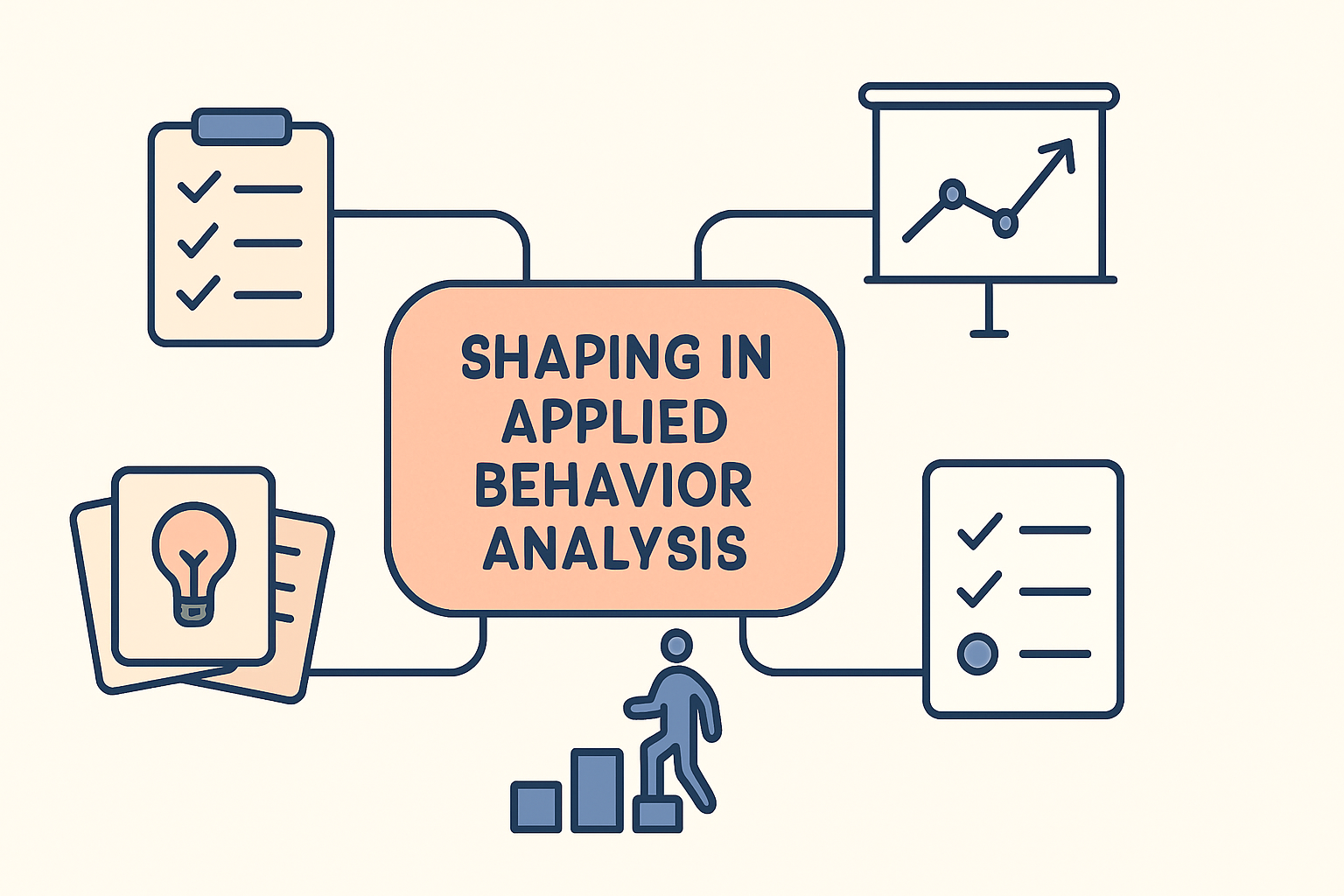
Shaping in Action: Detailed ABA Examples
Let’s examine three practical shaping ABA example scenarios that demonstrate how this procedure works in real applications. Each example includes specific steps and behavioral considerations.
Example 1: Teaching a Child to Vocalize Sounds
Target behavior: Child says ‘mama’ clearly. Starting behavior: Any vocalization sound.
- Step 1: Reinforce any vocalization sound
- Step 2: Reinforce only vocalizations with lip movement
- Step 3: Reinforce only ‘m’ sounds
- Step 4: Reinforce ‘ma’ syllable combinations
- Step 5: Reinforce clear ‘mama’ production
ABC data for Step 3: Antecedent – Therapist presents picture of mom, Behavior – Child makes ‘m’ sound, Consequence – Therapist provides praise and preferred toy. Function: Typically access to social attention or tangible reinforcement.
Example 2: Increasing Duration of Independent Play
Target behavior: 10 minutes of independent play. Starting behavior: 30 seconds of play while adult is 5 feet away.
- Approximation 1: Reinforce 1 minute of independent play
- Approximation 2: Reinforce 3 minutes of independent play
- Approximation 3: Reinforce 5 minutes of independent play
- Approximation 4: Reinforce 7 minutes of independent play
- Terminal: Reinforce 10 minutes of independent play
This example demonstrates reinforcement thinning as the duration requirement increases. The function is typically automatic reinforcement from engaging with preferred activities.
Example 3: Shaping Handwriting Legibility
Target behavior: Writing name legibly. Starting behavior: Scribbling on the line.
- Step 1: Reinforce making distinct letter-like shapes
- Step 2: Reinforce forming first letter of name
- Step 3: Reinforce forming all letters in sequence
- Step 4: Reinforce improving letter spacing
- Step 5: Reinforce legible name writing
This example clearly shows the change in response topography that characterizes shaping procedures. Each step represents a closer approximation to the terminal behavior.
Shaping on the BCBA Exam: Relevance and Common Traps
Understanding shaping is essential for BCBA exam success, as it appears in multiple content areas of the BACB Task List. The exam tests both conceptual understanding and practical application.
How the Exam Tests Your Understanding of Shaping
The BCBA exam typically assesses shaping knowledge through scenario-based questions. You might need to identify when shaping is the appropriate procedure, select the next successive approximation, or differentiate shaping from other behavior change strategies.
These questions often map to Task List item B-5: Use shaping. Understanding the key characteristics and when to apply shaping versus chaining or prompting is crucial.
Frequent Exam Mistakes and How to Avoid Them
Many candidates make predictable errors on shaping questions. Here are the most common traps:
- Confusing shaping with chaining: Remember that shaping changes topography, while chaining links behaviors
- Selecting unrealistic starting behaviors: The starting behavior must already be in the learner’s repertoire
- Failing to reinforce immediately: Reinforcement must follow each approximation promptly
- Making reinforcement criteria too difficult: Steps should be small enough for the learner to achieve
To avoid these mistakes, practice identifying the response topography changes and ensure each approximation is achievable. Review differential reinforcement procedures as they’re fundamental to shaping.
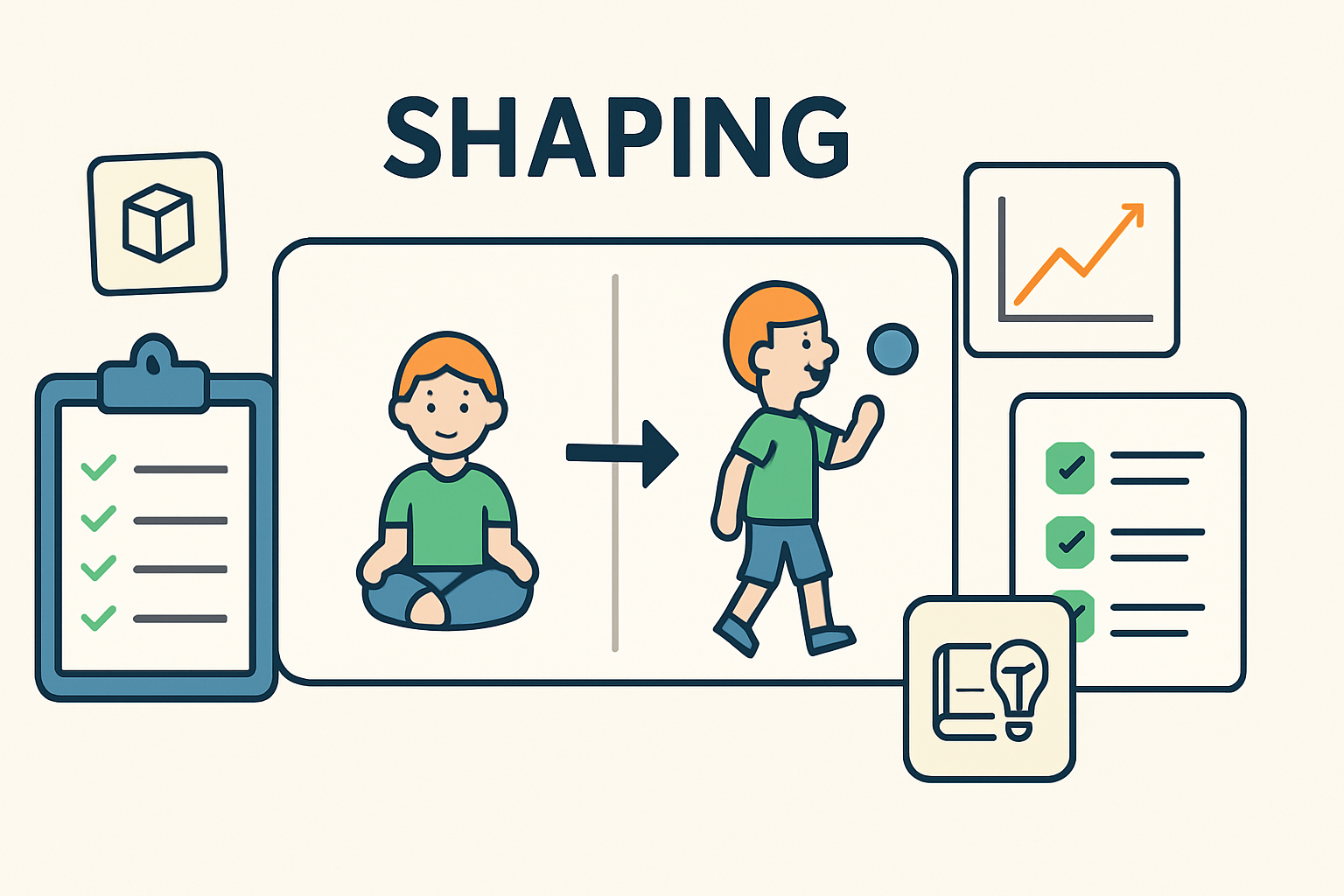
Implementing Shaping Effectively: A Quick Checklist
Use this practical checklist when planning and implementing shaping procedures in clinical practice or studying for the BCBA exam.
- Define the terminal target behavior clearly and measurably
- Identify a starting behavior already in the learner’s repertoire
- Plan successive approximations that are small, achievable steps
- Use immediate and potent reinforcers for each approximation
- Apply differential reinforcement consistently
- Monitor progress and adjust approximations as needed
- Fade reinforcement gradually as the terminal behavior stabilizes
- Document each step and the reinforcement criteria
This systematic approach ensures effective implementation and helps avoid common pitfalls in shaping procedures.
Summary and Key Takeaways
Shaping remains one of the most powerful tools in behavior analysis for building new behaviors. Mastering this procedure requires understanding its core principles and practicing application through realistic scenarios.
Remember that shaping involves reinforcing successive approximations toward a target behavior, differs fundamentally from chaining, and requires careful planning of achievable steps. For BCBA exam preparation, focus on identifying when shaping is appropriate and selecting proper approximations.
To deepen your understanding of related concepts, explore our guide on chaining procedures and how they complement shaping in comprehensive behavior change programs. For authoritative information on behavior analysis procedures, consult the Behavior Analyst Certification Board resources and peer-reviewed literature on shaping applications.
Complete BCBA Exam Prep
Turn this topic into exam-day practice
Practice concepts in context with five full-length 6th Edition mock exams, two bonus practice exams, a 6th Edition study guide, and key-term flashcards—all in one $120 USD package.
Get the $120 All-in-One Prep Pack
Review everything included on the product page before ordering. No pass guarantee is implied.



