
What Is a Stimulus Delta (S-Delta)?
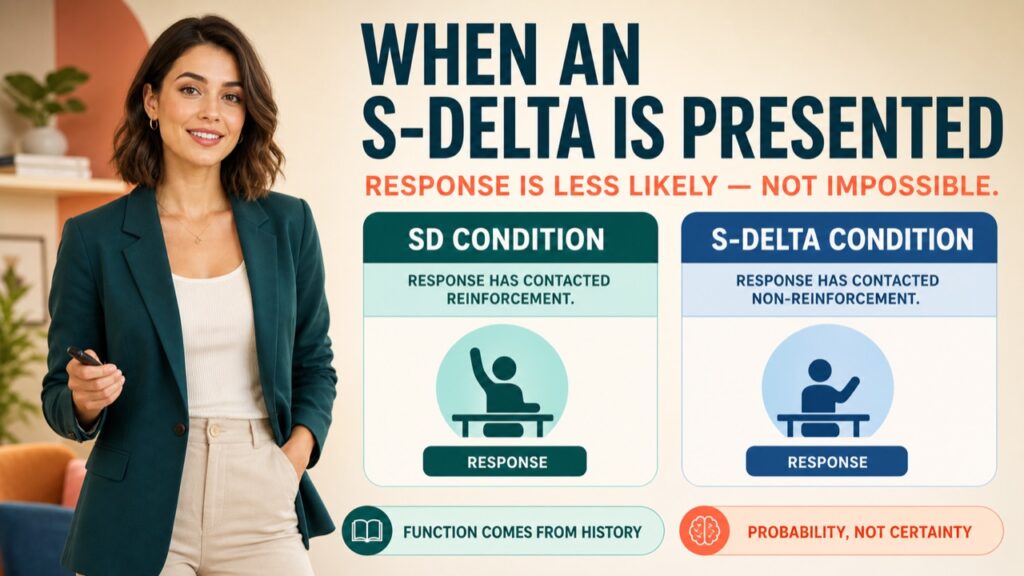
In applied behavior analysis, a stimulus delta (S-delta) is a stimulus in the presence of which a particular response has not been reinforced in the past, correlated with a lower probability of that response. When a stimulus delta is presented, a particular response is less likely to occur because it signals that non-reinforcement is likely. This concept is central to understanding stimulus control and discrimination training, which are foundational for behavior-analytic practice and BCBA exam preparation.
Table of Contents
- What Is a Stimulus Delta (S-Delta)?
- Why Is a Response Less Likely in the Presence of an S-Delta?
- Stimulus Delta vs. Extinction: Key Differences
- Discrimination Training: How S-Delta Works
- Practical Implications for Behavior Analysts
- Common Misconceptions and Scenario Checks
- Study Guide for BCBA Exam Preparation
- Conclusion and Next Steps
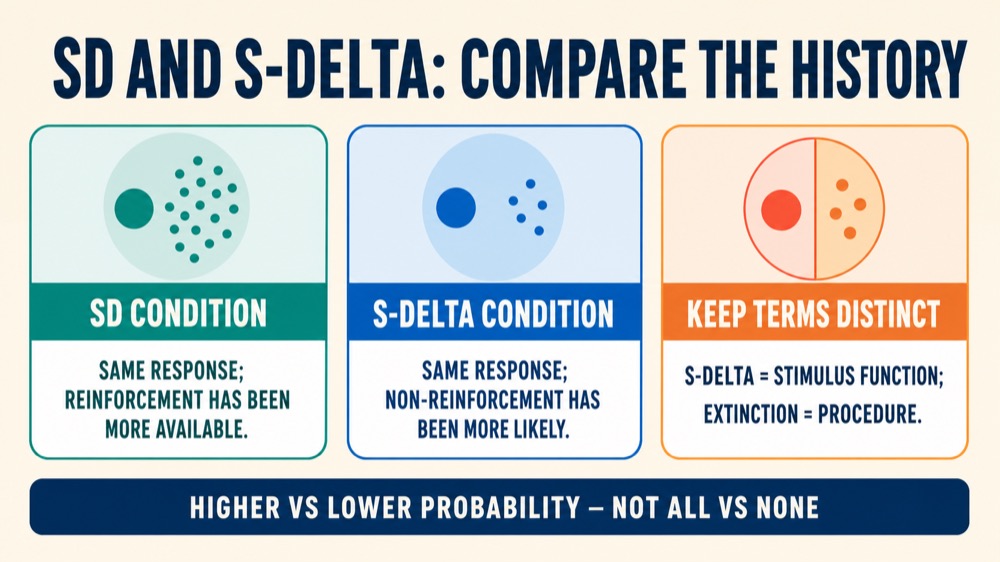
Compare a discriminative stimulus (SD) with an S-delta. An SD is correlated with greater reinforcement availability for a particular response; an S-delta is correlated with non-reinforcement or extinction for that response. For example, a teacher’s “questions now” card may function as an SD for raising a hand when questions are answered, while a “quiet work” card may function as an S-delta when hand raising has not produced teacher attention. The cards’ functions come from the learner’s history, not from their colors or appearance.
The effect of an S-delta is probabilistic rather than absolute. A response may occasionally occur in the presence of an S-delta, especially if a strong motivating operation is present or if the discrimination is not fully established. However, across repeated presentations, the response becomes less frequent in the S-delta condition compared to the SD condition. This article explains why a response is less likely in the presence of an S-delta, how it differs from extinction, and how to apply this concept in practice.
Why Is a Response Less Likely in the Presence of an S-Delta?
When a stimulus delta is presented, a particular response is less likely to occur because of the individual’s reinforcement history in that context. During discrimination training, the response is reinforced in the presence of the SD and not reinforced in the presence of the S-delta. This differential reinforcement establishes a pattern: the response occurs more often in the presence of the SD and less often in the presence of the S-delta. The S-delta becomes a signal for “no reinforcement available,” which reduces the response probability in that condition.
Consider a child who requests a snack. When the snack jar is visible during scheduled snack time (SD), an appropriate request has produced a snack. When the jar is stored and the “snack finished” cue is present (S-delta), the same request has not produced a snack. Across repeated opportunities, requesting becomes less likely in that condition. The S-delta does not erase requesting; the response may still occur where a different stimulus condition has a reinforcement history.
It is important to note that the suppressive effect of an S-delta is not immediate or guaranteed. In the early stages of discrimination training, responding may still occur during S-delta trials, but with repeated non-reinforcement, the response probability decreases. The strength of the S-delta’s control depends on factors such as stimulus salience, the number of pairings with non-reinforcement, and the presence of motivating operations. Behavior analysts must consider these variables when designing procedures to establish stimulus control.
Stimulus Delta vs. Extinction: Key Differences
An S-delta and extinction are related but not interchangeable. An S-delta is a stimulus function established through differential reinforcement: a specified response has contacted non-reinforcement more often in its presence than in the SD condition. Extinction is a procedure in which the reinforcer that previously maintained a response is discontinued. Extinction can be arranged in a particular stimulus context; it is not necessarily global, and it does not guarantee that responding will reach zero.
Suppose “more” has produced a cookie during snack time. A “snack available” cue may become an SD when the request is reinforced, while an “all done” cue may become an S-delta when the request is not reinforced in that condition. By contrast, an extinction procedure discontinues the cookie consequence for the previously reinforced request under the conditions specified in the plan. The stimulus relation and the procedure must therefore be identified separately.
- S-delta: a stimulus correlated with non-reinforcement for a specified response.
- Extinction: discontinuation of the reinforcer that previously maintained a response.
- Differential response: discrimination training produces higher response probability in the SD condition and lower probability in the S-delta condition.
- Scope: neither concept means the response is permanently eliminated across every setting.
Discrimination Training: How S-Delta Works
Discrimination training is the process by which a response comes under the control of an SD and an S-delta. During this training, the response is reinforced in the presence of the SD and not reinforced in the presence of the S-delta. Over repeated trials, the learner reliably responds in the presence of the SD and withholds responding in the presence of the S-delta. This differential responding is known as discriminated operant behavior, and it forms the basis of many everyday skills.
For example, a teacher might teach children to raise their hands before speaking. When the teacher looks at the group and says “raise your hand,” that is an SD—raising the hand is reinforced by being called on. When the teacher is talking to another adult, that is an S-delta—raising the hand is not reinforced because the teacher is not attending to the children. Through repeated trials, children learn to raise their hands only when the teacher is addressing them. This simple example illustrates how an S-delta reduces inappropriate interruptions and promotes appropriate timing.
Behavior analysts must carefully choose the S-delta to ensure it is distinct from the SD. If the S-delta is too similar to the SD, discrimination is difficult and errors may occur. If the S-delta is too broad, the response may be suppressed in contexts where it should occur. Effective discrimination training requires systematic variation of irrelevant features while keeping the critical features constant. For more on related processes, see our guide on discrimination training.
Practical Implications for Behavior Analysts
Practitioners can establish clear availability cues while teaching an appropriate response. For example, a “break available” card can function as an SD when an appropriate break request is honored, while a “break later” card can function as an S-delta when that request is not reinforced under the planned condition. The card’s function must be demonstrated by data and teaching history; color alone does not make a stimulus an SD or S-delta.
An S-delta is not a punisher. It is a stimulus condition correlated with non-reinforcement for a specified response. Plans should protect essential communication, safety, assent, and access needs; an overly broad S-delta may reduce a useful response in situations where it should remain available. Analysts should define the response, stimulus condition, consequence, and alternative response explicitly, then monitor for unwanted generalization.
Control is context-specific. A child may request candy less often in a doctor’s office where that request has not been reinforced, yet request it at home where reinforcement sometimes occurs. Analysts should probe across people, settings, and examples before concluding that an S-delta relation has generalized. See our guide to stimulus generalization and response generalization.
Common Misconceptions and Scenario Checks
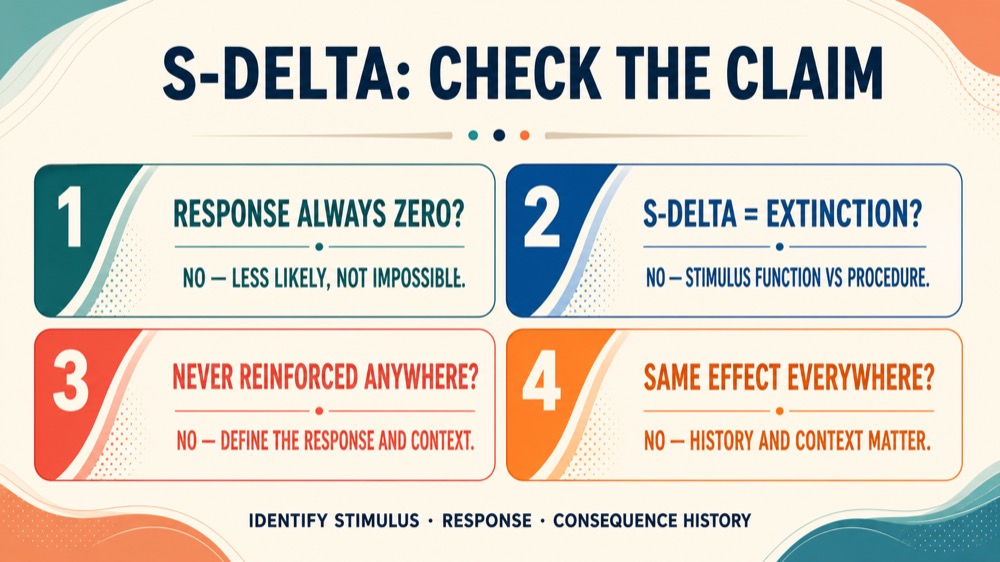
There are several common misconceptions about S-delta that can lead to errors in practice. Understanding these can help you avoid mistakes.
- Misconception: The presence of an S-delta always completely suppresses the response. Clarification: The response is less likely, but may still occur occasionally due to motivating operations or incomplete discrimination.
- Misconception: An S-delta is a stimulus that has never been paired with reinforcement. Clarification: It may have been paired with reinforcement in the past, but the current history indicates non-reinforcement in that context.
- Misconception: S-delta and extinction are the same thing. Clarification: They are distinct: S-delta is a stimulus, extinction is a procedure.
- Misconception: The presence of an S-delta increases the future probability of the response. Clarification: It decreases the probability of the response in its presence.
- Misconception: S-delta effects are identical across all contexts. Clarification: Effects depend on the individual’s reinforcement history in each context.
Recognizing these misconceptions helps behavior analysts avoid errors in practice. When interpreting behavioral data, distinguish between the stimulus function of an S-delta and the procedural operation of extinction. The S-delta does not eliminate a behavior; it establishes a context in which non-reinforcement is likely, reducing response probability in that context.
Study Guide for BCBA Exam Preparation
To master the concept of S-delta for the BCBA exam, review the key points below. This study guide will help you focus your preparation and ensure you can distinguish between related terms.
- Define S-delta: a stimulus in the presence of which a response has not been reinforced, correlated with a lower probability of that response.
- Contrast S-delta with SD: SD signals reinforcement available; S-delta signals reinforcement unavailable.
- Identify S-delta in scenarios: look for the stimulus condition that reliably precedes non-reinforcement.
- Explain why a response is less likely in the presence of an S-delta: due to the history of non-reinforcement in that context.
- Distinguish S-delta from extinction: extinction is a procedure; S-delta is a stimulus.
- Apply S-delta in discrimination training: response reinforced in presence of SD, not reinforced in presence of S-delta.
- Consider motivating operations: an establishing operation may temporarily increase the response even in the presence of an S-delta.
- Plan for generalization: use diverse SD and S-delta examples to promote appropriate responding across settings.
For additional practice, you can take the Free BCBA Mock Exam, which provides feedback on your understanding of applied behavior analysis concepts. The mock exam covers a range of topics relevant to the BCBA certification process, helping you build confidence and identify areas for improvement.
Conclusion and Next Steps
When an S-delta is presented, the target response is less likely—not impossible—because that stimulus condition has been correlated with non-reinforcement. Keep the stimulus function distinct from the extinction procedure and evaluate response probability in context. Review our stimulus control in ABA guide, practice with the free BCBA mock exam, and use the official BCBA Test Content Outline to confirm current exam scope.



