
What Is Stimulus Salience?
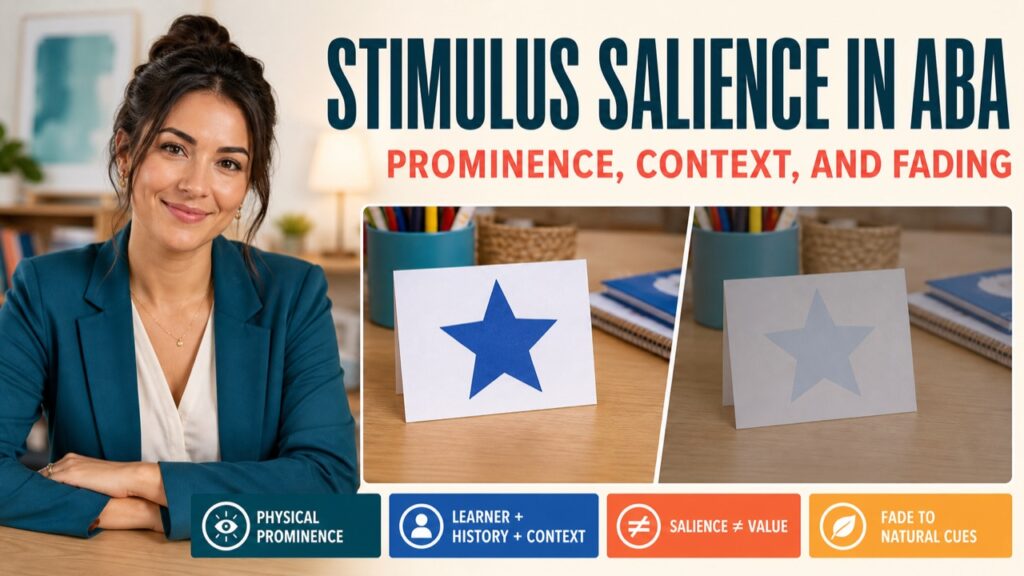
Stimulus salience refers to the prominence or noticeability of a stimulus in the environment. In applied behavior analysis (ABA), salience is a physical characteristic—such as brightness, size, contrast, motion, or novelty—that makes a stimulus stand out among others. When a stimulus has high salience, it is more likely to capture attention and, consequently, may acquire discriminative control more readily during discrimination training. However, salience is not the same as meaning or value; a stimulus can be salient without being reinforcing or aversive to a particular learner.
Table of Contents
- What Is Stimulus Salience?
- How Salience Affects Stimulus Control and Discrimination Training
- Salience vs. Other Stimulus Properties
- Why Salience Is Not the Whole Story: History and Motivating Operations
- Common Pitfalls and How to Avoid Them
- Practical Teaching Implications
- Relationship to Generalization and Stimulus Control
- Exam Preparation: What to Remember About Stimulus Salience
- Free BCBA Mock Exam
For example, a bright red circle on a white board is more salient than a pale pink circle on a similar board. A loud beep is more salient than a soft click. In everyday learning, a child may respond faster to a flashing light than to a steady, dim light. These examples illustrate that salience involves the physical attributes of a stimulus, but its effect on behavior also depends on the learner’s sensory abilities, learning history, and current motivating operations. Thus, a stimulus may be highly salient in one context but barely noticeable in another.
How Salience Affects Stimulus Control and Discrimination Training
Stimulus control occurs when a behavior is more likely in the presence of a particular stimulus because of a history of reinforcement in its presence. Discrimination training is a procedure that establishes stimulus control by reinforcing a response in the presence of a discriminative stimulus (SD) and not reinforcing it in the presence of other stimuli. Salience can accelerate this process because a highly noticeable stimulus is easier for the learner to detect and remember the correlation with reinforcement.
For instance, in a matching-to-sample task, a bright red sample may lead to faster acquisition than a slightly different shade of red. The learner can more easily notice the relevant feature, which reduces errors and speeds up learning. However, salience is not sufficient for discrimination to occur. The learner’s history and current motivating operations also play a critical role. A stimulus that is salient to one person may not be salient to another due to sensory differences or prior experience. For example, a very bright light may be highly salient to a typical adult but aversive to a child with light sensitivity, potentially controlling escape behavior rather than the intended discrimination.
Here are examples of how salience can be used in discrimination training:
- High salience example: A teacher uses a large, brightly colored flashcard with the word “dog” while presenting a plain white card with “cat.” The dog card is more likely to evoke the correct response.
- Low salience example: A therapist uses two nearly identical gray circles, making the discrimination task much harder and slower to learn.
- Fading example: Start with a bright red circle as SD and a white circle as S-delta. Gradually decrease the redness until both are similar in color, but the learner still responds correctly.
The key is that salience can facilitate acquisition, but it must be faded to promote generalization. If you always teach with exaggerated stimuli, the learner may only respond to those exaggerated features and not to the natural stimuli they will encounter in daily life. Thus, careful programming is required.
Salience vs. Other Stimulus Properties
Salience is often confused with other stimulus properties like intensity, value, or discriminability. Intensity (e.g., loudness, brightness) is a physical dimension, but salience is a broader concept that includes contrast, novelty, and motion, not just intensity. For example, a small moving object can be more salient than a large stationary object. Similarly, a novel stimulus that appears suddenly in a familiar environment may be more salient than a familiar but bright stimulus.
Salience also differs from stimulus value. A stimulus that is salient may not be reinforcing or aversive. For instance, a flashing neon sign is salient but may have no functional value for a learner. Conversely, a faint whisper from a caregiver may be highly significant because of its history with reinforcement, even though it is not physically prominent. This distinction is important for understanding why salience alone cannot explain stimulus control.
Furthermore, salience is context-dependent. A stimulus may be salient in one context but not another. For example, a red light is highly salient in a dark room but less so in a brightly lit environment. Similarly, a bell may be salient in a quiet classroom but ignored in a noisy cafeteria. This means that salience cannot be defined solely by physical properties; it always interacts with the environment and the learner’s current state. In ABA, we must consider these contextual factors when designing teaching programs.
Why Salience Is Not the Whole Story: History and Motivating Operations
While salience is a physical characteristic, its effect on behavior depends on the learner’s history and current motivating operations. A learner who has been reinforced for attending to a specific stimulus will be more likely to respond to it, even if it is not the most salient stimulus present. Conversely, a learner who is satiated on a particular reinforcer may not respond to an otherwise salient discriminative stimulus.
In practice, behavior analysts assess whether a stimulus is salient by observing whether it evokes the target response. If a stimulus does not gain control, we might increase its salience or adjust motivational variables. But we must also consider that too many salient stimuli can compete, leading to faulty stimulus control—the learner may respond to an irrelevant feature. For example, if a therapist holds up a bright red card but also wears a shiny watch, the child may attend to the watch instead. Thus, minimizing distractions is essential.
Common Pitfalls and How to Avoid Them
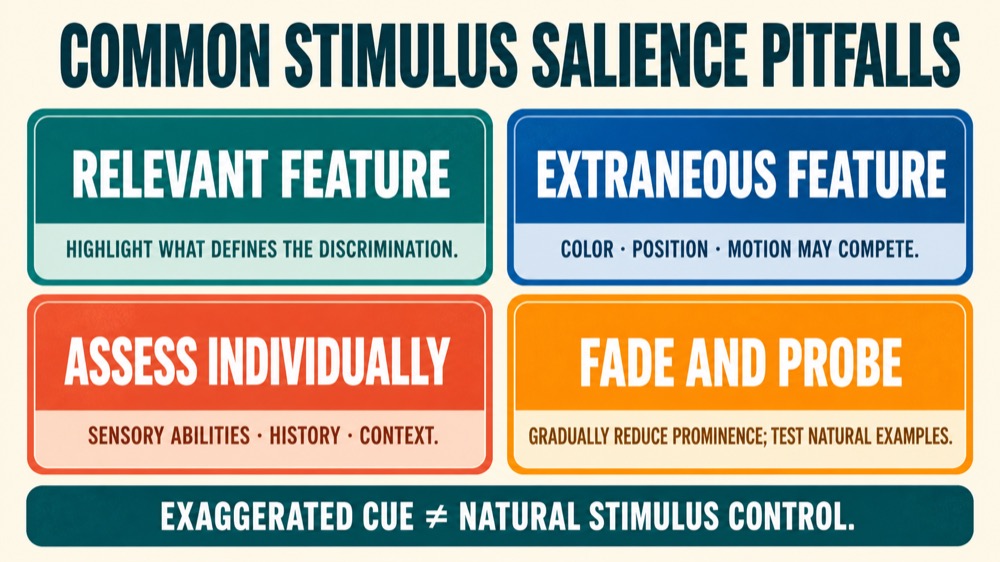
One major pitfall is over-reliance on salience. If you always use exaggerated stimuli, the learner may become dependent on them and fail to respond to natural stimuli. For example, if you always teach with a 3-inch red circle, the child may not respond to a real stop sign because it is smaller and less saturated. To avoid this, use fading to gradually reduce salience.
Another pitfall is that extraneous salient stimuli can compete with the relevant ones. For instance, a child may be more focused on the bright picture on the wall than on the flashcard you are presenting. This can lead to faulty stimulus control, where the behavior is controlled by the wrong feature. To mitigate, minimize distractions and make the relevant stimulus the most salient feature in the environment. Here are common traps to watch for:
- Common trap: Assuming that a more intense stimulus is always better. Intensity is only one dimension of salience; contrast and novelty also matter.
- Common trap: Believing that salience is a property of the stimulus alone. It depends on the learner’s sensory system and current context.
- Common trap: Using the same salient stimulus for all learners. Individual differences mean what is salient for one may not be for another.
- Common trap: Forgetting to fade salience. Without fading, generalization may be poor.
To promote generalization, after the learner has mastered a discrimination with high-salience stimuli, systematically fade the salience to resemble natural conditions. For example, gradually reduce the size of the red circle or make the S-delta more similar to the SD. This helps ensure that the behavior occurs in real-world settings. Remember, the goal is to transfer control to the natural environment, not to rely on artificial cues forever.
Practical Teaching Implications
In teaching, we can intentionally increase salience to facilitate acquisition of discrimination. Clinicians might use bold colors, larger sizes, or added motion to highlight the relevant stimulus. For example, when teaching a child to request a snack, a therapist might hold up a brightly colored picture of a cracker and say “cracker” while presenting a dull picture of a different item as a distractor.
After initial acquisition, the therapist gradually fades the salience by using more naturalistic pictures and eventually the actual object. This process is known as fading, and it is a type of stimulus prompt. It is important to fade both the physical characteristics and any extra prompts (e.g., pointing) to avoid prompt dependence. For example, a therapist might start by pointing to the correct card, then fade the point to a glance, and finally remove it entirely.
Another example: teaching a learner to discriminate between a car and a truck. You might start with a bright red car and a grey truck, then move to a red car and a red truck, forcing attention to shape rather than color. This teaches the learner to attend to the defining features of the stimulus class. Such strategies are vital for ensuring that the learner responds to the critical features, not incidental ones.
Relationship to Generalization and Stimulus Control
For example, if you teach a child to identify a “dog” using a bright cartoon dog, they may not recognize a real dog. By gradually presenting different dog pictures and eventually real dogs, you promote generalization. This is a core goal of ABA programs, as discussed in our article on stimulus generalization.
Salience can shift stimulus control, but teaching should transfer control to critical rather than incidental features. See our guide to stimulus control in ABA.
Exam Preparation: What to Remember About Stimulus Salience
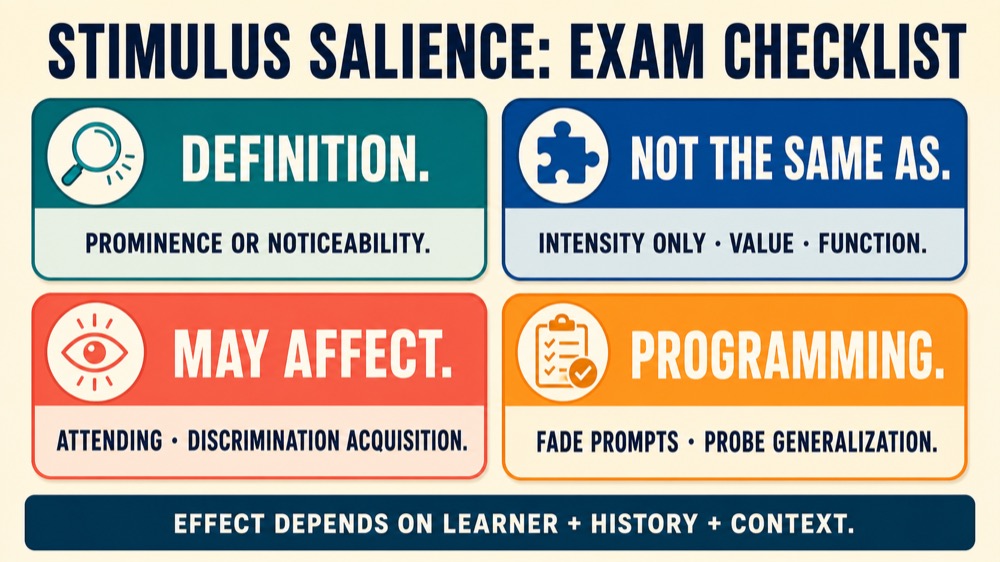
For the BCBA exam, you should be able to define stimulus salience and identify examples. Items may ask which stimulus is more salient or how to use salience to improve discrimination. Remember that salience is about physical prominence, not value; it can be manipulated to speed up learning, but must be faded to ensure generalization. Here is a quick study checklist to help you prepare:
- Define stimulus salience and give examples of high and low salience.
- Explain how salience affects discrimination training and stimulus control.
- Differentiate salience from intensity, value, and discriminability.
- Identify common pitfalls such as over-reliance on salience and competing stimuli.
- Describe fading procedures to reduce salience and promote generalization.
- Relate salience to motivating operations and learning history.
Additionally, practicing with exam-style questions is one of the most effective ways to solidify your understanding. However, please note that the current BCBA test content outline does not specifically list stimulus salience as a separate topic; instead, salience is typically covered under broader concepts like discrimination training and stimulus control. You can review the official BACB BCBA Task List for a complete list of required knowledge areas.
Free BCBA Mock Exam
Ready to test your knowledge further? Take our free BCBA mock exam to practice with a variety of questions and receive feedback on your performance. While the mock exam covers many topics relevant to the BCBA exam, it does not guarantee that stimulus salience will appear. The more you practice, the more confident you will be on exam day. Good luck with your studies!



