
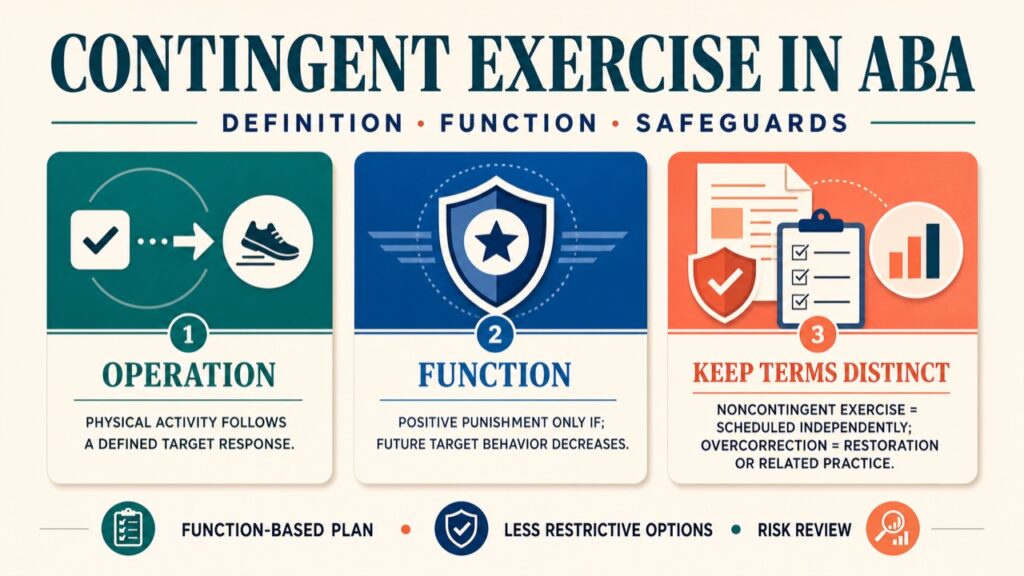
Contingent exercise in ABA describes an arrangement in which a specified physical activity follows a defined target behavior. The activity functions as a punisher, and the arrangement qualifies as positive punishment, only when reliable measurement shows that the future probability of that behavior decreases. This educational guide explains the definition, examples and nonexamples, distinctions from overcorrection and noncontingent exercise, and the safeguards required before any real-world consideration. It is not an implementation protocol.
Table of Contents
- What Is Contingent Exercise in ABA?
- Examples and Nonexamples of Contingent Exercise
- Contingent Exercise vs. Overcorrection
- Important Considerations in Using Contingent Exercise
- Function-Based Assessment and Reinforcement Alternatives
- Common Traps and Misconceptions
- Ethical Decision Checklist
- Summary and Next Steps
- Reference
What Is Contingent Exercise in ABA?
In the contingent arrangement, a physical-activity requirement is added after the specified response. The activity is not topographically or functionally related to correcting the target behavior. The word “contingent” identifies the response-consequence relation: the activity follows defined occurrences of the target response rather than being scheduled independently of behavior. Calling the consequence positive punishment additionally requires evidence of a future decrease; the label cannot be assigned from appearance or practitioner intent alone.
The distinction between operation and function is important. A team can arrange exercise contingently, yet the activity is not a punisher if the target behavior remains stable or increases. If behavior increases, the activity or other features of the contingency may be reinforcing. Analysts therefore need a clear operational definition, observation time, repeated measurement, and an appropriate design before making a functional claim.
Contrast this with noncontingent exercise, which is an antecedent intervention. In noncontingent exercise, physical activity is provided on a fixed or variable schedule regardless of behavior. For example, a teacher might give a student a daily five-minute jogging break to help them stay focused. That is not contingent exercise because the exercise is not a consequence for a specific target behavior.
Examples and Nonexamples of Contingent Exercise
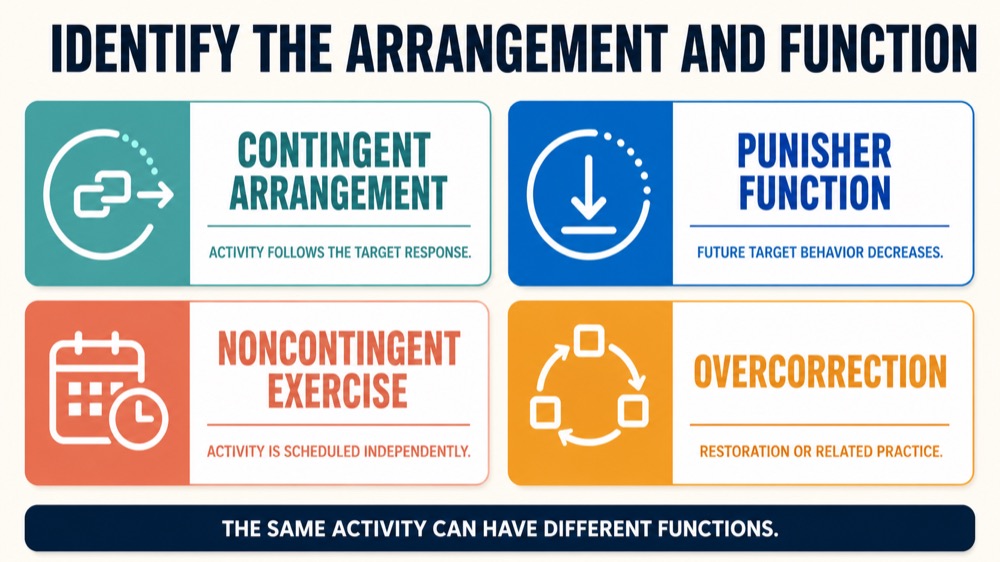
Use the following original, nonprescriptive scenarios to identify the arrangement and its measured function:
- Example by effect: In a hypothetical supervised plan, a medically cleared brief movement follows a precisely defined response, and repeated comparison data show a lower future response probability. The contingent activity functioned as a punisher in that case.
- Not a demonstrated punisher: The same response-activity sequence is arranged, but the target response does not decrease. The consequence has not been shown to function as punishment.
- Possible reinforcement: A person seeks or enjoys the activity and the target response increases. The activity may be reinforcing rather than punishing.
- Noncontingent exercise: Physical activity occurs on a time-based schedule or as part of a wellness routine regardless of the target behavior.
- Overcorrection: The consequence requires repairing effects of the response or repeatedly practicing a related appropriate response, rather than an unrelated physical activity.
These labels describe functional relations; they do not establish that any punishment-based plan is safe, ethical, necessary, or authorized for a particular person.
Contingent Exercise vs. Overcorrection
Overcorrection is historically described in two forms. Restitutional overcorrection requires correcting the effects of behavior and improving the environment beyond its prior state. Positive-practice overcorrection requires repeated practice of a topographically related appropriate response. Contingent exercise instead adds a physical activity that is unrelated to restoring the environment or practicing the correct response. The procedures are distinguished by their operations, not by whether either is acceptable in a given case.
The key comparison is unrelated physical activity versus response-related restoration or practice. Both are punishment-based arrangements and carry substantial clinical and ethical concerns. Before either is considered, a qualified team should evaluate behavioral function, reinforcement-based and less restrictive alternatives, individual risk, current governing requirements, consent and assent processes where applicable, oversight, and objective stopping criteria.
Important Considerations in Using Contingent Exercise
This overview is not sufficient to authorize implementation. Before any consideration, qualified reviewers should assess medical and physical risk, age and development, disability, trauma history, dignity, assent, the person’s right to communication and breaks, and current organizational, professional, and legal requirements. Qualified medical or safety input may be necessary; merely reducing the intensity of an exercise does not establish safety.
Physical activity is not inherently punishing. It may be neutral, aversive, or reinforcing for a particular person at a particular time. A preference assessment may inform risk, but it cannot establish a punisher function. Only measured changes in the future target behavior, interpreted with an appropriate design and competing explanations considered, can support that conclusion.
Current physiological state, motivating operations, learning history, context, and changes over time can alter the activity’s effect. Analysts should not infer function from fatigue, enjoyment, compliance, or a single observation. Repeated data are also needed to detect adverse effects, avoidance, emotional responding, response substitution, or deterioration in rapport.
Cross-setting punishment should not be treated as a generalization goal. Any approved plan should define its scope narrowly, protect settings where useful communication must remain available, and monitor whether suppression spreads to appropriate responses or unplanned contexts. Treatment integrity means implementing the written plan accurately within defined opportunities, not exposing a person to a punisher everywhere.
Ongoing measurement should report observation time alongside frequency when opportunities differ, as well as integrity, alternative behavior, adverse events, and contextual changes. A simple before-and-after decrease does not by itself demonstrate a functional relation; that inference requires an appropriate experimental or evaluative design with replication and plausible alternatives addressed.
Function-Based Assessment and Reinforcement Alternatives
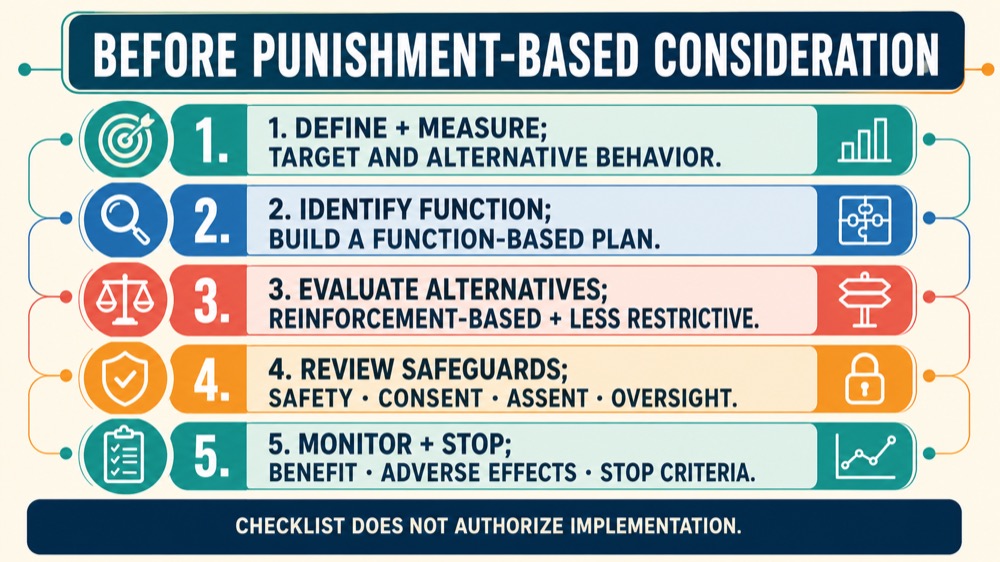
Before considering a punishment-based procedure, analysts should identify the variables maintaining the target behavior and design a function-based intervention. Reinforcement-based, skill-building, antecedent, and environmental alternatives should be evaluated when feasible, and the record should explain why less restrictive options are insufficient or contraindicated. Contingent exercise is not a default intervention; consideration requires documented risk-benefit analysis, applicable consent and assent processes, qualified oversight, and ongoing monitoring.
Safety review must cover contraindications, pain, fatigue, fall or injury risk, coercion, privacy, and the possibility that staff physical prompting could become restrictive. Ease of staff control is not a clinical justification. Any plan must specify who is qualified to oversee it, what adverse events trigger an immediate stop, and how the person’s welfare and dignity will be independently reviewed.
Treatment-integrity measurement should compare implementation with the written protocol across applicable opportunities. It does not justify an automatic consequence after every apparent event, especially when definitions, safety, assent, medical status, or context are uncertain. Staff need competency-based training, supervision, and authority to pause the procedure when stop criteria are met.
If the target behavior does not decrease, or if adverse effects emerge, the result does not justify increasing exercise type, duration, or intensity. The team should pause and reassess the functional hypothesis, measurement, contextual variables, reinforcement plan, safety, and whether the punishment-based component should be discontinued.
Common Traps and Misconceptions
- Assuming exercise is automatically punishing: function must be demonstrated by a future decrease in the defined target behavior.
- Confusing the procedures: contingent exercise follows the target response; noncontingent exercise is scheduled independently; overcorrection requires restoration or related practice.
- Skipping function-based planning: maintaining variables and reinforcement-based alternatives may remain unaddressed.
- Treating consistency as universality: context and current state can change effects, and cross-setting exposure may suppress appropriate behavior.
- Using a preference result as proof: preference does not establish punisher function or safety.
- Ignoring governance: follow current consent, assent, oversight, organizational, professional, and legal requirements applicable to the case.
- Relying on outcome data alone: monitor integrity and adverse effects, and use an appropriate design before claiming a functional relation.
Ethical Decision Checklist
For exam scenarios or professional review, use this checklist to evaluate whether a proposed plan has addressed necessary safeguards. The checklist does not authorize implementation.
- Define and measure the target behavior, alternative behavior, opportunities, and observation time.
- Identify behavioral function and document a function-based intervention.
- Evaluate reinforcement-based, skill-building, antecedent, environmental, and less restrictive alternatives.
- Complete individualized medical, physical, trauma, dignity, and coercion risk review.
- Follow applicable consent, assent, oversight, organizational, professional, and legal requirements.
- Specify treatment-integrity measures, adverse-event monitoring, stop criteria, and independent review.
- Use an appropriate evaluative design; do not infer causality from a simple before-and-after change.
- Pause and reassess if benefit is absent, adverse effects appear, or welfare is compromised.
Qualified clinical supervision and current governing requirements remain necessary. A checklist, caregiver request, or exam definition does not by itself provide sufficient justification for a punishment-based procedure.
Summary and Next Steps
Contingent exercise is a positive punishment procedure that can reduce a target behavior when the exercise is added contingently and the behavior decreases. It differs from noncontingent exercise and overcorrection in important ways. Safety, age-appropriateness, motivating operations, and individual preferences all influence whether the exercise functions as a punisher.
Function-based assessment and reinforcement-based alternatives should guide planning before a punishment-based component is considered. Data are essential, but a causal claim also requires an appropriate design. Risk-benefit review, applicable consent and assent, qualified oversight, treatment-integrity data, adverse-effect monitoring, and predefined stop criteria are central safeguards.
To continue building your skills in behavior reduction, practice with scenario-based questions. Our free BCBA mock exam offers realistic practice and feedback to help you solidify your understanding of procedures like contingent exercise. Strengthen your confidence and be prepared for your next step.



