
What Is an Unconditioned Stimulus?
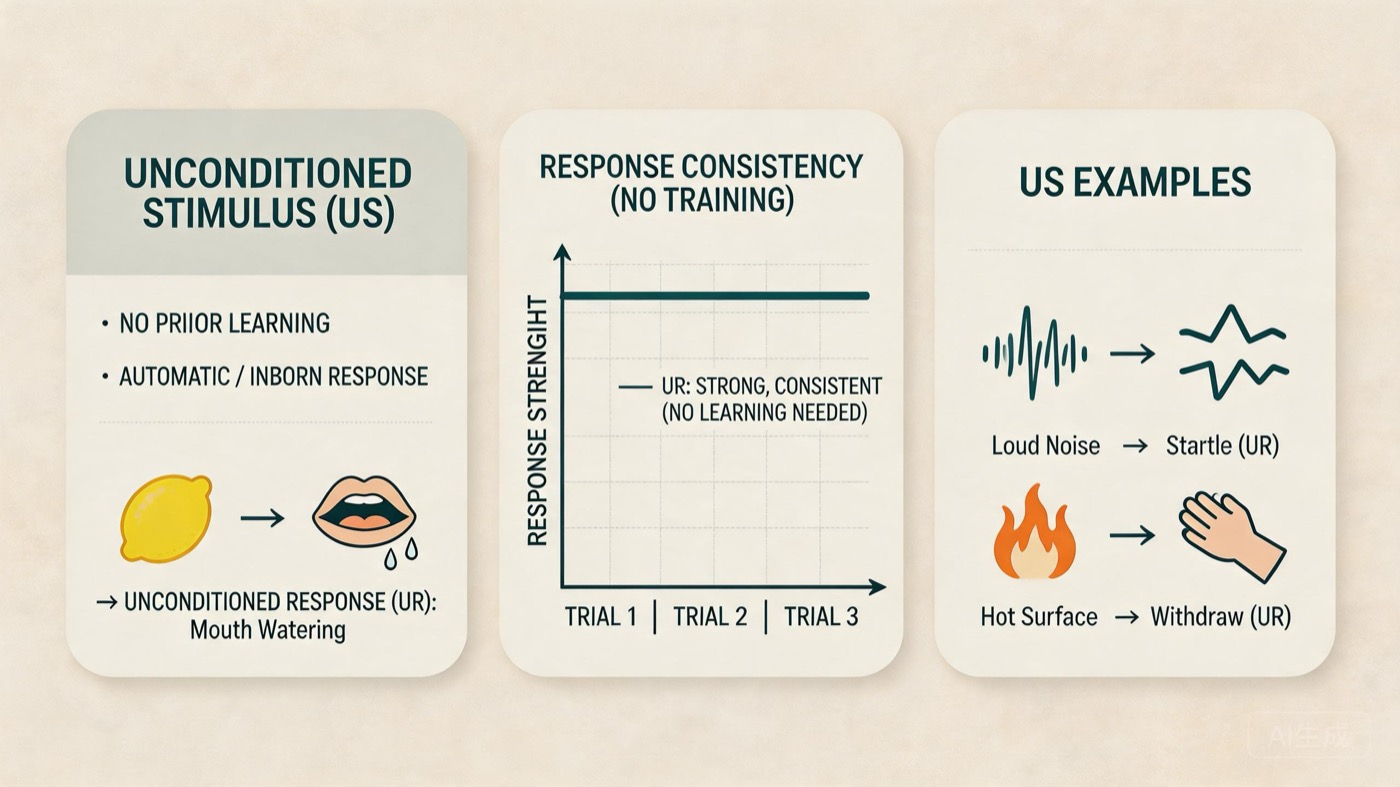
In applied behavior analysis, an unconditioned stimulus (US) is any stimulus that naturally and automatically triggers a response without any prior learning or pairing. This concept originates from respondent conditioning, where a US elicits an unconditioned response (UR). For example, food naturally elicits salivation, and a puff of air to the eye naturally elicits an eye blink. No training is needed for these reflexes to occur.
Table of Contents
- What Is an Unconditioned Stimulus?
- Real-World ABA Examples of Unconditioned Stimuli
- Why Unconditioned Stimuli Matter on the BCBA Exam
- Final Summary
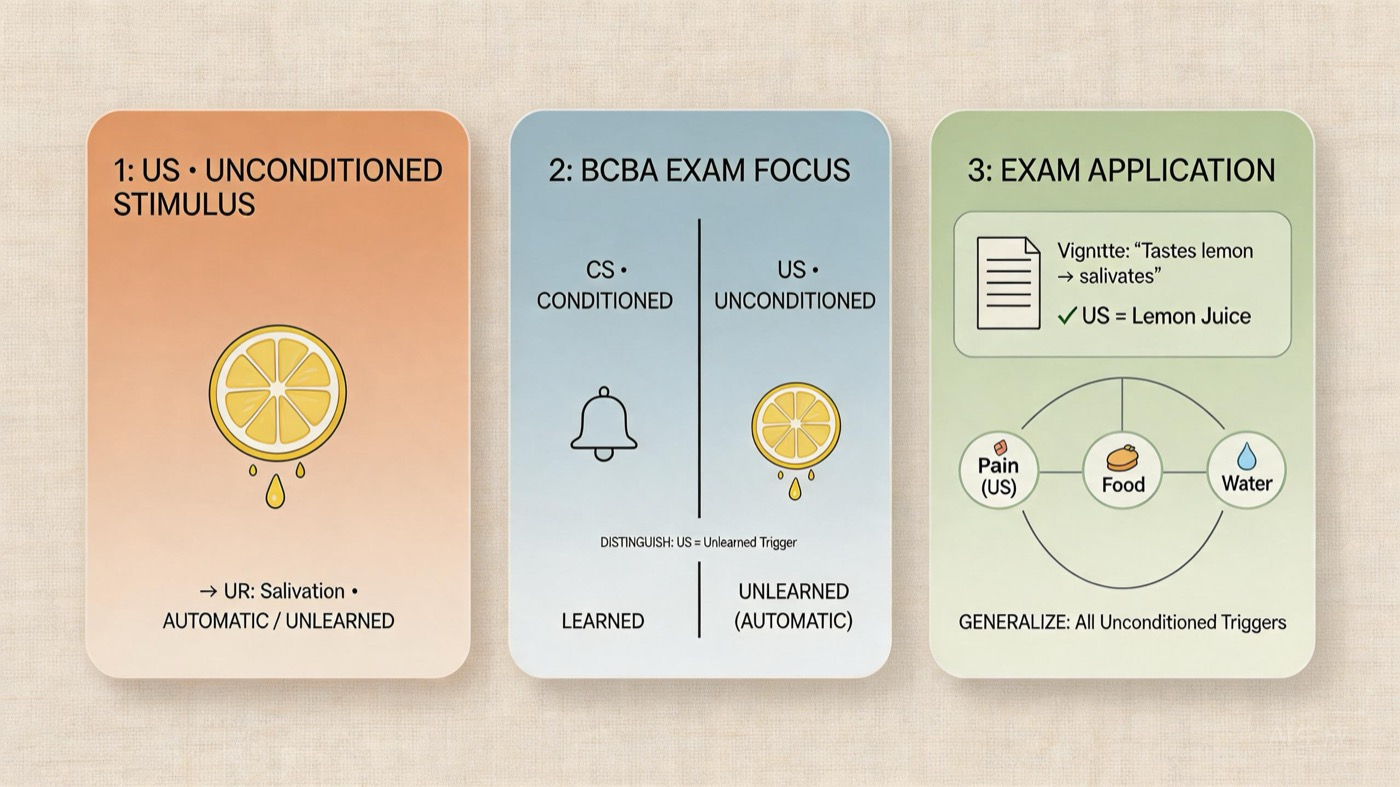
Understanding the unconditioned stimulus is foundational for distinguishing it from conditioned stimuli that acquire their power through repeated pairing. On the BCBA exam, you will be asked to identify US in vignettes and to differentiate it from other types of stimuli such as conditioned stimuli (CS) and discriminative stimuli (SD).
Key Characteristics of an Unconditioned Stimulus
- Naturally elicits a response: The US automatically produces a specific behavior, like a loud noise causing a startle reflex.
- No learning required: The response is innate, not taught or conditioned.
- Biologically relevant: US are often tied to survival, such as food, pain, or temperature extremes.
- Precedes respondent behavior: The US comes before and elicits the unconditioned response.
- Not dependent on history: Even a newborn will respond to a US like a sudden touch or taste.
Unconditioned Stimulus vs. Conditioned Stimulus: Critical Distinction
The table below highlights the core differences between an unconditioned stimulus and a conditioned stimulus. This distinction frequently appears on the BCBA exam, and confusion between the two is a common error.
| Feature | Unconditioned Stimulus (US) | Conditioned Stimulus (CS) |
|---|---|---|
| Origin | Innate, unlearned | Learned through pairing |
| Example | Food | Bell that predicts food |
| Response type | Unconditioned response (UR) | Conditioned response (CR) |
| Requires pairing | No | Yes |
| Biological basis | Yes, often survival-related | Not necessarily |
Remember that a US is powerful because it does not depend on learning. A CS, by contrast, gains its power only after being paired with a US. For example, if you pair a tone (CS) with food (US), eventually the tone alone will elicit salivation. But the tone would never do so without that pairing history.
Real-World ABA Examples of Unconditioned Stimuli
Applying the concept of unconditioned stimulus to real-world scenarios helps solidify your understanding for exam questions. Here are three common examples you might encounter in vignettes.
Example 1: Food as an Unconditioned Stimulus
A child sees a cookie on the table and reaches for it. In this scenario, the antecedent is the cookie (US), the behavior is reaching, and the consequence is eating. The function is automatic reinforcement to satisfy hunger. No learning is needed for the child to reach for food when hungry.
Example 2: Painful Stimuli as an Unconditioned Stimulus
A student accidentally touches a hot surface and immediately withdraws their hand. The antecedent is the heat (US), the behavior is hand withdrawal, and the hypothesized function is escape from pain. This reflexive response is innate and critical for survival.
Example 3: Loud Noise as an Unconditioned Stimulus
During a quiet classroom activity, a sudden loud bang from outside causes all students to startle. The antecedent is the loud noise (US), the behavior is the startle response, and the function is reflexive survival. This US does not require any prior conditioning to elicit the response.
Example 4: Eye Blink to a Puff of Air
A clinician directs a gentle puff of air toward a client’s eye; the client blinks involuntarily. The puff of air is the US, and the eye blink is the UR. This is a classic example used in respondent conditioning research and often appears on exams to illustrate a pure US-UR relationship.
When reviewing examples, note that the response to a US is always a respondent behavior, not an operant. The behavior is elicited automatically, not shaped by consequences. This distinction is important for correctly identifying function on the BCBA exam.
Why Unconditioned Stimuli Matter on the BCBA Exam
The BCBA exam frequently tests understanding of unconditioned stimuli within the context of respondent conditioning. You must be able to identify US in clinical vignettes, distinguish them from conditioned stimuli, and understand how they relate to motivating operations (MOs) and discriminative stimuli. For a deeper overview of respondent conditioning concepts, visit our respondent conditioning guide.
Common Exam Traps Involving the Unconditioned Stimulus
- Confusing US with CS: Remember that a CS requires pairing history; a US does not. If the stimulus has been paired with another stimulus to gain its effect, it is likely a CS.
- Forgetting that US does not require learning: Some exam questions try to trick you by suggesting a US was taught. The US is always unlearned.
- Misidentifying function: The response to a US is reflexive, not maintained by consequences. Do not assign operant functions like escape or attention to a US-UR relationship.
- Overlooking biological relevance: US are typically tied to survival (food, pain, warmth). If the stimulus is not biologically significant, it may not be a US.
Quick Review Checklist for the Unconditioned Stimulus
- Identify the stimulus: Is it a specific event or item in the environment?
- Check if the response is unlearned: Did the behavior occur without prior training?
- Determine biological significance: Does the stimulus relate to survival (e.g., food, pain, temperature)?
- Distinguish from operant antecedents: Is the behavior elicited (respondent) or emitted (operant)?
- Use related terms: Understand how US connects to unconditioned response (UR), respondent conditioning, and reflexes.
Additional Study Tips
To master unconditioned stimulus concepts for the exam, practice with mock questions. Our free BCBA mock exam questions include respondent conditioning items that test your ability to identify US, CS, UR, and CR. Also, review the respondent vs. operant behavior guide to strengthen your foundational knowledge.
Final Summary
The unconditioned stimulus is a cornerstone of respondent conditioning. It is any stimulus that naturally elicits an unconditioned response without prior learning. Key exam points include the contrast with conditioned stimuli, the biological relevance of US, and the reflexive nature of the response. Use real-world examples like food, pain, and loud noises to anchor your understanding. For authoritative information, see the BACB’s official website or a peer-reviewed text such as Cooper, Heron, and Heward’s Applied Behavior Analysis. By mastering the unconditioned stimulus, you will be better prepared to tackle respondent conditioning questions on the BCBA exam.



