
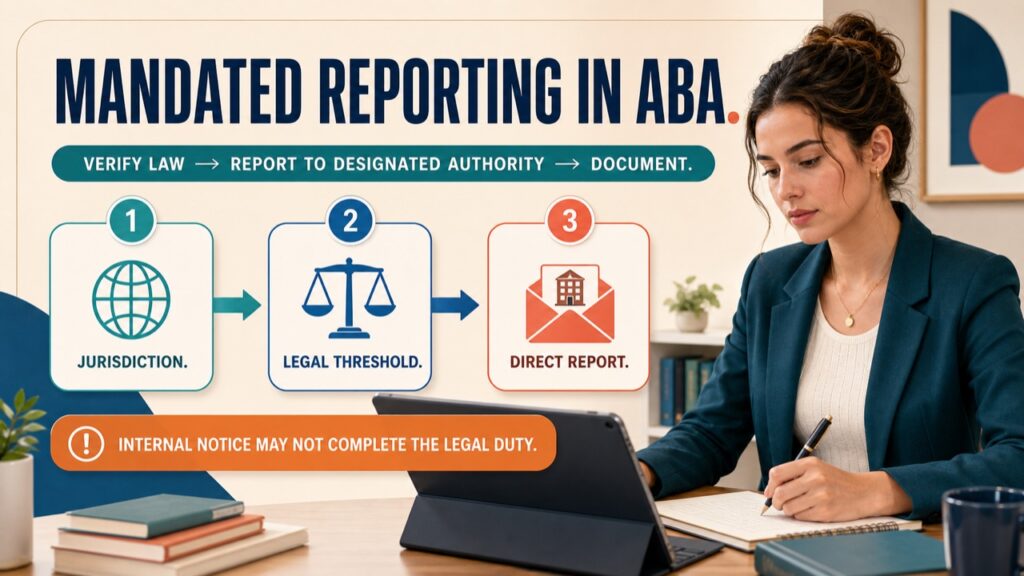
Mandated reporting is a critical legal and ethical responsibility for many behavior analysts. As a mandated reporter, you are required by law to report suspected abuse, neglect, or other specified harms to the designated authorities. However, these duties are jurisdiction-specific: they depend on your location, your professional role, the population you serve, and the specific facts of each situation. This article provides a practical, educational overview of mandated reporting in ABA, emphasizing that it is not legal advice and that you must always consult current official state or territorial sources.
Table of Contents
- What Is Mandated Reporting in ABA?
- When Does a Mandated Reporting Duty Arise?
- The Reporting Process: Steps for Behavior Analysts
- Common Traps and Misconceptions
- Ethics and Confidentiality Considerations
- Study Checklist for BCBA Exam Preparation
- References and Further Reading
What Is Mandated Reporting in ABA?
Mandated reporting is a legal duty imposed on people or roles identified by the controlling law. Whether an ABA professional is a mandated reporter, what populations and events are covered, which threshold applies, where a report goes, and how quickly it must be made are all jurisdiction-specific. Laws may use terms such as reasonable suspicion, reasonable cause, or reasonable belief, so readers must apply the exact statutory language for their location and role. The BACB Ethics Code separately requires behavior analysts to conform with legal and professional requirements under standard 1.02; it does not create one universal reporting statute.
Observations, disclosures, injuries, changes in behavior, or interactions may contribute to concern, but none should be treated as a universal checklist that independently proves maltreatment. Record what was directly observed or reported, distinguish quotation from inference, and compare the available facts with the applicable legal threshold. The federal Child Welfare Information Gateway overview explains that mandatory reporters report the facts and circumstances leading to suspicion and do not bear the burden of proving abuse or neglect. The legally designated agency—not the reporter—conducts the investigation.
When Does a Mandated Reporting Duty Arise?
A reporting duty arises when the facts meet the threshold and scope stated by the controlling law. Reasonable suspicion is a useful study term and a common legal formulation, but it is not the wording of every statute. The reporter should identify the covered population, the type of suspected harm, the role-based duty, the deadline, and the designated recipient without postponing a required report to build a private case. If the threshold or procedure is unclear, use current official jurisdictional instructions and obtain prompt legal or agency guidance when that can occur without delaying an obligation.
- Separate direct observations, exact disclosures, and third-party statements from interpretations.
- Use the applicable statutory threshold rather than waiting for certainty or trying to prove the allegation.
- Check who is covered, what is reportable, the required timing, and the legally designated authority.
- Do not interview for investigative detail or confront an alleged perpetrator unless an authorized agency directs that action.
Child-abuse reporting is only one possible reporting framework. Separate laws may address abuse or exploitation of older adults, dependent adults, or people with disabilities, and some locations impose other safety-related duties. Coverage cannot be inferred from the BCBA credential, an employer title, or another profession’s statutory category. Verify the current statute, implementing agency guidance, and any applicable licensure rule for the person’s actual role and practice location.
The Reporting Process: Steps for Behavior Analysts
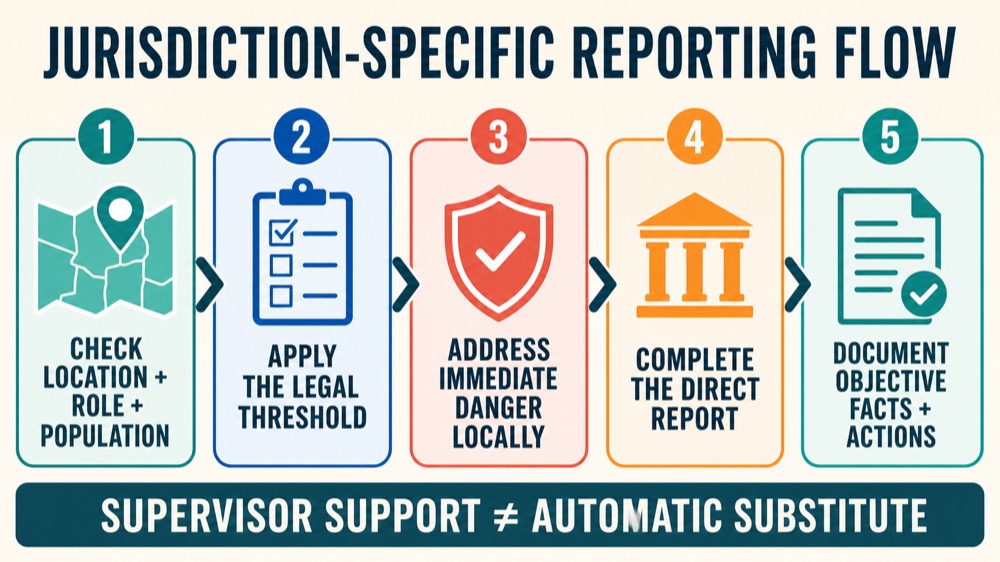
When you identify a potential reporting obligation, follow a structured process to ensure compliance and ethical practice. The steps below assume no immediate danger; if there is an immediate threat, follow local emergency procedures first.
1. Identify the controlling rule and threshold: Confirm the practice location, reporter role, covered population, reportable conduct, trigger language, deadline, and designated recipient. Do not combine child, adult, disability, domestic-violence, and institutional-reporting rules into one assumed standard.
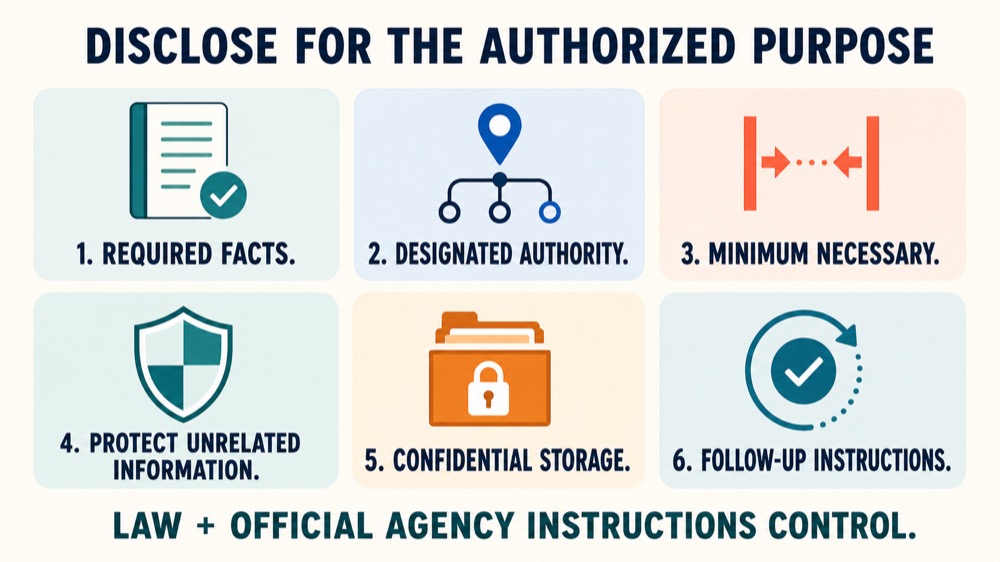
2. Complete the legally required report: Use the hotline, online portal, agency, law-enforcement contact, or other recipient named by current official instructions. A direct report means the report reaches that designated authority rather than remaining inside the employer. When the law imposes an individual duty, do not assume delegation satisfies it; when the law expressly permits an institutional process, follow that rule exactly. Provide all information the authority requires while limiting unrelated disclosure. Here, minimum necessary means no more confidential information than is critical to the authorized purpose, consistent with BACB standard 2.04 and the controlling law.
3. Address immediate danger under local procedures: A protective-services report and an emergency response can be separate actions. If facts indicate imminent danger, contact the locally designated emergency service and follow authorized safety procedures, then complete any separate mandatory report and document the sequence of actions.
4. Use internal support without substituting it for the law: Notify a supervisor, compliance officer, or employer when required or permitted for coordination, safety, and service continuity. Consultation can help locate a rule or organize next steps, but it must not delay a time-sensitive report or replace an individual direct report unless the controlling law expressly authorizes that process.
5. Create objective documentation: Record dates, times, locations, direct observations, exact material statements, the source of second-hand information, the authority contacted, confirmation or reference details supplied by that authority, internal notifications, safety actions, and follow-up instructions. Do not add an unsupported diagnosis or investigative conclusion. Store the record under the applicable legal, organizational, funder, and confidentiality requirements; do not invent a universal rule that it must be inside or outside the clinical record.
Common Traps and Misconceptions
- Credential does not establish universal status: Determine reporter status from the current law governing the actual role, population, and location.
- Internal notice is a separate question: Do not assume a supervisor conversation reaches the legally designated authority or discharges an individual duty.
- Reporting is not private investigation: Preserve and communicate relevant facts without interrogating for proof, diagnosing maltreatment, or deciding culpability.
- The statutory trigger controls: Apply the law’s suspicion, cause, knowledge, or belief standard rather than creating a certainty requirement.
- Confidentiality has defined limits: BACB standards 2.04 and 3.10 permit or require disclosures in specified circumstances; share information critical to the authorized report and protect unrelated information.
Ethics and Confidentiality Considerations
Mandated reporting requires simultaneous attention to legal duties and confidentiality. BACB standard 2.03 addresses protection of confidential information; 2.04 permits disclosure in listed circumstances, including when compelled by law, and limits authorized third-party discussion to information critical to its purpose. Standard 3.10 requires explaining confidentiality limits at the outset and when disclosure is required, while 3.11 requires high-quality professional documentation. Avoid promising secrecy that cannot be maintained. Explain the reporting boundary in developmentally and contextually appropriate language without revealing unnecessary details to uninvolved people.
Keep separate channels conceptually distinct. A protective-services or other statutory report goes to the authority named by law. An internal incident report follows organizational policy. A licensure-board, funding-source, BACB, or employment report follows its own trigger and recipient. One event may activate more than one channel, but completing one form does not automatically complete the others. BACB 1.02 requires compliance with applicable legal and professional requirements, and the Code’s application section notes that urgent safety concerns may need to reach relevant authorities before a professional regulator.
Study Checklist for BCBA Exam Preparation
Use this checklist to ensure you understand mandated reporting for the BCBA exam:
- Define mandated reporter and explain why the applicable legal threshold may or may not use the phrase reasonable suspicion.
- Identify the location, role, population, reportable conduct, deadline, and designated authority.
- Distinguish a direct report from employer consultation and an internal incident report.
- Explain why a reporter communicates relevant facts without conducting an independent investigation.
- Apply minimum necessary as a confidentiality safeguard while supplying all information legally required.
- Separate statutory, emergency, organizational, licensing, funding, and BACB reporting channels.
- Review BACB standards 1.02, 2.03, 2.04, 3.10, and 3.11 using the current official Code.
- Practice objective documentation of facts, sources, dates, contacts, instructions, actions, and outcomes.
- Explain confidentiality limits before a crisis rather than promising absolute secrecy.
- Use current official jurisdictional sources; do not rely on a study article for a live legal decision.
For additional practice on ethics and professional conduct, try our Free BCBA Mock Exam. It offers realistic questions and detailed feedback to help you assess your readiness. Note that the mock exam covers a broad range of topics and is not specifically designed to test mandated reporting, but it will help you apply ethical decision-making under exam conditions.
References and Further Reading
Consult official sources for current legal requirements:
- BACB Ethics Code for Behavior Analysts: https://www.bacb.com/wp-content/uploads/2022/01/Ethics-Code-for-Behavior-Analysts-240830-a.pdf
- Child Welfare Information Gateway: Mandatory Reporting of Child Abuse and Neglect: https://www.childwelfare.gov/resources/states-territories-tribes/related-organizations/
- Child Welfare Information Gateway, Mandatory Reporting of Child Abuse and Neglect: official jurisdictional overview PDF
Always verify the current laws in your specific jurisdiction. This article is educational and does not constitute legal advice. If you have questions about a specific situation, consult a qualified attorney. By understanding and fulfilling your mandated reporting duties, you protect vulnerable individuals and uphold the integrity of the ABA profession.




Pingback: BACB Report Violation: Reporting Paths Explained