
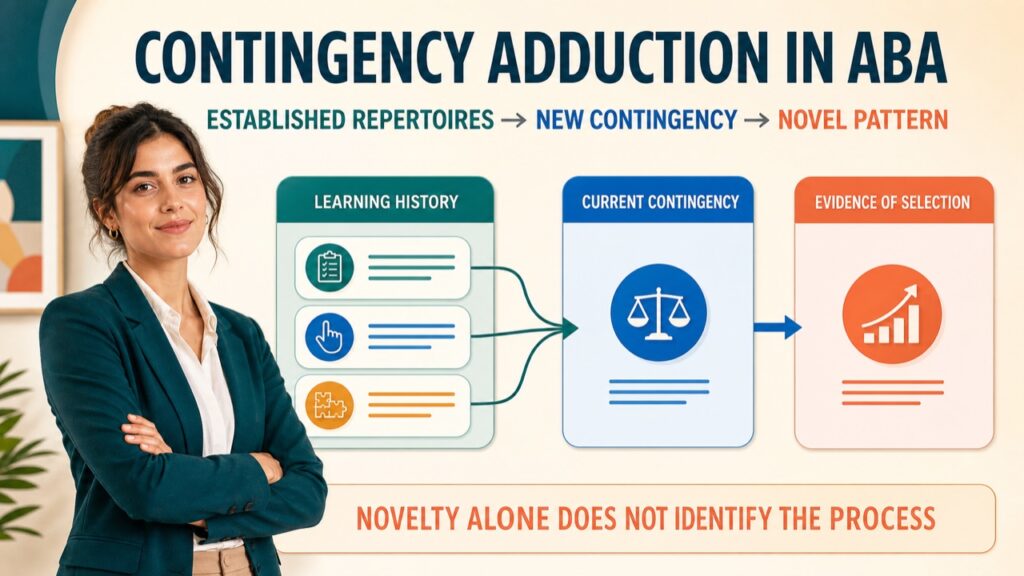
Contingency adduction describes a response pattern established under one learning history being recruited by a current contingency for which it was not expressly trained. In some cases, component repertoires recombine into a novel response pattern; in others, established responding is selected in a new context. Novelty alone is not enough for the label. The analysis must identify the earlier history, the current antecedent and consequence relation, and evidence that the current contingency selects or maintains the pattern. Contingency adduction is one behavior-analytic account relevant to generative responding, not a synonym for all generalization, creativity, or emergent performance.
Table of Contents
- Defining Contingency Adduction and Key Components
- Distinguishing Contingency Adduction from Related Concepts
- Applied Examples of Contingency Adduction in ABA
- How to Promote Contingency Adduction in Practice
- Common Traps and Misconceptions
- Practical Tips for Study and Application
- Free BCBA Mock Exam: Practice and Feedback
Defining Contingency Adduction and Key Components
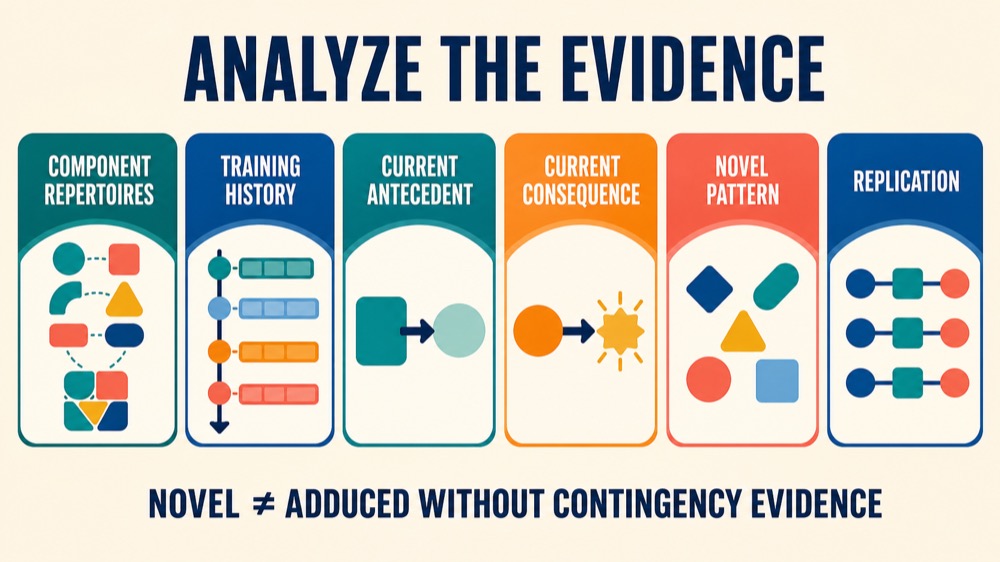
In the original experimental literature, Andronis, Layng, and Goldiamond (1997) documented a novel pigeon response pattern that arose from previously established nonsocial repertoires and was maintained by its effect on another bird. That experiment illustrates a contingency analysis; it is not a direct prescription for human teaching. A later conceptual review of repertoire dynamics distinguishes recombination from adduction and notes that both processes can occur together. Accordingly, a sound analysis identifies component repertoires, their training histories, the current contingency, the novel pattern, and evidence of selection or maintenance.
- Component Repertoire: A set of behaviors or skills that have been previously shaped or taught under specific contingencies. For example, a child may have a component repertoire of labeling colors and a separate repertoire of sorting objects.
- Current Contingency: The present antecedent-behavior-consequence relation that recruits the response pattern. This contingency is different from the one that established the component repertoires.
- Learning History: The individual’s past experiences with reinforcement, punishment, and stimulus control that shaped the component repertoires.
- Novel Response Pattern: The behavior that emerges under the new contingency, which is not directly trained but is composed of or influenced by previously established components.
- Generative Responding: A broad outcome category involving novel, untrained performance based on existing repertoires. Contingency adduction is one possible process to analyze, not the default explanation for every generative outcome.
Distinguishing Contingency Adduction from Related Concepts
Stimulus generalization concerns responding across stimuli that share relevant features with training conditions. Maintenance concerns continued performance over time. Equivalence-based instruction can yield untrained stimulus relations, and response-variability procedures can increase novel forms. Contingency adduction instead asks whether a current contingency recruits a pattern whose relevant history was established elsewhere. The consequence need not be a categorically different reinforcer or function in every case; what must differ is the contingency for which the response pattern was originally established. These concepts may interact, so the controlling relations—not surface novelty—determine the best description.
- Stimulus Generalization: Behavior occurs under similar antecedents; the contingency is essentially unchanged.
- Response Maintenance: Behavior persists over time under similar contingencies (e.g., intermittent reinforcement).
- Contingency Adduction: A current contingency recruits responding established under another history; a new reinforcer or function may occur but is not a defining requirement.
- Equivalence-Based Instruction: A teaching method that may produce derived relations, but not necessarily adduction.
- Generic Creativity: Novel behavior may occur without clear contingency control; adduction requires evidence that the current contingency selects the response.
Applied Examples of Contingency Adduction in ABA
The following hypothetical examples illustrate how contingency adduction might manifest in clinical or educational settings. These are analyses, not proof that a learner’s behavior was adduced; practitioners must evaluate the controlling contingencies.
- Object Labeling to Sentence Construction: A preschooler learns to label objects (e.g., “apple,” “want”) and to request items using single words (e.g., “cookie”). The teacher then implements a new contingency: the child must use a two-word phrase (e.g., “want apple”) to receive the item. Without explicit teaching, the child combines the previously separate labels to produce the novel response. The original contingency for labeling (social praise) differs from the new contingency (access to the item). This example illustrates a possible recombination of component repertoires under a new current contingency.
- Arithmetic Skills to Money Management: A teenager learns addition and subtraction through worksheets with token reinforcers. Later, in a community-based instruction program, the teen is given a budget to buy snacks. The new contingency—purchasing within a budget using real money—recruits arithmetic skills. The teen spontaneously applies addition and subtraction to calculate total cost and change, even though these skills were not directly taught in the money context. The behavior (adding and subtracting) is now under the control of a new contingency (effective purchasing).
- Social Initiations to Peer Interaction: A child with social delays learns to make eye contact and say “hi” with adults for praise. During recess, the child uses these same behaviors to initiate play with peers, where the new contingency is peer attention and continued play. The original contingency (adult praise) is different from the new one (peer engagement), yet the behavior carries over.
These hypothetical cases illustrate candidate analyses rather than confirmed adduction. To justify the label, document the component histories and show that the current contingency selects or maintains the untrained pattern. For related distinctions, review stimulus control in ABA and stimulus generalization in ABA.
How to Promote Contingency Adduction in Practice
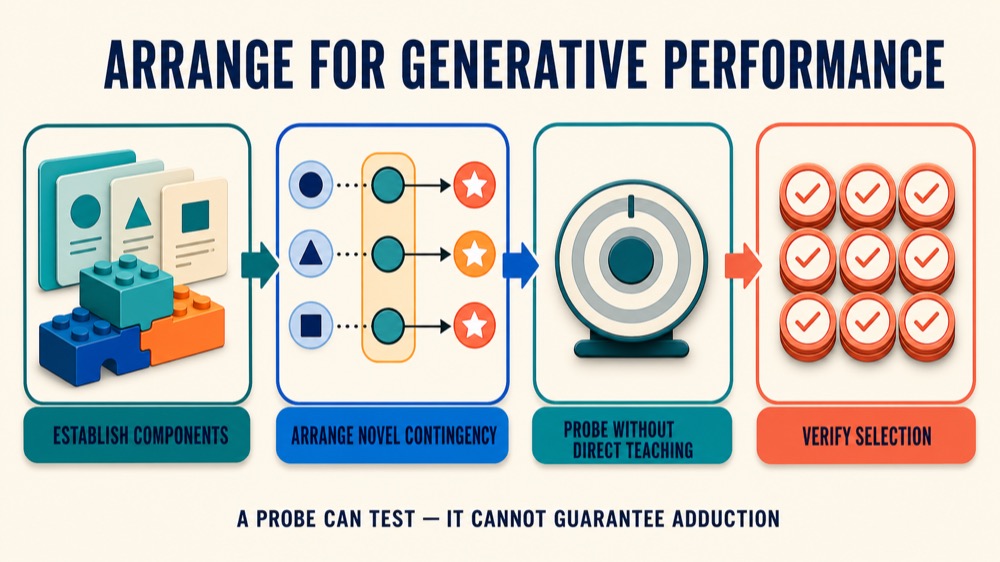
Behavior analysts can intentionally design interventions to facilitate contingency adduction, leading to more generalized and flexible skill use. However, the literature does not supply a universal clinical recipe or guarantee; practitioners may establish fluent prerequisite repertoires and arrange probes or novel contingencies, but outcomes depend on the individual’s learning history and the specific contingencies.
- Establish Fluent Component Repertoires: Ensure that the learner has mastered the prerequisite skills to fluency. Fluency increases the likelihood that components will be available for recombination under new contingencies.
- Arrange Probes for Novel Responses: Systematically present novel antecedent conditions or contingencies and observe whether the learner engages in untrained but functional responses. This can help identify if adduction is occurring.
- Teach in Natural Contexts: Conduct teaching in the environments where the behavior is expected to be used later. For example, teach requesting during snack time using real items rather than flashcards.
- Monitor for Emergent Relations: Conduct formal or informal probes to detect untrained responses that combine existing skills. This can be done through observation or structured tests.
Multiple-exemplar teaching may establish control by relevant features while varying irrelevant conditions, but that outcome is generalization programming and does not by itself demonstrate adduction. If a probe produces a novel response, collect evidence about the component histories and current contingency before naming the process. Appropriate stimulus control should be broadened or transferred according to the instructional goal, not weakened indiscriminately.
Common Traps and Misconceptions
Being aware of common pitfalls can improve your understanding and application of contingency adduction. The following list highlights misconceptions and clarifies accurate conceptual boundaries.
- Contingency adduction is not simply stimulus generalization: Generalization involves the same behavior under similar antecedents; adduction involves a shift in the controlling contingency.
- Novelty alone is insufficient evidence: An untrained response may arise through response variability, derived relations, generalization, or other processes without being selected by a new contingency.
- A different reinforcer or behavioral function is not required in every case: While often the reinforcer changes, adduction can occur when the same reinforcer is delivered under a different antecedent condition, provided the contingency arrangement differs from the original training.
- Varying reinforcers does not guarantee contingency adduction: Varied reinforcement may promote generalization but does not automatically cause adduction; the new contingency must actively recruit the behavior.
- Strong stimulus control should not be loosened indiscriminately: Rather, practitioners should build flexible stimulus control by teaching under varied conditions.
- Equivalence-based instruction does not automatically produce contingency adduction: Equivalence can yield emergent relations, but adduction requires a different contingency to select the response.
Practical Tips for Study and Application
The current BACB BCBA Test Content Outline (6th ed.) asks candidates in G.19 to design and evaluate procedures that promote emergent relations and generative performance. It does not name contingency adduction as a standalone term. Study the documented relation between history, current contingency, and performance without inferring that this specific label is guaranteed to appear on the examination.
- ☐ Define contingency adduction and identify its key components: component repertoire, current contingency, learning history, novel response pattern.
- ☐ Distinguish contingency adduction from stimulus generalization, response maintenance, equivalence, and response variability.
- ☐ Analyze hypothetical examples by separating the established component repertoires, their training histories, the current antecedent and consequence relations, the novel pattern, and evidence of contingency control.
- ☐ Recognize that contingency adduction is not guaranteed; it depends on the learner’s history and the similarity between old and new contingencies.
- ☐ Describe strategies to promote adduction: fluent prerequisites, varied contingencies, natural environment teaching, and systematic probes.
- ☐ Avoid common misconceptions, such as assuming adduction is automatic or that strong stimulus control should be weakened.
Free BCBA Mock Exam: Practice and Feedback
Use the Free BCBA Mock Exam to practice analyzing stimulus control, generalization, maintenance, and related principles with answer feedback. Apply the same discipline here: identify the learning history, specify the current contingency, and choose a conceptual label only when the evidence supports it.



