
What Is an Unconditioned Stimulus? Definition and Role in ABA
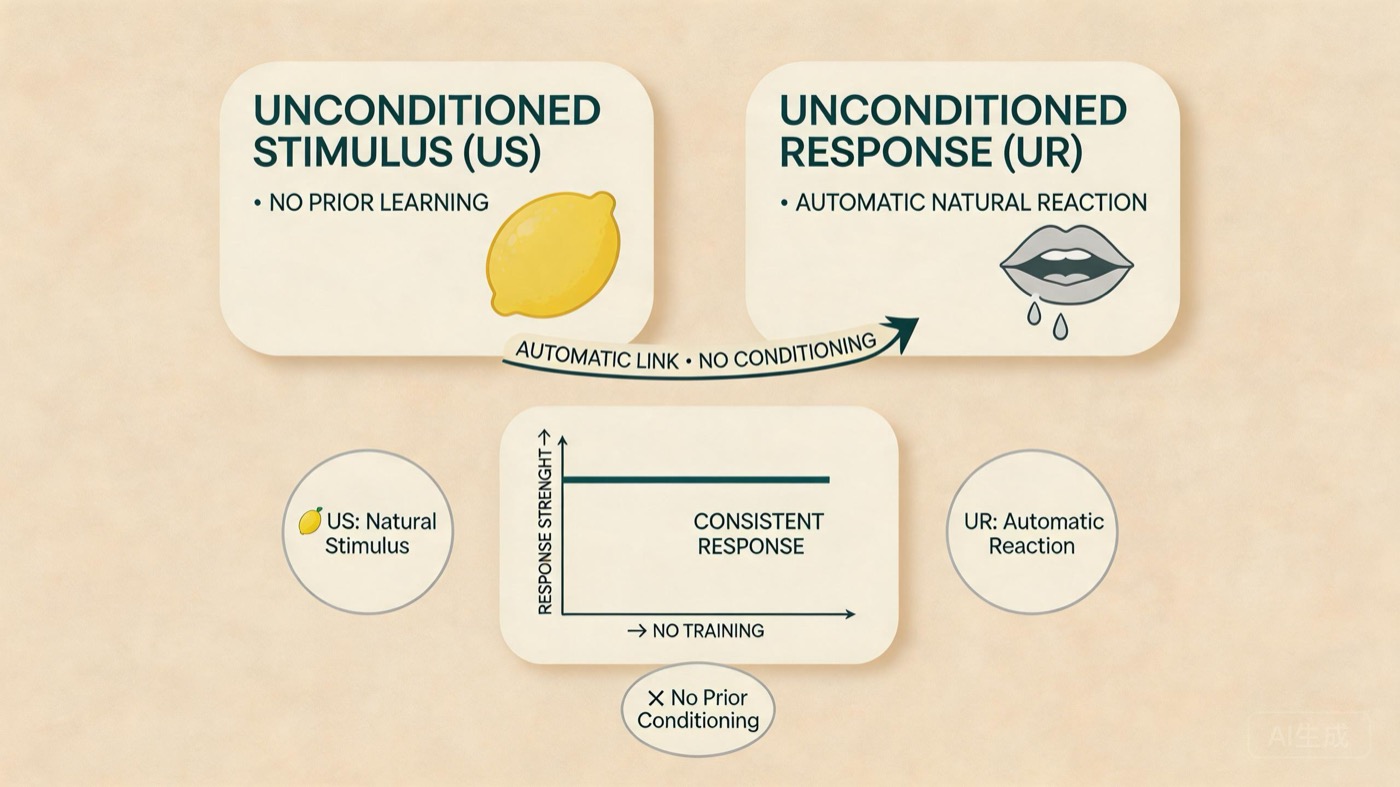
An unconditioned stimulus (US) is any stimulus that naturally and automatically triggers a response without prior learning or conditioning. In applied behavior analysis (ABA), the US is a foundational concept within respondent conditioning, also known as classical conditioning. For example, food naturally elicits salivation; a loud noise naturally elicits a startle reflex. These responses are called unconditioned responses (UR). Understanding the US is crucial for BCBA candidates because it forms the basis for distinguishing between reflexive, involuntary behaviors (respondent) and learned, voluntary behaviors (operant). Moreover, recognizing unconditioned stimuli helps in designing effective behavior intervention plans—for instance, when using systematic desensitization to reduce phobias, the clinician must identify the US that triggers the fear response.
Table of Contents
- What Is an Unconditioned Stimulus? Definition and Role in ABA
- 3 Worked ABA Examples: Unconditioned Stimulus in Action
- Why This Matters for Your BCBA Exam
- Quick Checklist: Key Points for the Exam
- Summary: Unconditioned Stimulus in ABA
- References
The US is biologically significant because it is tied to survival—such as pain, temperature changes, or food. Understanding the US helps BCBA candidates distinguish between unlearned and learned behaviors, a key skill for the exam. Additionally, the US plays a role in respondent extinction: if the US is no longer presented, the unconditioned response will gradually diminish. For example, if a loud noise is repeatedly presented without consequence, the startle response may habituate over time. This is distinct from operant extinction, where a previously reinforced behavior decreases because reinforcement is withheld.
Unconditioned Stimulus vs. Conditioned Stimulus: Key Differences
The table below highlights the essential differences between an unconditioned stimulus and a conditioned stimulus. Keep in mind that on the BCBA exam, you may be asked to identify which is which in a scenario.
- Unconditioned stimulus (US): Naturally elicits a response; no learning history required. Example: food → salivation.
- Conditioned stimulus (CS): A neutral stimulus that, after pairing with a US, elicits a learned response. Example: bell (CS) → salivation after pairing with food.
- Unconditioned response (UR): The automatic reaction to the US (e.g., salivation to food).
- Conditioned response (CR): The learned reaction to the CS (e.g., salivation to bell).
For exam purposes, remember that the US is always unlearned and biologically relevant. Also note that the CR and UR are often similar in form but are triggered by different stimuli. A common exam question presents a scenario where an initially neutral stimulus (e.g., a tone) is paired repeatedly with a US (e.g., a puff of air). After pairing, the tone alone elicits blinking. In this case, the tone is now a conditioned stimulus, and the blink is a conditioned response.
3 Worked ABA Examples: Unconditioned Stimulus in Action
Real-world scenarios help solidify your understanding. Below are three examples written in ABC format with hypothesized functions, similar to exam questions. Each example emphasizes that the US elicits an involuntary response without any prior learning.
Example 1: Loud Noise and Startle Reflex
- Antecedent: A sudden loud noise (US) occurs.
- Behavior: The person jumps, eyes widen, and body tenses (UR).
- Hypothesized function: Protection from potential threat (survival).
In behavior intervention, this US may be relevant when designing desensitization procedures for individuals with sound sensitivities. For instance, a therapist might gradually expose a client to recorded sounds at low volume while pairing with relaxation techniques, aiming to reduce the unconditioned startle response over time.
Example 2: Food and Salivation
- Antecedent: Food placed in mouth (US).
- Behavior: Salivation begins (UR).
- Hypothesized function: Digestion preparation (biological).
This classic Pavlovian example is often used on the exam to illustrate respondent conditioning. Note how this differs from operant conditioning, where behaviors are influenced by consequences rather than antecedent reflexes. On the exam, you might be asked to distinguish between a US (food) and a CS (the sight of the food container after repeated pairings). Another important nuance: the intensity of the US can affect the magnitude of the UR—stronger food or more intense pain typically elicits a stronger response.
Example 3: Pain and Withdrawal
- Antecedent: Touching a hot surface (US – painful stimulus).
- Behavior: Hand immediately pulls away (UR).
- Hypothesized function: Avoidance of tissue damage (safety).
In clinical ABA, understanding pain as a US can inform assessments of self-injurious behavior or escape-maintained behaviors. For example, if a client engages in head-banging, the pain from impact may serve as a US that elicits crying or withdrawal, but the behavior itself may be operantly maintained by attention or escape. Distinguishing the respondent component (pain-elicited crying) from the operant component is a high-level exam skill.
Why This Matters for Your BCBA Exam
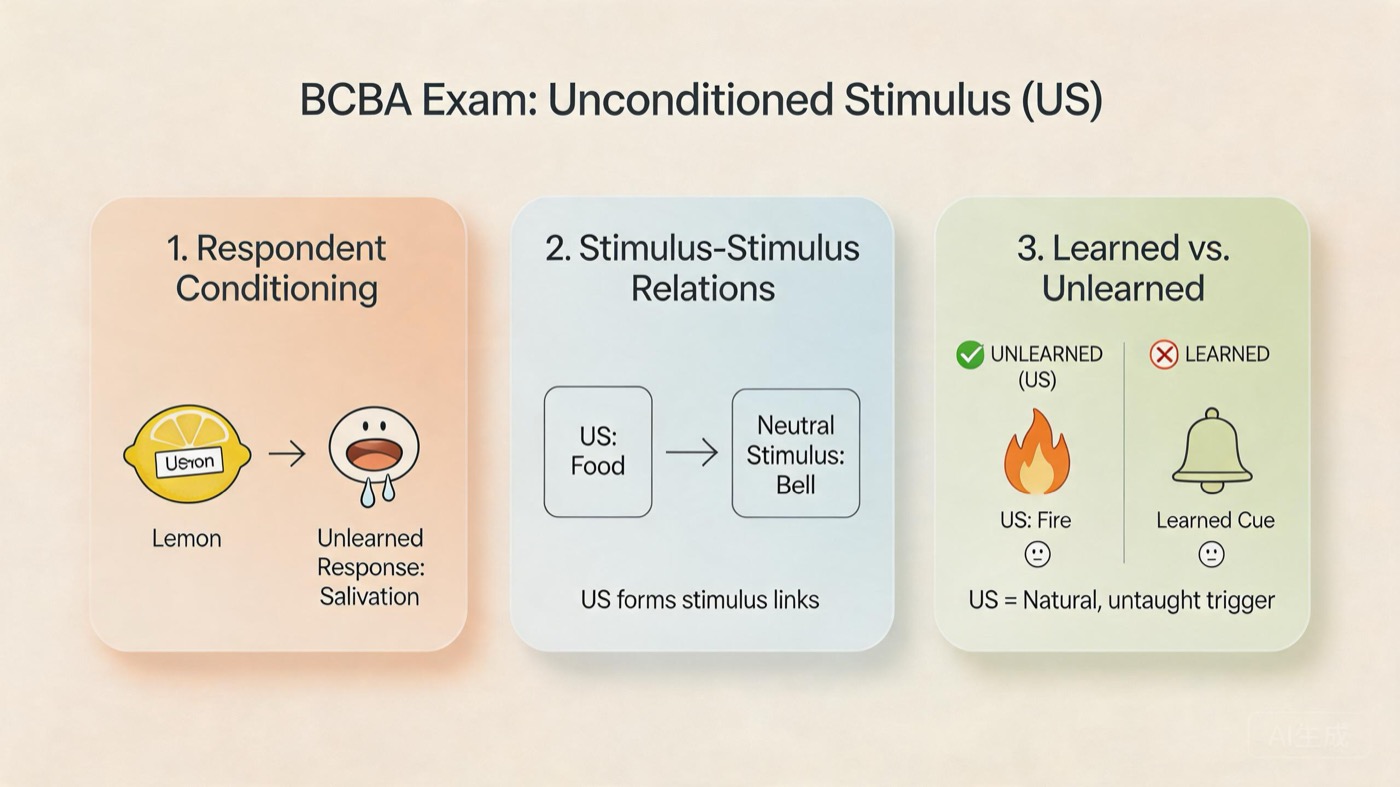
The unconditioned stimulus appears on the BCBA exam in questions about respondent conditioning, stimulus-stimulus relations, and distinguishing between unlearned and learned behaviors. Many candidates miss points because they confuse the US with related concepts. Additionally, the US is central to understanding phobias and anxiety disorders, which are often discussed in the context of respondent conditioning. For instance, a client with a dog phobia may have originally experienced a dog bite (US) that caused pain (UR), and now the sight of any dog (CS) elicits fear (CR).
Common Exam Traps and How to Avoid Them
- Trap 1: Mixing up US and CS. Remember: the US is unlearned; the CS becomes learned after pairing. Always check whether a learning history is required. If the scenario says “after repeated pairings,” the stimulus is likely a CS.
- Trap 2: Forgetting the US is unlearned. If a stimulus only elicits a response after conditioning, it is not a US. For example, the sound of a can opener might elicit excitement in a cat only because it has been paired with food; thus, it is a CS.
- Trap 3: Confusing unconditioned stimulus with establishing operation (EO). An EO alters the value of a reinforcer, while a US elicits an involuntary response. They are distinct. For example, food deprivation is an EO that increases the reinforcing value of food, but the food itself is a US when it elicits salivation.
- Trap 4: Misidentifying the UR. The unconditioned response is the automatic reaction to the US, not the US itself. For example, in the hot surface scenario, the US is the heat/pain, and the UR is the hand withdrawal. Some candidates mistakenly call the withdrawal the US.
- Trap 5: Assuming all reflexive responses are URs. Some reflexes can be conditioned; for instance, a conditioned eye-blink can be established by pairing a tone with an air puff. The air puff is the US, but the tone-elicited blink is a CR. Always check if the response is to a previously neutral stimulus.
Test-Taking Tip: How to Spot US in Scenario Questions
Look for stimuli that naturally trigger a response without any prior conditioning history. Common US examples include pain, temperature extremes, food, sudden loud sounds, and light flashes. If the scenario mentions that the stimulus has been paired with another stimulus previously, it is likely a conditioned stimulus instead. Also, remember that the US is often a biologically relevant event that serves a survival function. On the exam, you may be given a list of stimuli and asked to select which one is an US. For instance, among “a bell, a flash of light, a smile, and a token,” only the flash of light could be a US (if it elicits a blink), whereas the others typically require learning.
Quick Checklist: Key Points for the Exam
- Define US: Naturally elicits a response; no learning needed.
- Distinguish from CS: CS is learned through pairing with US.
- Identify common USs: Pain, food, loud noise, temperature, light.
- Link to UR: The automatic response, not the stimulus.
- Apply to scenarios: Look for unlearned, involuntary reactions.
- Be cautious with habituation: A UR can weaken if the US is repeatedly presented, but the US itself remains unlearned.
For more foundational concepts, explore our guide on respondent conditioning examples and review the differences between respondent and operant behavior.
Summary: Unconditioned Stimulus in ABA
The unconditioned stimulus is a cornerstone of respondent conditioning. It naturally elicits a response without prior learning, distinguishing it from conditioned stimuli. For the BCBA exam, focus on identifying USs in scenarios, avoiding common traps, and understanding their role in behavior assessment and intervention. Mastery of this concept not only helps with exam questions but also informs clinical decisions, such as when to use extinction or counterconditioning in treatment plans.
Practice with mock questions to solidify your knowledge. For a deeper dive into related concepts, check out the BCBA exam prep resources on our site.
References
Complete BCBA Exam Prep
Turn this topic into exam-day practice
Practice concepts in context with five full-length 6th Edition mock exams, two bonus practice exams, a 6th Edition study guide, and key-term flashcards—all in one $120 USD package.
Get the $120 All-in-One Prep Pack
Review everything included on the product page before ordering. No pass guarantee is implied.



