
What Do Valid and Reliable Mean in ABA?
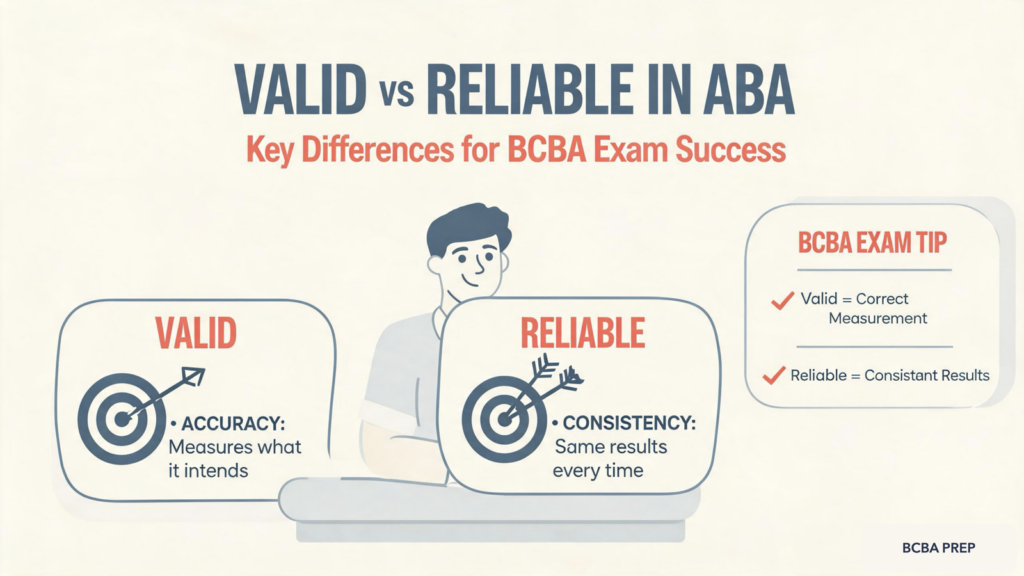
Understanding valid vs reliable is essential for any BCBA candidate. In simple terms, validity means you are measuring what you intend to measure. Reliability means your measurements are consistent and repeatable. Both are cornerstones of quality data in applied behavior analysis.
Table of Contents
- What Do Valid and Reliable Mean in ABA?
- A Measure Can Be Reliable but Not Valid: An Example
- How Validity and Reliability Appear on the BCBA Exam
- Quick Checklist for BCBA Exam Success
- Summary: Key Takeaways for BCBA Candidates
- References
Validity in Behavioral Assessment
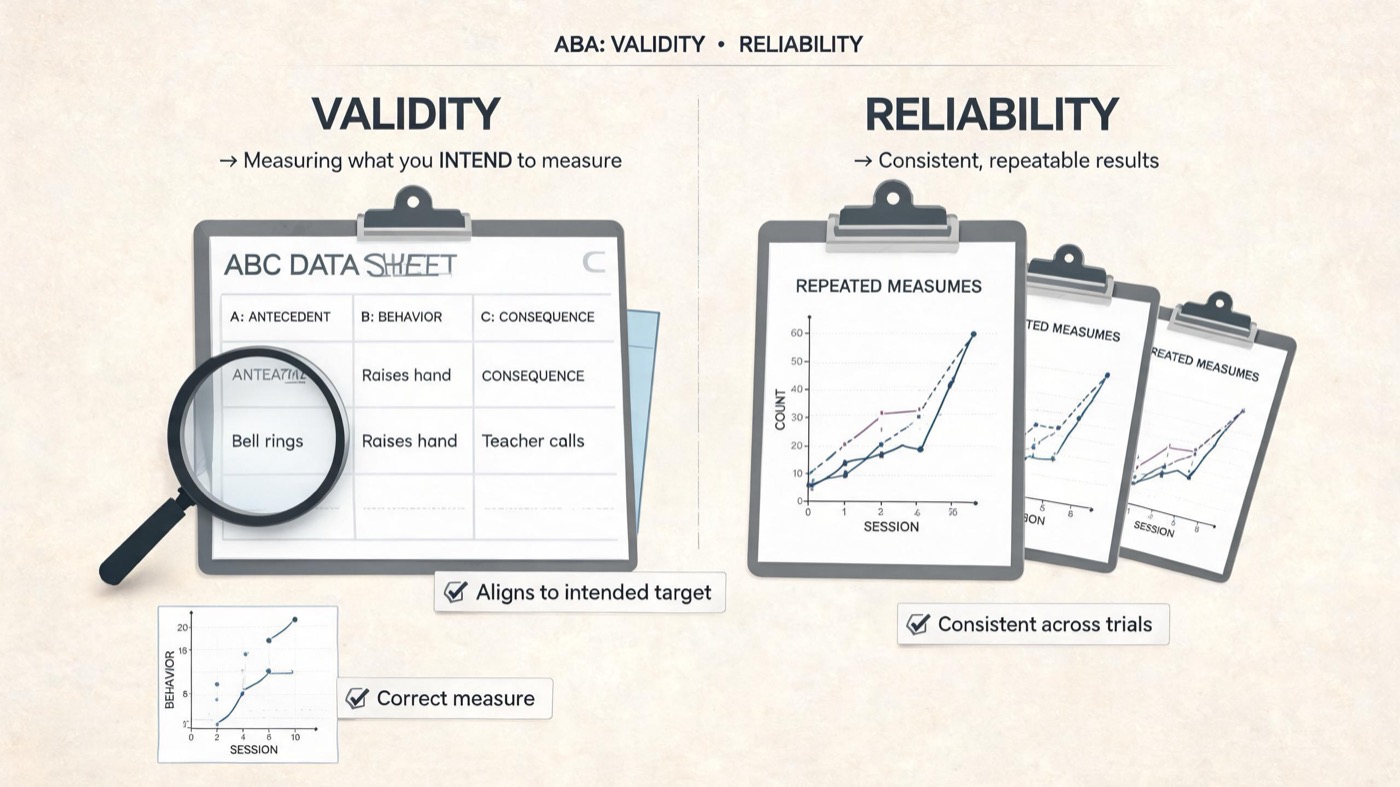
Validity ensures that your assessment targets the correct construct. In ABA, this might mean a functional analysis that correctly identifies the function of a behavior. There are several types:
- Face validity: The measure appears to assess what it claims (e.g., a self-injury scale looks relevant).
- Content validity: The measure covers all aspects of the behavior (e.g., includes topographies, duration, and intensity).
- Criterion validity: The measure correlates with a gold standard (e.g., a brief functional analysis matches a full FA).
- Construct validity: The measure accurately reflects the underlying concept (e.g., social skills assessment captures real social competence).
When a measure is valid, you can trust that your conclusions about behavior function are correct. Without validity, interventions may target the wrong variable.
Reliability in Data Collection
Reliability focuses on consistency. In ABA, we often assess interobserver agreement (IOA), where two observers independently record the same behavior and their data are compared. Other forms include:
- Test-retest reliability: Stability of scores over time (e.g., same behavior rate on two consecutive days).
- Internal consistency: Items within a measurement tool correlate with each other (e.g., all questions in a preference assessment point to the same reinforcer).
High reliability does not guarantee validity. A reliable measure may produce consistent but irrelevant data.
A Measure Can Be Reliable but Not Valid: An Example
A classic exam scenario: Two observers record the same behavior and achieve high IOA (reliable). However, they both measure the wrong variable. For instance, they consistently record ‘attention’ as the function of tantrums, but the true function is escape from demands. The data are reliable (consistent) but not valid because they do not capture the actual function.
ABC Data Example: Reliable but Invalid
Consider a child who engages in aggression. Two BCBAs independently collect ABC data. Both record that the consequence is ‘teacher attention’ every time. Their IOA is 95% (high reliability). However, a subsequent functional analysis reveals that the behavior is maintained by escape from tasks. The ABC data were reliable but invalid because the observers misinterpreted the consequence. This common trap shows why you must always evaluate validity independently of reliability.
Another example: A duration recording system for on-task behavior is used, but the definition of ‘on-task’ includes looking at the teacher while doodling. Data are consistent across sessions (reliable) but do not measure actual engagement (invalid).
How Validity and Reliability Appear on the BCBA Exam
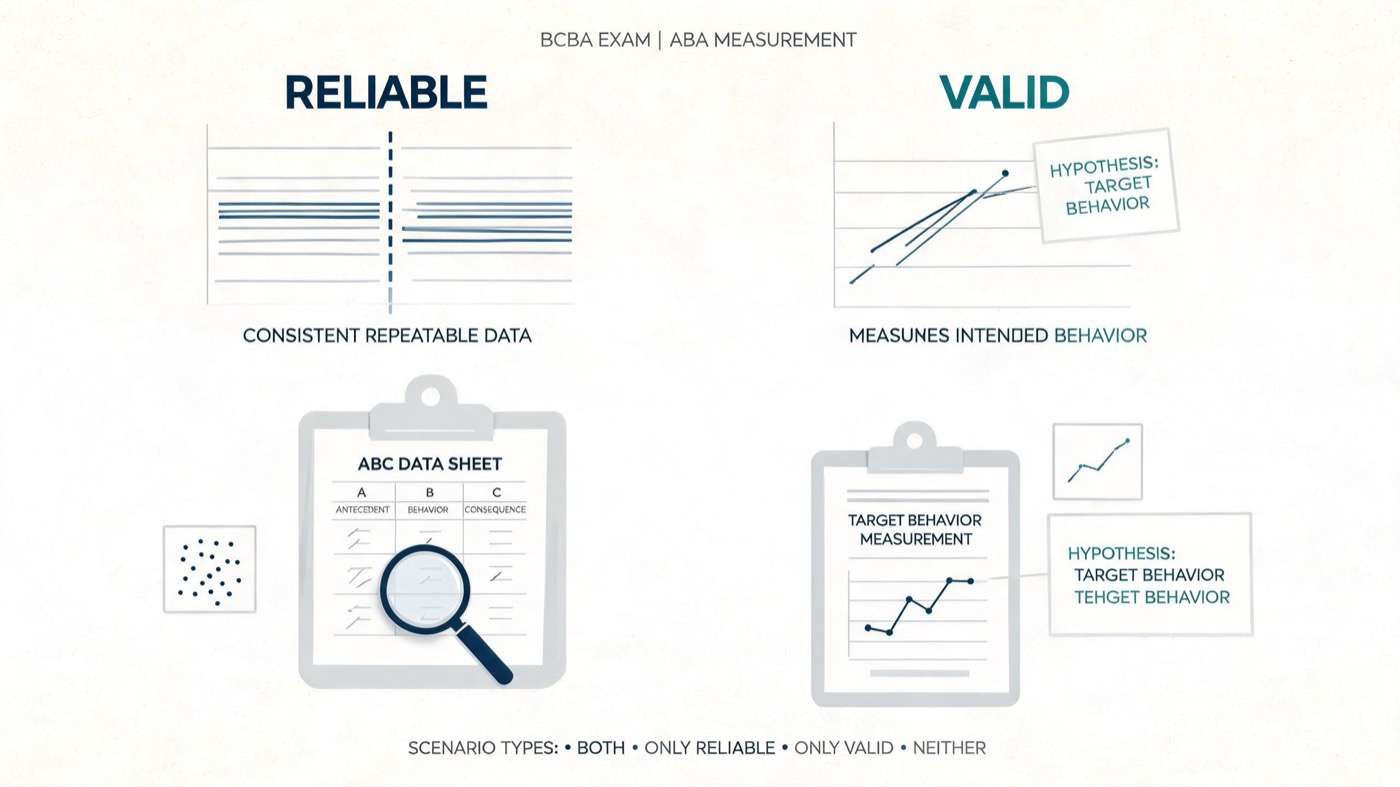
The BCBA exam frequently tests your ability to distinguish between valid and reliable. Scenario-based items ask you to identify whether a measurement system is valid, reliable, both, or neither. Here are common traps:
Common Traps: Confusing Reliability with Accuracy
A frequent misunderstanding is equating reliability with accuracy. Accuracy refers to how close a measurement is to the true value. Reliability is about consistency, not truth. For example, a scale that always reads 5 pounds too high is reliable (consistent) but not accurate. On the exam, you may see a scenario where data are consistent but biased away from the true value. Always remember: validity implies accuracy, but reliability does not.
Example Exam Item: Evaluating Measurement Quality
Scenario: ‘A behavior analyst measures tantrums by counting duration. Data are consistent across sessions but include time out-of-seat behavior that is not a tantrum. Is this measure valid? Reliable?’
Answer: Reliable but not valid. The measure is consistent (reliable) but captures non-target behavior (invalid). This item tests your ability to separate consistency from relevance.
Another example: A questionnaire to assess social skills shows high test-retest reliability but correlates poorly with observed social interactions (low criterion validity). The exam may ask: ‘What is the primary weakness of this measure?’ Answer: Low validity.
Quick Check for Exam Day
Use this checklist when evaluating measurement quality in an exam item:
- Identify the target: What behavior or construct is being measured?
- Check consistency: Are repeated observations similar? If yes, consider reliability.
- Check relevance: Does the measure actually capture the target? If yes, consider validity.
- Watch for bias: Consistent error means reliable but not valid.
- Don’t confuse with accuracy: Accuracy is closeness to truth, not consistency.
Quick Checklist for BCBA Exam Success
To master valid vs reliable for the exam, keep these points in mind:
- Validity = measuring the right thing; reliability = getting consistent results.
- A measure can be reliable but not valid (e.g., wrong function consistently identified).
- A measure cannot be valid if it is not reliable (inconsistent data cannot be valid).
- Always evaluate both when assessing data quality.
- Practice with scenario-based questions to sharpen your discrimination.
For more on related measurement concepts, see our guide on data collection methods in ABA.
Summary: Key Takeaways for BCBA Candidates
Validity and reliability are distinct but related. Validity ensures you are measuring the right construct; reliability ensures consistency. Both are necessary for trustworthy data. On the exam, look for clues about what the measure actually captures (validity) and whether results are repeatable (reliability). Avoid the trap of equating reliability with accuracy. With practice, these concepts become straightforward. Good luck!
References
Complete BCBA Exam Prep
Turn this topic into exam-day practice
Practice concepts in context with five full-length 6th Edition mock exams, two bonus practice exams, a 6th Edition study guide, and key-term flashcards—all in one $120 USD package.
Get the $120 All-in-One Prep Pack
Review everything included on the product page before ordering. No pass guarantee is implied.



