
A remote telehealth BCBA delivers behavior-analytic services through a secure distance format rather than relying on an in-person clinic visit for every observation, caregiver meeting, or supervision contact. The phrase describes a service model, not a shortcut around clinical judgment. A remote BCBA job may involve documentation, scheduling, or case management without telehealth, while telehealth usually involves live or asynchronous clinical contact with a client, caregiver, or treatment team.
Table of Contents
- What Is a Remote Telehealth BCBA?
- How Is Telehealth Different From Other Remote BCBA Work?
- What Should a Telehealth BCBA Verify Before Starting?
- How Does the Clinical Workflow Work?
- What Makes a Client a Good Fit?
- How Should Supervision and Observation Work?
- What Technology and Privacy Controls Matter?
- How Do You Evaluate Quality?
- What Are Common Remote Telehealth BCBA Red Flags?
- Frequently Asked Questions
- Sources for Further Study
- Take the Free BCBA Mock Exam
The practical question is whether the client, caregiver, goals, technology, privacy conditions, and supervision plan support useful clinical work. This guide explains what to evaluate before starting and how to keep an online service tied to measurable clinical purpose.
What Is a Remote Telehealth BCBA?
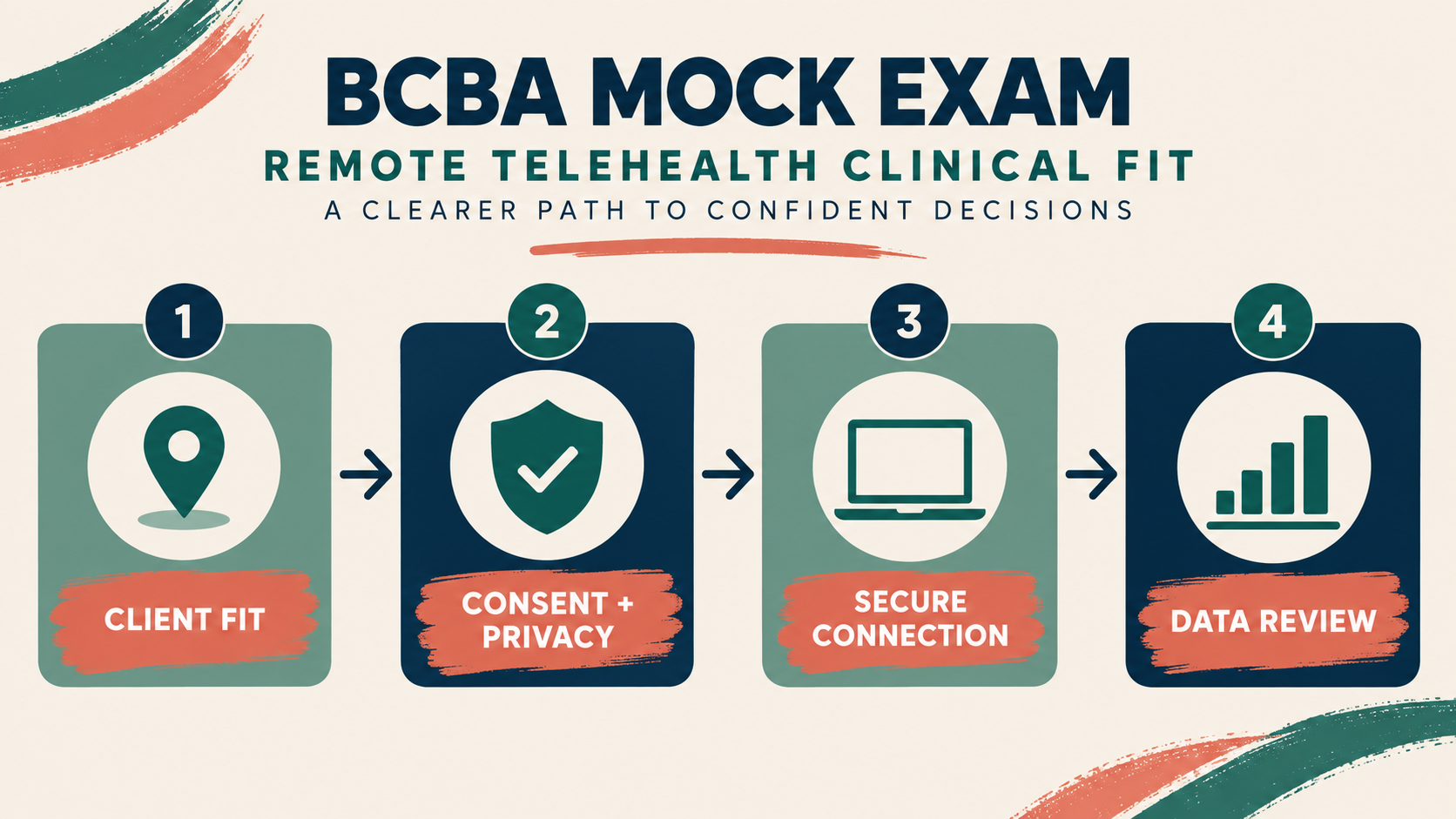
A remote telehealth BCBA is a board-certified behavior analyst who provides assessment, caregiver support, treatment oversight, consultation, or supervision through telehealth technology. The BCBA still has to define the clinical question, select a measurement system, interpret data, protect dignity, and work within credentialing, licensure, payer, employer, and ethical boundaries.
Telehealth can take different forms. A BCBA might coach a caregiver while the caregiver works with a learner in the home, observe an implementation session, meet with a treatment team, review data asynchronously, or combine short remote contacts with in-person services. The exact blend should be documented. Calling a service “telehealth” does not by itself explain what happened during the session or whether the chosen method can answer the clinical question.
This is why remote telehealth BCBA is not a synonym for “work from anywhere.” Client and provider locations, service setting, emergency procedures, privacy, and applicable rules all matter. Verify current requirements with the relevant state, employer, payer, and professional sources. BACB resources help frame certification responsibilities but do not replace state licensure or payer guidance.
How Is Telehealth Different From Other Remote BCBA Work?
Remote work describes where the professional performs the work. Telehealth describes how a health or behavioral-health service is delivered at a distance. Those categories overlap, but they are not identical. A BCBA can work remotely on reports without providing telehealth, and a telehealth service can include an on-site caregiver or technician who carries out the hands-on part of the plan.
| Model | What happens remotely | Main question to verify |
|---|---|---|
| Remote administrative work | Scheduling, documentation, data review, or team communication | Is the activity administrative, clinical, or both? |
| Telehealth consultation | The BCBA meets with a caregiver, learner, technician, or team through a distance platform | Can this contact answer the defined clinical question? |
| Hybrid service | Remote contacts are combined with in-person assessment, treatment, or observation | Which decisions require an in-person component? |
Name the service, not just the location. “I work remotely” is too vague for a clinical handoff. “I coach caregivers by live video, review ABC data, and arrange in-person observation when needed” gives the team something to evaluate.
What Should a Telehealth BCBA Verify Before Starting?
Before the first clinical contact, build a short verification record. This protects the client and helps the BCBA distinguish a legitimate telehealth workflow from an employer’s vague promise that every case can be handled online.
- Jurisdiction and credentials. Identify where the client receives the service, where the provider is located, what credential or license the service requires, and which official source controls the answer. Do not assume that a national certification automatically resolves every state or payer question.
- Clinical scope. Write down the service being delivered: assessment support, caregiver training, direct observation, technician supervision, consultation, or data review. A clear scope makes it easier to recognize when the case needs another modality or professional.
- Payer and employer rules. Confirm authorization, covered modality, documentation expectations, billing location, cancellation rules, and whether an in-person component is required. A service can be clinically reasonable and still fail a payer’s administrative requirements.
- Consent and privacy. Explain how telehealth works, what technology is used, who may be present, what happens if the connection fails, and how the family can raise a concern. Consent should be meaningful and revisited when the service model changes.
- Emergency and escalation plans. Record the client’s service address, local contact, caregiver availability, supervisor contact, and procedure for an urgent safety concern. A remote clinician cannot rely on being physically nearby if a crisis develops.
- Data access. Decide how the team will collect, label, share, store, and review data. If the BCBA cannot see enough information to evaluate treatment integrity or progress, the answer is not to make a more confident guess; the service plan needs to change.
Federal telehealth guidance and professional practice parameters can help organize these questions, but they are not a universal substitute for the rules in the client’s jurisdiction. Treat them as planning resources, then verify the details that govern the actual service.
How Does the Clinical Workflow Work?
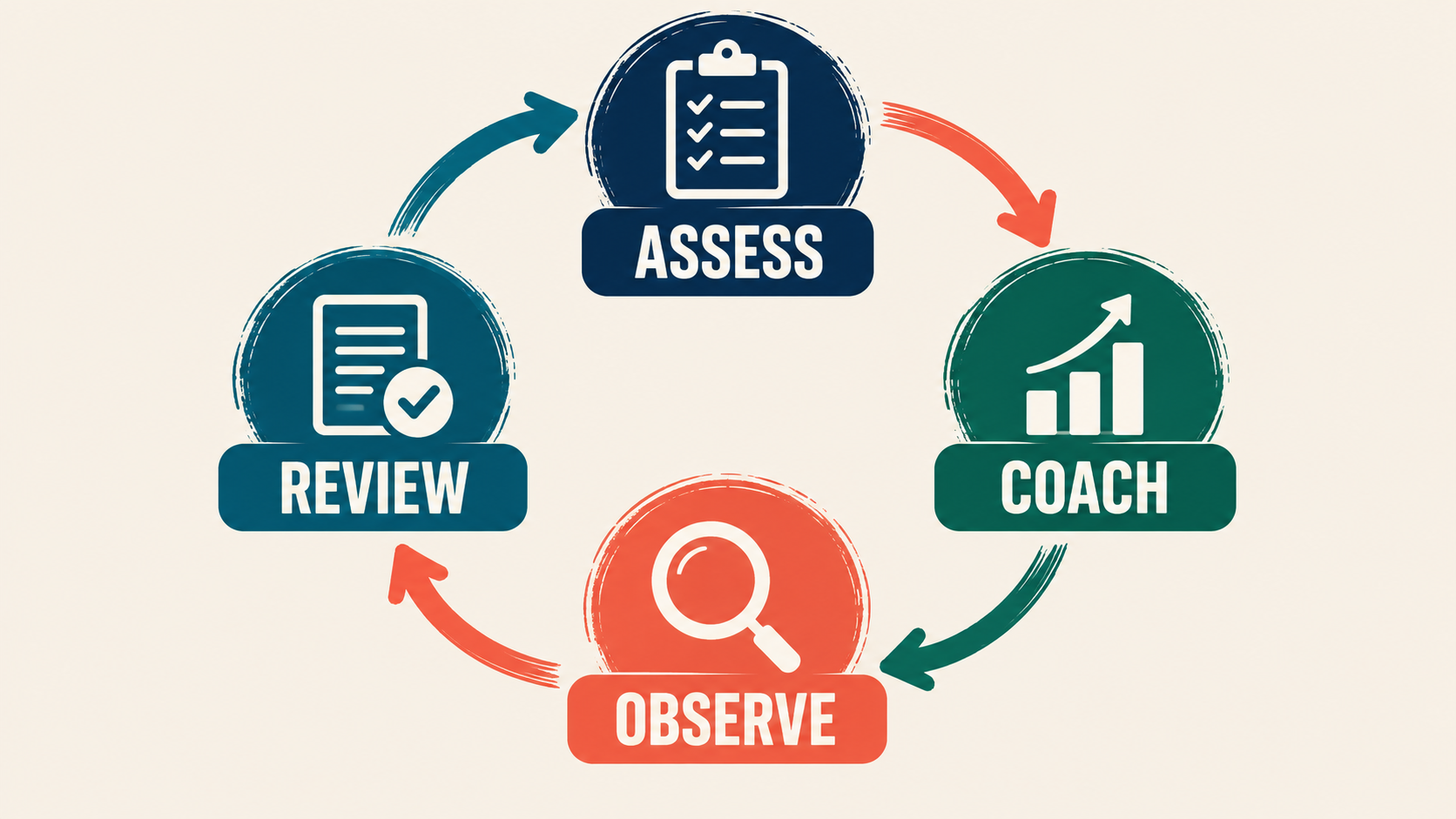
A strong telehealth workflow is a cycle of clinical decisions, not a sequence of video calls. Each step should produce a record that another qualified team member can understand.
| Stage | Remote task | Quality check |
|---|---|---|
| Assess | Define the referral question, review history, observe relevant conditions, and identify missing information | The observation matches the question; limitations are documented |
| Coach | Teach the caregiver or technician how to implement an assigned procedure | The implementer demonstrates the skill or receives specific feedback |
| Observe | Watch implementation, review recordings when authorized, or analyze live data | The BCBA can distinguish client behavior from technology or observer effects |
| Review | Compare data with goals, treatment integrity, caregiver feasibility, and safety information | The next decision is tied to data, not the number of minutes spent online |
For example, if a communication goal works during breakfast but not transitions, a useful remote visit might observe one transition, ask the caregiver to demonstrate prompting, review response data, and select one small change to test. A long conversation that never observes the relevant condition does not answer the treatment question.
What Makes a Client a Good Fit?
Client fit is a clinical decision, not a technology preference. A client may be a good candidate when the caregiver can participate reliably, the environment is reasonably private and safe, the target behavior can be observed or measured in the selected format, and the team can respond when the platform fails. The fit may also change as goals, risk, caregiver availability, or service setting changes. Signals that support a telehealth trial can include:
- The caregiver or on-site implementer can attend, practice, and ask questions.
- The target routine occurs in a setting the remote clinician can see or evaluate meaningfully.
- The team has a simple data system and can report what happened between contacts.
- Privacy, consent, and local emergency contacts are clear.
- The case has a plan for in-person assessment or escalation when remote observation is insufficient.
Pause and reassess when the client is at immediate risk, the caregiver cannot participate at the level required, the environment prevents meaningful observation, the team cannot protect confidential information, or repeated connection failures distort the data. “The platform worked” is not evidence that the clinical model worked.
How Should Supervision and Observation Work?
Telehealth supervision should preserve the same basic purpose as any effective supervision relationship: the supervisor observes relevant performance, provides specific feedback, checks competency or treatment integrity, and makes the next clinical decision visible. The medium changes; the responsibility to monitor quality does not.
Before a remote observation, define what the observer is looking for. A technician may need feedback on prompting, reinforcement, data recording, or error correction; a caregiver may need coaching on arranging the environment. Do not assume that a camera angle shows every relevant event. If the view is incomplete, label the limitation and gather another source.
After the observation, document the behavior observed, feedback given, implementer response, and follow-up plan. Avoid notes such as “telehealth went well.” A stronger note might state that the caregiver used the three-step prompting sequence across five opportunities, received feedback, and will collect the same data during the next transition routine.
Supervision requirements can depend on the credential, setting, service arrangement, and current official rules. Use the current BACB supervision resources and the applicable employer, payer, and jurisdictional guidance. Do not turn a general internet summary into a universal supervision percentage or promise that remote observation is sufficient for every case.
What Technology and Privacy Controls Matter?
The technology should support the clinical task and protect the client’s information. Confirm approved platform use, account access, device security, recording policy, and the method for sending data. Do not move protected information into personal messaging, unapproved cloud storage, or informal screenshots. Use a short pre-session check:
- Confirm identity, location, consent status, and who is in the room.
- Check audio, camera position, lighting, connection stability, and backup contact.
- Remove unrelated notifications and keep the session device controlled by the authorized user.
- Explain whether recording is allowed; never assume that a platform’s recording button equals consent.
- Agree on what happens if video stops, the client leaves the area, or an urgent safety issue occurs.
Privacy is part of treatment quality because a family may change behavior when an unknown person, device, or recording is present. Make the smallest useful amount of information visible, explain the purpose of observation, and change the method when confidentiality cannot be maintained.
How Do You Evaluate Quality?
Evaluate telehealth with the same discipline used for any clinical service: define an outcome, measure it, check implementation, and adjust when the data do not support the plan. Add modality-specific checks for connection failures, camera limitations, caregiver burden, privacy, and access barriers. A practical monthly review can ask:
- Did the remote contact address the documented clinical question?
- Was the relevant person, routine, or implementation behavior observable enough?
- Did the caregiver or technician demonstrate the procedure rather than only describe it?
- Are data complete enough to support the decision being made?
- Did technology, language, disability access, scheduling, or privacy reduce participation?
- What evidence would trigger an in-person assessment, a different service format, or a change in supervision?
Quality is not measured by the percentage of visits that happened online. It is measured by whether the service produced valid information, usable skill transfer, safe implementation, and a defensible next step.
What Are Common Remote Telehealth BCBA Red Flags?
Some warning signs appear in job descriptions; others appear after a case begins. Treat them as prompts for clarification rather than automatic proof of misconduct:
- The employer promises that every client can be served remotely without a fit or escalation process.
- The role expects the BCBA to work across locations without explaining licensure, payer, or service-address requirements.
- There is no named supervisor, emergency contact, privacy policy, or technology backup plan.
- Documentation focuses on minutes connected rather than the observation, data, feedback, and decision.
- The organization discourages the BCBA from requesting in-person assessment when the remote method is not answering the question.
- Recording, personal devices, or data sharing are treated as informal conveniences instead of controlled processes.
Ask for the written process, record the answer, and escalate unresolved clinical or safety concerns through the proper channel. A remote telehealth model can be well designed, but it should never depend on the BCBA quietly absorbing risks that the organization has not addressed.
Frequently Asked Questions
Is a remote telehealth BCBA the same as a remote BCBA job?: No. A remote BCBA job can include administrative, documentation, or consulting work. A remote telehealth BCBA provides some clinical contact through a distance format. Read the role description for the actual service, client location, supervision, privacy, and escalation expectations.
Can every BCBA client be served through telehealth?: No. Suitability depends on the clinical question, risk, caregiver participation, environment, technology, privacy, and applicable rules. A case may need in-person assessment, hybrid care, or another professional when remote observation is not sufficient.
Does telehealth remove the need to verify state or payer rules?: No. Telehealth can create additional questions about client location, provider location, licensure, authorization, documentation, and reimbursement. Verify current requirements with the relevant official sources, employer, payer, and jurisdiction before starting.
What should a BCBA do when the video connection fails?: Follow the documented backup plan, protect privacy, record what was and was not observed, and decide whether the clinical task can be completed another way. Do not present an incomplete observation as if it were reliable data.
How can I study remote supervision and clinical decision-making?: Practice identifying the clinical question, role boundary, measurement problem, privacy issue, and safest next step. You can use the free BCBA mock exam as study practice. It is not BACB guidance, a guarantee of passing, or a source of recalled exam questions.
Sources for Further Study
- Behavior Analyst Certification Board: Supervision and Training — current BACB supervision and training resources.
- Council of Autism Service Providers: Practice Parameters for Telehealth — practice-planning resource for telehealth ABA services.
- California Association for Behavior Analysis: Telehealth Applied Behavior Analysis — professional practice brief.
- U.S. Department of Health and Human Services: Getting Started With Telebehavioral Health — planning considerations for telebehavioral health.
- Preliminary Recommendations for Telehealth-Based Applied Behavior Analysis — peer-reviewed discussion of telehealth ABA practice considerations.
These resources help frame a decision; they do not replace current state law, payer instructions, employer policy, or individualized clinical judgment.
Take the Free BCBA Mock Exam
If you want a low-pressure way to check your recall, use the free practice resource below. Take the Free BCBA Mock Exam



