
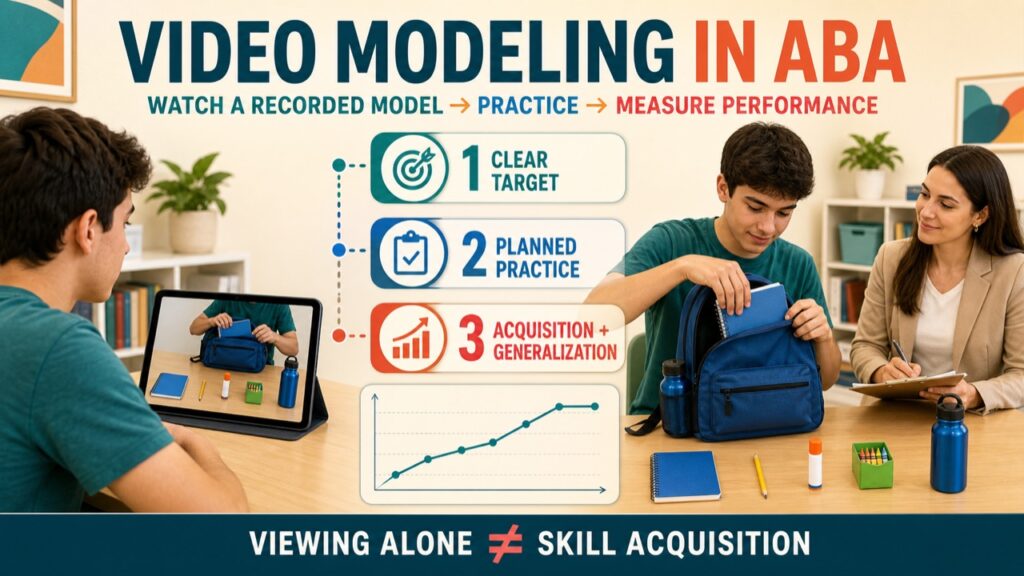
Video modeling ABA is a teaching procedure in which a learner watches a recorded model perform a clearly defined target behavior and then receives planned opportunities to perform that behavior under relevant conditions. The recording is an antecedent component of a larger teaching arrangement; acquisition is evaluated from the learner’s observable performance, not from viewing alone. This guide distinguishes the major video-based formats and explains how to plan practice, prompting when needed, reinforcement or feedback, generalization, maintenance, treatment integrity, and outcome measurement.
Table of Contents
- Definition and Key Components of Video Modeling ABA
- Video Modeling Formats in ABA
- Prerequisite and Design Considerations
- Common Traps and Misconceptions for the BCBA Exam
- Stimulus Control and Generalization in Video Modeling
- BCBA Exam Study Checklist
- Evidence and Current Exam-Outline Boundary
- Ready to Practice?
Definition and Key Components of Video Modeling ABA
In behavior-analytic terms, video modeling describes a procedure, not a stimulus function. A recording or a feature within it may acquire discriminative control through a relevant reinforcement history, but it should not automatically be labeled an SD or S-delta. Imitation after a video, failure to imitate, and time spent looking at a screen do not by themselves establish those functions. The defensible question is whether exposure to the modeled performance, within the complete teaching arrangement, is followed by measurable change in the target response.
Research has examined video-based instruction across social, communication, daily-living, academic, play, and staff-performance targets. A teaching sequence can include a defined model, planned viewing, a clear opportunity to respond, individualized prompting and fading when needed, relevant consequences, and repeated measurement. Those components should be selected from assessment and data rather than treated as an inseparable package for every learner. Accuracy, independence, latency, completed task steps, or another dimension matched to the goal can be measured across baseline, teaching, generalization, and maintenance conditions.
Video Modeling Formats in ABA
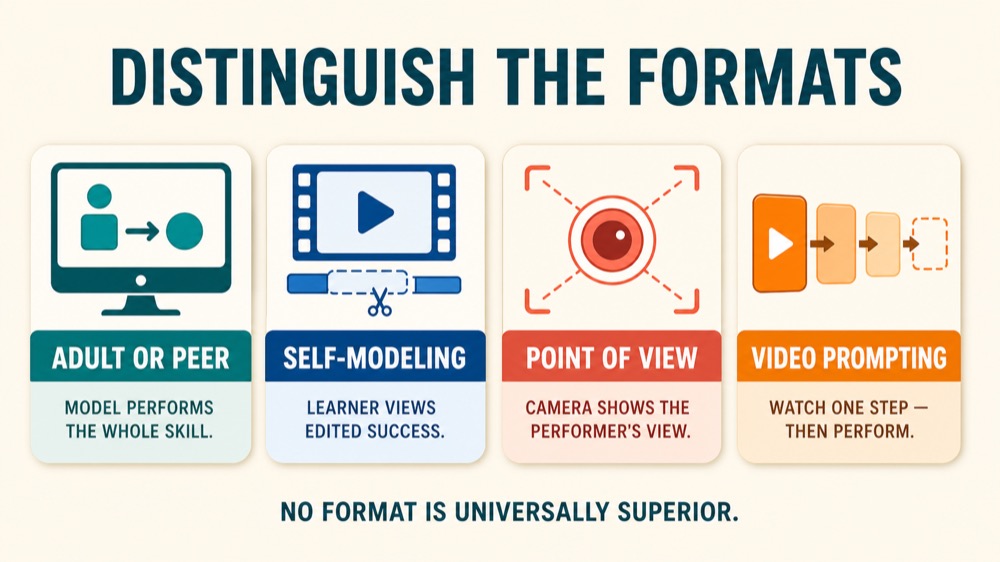
There are several distinct formats of video modeling, each with its own procedural variations. No single format is inherently superior; selection depends on learner characteristics, the target behavior, and available resources. Below are the most common formats used in ABA practice.
- Adult or peer video modeling: A fluent adult or peer performs the whole target skill in the recording. The learner watches and then receives an opportunity to perform it. Model and context similarity can be considered when relevant, but similarity should not be assumed necessary or sufficient for learning or generalization.
- Video self-modeling: The learner views a recording of their own successful performance, sometimes edited to omit assistance or errors. Editing feasibility, consent and privacy, response history, target behavior, and outcome data matter; seeing oneself is not a universally superior format.
- Point-of-view modeling: The recording shows the performer’s visual perspective, often emphasizing hands, materials, and the action sequence. It may reduce some irrelevant detail for a task, but selection still depends on the learner and the response requirements.
- Video prompting: The learner watches one segment or task step, performs that portion, and then views the next segment. This watch-perform sequence differs from whole-task video modeling. A program can evaluate either format or a planned combination without treating the labels as interchangeable.
Prerequisite and Design Considerations
Before selecting the procedure, assess variables that may affect its usefulness rather than imposing one universal prerequisite gate. Relevant questions include whether the learner contacts the important features of the recording, what imitation or observational-learning history is present, whether the target response is already emerging, and what motor, communication, sensory, privacy, and accessibility needs affect participation. The 2011 function-based study noted that prior research suggested some role for imitation, while also stating that clear pretreatment criteria had not been identified. Looking time alone is therefore not a pass-or-fail test of readiness.
Design begins with an observable target and a measurement plan. Decide whether a whole response or task-analyzed sequence should be shown, select a model and perspective for a stated reason, and make the clip brief and focused enough for the target and learner rather than following a fixed duration rule. Arrange realistic performance opportunities after viewing. Select prompts, fading, reinforcement, and feedback individually, and record what was actually delivered.
For a low-risk example, suppose the target is packing a school bag from a five-item checklist. The learner first completes baseline opportunities without the teaching clip. During intervention, the learner watches a focused whole-sequence model, receives the same checklist and comparable materials, and then packs the bag. The instructor records independently completed steps, any prompt used, and completion time. Generalization probes use a different bag, materials, or location; maintenance probes occur after routine teaching has been reduced.
This example still requires an experimental logic appropriate to the decision. Improvement after one viewing could reflect prior practice, prompting, materials, or another uncontrolled variable. Repeated measurement and a suitable single-case design can strengthen an inference that the planned teaching arrangement produced change. Treatment-integrity data should show whether viewing, practice opportunities, prompt delivery, and consequences occurred as planned. Social-validity information should address whether the goal matters, the procedure is acceptable and feasible, privacy is protected, and the resulting performance is useful to the learner.
Common Traps and Misconceptions for the BCBA Exam
When studying video modeling for the BCBA exam, it is easy to fall into common misconceptions. Being aware of these traps will help you answer questions accurately and avoid losing points.
- Do not equate exposure with acquisition. Viewing is an arranged event; acquisition is demonstrated by a reliable change in measured performance.
- Avoid universal-response assumptions. Procedure selection and modification depend on the learner, target, context, preferences, feasibility, and observed data.
- Separate whole-sequence modeling from stepwise prompting. In video prompting, viewing and performing alternate by segment; in whole-task video modeling, the modeled sequence precedes the performance opportunity.
- Select video self-modeling from evidence. A self-model can be useful in some programs, but the learner’s image does not guarantee a stronger effect than an adult, peer, or point-of-view model.
- Plan beyond playback. Define when and where the learner can respond, what assistance is available, which consequences follow performance, and how learning will be measured.
- Do not infer an SD or S-delta label from one outcome. Stimulus functions depend on history and demonstrated relations, not on whether imitation happened after a particular viewing.
- Match the method to the task and risk. A low-risk routine can support a study example; crisis, dangerous, or highly individualized behavior requires assessment, competence, safeguards, and a context-specific plan.
- Compare or combine formats deliberately. Switching formats is a data-based program decision, not evidence that one label is inherently best.
Stimulus Control and Generalization in Video Modeling
Stimulus control is evaluated from responding under specified conditions; it is not established by calling the recording an SD. To assess generalization, probe performance with relevant people, materials, examples, or settings that were not identical to teaching. Multiple exemplars, natural-context practice, programmed common stimuli, and a gradual reduction in video access can be evaluated when appropriate. Maintenance requires later probes after teaching has been reduced or ended. If performance occurs only immediately after the same clip, the data support a narrow relation rather than broad generalization. Review our guides to Stimulus Control in ABA and Stimulus Generalization in ABA for the underlying distinctions.
BCBA Exam Study Checklist
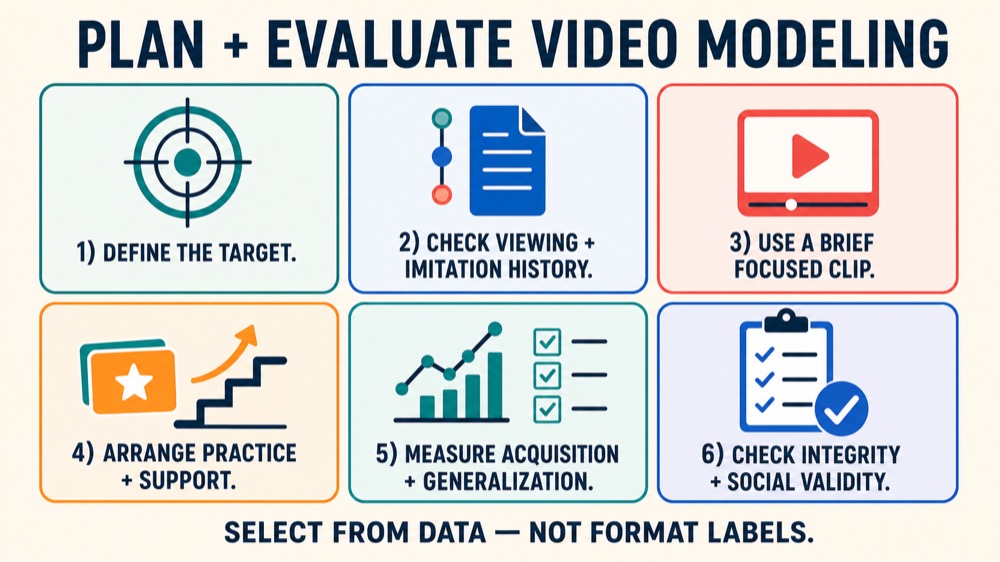
Use this checklist when reviewing video modeling for the BCBA exam. It covers key concepts, applications, and common pitfalls to ensure you are well prepared.
- Define video modeling as a recorded-model teaching procedure and distinguish the procedure from a possible stimulus function.
- Distinguish adult or peer modeling, video self-modeling, point-of-view modeling, and video prompting.
- Evaluate relevant viewing, imitation, accessibility, response, privacy, and contextual variables without inventing universal prerequisites.
- Define the target, model, clip, response opportunity, prompting and fading plan, consequences, and measurement system.
- Measure acquisition instead of using viewing as the dependent variable.
- Probe generalization across relevant untrained conditions and maintenance after teaching is reduced.
- Measure treatment integrity, including video exposure, practice opportunities, prompts, consequences, and dosage.
- Evaluate social validity with the learner and relevant stakeholders, including acceptability, feasibility, privacy, and meaningful outcomes.
- Use BCBA Practice Questions on Stimulus Control to practice distinguishing procedures, stimulus functions, and measured effects.
Evidence and Current Exam-Outline Boundary
The current BCBA Test Content Outline (6th ed.) does not explicitly name video modeling. Related tasks include B.24 on imitation and observational learning, G.9 on modeling procedures, G.15 on generalization, and G.16 on maintenance. Those connections make the procedure useful for concept integration, but they do not make it guaranteed exam content.
- The open-access evidence and gap map, Video-based interventions promoting social behavioural skills for autistic children and young people, maps multiple video-based formats and shows that the evidence is uneven across intervention types, outcomes, populations, and settings.
- The applied study Establishing Verbal Repertoires in Children With Autism Using Function-Based Video Modeling illustrates a specific, experimentally evaluated arrangement; its procedure and results should not be generalized into a universal protocol.
Ready to Practice?
Use the Free BCBA Mock Exam for independently written practice and feedback across behavior-analytic content. It does not reproduce live BACB items or promise that this exact topic appears in a given form.



