
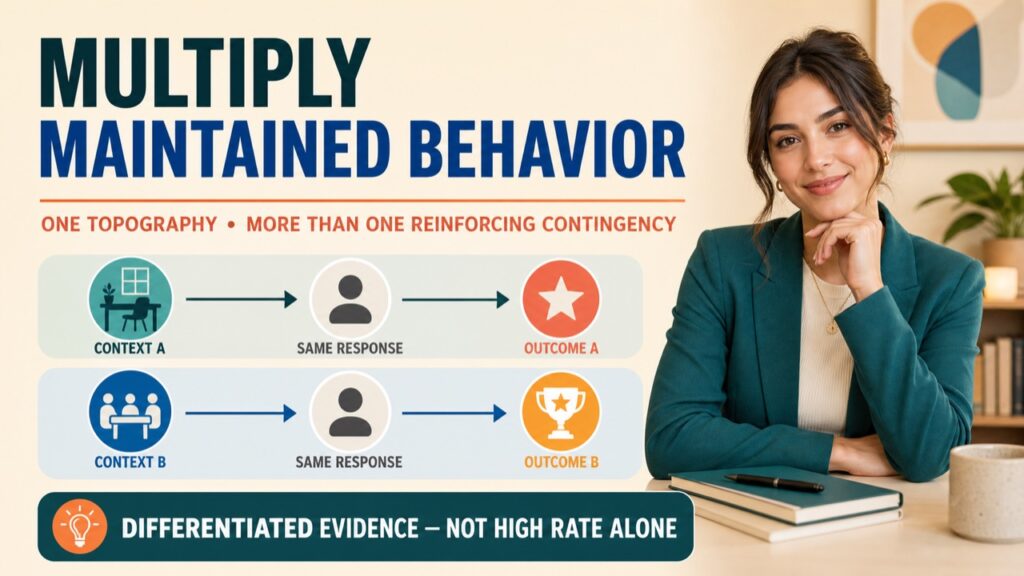
Multiply maintained behavior is behavior maintained by more than one source of reinforcement. The term can describe a specific response topography that contacts different reinforcers across relevant contexts, but apparent multiple control can also arise when several topographies with different functions are aggregated into one measure. A defensible conclusion depends on differentiated and replicated assessment evidence—not severity, variability, or a high response rate alone. This guide distinguishes multiple control from a functional class, an undifferentiated analysis, and a synthesized contingency, then reviews cautious assessment and treatment decisions.
Table of Contents
- What Is Multiply Maintained Behavior?
- Distinguishing Multiply Maintained from Related Concepts
- Assessment Considerations for Multiply Maintained Behavior
- Common Assessment Traps
- Treatment Approaches
- Study Checklist for Practitioners
- References
What Is Multiply Maintained Behavior?
In functional-analysis literature, multiple control is commonly identified when the measured behavior occurs at consistently higher levels in two or more test conditions than in a relevant control condition. For example, one clearly defined vocal response might be reinforced by task removal in one context and by access to an activity in another. Those are different response–consequence relations involving the same topography. Interpretation still depends on experimental control, repeated measurement, the way target responses were defined, and plausible sequence, carryover, discrimination, or interaction effects.
Higher responding in two test conditions with lower responding in control can support a multiple-control hypothesis when the pattern is replicated and alternative interpretations are addressed. If responding is similar across test and control conditions, the result is undifferentiated; it does not show that every programmed contingency maintains the behavior. Possible next questions include whether the relevant variables were arranged, condition discrimination occurred, responding was automatically reinforced, topographies should be separated, or other assessment formats are needed. The next step is selected from the question, risk, feasibility, competence, and available evidence rather than from a fixed recipe.
Distinguishing Multiply Maintained from Related Concepts
Multiply maintained behavior vs. a functional class: A functional class groups responses by a common effect on the environment, so different topographies can enter the same class when they contact the same reinforcer. Conversely, one topography can participate in different functional relations across contexts. The labels are therefore not simple opposites. A critical measurement problem occurs when several topographies are collapsed into one dependent variable: attention-maintained hitting and escape-maintained yelling can produce an aggregate graph that appears multiply controlled even though each separately graphed topography shows a different relation.
Multiple control vs. an undifferentiated analysis: An undifferentiated pattern lacks a reliable test–control difference under the evaluated arrangement. It can be compatible with several interpretations, including automatic reinforcement, carryover, inadequate establishing operations, ineffective test consequences, weak discrimination, response-class aggregation, or measurement problems. The graph does not by itself select among them. Evidence of multiple control instead requires differentiated relations supporting more than one source of reinforcement.
Multiple control vs. a synthesized contingency: A synthesized analysis evaluates the combined contingency as an arranged unit. Differentiation can demonstrate control by that unit, but it does not decompose the contribution of each component. If the clinical or research question requires component-level conclusions, separate test conditions, a component analysis, or a desynthesis analysis may be considered when appropriate. No single format is automatically required for every case; the design must match the inference being made.
- Common functional class: Hitting, yelling, and pushing materials are separately measured and each reliably produces task removal. Different topographies share a demonstrated reinforcing consequence.
- Single topography with multiple control: One operationally defined vocal response is repeatedly elevated in an escape test and an activity-access test relative to control, with the relevant consequence arranged separately in each context.
- Spurious aggregate pattern: Hitting is elevated only in an attention condition and yelling only in an escape condition. A combined “problem behavior” measure is elevated in both, but separate graphs do not show that either topography has two functions.
- Undifferentiated result: Similar responding across test and control conditions leaves the maintaining relation unresolved under that analysis; it is not evidence that all conditions are functional.
These distinctions change the treatment question. Treating an aggregate label can add unnecessary components, whereas an intervention matched to just one demonstrated relation may leave another demonstrated relation unchanged. Preserve topography-level data, state exactly which relation the evidence supports, and avoid treating a category name as a functional conclusion.
Assessment Considerations for Multiply Maintained Behavior
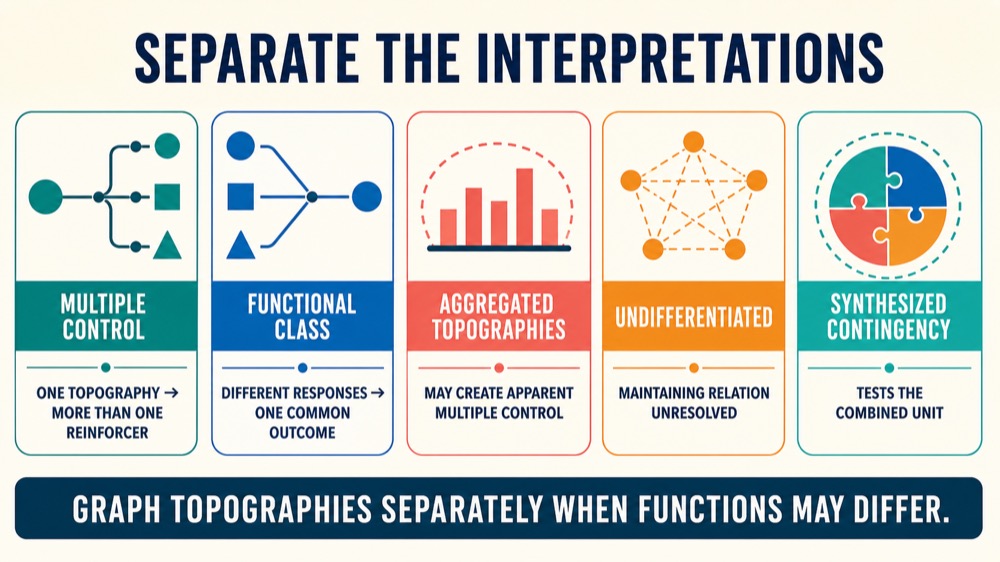
Assessment planning starts with the dependent variable and the inference needed. Operationally define each response topography, graph topographies separately when their functions might differ, and justify any combined response class. Conditions that separately arrange suspected reinforcement sources can test whether one target response is sensitive to more than one contingency. When variables naturally co-occur, a combined analysis may answer a contextual question, followed by component comparisons if the contribution of individual variables matters. Design, session, control, and replication decisions should be adapted to the response, risk, setting, and available expertise.
Functions in separate contexts: When maintaining relations occur in meaningfully different contexts, a team may evaluate context-specific alternatives and consequences—for example, an accessible break response during an instructional routine and an attention request during a social routine. Whether antecedent conditions acquire useful stimulus control is an outcome to measure, not an assumption from the plan. See stimulus control in ABA for the underlying distinction.
Functions in the same context: Published approaches include an omnibus communication response that contacts a synthesized outcome, chained or concurrent arrangements, and different responses that contact separate outcomes. Each option changes response effort, delay, clarity, and implementation demands. Select among them using assessment evidence, client and stakeholder priorities, safety, feasibility, competence, and direct outcome data. Program and probe stimulus generalization rather than assuming that a response taught in one arrangement transfers to another.
- Define and separate responses: Make each topography observable and measurable, then compare individual and aggregate graphs before assigning multiple control.
- Match design to the question: Select test, control, sequence, replication, and single-case design features that support the intended inference and can be implemented safely.
- Check competing explanations: Review establishing operations, consequence quality, discrimination, carryover, interaction effects, measurement reliability, and treatment history.
- Use the least risky informative next step: An alone or ignore condition is not a generic follow-up; its relevance, safeguards, feasibility, and alternatives require case-specific review.
- Reassess uncertainty: Extend, modify, or change the assessment when data remain unclear, documenting why the new arrangement can answer the unresolved question.
Common Assessment Traps
- High rates do not equal multiple functions: Behavior may be high in one condition due to a strong single reinforcer. Check differentiation, not rate alone.
- Variability does not prove multiple control: Variability can stem from extinction bursts, session order, or poor reinforcer quality. Do not infer multiple control without stable, differentiated levels.
- Combining topographies can create spurious multiply maintained interpretations: Aggregating topographies can mask individual functions. For instance, if one topography is escape-maintained and another is attention-maintained, combining them may show elevated levels in multiple conditions, falsely suggesting multiply maintained behavior.
- Undifferentiated FA does not mean multiply maintained: Undifferentiated patterns require further analysis—such as an alone condition or reinforcer assessment—not automatic classification as multiply maintained.
- Severity does not indicate function: A single reinforcer can maintain extremely high-rate behavior; severity alone does not imply multiple control.
Treatment Approaches
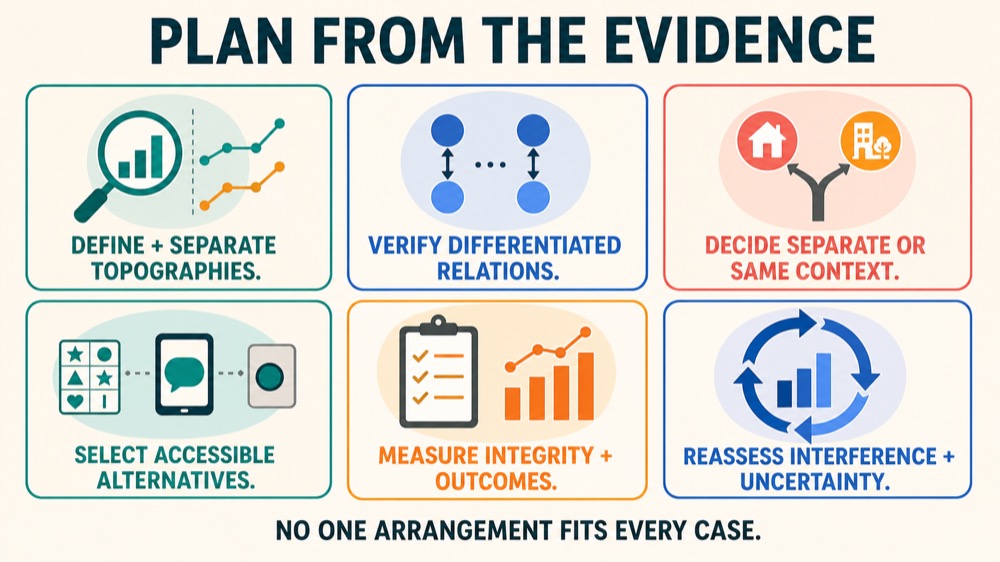
Once evidence supports multiple control, treatment should address the demonstrated relations while remaining acceptable, feasible, and individualized. One option is to teach distinct accessible responses for different outcomes, such as a break request in an instructional routine and an activity request when access is unavailable. Another is to evaluate one communication response that produces a combined outcome. Selection depends on whether functions occur separately or together, learner preferences and abilities, response effort, implementation resources, safety, and the effects observed in direct measurement.
A treatment can address functions in separate sessions, within the same session, or in a staged sequence. Components for one function may interfere with components for another, so monitor each target response, alternative response, delivered outcome, treatment-integrity measure, and possible unwanted effect. If progress is limited, first verify implementation and the current contingencies, then revisit the assessment question as needed. Do not assume that a function changed or that a new function emerged solely because an intervention did not produce the expected outcome.
- Select accessible alternatives: Choose one or more responses that can contact the relevant outcomes with acceptable effort, delay, reliability, and contextual fit.
- Arrange reinforcement deliberately: Define which outcome follows each response and measure allocation. Extinction is not an automatic component; any use requires a specific rationale, competence, feasibility and risk review, safeguards, and monitoring.
- Evaluate stimulus control: Measure whether alternatives occur under the intended conditions and revise cues, prompting, or consequences when control is too narrow or unclear.
- Measure implementation: Sample whether relevant implementers deliver prompts and consequences as planned; variation is data for support and redesign, not a reason to blame caregivers.
- Probe generalization and maintenance: Test relevant people, settings, materials, and later time points without treating transfer as guaranteed.
- Protect client welfare: Use client-informed goals, assent when applicable, stakeholder input, least-intrusive effective options, individualized safety planning, and decision rules for pause or consultation.
Treatment effectiveness is established by meaningful behavior change under the implemented plan, not by the assessment label alone. Revisit operational definitions, topography-specific graphs, motivating operations, delivered consequences, fidelity, contextual changes, and social-validity outcomes when the data do not support continuing the current arrangement.
Study Checklist for Practitioners
- Define multiply maintained behavior: one topography, two or more sources of reinforcement.
- Differentiate from functional class: one reinforcer per topography vs. one topography with multiple reinforcers.
- Interpret FA graphs: look for elevated levels in two or more test conditions relative to control.
- Recognize common traps: high rate ≠ multiple functions; undifferentiated ≠ multiply maintained.
- Design treatment: teach separate FERBs for each function or a combined FCR with careful reinforcement.
- Review stimulus control: antecedent contexts signal which function will be reinforced.
- Use our Free BCBA Mock Exam for independently written practice and feedback across behavior-analytic content; it does not reproduce live BACB items or promise this exact topic.
The current BCBA Test Content Outline (6th ed.) does not explicitly name multiply maintained behavior. Related tasks include functional assessment and analysis, interpreting assessment data, function-based intervention, experimental design, procedural integrity, and data-based modification. Use those outline relations as study boundaries rather than as a prediction about any particular examination item.
References
- BACB BCBA Test Content Outline
- Approaches for Treating Multiply Controlled Problem Behavior
- Prevalence of Multiply Controlled Problem Behavior



