

What Is Treatment Drift in ABA?
Treatment drift in applied behavior analysis (ABA) is the gradual, often unplanned deviation from a prescribed treatment protocol during implementation. Unlike a one-time error, drift develops over time as the intervention is delivered across sessions. For example, a teacher who initially praises every correct response every 30 seconds may slowly extend that interval to two minutes over several weeks. Because the change is incremental, it can go unnoticed without careful monitoring, yet it can quietly undermine the quality of the intervention and the accuracy of outcome data.
Table of Contents
- What Is Treatment Drift in ABA?
- Treatment Drift vs. Treatment Integrity
- Examples of Treatment Drift in Practice
- How to Measure Treatment Drift
- Why Treatment Drift Occurs
- Effects of Treatment Drift
- Prevention Strategies
- Treatment Drift and the BCBA Exam
- Study Checklist for Treatment Drift
For BCBA exam candidates, understanding treatment drift is essential because it directly affects treatment integrity and the internal validity of behavioral measurements. When a protocol drifts, the data may no longer reflect the true effect of the intervention, leading to incorrect clinical decisions. This article defines treatment drift, contrasts it with treatment integrity and procedural fidelity, provides practical examples, and outlines measurement, causes, effects, and prevention strategies. You will also find exam-relevant insights and a study checklist to help you master this topic.
Treatment Drift vs. Treatment Integrity
Treatment integrity, also called procedural fidelity, is the degree to which an intervention is implemented as designed. It is a snapshot of protocol adherence at a given moment. For instance, if a therapist correctly implements 18 of 20 prescribed steps during a session, treatment integrity is 90% for that session. Treatment drift, in contrast, is a specific type of integrity failure that emerges gradually over time. It is not a single missed step; it is a pattern of increasing deviation across sessions.
Think of treatment integrity as a photograph of implementation quality, while treatment drift is a video that shows how that quality changes. A therapist may begin with near-perfect integrity, but by the fourth week, their adherence may have slipped. That progressive decline is drift. Drift is often unintentional, arising from forgetting, time pressure, or well-meaning adjustments that seem harmless but are not part of the protocol.
Consider this example: a behavior technician is trained to deliver a 30-second break after each completed trial. For the first two weeks, the technician follows this schedule precisely. By the third week, the break extends to 60 seconds, and by the fourth week, it reaches 90 seconds. The technician does not record this change, and no one observes it. This is treatment drift because the implementation has gradually deviated from the prescribed procedure.
Examples of Treatment Drift in Practice
To recognize treatment drift in real-world settings, it helps to examine concrete scenarios. Each example below illustrates a gradual shift that might escape notice without systematic checks.
- Reinforcement schedule drift: A teacher initially provides praise after every correct response during discrete trial training. Over two weeks, the praise becomes less frequent, eventually occurring only after every five correct responses. This change in the reinforcement schedule is a form of drift.
- Task analysis drift: A therapist is trained to teach handwashing using a 10-step task analysis. In early sessions, they follow the steps exactly. By session ten, they begin combining two steps, such as rubbing soap and rinsing simultaneously, without noting the modification.
- Timing drift: A technician is supposed to provide a 30-second break after each trial. Over time, the break extends to 90 seconds, but the technician does not record this change, resulting in a slower pace of instruction.
- Parameter drift: A BCBA designs a differential reinforcement of alternative behavior (DRA) procedure with a 5-minute interval. The implementer gradually shifts to a 7-minute interval because it seems to reduce problem behavior, but this change is not authorized.
These examples show that drift can affect any component of a procedure, including timing, frequency, order, and duration. They also highlight that drift is often not a sign of incompetence or intent; rather, it emerges from subtle, cumulative adjustments that go unnoticed without regular supervision and measurement.
How to Measure Treatment Drift
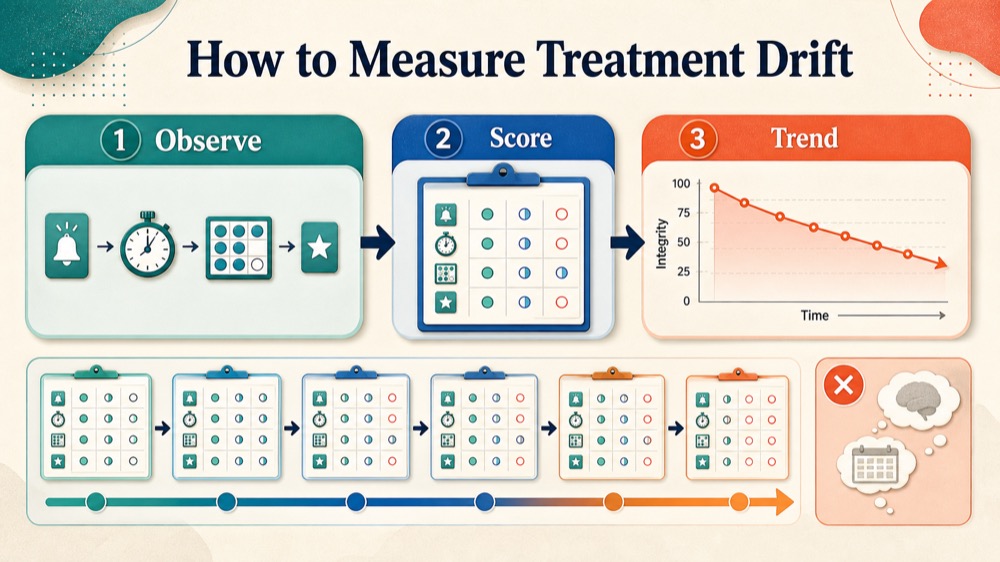
Detecting treatment drift requires systematic measurement of treatment integrity over time. Relying on memory or informal impressions is insufficient. Several methods, when used together, provide a clear picture of implementation quality and reveal gradual declines.
- Treatment integrity checklists: Develop a task analysis of the protocol and have an observer score whether each step was implemented correctly. This yields a percentage score for each session, allowing you to track adherence across time.
- Direct observation: Have a trained supervisor or peer observe live sessions or video recordings and rate adherence using the checklist. Direct observation is generally more objective than self-report and can capture subtle deviations.
- Self-report: The implementer can complete a checklist after each session, but self-report is subjective and may be biased. Use it as a supplement, not a primary measure, because implementers may unintentionally overestimate their fidelity.
- Graph adherence data: Plot treatment integrity scores on a line graph across sessions. This visual display makes it easy to spot descending trends, which are a classic sign of drift. Graphing also allows you to compare integrity with client progress data.
For example, if integrity scores decline from 95% in week one to 80% in week four, the downward trend signals drift. Graphing this data alongside client progress can help you determine whether the intervention is truly effective or whether implementation failures are masking its effects.
Why Treatment Drift Occurs
Understanding the common causes of treatment drift helps you design effective prevention strategies. Drift rarely happens without reason; it is typically driven by one or more of the following factors.
- Inadequate training: If the implementer does not achieve mastery before starting, they are more likely to deviate from the protocol. Training that lacks modeling, rehearsal, and feedback may not prepare them adequately.
- Lack of supervision: When supervisors are rarely present, implementers may not receive corrective feedback, and drift can go unnoticed for weeks or longer.
- Forgetting: Over time, memory for exact steps can fade, especially if the protocol is complex or used infrequently. This is more likely when written protocols are not readily accessible.
- Unintended modifications to increase efficiency: Implementers may shorten or skip steps they believe are unnecessary, without realizing the impact on the intervention’s effectiveness.
- Time pressure: Busy schedules may lead to shortcuts, such as reducing the number of trials or shortening breaks, to fit more sessions into the day.
- Environmental factors: Noise, interruptions, or changes in setting can disrupt implementation, leading to inadvertent changes in timing or sequence.
In all cases, drift is a form of procedural infidelity. It is important to recognize that even experienced clinicians can drift, which is why regular checks are essential. By identifying the root causes, you can implement targeted prevention measures.
Effects of Treatment Drift
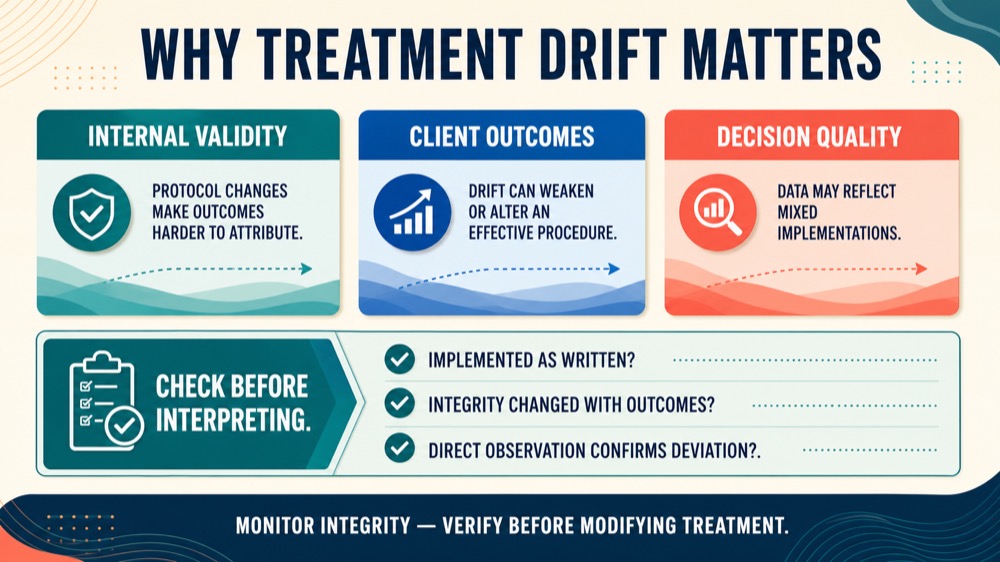
Treatment drift can have serious consequences for both the client and the credibility of your analysis. Here are the primary effects you need to know.
- Reduced treatment effectiveness: Even slight deviations can weaken the impact of an intervention. For example, if reinforcement is delayed too long, the target behavior may not increase as expected, and the client may not make the desired progress.
- Inaccurate conclusions: If drift goes undetected, you might attribute a lack of progress to the intervention itself, when in fact the implementation was faulty. This can lead you to discard a potentially effective treatment.
- Multiple treatment errors: Drift can multiply over time, as one deviation leads to another, further compromising the entire protocol. For instance, changing the timing of reinforcement might also affect the schedule of demands, creating additional errors.
- Threatens internal validity: In behavior-analytic research and practice, drift threatens internal validity because you cannot confidently attribute changes in behavior to the intervention when the intervention was not consistently applied. This makes it difficult to draw causal conclusions.
These effects underscore why vigilant monitoring is non-negotiable. The literature on treatment integrity emphasizes that maintaining high integrity is essential for valid outcome evaluation. By understanding these consequences, you can appreciate the importance of prevention.
Prevention Strategies
Preventing treatment drift is a critical skill for BCBAs. The following strategies are practical and evidence-based, and they should be embedded in your supervision and quality assurance routines.
- Provide regular supervision: Schedule frequent check-ins with implementers to discuss progress, review data, and observe sessions live or via video. Supervision is a core component of professional practice, as outlined in the BCBA Test Content Outline.
- Conduct periodic integrity checks: Use direct observation or video review with checklists at regular intervals, not just when problems are suspected. This proactive approach catches drift early.
- Use behavioral skills training (BST): Train implementers using instructions, modeling, rehearsal, and feedback until they achieve mastery. This is more effective than simply providing written instructions.
- Create clear written protocols: Make sure the protocol is written in a way that is easy to follow, with step-by-step instructions and visual aids. Keep the protocol accessible to all implementers.
- Graph integrity data: Share graphs with the team so everyone can see trends and catch drift early. This transparency promotes accountability and collective monitoring.
- Provide behavior-specific feedback: When you observe sessions, give the implementer specific, constructive feedback about what they did well and what needs improvement. This helps them adjust their performance.
Use these strategies proactively to reduce drift and maintain treatment integrity. For related discussion of environmental variables, review our guide on stimulus control in ABA.
Treatment Drift and the BCBA Exam
Treatment drift is a concept that can appear on the BCBA exam because it relates to measurement, experimental design, and professional conduct. The BCBA Test Content Outline includes content on treatment integrity, data collection, and ensuring that interventions are implemented as designed. While the exact term “treatment drift” may not be used, exam items may present scenarios where you must identify drift or recommend prevention strategies. When studying, focus on the following points:
- Know the definition and distinguishing features of treatment drift.
- Recognize scenarios that illustrate drift versus one-time errors.
- Understand how drift affects internal validity.
- Identify prevention strategies from a list of options.
It is also helpful to connect treatment drift to other behavioral concepts. For example, if a therapist inadvertently changes the discriminative stimulus (SD) during training, that could be a form of drift. Reviewing stimulus generalization can deepen your understanding of how environmental cues influence behavior and treatment fidelity. Note that the BCBA exam does not guarantee that any specific topic will appear, so use this information as a guide rather than a prediction.
Study Checklist for Treatment Drift
Use this checklist to review treatment drift concepts.
- Define treatment drift and differentiate it from treatment integrity and procedural fidelity.
- Give at least three examples of drift in ABA settings.
- Explain how to measure drift using integrity checklists, direct observation, and graphing.
- List the main causes of drift and corresponding prevention strategies.
- Describe the effects of drift on internal validity and intervention effectiveness.
- Review relevant practice questions to test your application of these concepts.
By working through this checklist, you will build a solid foundation for answering related exam items. For additional practice, take our free BCBA mock exam to test your knowledge and identify areas that need more review. The mock exam offers practice questions and feedback, helping you reinforce your understanding and improve your test-taking skills.



