

In Applied Behavior Analysis (ABA), the trustworthiness of your data underpins every clinical decision. When you record behavior, you expect the numbers to reflect what actually happened. However, sometimes the data set shows a pattern that does not correspond to the learner’s behavior at all; instead, it is an artifact of the measurement system itself. This article explains what a measurement artifact is, how it differs from genuine behavior change, and how you can detect and prevent it. By understanding these false data patterns, you protect data integrity and make sound intervention decisions.
Table of Contents
- What Is a Measurement Artifact in ABA?
- Common Sources of Measurement Artifacts
- Why Measurement Artifacts Matter: Impact on Analysis
- How to Detect Measurement Artifacts
- Prevention Strategies for Measurement Artifacts
- Practical Example of a Measurement Artifact
- Measurement Artifacts vs. Measurement Error
- How Measurement Artifacts Affect BCBA Exam Preparation
- Conclusion
- Reference
What Is a Measurement Artifact in ABA?
A measurement artifact is a false or misleading pattern in data that arises from the measurement system itself, not from an actual change in the target behavior. In other words, the recorded data do not match the true behavior. For example, if an observer fails to record responses during a busy period, the data may show a drop that never occurred. Measurement artifacts can stem from human error, equipment problems, or environmental factors, and they threaten the data accuracy and data integrity of your analysis.
To distinguish an artifact from a true behavior change, consider whether the behavior actually differed or whether the measurement method changed. For instance, a teacher records the frequency of a student’s hand-raising during a lesson. During a chaotic transition, the teacher is distracted and misses several hand-raisers. The data show a sudden decrease, but the student actually raised their hand just as often. That decrease is a measurement artifact; it reflects the teacher’s recording failure, not the behavior. In contrast, a true behavior change would be corroborated by independent observers and consistent across measurement methods.
Common Sources of Measurement Artifacts
Measurement artifacts can originate from several distinct sources. Recognizing them helps you identify and correct problems early.
- Observer drift: Over time, an observer unintentionally changes how they apply the operational definition. For example, an observer may gradually start counting “on-task” behavior that includes looking at the teacher, even though the definition requires eyes on material. This drift creates systematic data changes unrelated to the behavior.
- Inadequate training: Observers who are not thoroughly trained on the definition and data collection procedures may record inconsistently from the start.
- Unclear operational definitions: Vague definitions allow subjective interpretation, leading to inconsistent recording across observers or sessions.
- Environmental reactivity: The presence of an observer or device can alter the learner’s behavior, a phenomenon known as reactivity. While reactivity is a genuine behavior change, it can confound data interpretation and mimic an intervention effect if not accounted for.
- Instrument malfunction: Automated data collection systems can malfunction, producing zeros or extreme values due to technical glitches, not actual behavior.
Observer Drift in Depth: Observer drift is a subtle but common threat to data accuracy. It occurs when an observer’s recording behavior changes over time even though the target behavior and definition remain constant. For example, an observer who initially records “aggression” only when physical contact occurs may later include instances of shouting. This drift can cause a false increase in aggression data, leading you to think an intervention is ineffective when it is actually working. Regular retraining and periodic accuracy checks are essential to minimize drift.
Reactivity as a Confound: Reactivity is the effect of an observer’s presence on behavior. For instance, a child may behave better when they know they are being watched. Although reactivity is a real behavior change, it can produce data that are not representative of typical behavior, misleading you into thinking an intervention is effective when the change is temporary. To mitigate reactivity, allow for a habituation period before formal data collection and consider unobtrusive observation methods.
Why Measurement Artifacts Matter: Impact on Analysis
Measurement artifacts have serious consequences for applied behavior analysis. They distort the data accuracy, reliability, and validity of your measurements, directly affecting intervention decisions. When artifacts are present, you may draw false conclusions about whether a behavior is changing. For example, an artifact that makes a behavior appear to be increasing might prompt you to add an unnecessary, more intensive intervention, wasting time and resources. Conversely, an artifact that hides true improvement could lead you to discontinue an effective treatment prematurely. In research, artifacts undermine the credibility of your findings; in practice, they compromise the quality of care your clients receive.
How to Detect Measurement Artifacts
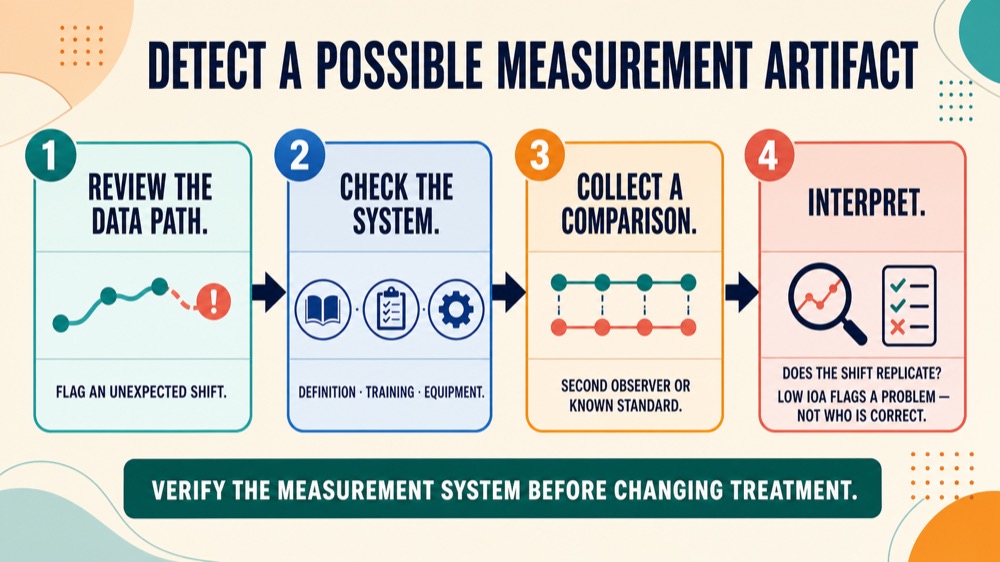
Detecting artifacts requires a systematic approach to data review and quality assurance. Here are key methods to identify potential problems:
- Check interobserver agreement (IOA): Regular IOA checks compare data collected by two independent observers. Low IOA indicates that at least one observer is not measuring accurately, signaling a possible artifact.
- Compare data across observers: Even if IOA is not formally calculated, reviewing data from different observers can reveal inconsistencies that suggest artifacts.
- Review operational definitions: Re-examine the definitions to ensure they are clear, specific, and used consistently. Ambiguities can lead to observer errors.
- Examine data paths for abrupt changes: Look for sudden shifts that are not aligned with intervention changes. If data jump dramatically without a corresponding change in conditions, it may be an artifact.
- Assess environmental conditions: Note any changes in the observation environment, such as noise, lighting, or the presence of the observer, that could affect recording.
Prevention Strategies for Measurement Artifacts
Preventing artifacts is more efficient than detecting them after the fact. The following strategies help ensure data integrity:
- Provide thorough initial training and ongoing retraining: Ensure all observers are proficient in the operational definition and data collection procedures. Periodic refresher sessions can prevent drift.
- Use clear, measurable operational definitions: The more objective and specific the definition, the less room for misinterpretation. Include examples and non-examples.
- Conduct regular IOA checks: Schedule IOA sessions throughout the intervention, not just at the beginning. Use the results to correct any discrepancies promptly.
- Automate data collection when feasible: Use technology such as counters, timers, or software to reduce human error. Automated systems can also provide timestamped data that make artifacts easier to identify.
- Blind observers when possible: If the design allows, have observers who do not know the intervention phase or hypothesis, reducing expectation bias.
Practical Example of a Measurement Artifact
Consider a BCBA working with a teacher to increase hand-raising behavior in a classroom. The teacher records the frequency of hand-raising during a 30-minute lesson. After two weeks, the data show a steady increase. Encouraged, the teacher continues. However, the BCBA conducts an IOA check and finds the agreement is only 60%, well below the acceptable threshold. A review of the session records and a simultaneous observation show that during transitions between activities, the teacher does not record hand-raises while completing class-management tasks. The independent observer recorded those instances. Thus, the apparent increase was actually inflated as the teacher gradually recorded more transitions over time. The true rate of hand-raising was lower, and the intervention was only moderately effective. This artifact could have led to a false conclusion and unnecessary treatment changes.
Measurement Artifacts vs. Measurement Error
It is important to distinguish between a measurement artifact and general measurement error. Measurement error is any deviation of the observed value from the true value, which can be random or systematic. A measurement artifact is a specific type of systematic error that produces a pattern not attributable to the target behavior. For example, an automatic counter that fails to record responses after a battery runs low creates a systematic error and an artifact. In contrast, random measurement error might occur when an observer occasionally misses a response due to momentary distraction, but it does not create a consistent pattern. Both reduce data accuracy, but artifacts pose a greater threat because they can mimic real behavior changes.
How Measurement Artifacts Affect BCBA Exam Preparation
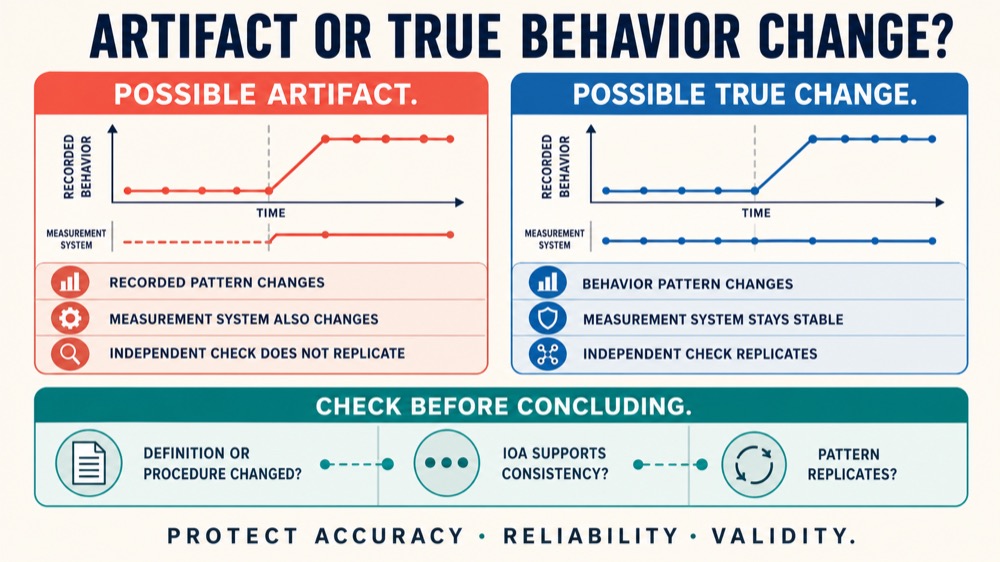
For BCBA exam preparation, understanding measurement artifacts is essential because the test assesses your ability to evaluate data and ensure measurement integrity. You may encounter scenarios that describe data patterns and ask you to identify whether the change is due to true behavior change or an artifact. To prepare, focus on mastering the following:
- Define and recognize measurement artifacts.
- Identify common sources: observer drift, poor training, unclear definitions, reactivity, and instrument malfunction.
- Understand the impact on accuracy, reliability, and validity.
- Apply detection methods such as IOA and visual inspection.
- Implement prevention strategies in practice.
For more structured practice, explore our Free BCBA Mock Exam to test your understanding and receive feedback. Additionally, review related guides on measurement bias and continuous measurement to broaden your measurement skills.
Conclusion
Measurement artifacts are a critical concept in ABA because they challenge the data integrity and validity of your conclusions. By understanding their sources and implementing proactive detection and prevention strategies, you can ensure that your data accurately reflect the behavior you are targeting, leading to better outcomes for your clients. As you study, practice identifying artifacts in various scenarios to sharpen your analytical skills and become a more effective behavior analyst. For additional practice, take the Free BCBA Mock Exam to gain feedback on your measurement knowledge.
Reference
BACB BCBA Test Content Outline
Next step for BCBA exam prep
Turn this topic into exam-day practice
Use this topic as a focused review, then test it in exam-style conditions with a free mock before deciding whether five full-length mocks are the right next step.
Start the Free BCBA Mock ExamContinue with Five Full-Length Mocks — $99
Review the included materials and access details before ordering. No pass guarantee is implied.



