

If you are learning how to train sufficient exemplars ABA programs, do not stop after the learner performs a skill with one item, one cue, or one instructor. Training sufficient exemplars means deliberately teaching enough varied examples of the same functional lesson to help the response contact the relevant features of the skill and transfer to conditions that were not directly taught.
Table of Contents
- What Does Train Sufficient Exemplars ABA Mean?
- Why Does Training Multiple Exemplars Support Generalization?
- How Do You Select a Sufficient Exemplar Set?
- How Do You Train the Exemplars?
- How Do You Probe an Untrained Exemplar?
- How Do You Decide Whether the Set Is Sufficient?
- How Is This Different from General Case Analysis?
- What Should You Remember for the BCBA Exam?
- Frequently Asked Questions
- Sources for Further Study
- Quick Review Checklist
- Take the Free BCBA Mock Exam
This is a generalization-programming strategy, not a rule to use as many examples as possible. The BCBA identifies dimensions that may change in real life, selects a purposeful sample, teaches it, probes an untrained condition, and uses data to decide whether the sample is sufficient. The guide keeps this procedure separate from a broad stimulus-generalization definition and a generic multiple-exemplar overview.
What Does Train Sufficient Exemplars ABA Mean?
To train sufficient exemplars is to teach a target skill across a planned sample of stimulus or response examples rather than teaching only one example and assuming the learner will transfer the skill. An exemplar is one member of the class being taught. For a “request an item” program, an exemplar might be a particular item, communication partner, cue, location, or response form, depending on the question the program is designed to answer.
The word sufficient is functional and data-based. It does not mean every possible item has been trained, and it does not mean that a fixed number works for every learner or skill. The sample is sufficient when the learner demonstrates the target response under relevant untrained conditions at a level that meets the program’s criterion, while the response remains appropriate to the cues and context. For BCBA study purposes, keep three parts separate:
- Training exemplars: the examples that receive direct instruction, prompting, reinforcement, and error correction.
- Probe exemplars: examples presented to test transfer without teaching them first.
- Generalization criterion: the data rule used to decide whether performance has transferred far enough to be useful.
Why Does Training Multiple Exemplars Support Generalization?
One trained example can accidentally make an irrelevant feature part of the learner’s control. If a learner is taught to identify one red apple on a table, the response might be controlled by the exact picture, position, color, or instructor wording instead of the intended category. Varying relevant features helps the learner contact what stays the same and what changes.
Research describes training sufficient exemplars as a way to program responding to untrained conditions rather than waiting to see whether transfer happens. Applied studies show that several exemplars can support maintenance and generalization, although transfer may be stronger within a trained category than across a very different category. A probe is essential because the procedure creates an opportunity for transfer, not a guarantee.
The strategy can also reduce overgeneralization. A learner may be taught to request several preferred items while still learning when a request is appropriate, what is available, and how to respond when an item is unavailable. Variety should expand functional responding without removing stimulus control.
How Do You Select a Sufficient Exemplar Set?
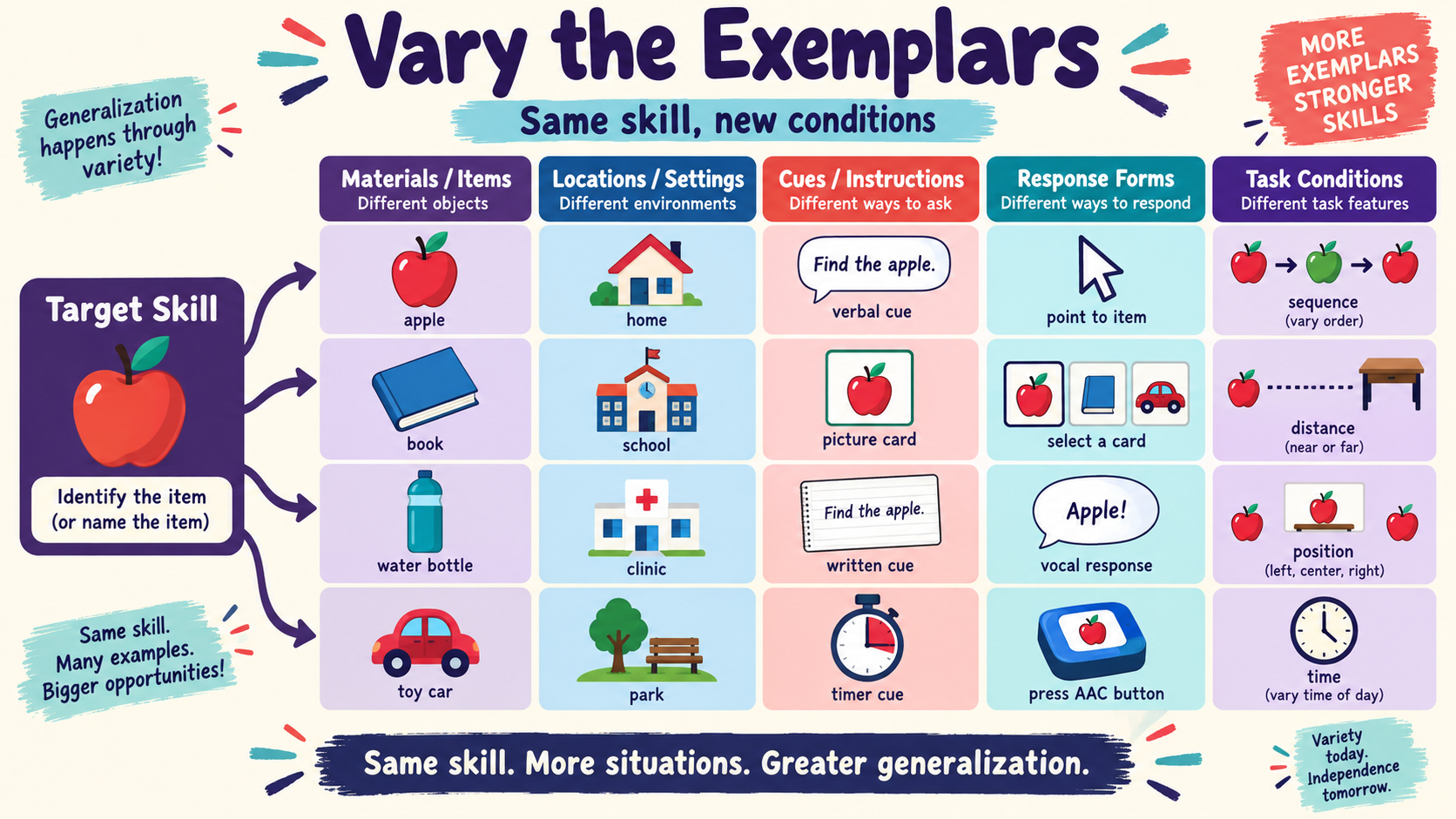
Start with the natural range of conditions in which the skill will matter. Observe or interview relevant supporters, review baseline data, and identify the dimensions that could change outside the teaching arrangement. The goal is not decorative variety. Each selected exemplar should represent a feature that may affect performance or that the learner must learn to treat as irrelevant.
| Dimension to vary | Example of an exemplar set | Question for planning |
|---|---|---|
| Materials or items | Different sizes, colors, brands, pictures, tools, or objects | Which physical features will change in the natural routine? |
| Settings | Home, school, clinic, store, playground, or work area | Where should the skill be useful and safe? |
| Cues and instructions | Verbal direction, picture cue, written cue, natural signal, or time cue | Which signals should occasion the response outside training? |
| Response forms | Pointing, selecting, vocalizing, signing, writing, or using AAC | What equivalent responses serve the same functional outcome? |
| Task conditions | Position, distance, order, time of day, or number of steps | What variation could change the response effort or discrimination? |
Do not vary everything at once if the learner cannot contact the relevant relation. Begin with a manageable set, define the target response, and introduce variation systematically. Baseline, preference, and skill data can help identify meaningful examples and changes that require extra teaching.
How Do You Train the Exemplars?
A practical teaching sequence makes the selected exemplars part of instruction from the beginning. The exact prompting, reinforcement, and error-correction procedures must be individualized and supervised, but the planning logic can be summarized as follows:
- Define and map: Write the observable response and list the materials, cues, settings, response forms, and task features that matter naturally.
- Choose a representative set: Include common examples and, when appropriate, examples that differ on important dimensions rather than only the easiest items.
- Teach with planned variation: Rotate exemplars while keeping the target and consequence clear, and record which exemplar was present.
- Fade and reinforce: Transfer control toward natural cues and use consequences that are relevant and available in the natural context when possible.
- Probe and refine: Present an untrained exemplar before teaching it. If responding is selective, identify the controlling feature and add a targeted exemplar or change the arrangement.
For example, suppose the lesson is identifying an item when a request is needed. Training might rotate an apple, book, water bottle, and toy car while varying the picture cue and response mode. A probe could present a new object with a natural opportunity and no extra teaching prompt. Record the item, cue, location, response form, and prompt level—not just correct or incorrect.
Concurrent and sequential arrangements are possible. Several exemplars may be available in one teaching period, or one may be taught to criterion before another is introduced. Choose from acquisition efficiency, error patterns, learner preference, and the generalization opportunities required.
How Do You Probe an Untrained Exemplar?
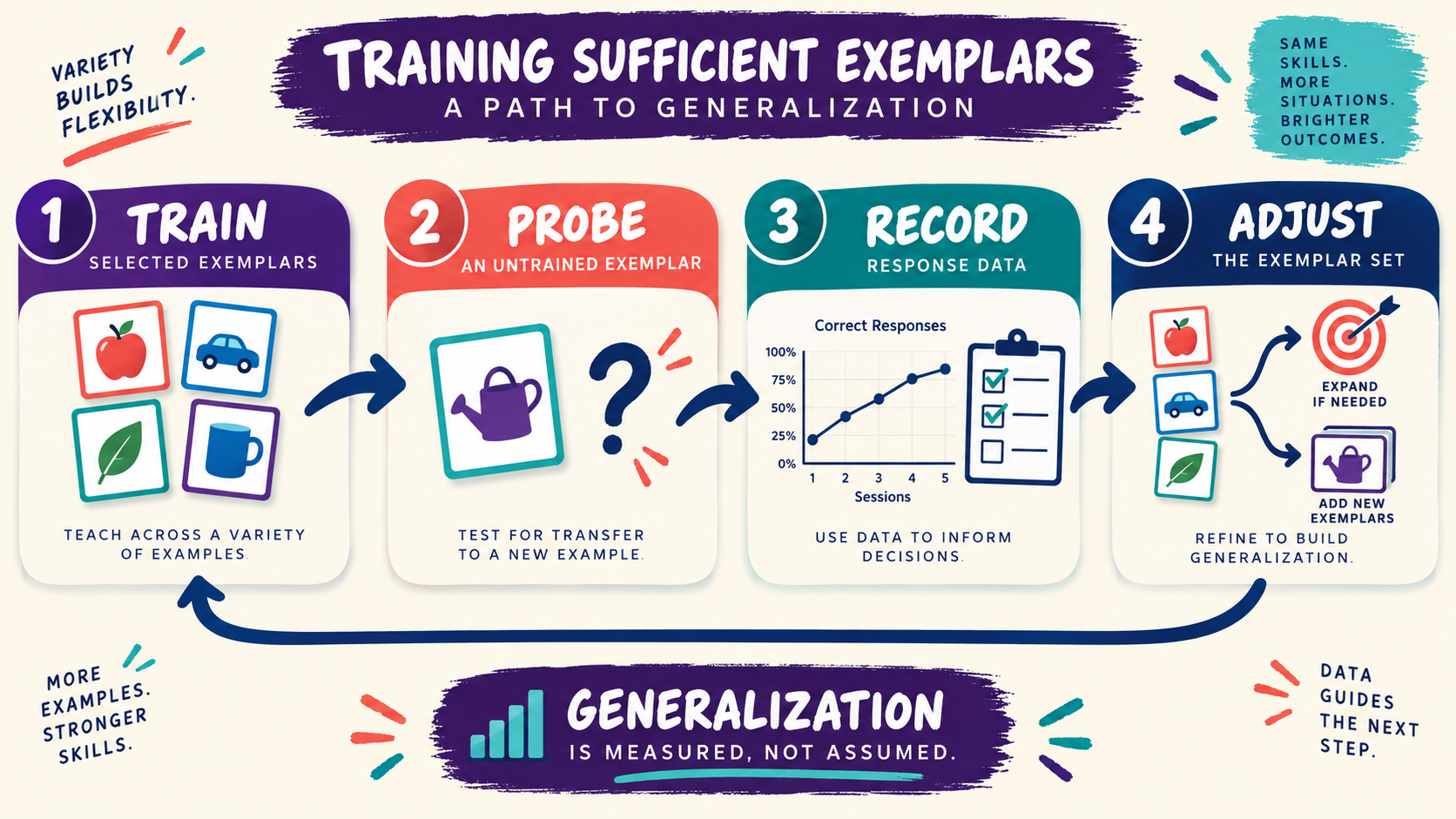
A generalization probe asks whether the response occurs when a relevant condition changes and that exact condition has not received direct teaching. Plan it before the session: define “untrained,” allowed prompts, consequences, and the recording system.
| Component | Training trial | Generalization probe |
|---|---|---|
| Exemplar | Included in the planned teaching set | New on the dimension being tested |
| Prompt | Prompting and error correction may be used as written | Use only the planned probe prompt; record any assistance |
| Decision | Shows acquisition under teaching conditions | Tests transfer, not merely repeated practice |
| Next step | Continue, thin prompts, or rotate the next exemplar | Maintain the set, add targeted variation, or revise the plan |
Probe the dimensions that matter, not random novelty. A new object may test stimulus generalization, a new response form response generalization, and a new location setting generalization. If several dimensions change at once, a low score may not identify which change was responsible.
How Do You Decide Whether the Set Is Sufficient?
Use a preplanned decision rule instead of declaring success after one correct response. The criterion might specify accuracy across opportunities, independence from prompts, more than one untrained exemplar, maintenance later, or use in a natural routine. Match it to the response, risk, baseline, reliability, and functional outcome.
When a probe shows selective responding, ask what the learner may have learned: the exact picture rather than the category, one instructor’s voice, or an item too similar to training? Data can guide a small change, such as adding one relevant feature, changing presentation order, or practicing in the natural setting. “Sufficient” is an empirical conclusion for the current learner, skill, and environment. It may change when the response, materials, setting, or natural contingency changes, so keep maintenance and follow-up data.
How Is This Different from General Case Analysis?
Training sufficient exemplars and general case analysis are related, but not interchangeable. Training sufficient exemplars emphasizes teaching a sample until responding transfers beyond the directly taught examples. General case analysis begins by identifying the natural range of stimulus features and response requirements, then selects examples that represent that range.
In a general case approach, the set should include critical features while avoiding unnecessary variation. Multiple-exemplar training is a broader term for teaching several examples of a class or several response forms. A program may use all three ideas, but an exam question may distinguish how examples are selected, taught, and measured.
On the site, this article owns the narrow procedure “train sufficient exemplars.” The existing stimulus-generalization guide covers the broader concept. Link between them when helpful, but do not turn this page into a second generalization glossary.
What Should You Remember for the BCBA Exam?
When a learner masters one example but not new materials or settings, look for a generalization-programming solution. Adding relevant examples to direct teaching and checking an untrained condition is closer to training sufficient exemplars than repeating the original trial.
- Train: Directly teach a purposeful sample of exemplars.
- Vary: Change the dimensions that matter in the natural setting.
- Probe: Test a relevant condition that was not directly taught.
- Measure: Record accuracy, independence, prompts, latency, and context as appropriate.
- Adjust: Add or redesign exemplars when data show selective control or weak transfer.
Common traps include treating one novel trial as proof, assuming more examples are always better, confusing maintenance with generalization, and calling a taught example a probe. The strongest answer preserves stimulus control, uses data, and selects functional variation.
For certification-study scope, consult the current BACB Test Content Outline and Task Lists. The examples on this page are original study illustrations, not official BACB questions. When you are ready to test discrimination among generalization procedures, use the free BCBA mock exam.
Frequently Asked Questions
What does train sufficient exemplars mean in ABA?: It means directly teaching a planned sample of examples so the learner can respond beyond one trained item or condition. The sample is sufficient only when probe data show transfer under relevant conditions.
How many exemplars are sufficient in ABA?: There is no universal number. It depends on the learner, skill, stimulus class, natural conditions, risk, and criterion. Use untrained probes and maintenance checks instead of a fixed number without a rationale.
What is the difference between a training exemplar and a probe exemplar?: A training exemplar receives direct teaching and planned prompting or reinforcement. A probe exemplar tests transfer without being taught first. Once it is taught, it is no longer an untrained probe.
Does training sufficient exemplars guarantee generalization?: No. It is a way to program for generalization, not a guarantee. The sample may miss important dimensions, the response may depend on an unnecessary cue, or the probe may be too large. Use data to refine the program.
Is training sufficient exemplars the same as multiple-exemplar training?: They overlap because both teach more than one example. “Train sufficient exemplars” highlights programming for useful transfer; multiple-exemplar training is a broader label for varied stimulus or response examples.
Sources for Further Study
- Behavior Analyst Certification Board: Test Content Outlines and Task Lists — current certification-study scope.
- Stokes and Baer, “An Implicit Technology of Generalization” — foundational categories of generalization programming, including training sufficient exemplars.
- Holth, “Multiple Exemplar Training: Some Strengths and Limitations” — strengths, limits, and the need to study exemplar selection and diversity.
- Marzullo-Kerth and colleagues, “Using Multiple-Exemplar Training to Teach a Generalized Repertoire of Sharing” — applied example with training and generalization probes.
- Barahona, “Programming Generalization: The Use of Sufficient Exemplars Within a DTT Program” — dissertation abstract on sufficient exemplars, sequential and concurrent arrangements.
- Association for Behavior Analysis International: Choosing Wisely — recent discussion of representative examples, diversity, and limits of fixed exemplar counts.
Quick Review Checklist
Use this final checklist to turn train sufficient exemplars aba into exam-ready reasoning. The goal is not to memorize a label in isolation; it is to identify the relevant evidence and explain why the best answer fits the scenario. Key ideas to review:
- State the central definition or decision point for train sufficient exemplars aba in your own words.
- Identify the detail that makes train sufficient exemplars aba different from its closest related ABA term.
- Separate the observable facts in a scenario from assumptions that are not supported by the facts.
- Write one example and one nonexample so you can recognize the concept in a new setting.
Exam application checks:
- Ask what the question is actually requesting before comparing the answer choices.
- Mark the antecedent, response, consequence, or other evidence that supports the selected answer.
- Look for a distractor that describes a related process but does not answer the specific question.
Final self-check:
- Explain how you would verify the interpretation with clear observations or data.
- Change one detail in the scenario and decide whether your answer should change.
- Give a one-sentence rationale that a supervisor or study partner could evaluate.
Take the Free BCBA Mock Exam
If you want a low-pressure way to check your recall, use the free practice resource below. Take the Free BCBA Mock Exam



