
Can you become an ABA therapist without a degree? Often, you may qualify for an entry-level behavior-therapy role without a college degree, but the answer depends on what the employer means by “ABA therapist.” That phrase is used broadly. It can describe an RBT, behavior technician, therapy aide, BCaBA, BCBA, or a staff member with a different credential entirely.
Table of Contents
- Can You Become an ABA Therapist Without a Degree?
- What Does “ABA Therapist” Actually Mean?
- Can You Start as an RBT Without a College Degree?
- Does BCaBA Require a Degree?
- Does BCBA Require a Graduate Degree?
- What Should You Do Before Applying?
- No-Degree ABA Career FAQ
- Key Takeaway
- Take the Free BCBA Mock Exam
The important boundary is this: no degree may be possible for some supervised entry-level work, but it is not a shortcut to every behavior-analysis credential. The BACB’s RBT information, BCaBA requirements, BCBA requirements, state rules, payer rules, and the employer’s job description should be checked separately.
Can You Become an ABA Therapist Without a Degree?
For the search question can you become an ABA therapist without a degree, the practical answer is: possibly for an entry-level technician or RBT-type role, but not for every job that uses the label. Some employers hire people with a high school diploma or equivalent and provide structured training, competency checks, and ongoing supervision. Other employers require college coursework, prior experience, a state credential, or a specific payer-approved qualification. Read the requirements in this order:
- What exact title and credential does the posting require?
- Who supervises the work and what duties are allowed?
- What education, training, background check, exam, or registration is required?
- Which state, payer, school, clinic, or agency rules apply?
- What can you document before accepting the job?
What Does “ABA Therapist” Actually Mean?
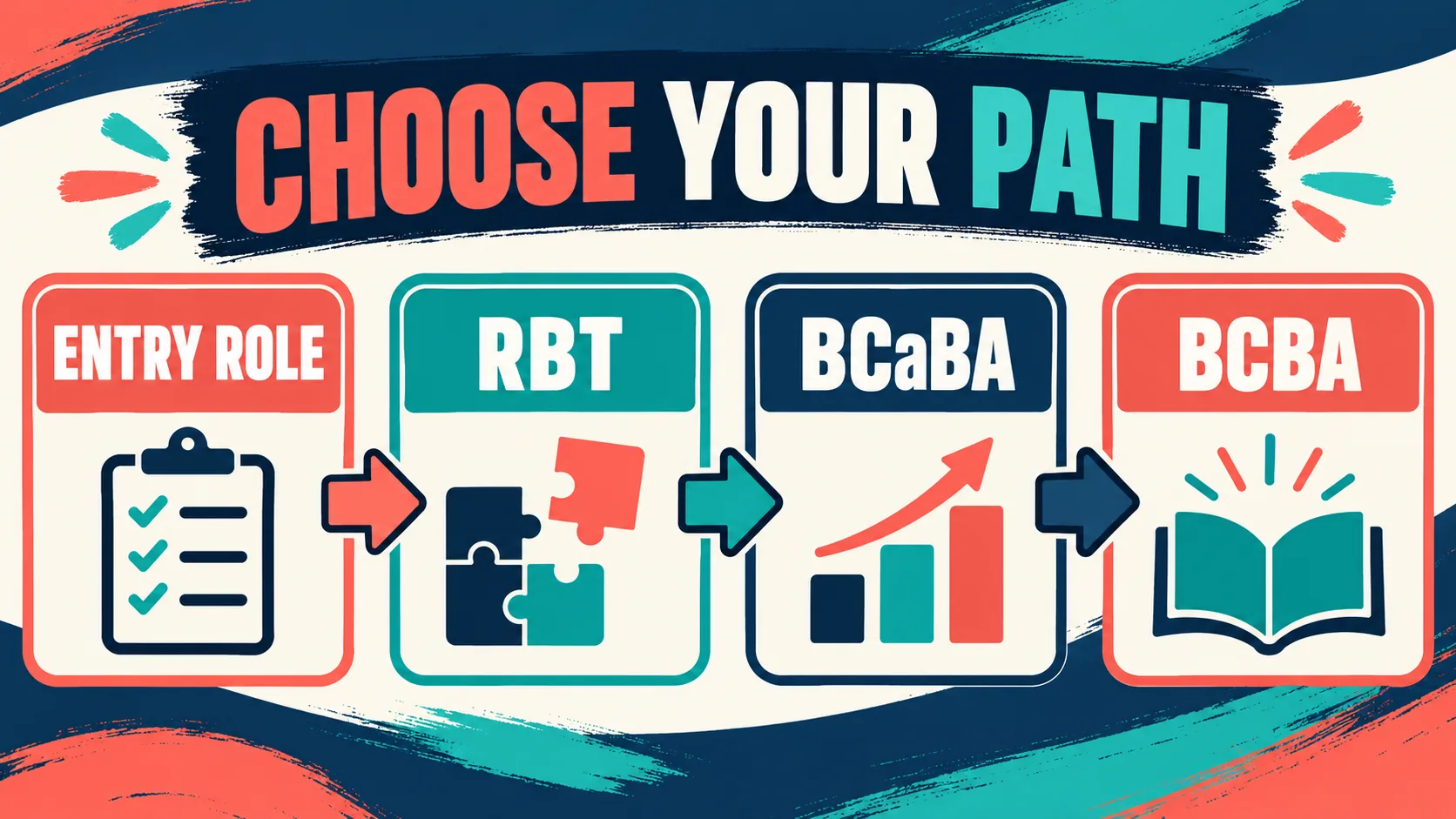
“ABA therapist” is a job-search phrase, not one universal BACB certification. A posting may use it for direct therapy delivered under a BCBA’s plan, while another may use it for a credentialed RBT. A third may be describing a case manager or behavioral-health worker who does not hold a BACB credential. Before comparing training programs, make a simple distinction:
| Role or label | Typical education boundary | Supervision boundary |
|---|---|---|
| Behavior technician / entry-level ABA therapist | Employer may accept a high school diploma or equivalent, but requirements vary. | Works under the employer’s clinical and credentialed supervision. |
| RBT | BACB application, training, competency, examination, and other current requirements apply. | Provides behavior-analytic services under ongoing supervision. |
| BCaBA | Undergraduate-level certification with its own eligibility pathway. | Practices under BCBA or other permitted supervision. |
| BCBA | Graduate-level certification with education, fieldwork, application, and examination requirements. | May practice independently within applicable rules and supervise others. |
The BACB consumer resources are useful for checking the difference between RBT, BCaBA, and BCBA credentials. If a job posting uses a title loosely, ask the employer which credential appears on the payer contract, treatment record, or supervision plan.
Can You Start as an RBT Without a College Degree?
An RBT pathway may be the clearest no-degree entry route for people who want to work directly with clients while receiving supervision. However, “no college degree” does not mean “no requirements.” The BACB’s current RBT page and handbook may require a minimum age, education or equivalent, training, competency assessment, examination, background checks, and ongoing supervision. Requirements can change, so use the current official materials rather than a course advertisement.
Employers and payers may add requirements. They may ask for CPR or first aid, a driver’s license, immunizations, child-safety checks, a specific schedule, physical work capacity, or prior experience. A clinic can also require a degree even when the BACB entry credential does not require one. For an RBT or technician application, be ready to show:
- Reliable availability for the client’s schedule and setting.
- Willingness to complete training, competency checks, and supervision.
- Clear communication with caregivers, supervisors, and team members.
- Accurate data collection and professional documentation habits.
- Understanding that the role follows a treatment plan rather than independently creating one.
Does BCaBA Require a Degree?
The BCaBA credential is an undergraduate-level certification. That means a person who wants to become a BCaBA should plan for the degree and coursework requirements listed in the current BACB handbook, plus the applicable fieldwork, application, and examination steps. An entry-level job without a degree can provide experience, but it does not by itself satisfy the BCaBA pathway.
Ask a school or employer to identify which experience will count, if any, and which experience is only employment. Keep training certificates, supervision records, job duties, and performance documentation separate. That record makes it easier to evaluate a future pathway without assuming that every hour worked is qualifying fieldwork.
Does BCBA Require a Graduate Degree?
BCBA certification is a graduate-level pathway. The BACB BCBA page and current BCBA handbook describe the education, coursework, fieldwork, application, and examination requirements. A person can begin in an entry-level ABA role without a degree, but that does not make them a BCBA or allow them to perform BCBA-level independent duties.
Think of the path as a progression, not a promise: entry-level work may help you learn whether behavior analysis fits; a college program may lead toward BCaBA eligibility; graduate education may be required for BCBA eligibility. Confirm each transition with the current BACB requirements and the state or employer rules that apply. Keep these boundaries in mind:
- Employment experience is not automatically qualifying coursework or fieldwork.
- Employer training is not automatically BACB certification.
- Working under supervision does not authorize independent BCBA-level practice.
- A job title does not override state, payer, or credential rules.
What Should You Do Before Applying?
Use this checklist before paying for a course or accepting an offer:
- Copy the exact job title, credential requirement, and supervision language.
- Ask whether the employer accepts applicants without a degree and what training it provides.
- Confirm whether the job requires RBT certification or only an employer training program.
- Check state, payer, school, background-check, transportation, and schedule requirements.
- Ask which duties are direct implementation and which duties require a higher credential.
- Read the current BACB handbook before treating a job as a certification pathway.
Be cautious with any advertisement that promises a fast route to become a BCBA without graduate education, or that claims a short course alone guarantees an RBT job. Training can be useful, but credential eligibility and employment are separate decisions.
No-Degree ABA Career FAQ
Can I work in ABA with only a high school diploma?: Some employers hire entry-level technicians or RBT candidates without a college degree, subject to current BACB, employer, state, and payer requirements. Others require more education. Can I call myself a BCBA after working as an ABA therapist?: No. BCBA is a specific graduate-level credential. Job experience does not replace the education, fieldwork, application, and examination requirements. Is RBT the same as ABA therapist?: No. ABA therapist is a broad job label; RBT is a specific BACB credential with defined requirements and supervision expectations.
Can an entry-level ABA job help me become a BCBA?: It may help you explore the field and build experience, but only experience that meets the current BCBA pathway rules can count toward certification. Verify before relying on it.
Key Takeaway
Yes, some people can begin ABA work without a college degree, especially in supervised entry-level roles. The degree boundary changes when you move toward BCaBA or BCBA certification. Match the exact role, credential, supervision, employer, state, and payer requirements before you enroll, apply, or describe your qualifications.
Take the Free BCBA Mock Exam
When you are ready to apply the idea, use the free practice resource below for additional feedback. Take the Free BCBA Mock Exam



