
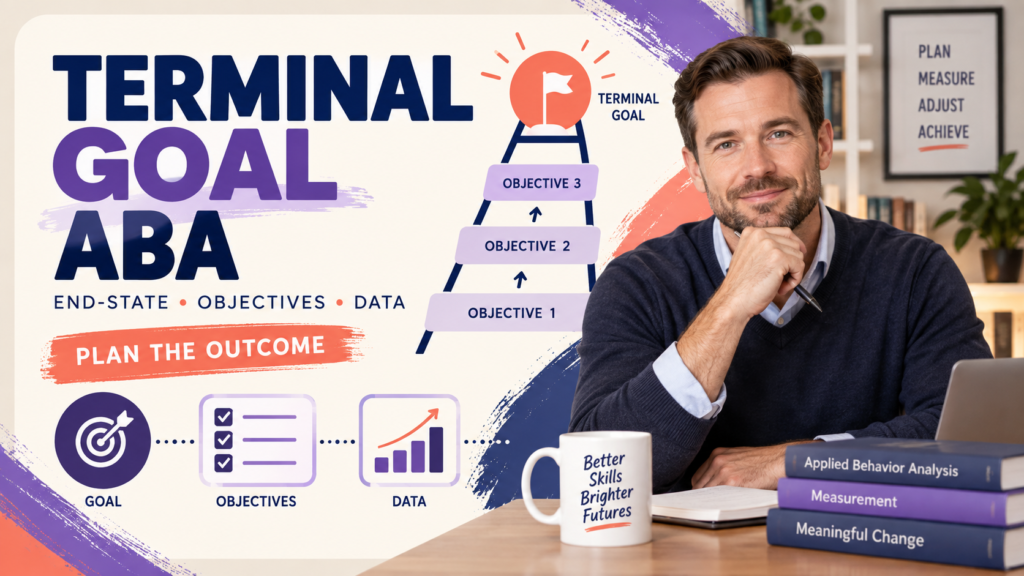
If you are studying terminal goal ABA terminology, the key idea is the long-range outcome a program is designed to reach. A terminal goal describes the meaningful behavior or functional outcome at the end of a teaching sequence, while short-term objectives describe the smaller steps that make progress observable. It is not simply “the hardest step,” a number copied from a template, or a promise that a person will reach a predetermined result.
Table of Contents
- What Is a Terminal Goal in ABA?
- How Does a Terminal Goal ABA Plan Work?
- How Do You Build a Terminal Goal?
- What Makes a Terminal Goal Functional?
- How Are Short-Term Objectives Linked to It?
- How Do Mastery, Maintenance, and Generalization Fit?
- What Errors Should You Avoid?
- What Should You Remember for the BCBA Exam?
- Frequently Asked Questions
- Sources for Further Study
- Take the Free BCBA Mock Exam
In practice, a strong terminal goal connects an important life outcome to observable behavior, a real context, a measurement plan, and a review process. The goal should be individualized with the person, family, and clinical team. This guide focuses on the terminology and planning logic that appear in behavior-analysis coursework and BCBA-style questions. It does not provide a universal treatment goal or replace supervision.
What Is a Terminal Goal in ABA?
A terminal goal is a description of the end-state behavior or outcome that a teaching program is intended to produce. “Terminal” refers to the endpoint of the instructional sequence, not the end of the person’s learning or the end of services. A terminal goal might describe independent communication in a daily routine, completion of a functional skill, participation in a meaningful activity, or use of a replacement response across relevant settings.
The term is easiest to understand when compared with current performance. If a learner needs a full physical prompt for handwashing, the terminal goal might involve completing the routine with natural materials. Intermediate objectives would still cover the component steps. The terminal goal names the functional destination; it does not eliminate teaching steps.
A terminal goal should describe behavior rather than an internal state. “Will be motivated,” “will improve social skills,” and “will reach potential” do not tell an observer what to measure. A better statement identifies what the person will do, under what conditions, with what level of independence, and why the outcome matters. The wording can be concise, but it must be specific enough to guide instruction and review.
How Does a Terminal Goal ABA Plan Work?
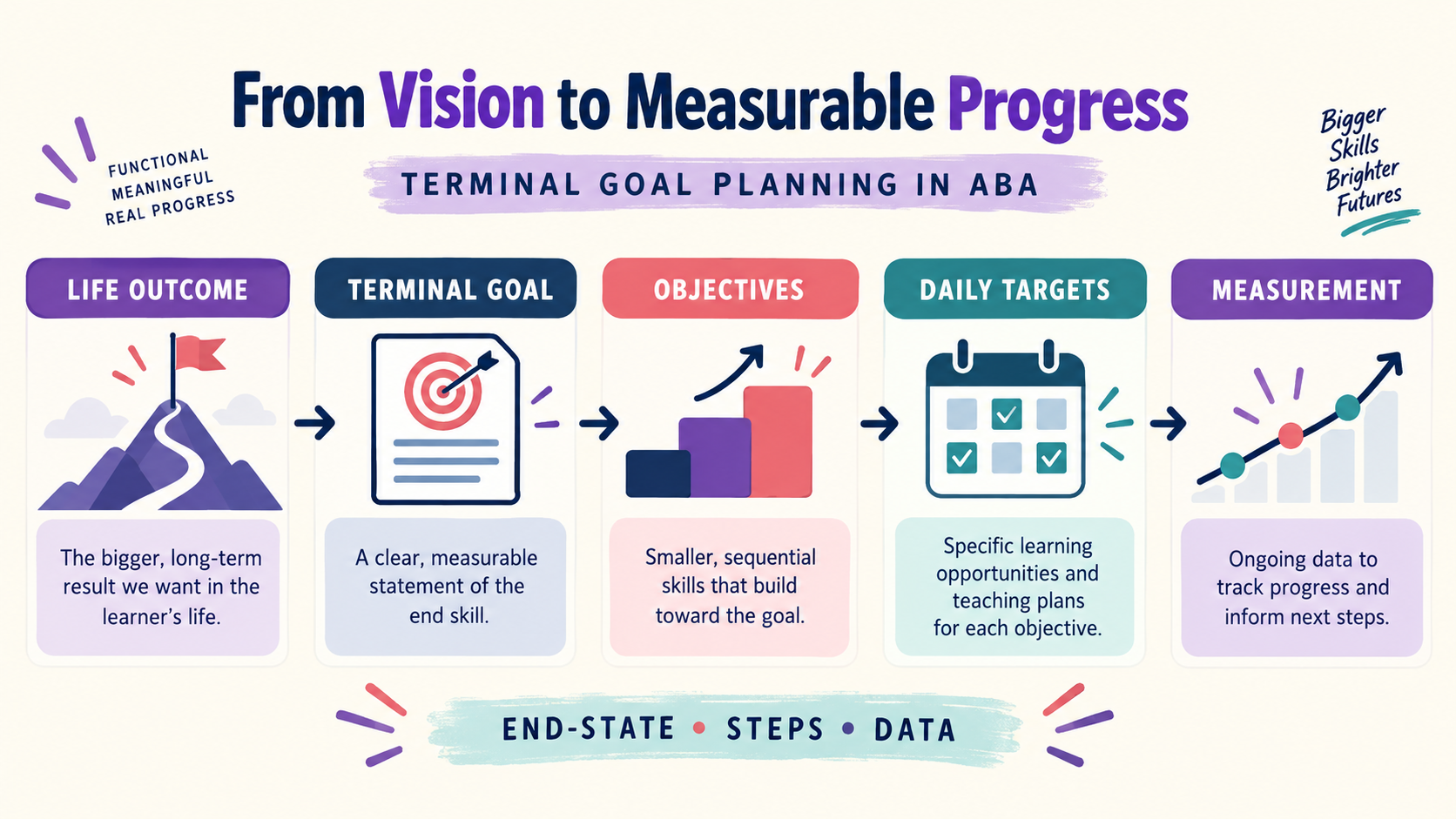
Think of the plan as a hierarchy rather than a single sentence. A broad life outcome provides direction, the terminal goal translates that outcome into an observable end-state, short-term objectives break the path into teachable changes, and daily targets create immediate practice opportunities. Measurement connects every level so the team can determine whether the sequence is working.
| Planning level | What it describes | Example question |
|---|---|---|
| Life outcome | Why the skill matters in the person’s daily life. | What would make this routine more accessible or meaningful? |
| Terminal goal | The observable functional end-state of the teaching sequence. | What should the person do in the natural context? |
| Short-term objective | A measurable step or nearer criterion toward the terminal goal. | What change is attainable next, given baseline? |
| Daily target | The immediate response opportunity used for teaching and data collection. | What will be practiced in this opportunity? |
This hierarchy prevents two problems: a broad goal without measurable steps, and disconnected trial targets with no link to daily life. The terminal goal is the bridge; it keeps objectives pointed toward a useful end-state while allowing the team to change the route when data or preferences change.
How Do You Build a Terminal Goal?
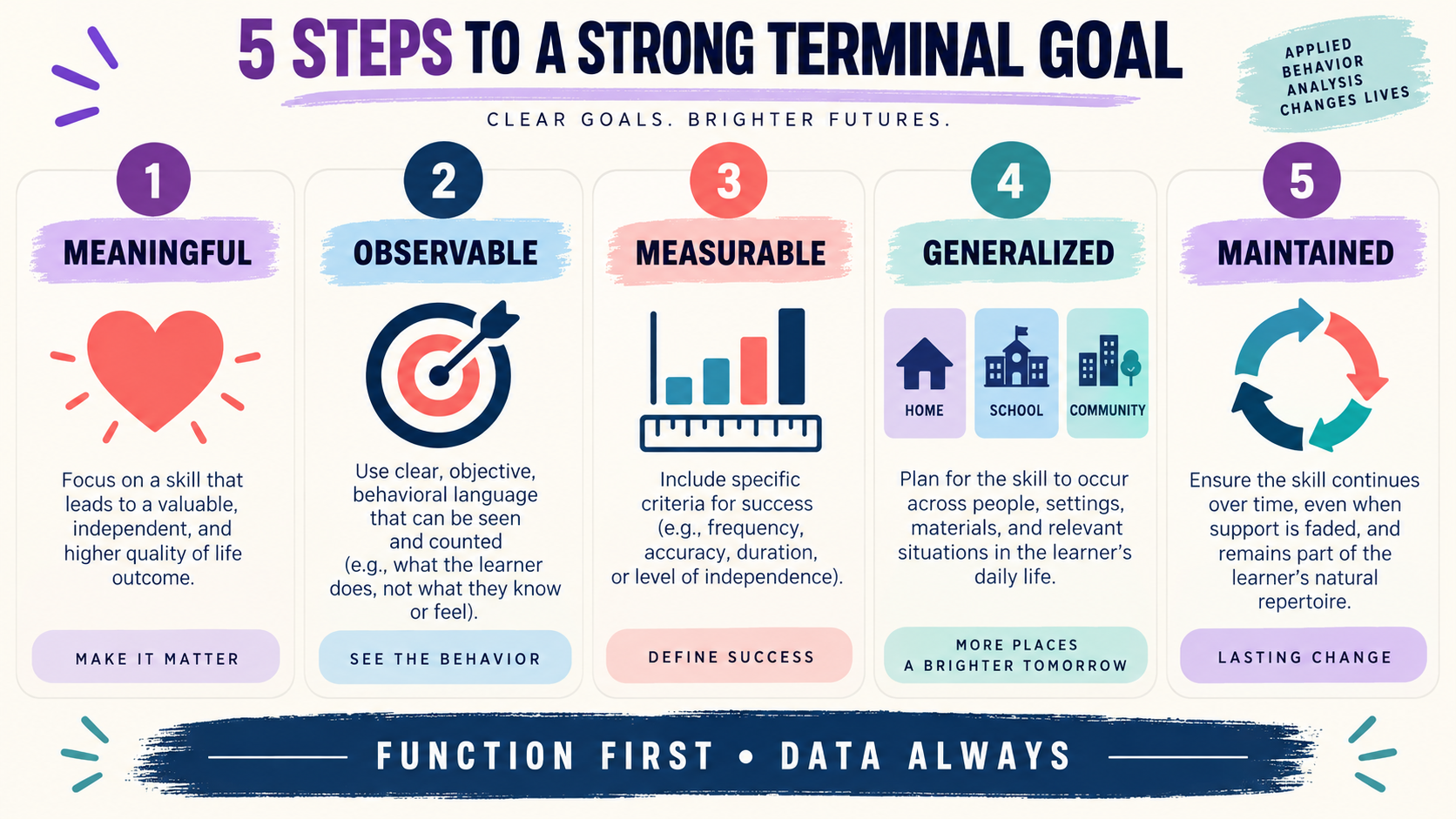
Begin with the outcome that the person and relevant supporters value. Then translate it into a response that another observer can see or hear. Add the context, level of independence, measurement dimension, and criteria for reviewing progress. A terminal goal does not need to predict a precise date of mastery if the timeline would be arbitrary; it does need a clear method for deciding whether the target has been met or should be revised.
- Start with function: State what the skill will make possible in daily life, communication, participation, safety, self-care, learning, or work.
- Describe the response: Use observable actions rather than traits or internal states.
- Name the conditions: Identify the relevant materials, people, places, cues, and opportunities.
- Specify independence: State what prompts, supports, or communication systems remain acceptable at the terminal level.
- Select the measure: Choose accuracy, steps, duration, latency, rate, opportunities, or another dimension that matches the response.
- Add generalization: Include the people, materials, settings, and natural consequences that matter beyond instruction.
- Set a review rule: Explain how the team will continue, modify, pause, or replace the goal based on data and stakeholder input.
For example, instead of “improve independent living,” a terminal goal could be: “During the evening routine at home, the learner will use an accessible checklist and communication system to gather clothing, dress, place worn clothes in the designated container, and request help when needed, completing the routine with no more than one gestural prompt across four of five opportunities.” The actual criterion must come from assessment and collaboration; this sentence is only an illustration of the level of specificity.
Notice that the goal describes a functional routine, includes a support that may remain useful, and provides a way to measure the response. It does not say that independence means never using an assistive tool. A terminal goal can include a stable accommodation when that support increases access and reflects the person’s needs.
What Makes a Terminal Goal Functional?
A functional terminal goal has value outside the training arrangement. The person can use the skill in a routine, relationship, activity, or environment that matters to them. Functional does not mean “easy,” “typical,” or “performed without any support.” It means that the target changes access, participation, communication, autonomy, or safety in a meaningful way.
- Communication: Requesting help, information, a break, attention, or a preferred activity through an accessible response.
- Daily living: Completing a self-care or household routine with the supports that make the routine usable.
- Participation: Joining an activity, transitioning with communication support, or remaining engaged in a chosen routine.
- Social interaction: Initiating, responding, taking turns, or repairing a communication breakdown when those outcomes are meaningful.
- Learning and work: Completing a relevant task, asking for clarification, or using a strategy to solve a recurring problem.
- Behavior support: Using a replacement response that accesses the same function more safely or effectively.
Ask whose priority the goal represents and what would count as a meaningful improvement. A terminal goal that only makes a session easier for staff may not be a sufficient functional outcome. A behavior analyst should also consider cultural context, communication access, sensory needs, environmental barriers, and whether the goal can be practiced without unnecessary restriction.
How Are Short-Term Objectives Linked to It?
Short-term objectives are not mini terminal goals chosen at random. They are measurable changes that move the learner toward the terminal response or increase the conditions under which it can occur. An objective might increase the number of completed steps, reduce prompt intensity, expand the range of materials, increase response duration, or transfer control from an instructional prompt to a natural cue.
| Terminal outcome | Possible objective sequence | What to measure |
|---|---|---|
| Communicate a need for help | Accept a model → use the response with a prompt → use it independently → use it with different partners. | Response form, prompt level, latency, function and generalization. |
| Complete a routine | Perform one step → complete a short chain → complete the full chain → use it in the natural setting. | Independent steps, errors, prompts, time and maintenance. |
| Participate in a chosen activity | Engage briefly → increase duration → vary materials → participate with a natural partner or setting. | Duration, quality of engagement, choice, prompts and generalization. |
The objective sequence should be flexible. If the person is progressing in one context but not another, the team may need to change materials, antecedents, communication supports, reinforcement, or practice opportunities rather than simply lowering the criterion. If the current objective is not meaningful or produces distress, the plan should be reviewed instead of treating nonachievement as a character problem.
How Do Mastery, Maintenance, and Generalization Fit?
Mastery is the rule used to decide whether the terminal goal or an objective has been met under specified conditions. A percentage such as 80% is not automatically appropriate. The criterion should match the risk, complexity, natural opportunity, measurement reliability, and function of the skill. For a safety response, a higher level of accuracy may be necessary; for a flexible leisure routine, the team may value independent choice and use across settings more than a single percentage.
Maintenance checks whether the skill continues after intensive teaching or after the schedule changes. Generalization checks whether the response occurs with new people, materials, places, cues, or examples. A learner can meet a terminal criterion in a therapy room and still need a plan for home, school, work, or community settings. Include follow-up probes and natural opportunities when they matter.
Review more than the final percentage. Prompt dependence, response quality, latency, stress signals, communication access, and the natural consequence may all affect whether the goal is truly functional. A terminal goal is an endpoint for a plan, not a reason to ignore feedback from the learner or to continue a procedure that is not helping.
What Errors Should You Avoid?
- Confusing a goal with a task: A terminal goal describes an outcome; a single trial is only one opportunity to practice.
- Writing an internal state: “Will be motivated” or “will understand” is not directly measurable without observable indicators.
- Using an arbitrary number: A round percentage or date needs a rationale tied to baseline and function.
- Making independence mean no support: Assistive technology, visual tools, and communication systems may be valid parts of the terminal response.
- Ignoring generalization: A goal met with one instructor may not be met in the natural context.
- Stopping at accuracy: Check whether the response is fluent, functional, maintained, and meaningful.
- Keeping an outdated endpoint: Goals should be reviewed when priorities, access needs, environment, or learner preferences change.
- Reducing the person to a deficit: Write what the person will gain access to or be able to do, not only what others want removed.
For a related but different concept, compare the site’s skill-acquisition overview. That page addresses acquisition tasks broadly; this article owns the terminal-goal hierarchy and the distinction between an end-state, objectives, and daily targets.
What Should You Remember for the BCBA Exam?
When a question uses “terminal,” look for the endpoint of a teaching sequence. If the answer describes a smaller measurable step toward that endpoint, it is more likely a short-term objective or intermediate target. If it describes the conditions, behavior, and criterion for the final functional outcome, it is closer to a terminal goal. If it names the event that follows a response, it is a consequence—not a goal.
- Terminal goal means the planned instructional end-state, not the end of all learning.
- Objectives should be observable, measurable, and logically connected to the terminal response.
- Mastery criteria need a rationale; no single percentage fits every target.
- Generalization and maintenance are part of functional planning, not optional decorations.
- Choose the answer that describes behavior in context rather than an internal trait or vague improvement.
Use the current BACB Test Content Outline and Task Lists for official certification-study scope. The examples in this guide are original illustrations, not official BACB questions. The free BCBA mock exam can provide additional scenario practice.
Frequently Asked Questions
What is a terminal goal in ABA?: It is the observable functional end-state that a teaching program is designed to reach. It should connect to a meaningful outcome, specify relevant conditions and measurement, and allow the team to review progress and revise the plan.
Is a terminal goal the same as a long-term goal?: They can overlap in planning language, but “terminal” emphasizes the end-state of an instructional sequence. A long-term goal may describe a broader time horizon; the exact terminology depends on the curriculum, plan, or source being used.
What is the difference between a terminal goal and a short-term objective?: The terminal goal describes the functional endpoint. A short-term objective describes a nearer, measurable change that moves the learner toward that endpoint, such as more independent steps, fewer prompts, greater duration, or use across settings.
Can a terminal goal include prompts or assistive technology?: Yes. Independence does not have to mean performing without every support. If a visual schedule, AAC system, or other accommodation is functional and appropriate, the terminal goal can specify how it is used while still measuring the intended outcome.
How do I know whether a terminal goal is meaningful?: Ask whether the goal improves access, communication, participation, autonomy, safety, learning, or another outcome the person and relevant supporters value. Then check whether the skill occurs beyond the training arrangement and remains useful over time.
Sources for Further Study
- Behavior Analyst Certification Board: Test Content Outlines and Task Lists — current certification-study scope.
- ERIC: Goals and Objectives training module — terminal objectives, conditions, behavior, and criteria.
- Finni Health: Meaningful and measurable ABA goals — outcome, observation, measurement, generalization, and review.
- Find ABA Therapy: ABA goals and measurement examples — observable and functional goal features.
- Praxis Notes: SMART goal writing — measurable objective-writing practice.
- Inclusive ABA: How to Set ABA Goals — individualized target selection and data review.
Take the Free BCBA Mock Exam
If you want a low-pressure way to check your recall, use the free practice resource below. Take the Free BCBA Mock Exam



