
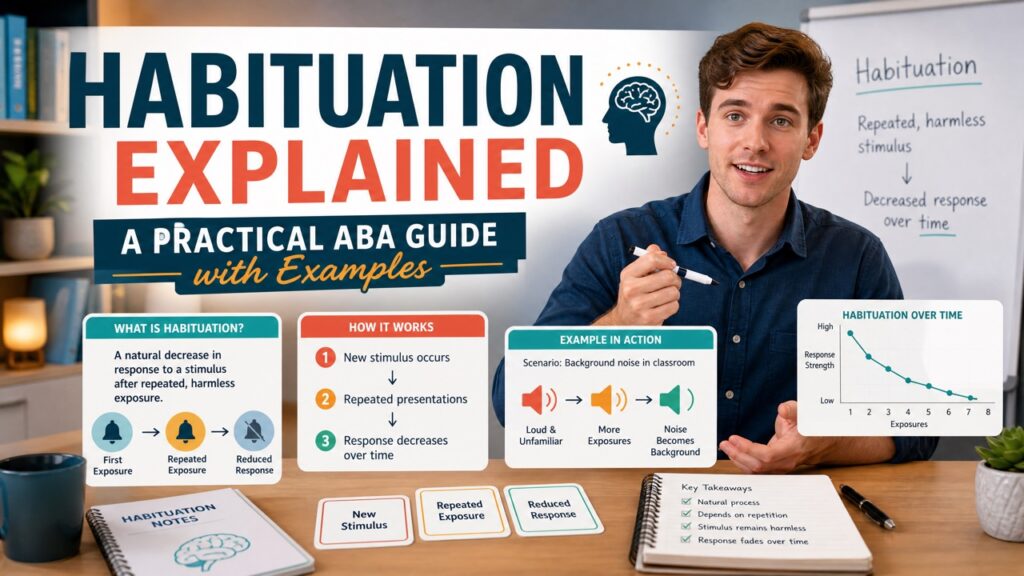
In applied behavior analysis (ABA), understanding how stimuli affect behavior is fundamental. One often-overlooked process is habituation. This guide provides a practical definition of habituation in ABA, contrasts it with similar concepts, and offers real-world examples to help you recognize it in practice. Whether you’re a BCBA candidate or a practicing professional, mastering this basic behavioral principle is essential for effective intervention design. Table of Contents
Table of Contents
- What Is Habituation in ABA?
- Habituation vs. Extinction vs. Sensory Adaptation
- The Role of Habituation in ABA Practice
- Habituation vs. Satiation: What’s the Difference?
- Common Traps in Identifying Habituation
- Practical Examples of Habituation in Everyday Life
- Habituation and Stimulus Control
- Habituation Study Checklist for BCBA Candidates
- Final Thoughts: Habituation as a Basic Learning Process
- Reference
What Is Habituation in ABA?
Habituation is defined as a decrease in the strength or frequency of a response following repeated or continuous presentations of a stimulus, where that decrease is not due to sensory adaptation or fatigue. In simpler terms, an organism stops responding to a familiar, harmless stimulus because it has learned that the stimulus is irrelevant. This process is adaptive because it frees up cognitive and behavioral resources for more important events.
For example, imagine a learner who startles every time a door slams. The first few times, the startle response is strong. After many repetitions, the startle response diminishes. The door still slams with the same intensity, and the learner is not physically tired; the decrease is due to habituation. Over time, the learner may even become habituated to other loud noises, such as a vacuum cleaner or a dog barking, if those sounds are presented repeatedly without consequence. Habituation is not a permanent change. It has several characteristic features that are important for behavior analysts to recognize. These features help differentiate habituation from other processes and guide clinical decisions.
- Spontaneous recovery: If the stimulus is withheld for a period, the response may return when the stimulus is presented again. For instance, after a long quiet period, the learner may startle again at the first door slam, but habituation will occur more quickly the second time.
- Stimulus generalization: Habituation can generalize to similar stimuli. If the learner becomes habituated to the slam of a particular door, they may also show reduced startle to other loud noises, such as a book slamming shut.
- Dishabituation: A novel or different stimulus can temporarily restore the habituated response. If a new type of loud noise occurs, such as a firecracker, the learner might startle again, even to the original door slam.
Habituation vs. Extinction vs. Sensory Adaptation
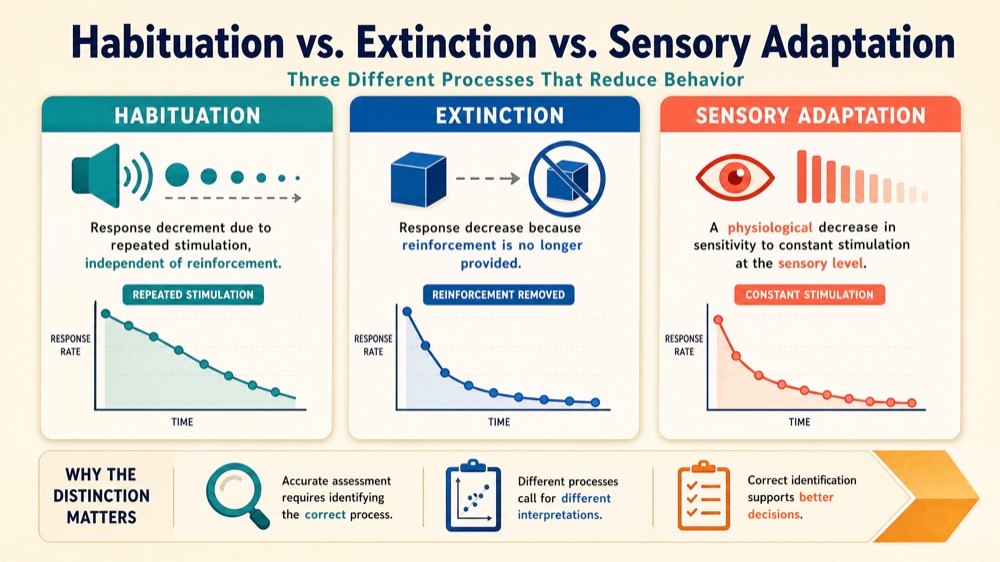
It is easy to confuse habituation with other processes that reduce behavior. Understanding the differences is crucial for accurate behavioral assessment. Habituation is a response decrement due to repeated stimulation, independent of reinforcement or fatigue. Extinction, on the other hand, occurs when a previously reinforced behavior is no longer followed by that reinforcer, leading to a decrease in responding. In extinction, the response decreases because it is no longer reinforced, not because the stimulus has become familiar.
Sensory adaptation is a physiological process where sensory receptors become less sensitive to a constant stimulus. For example, entering a room with a strong odor, you eventually stop noticing it because the receptors have adapted. Fatigue is a decrease in response due to resource depletion, such as muscle or neural exhaustion. If you repeatedly lift a heavy weight, you eventually cannot lift it due to muscle fatigue. Habituation is distinct because it involves the central nervous system and can be reversed by a novel stimulus. To clarify these differences, consider the following comparison points:
- Habituation: Decrease in response due to repeated presentation of the same stimulus; independent of reinforcement or fatigue; can be reversed by a novel stimulus.
- Extinction: Decrease in responding because the behavior is no longer reinforced; requires a history of reinforcement.
- Sensory adaptation: Decrease in sensory receptor sensitivity to a constant stimulus; physiological, not learned.
- Fatigue: Decrease in response due to physical or mental exhaustion; not stimulus-specific.
Understanding these distinctions is essential for practitioners, as misidentifying habituation can lead to incorrect intervention decisions. For example, if a response decrement is mistakenly attributed to extinction when it is actually habituation, a behavior analyst might unnecessarily remove reinforcement, leading to other behavioral issues.
The Role of Habituation in ABA Practice
Habituation can significantly impact the effectiveness of stimuli used in interventions. For instance, if a reinforcer is presented too frequently, its effects may diminish due to habituation (or satiation, which we will discuss). Practitioners should consider this when designing reinforcement schedules to maintain stimulus effectiveness. For example, a child who receives the same edible reinforcer for every correct response may eventually show less enthusiasm, not only because of satiation but also because of habituation to the sensory properties of the food.
Habituation also affects non-reinforcing stimuli, such as aversive noises or cues. If a classroom is noisy, students may habituate to the noise and no longer be distracted. Conversely, a novel stimulus can draw attention, but over time it may lose its effect. This has implications for stimulus control: a previously neutral stimulus may lose its salience after repeated exposure, making it less effective as an SD. Thus, behavior analysts should rotate stimuli and incorporate breaks to allow spontaneous recovery. The following strategies can help prevent habituation from interfering with intervention outcomes:
- Rotate reinforcers to prevent habituation and maintain effectiveness.
- Use varied stimuli, such as different toys or activities, to keep responses strong.
- Incorporate breaks or change the environment to allow spontaneous recovery.
- Monitor for signs of habituation, such as increased latency to respond or reduced enthusiasm.
Habituation vs. Satiation: What’s the Difference?
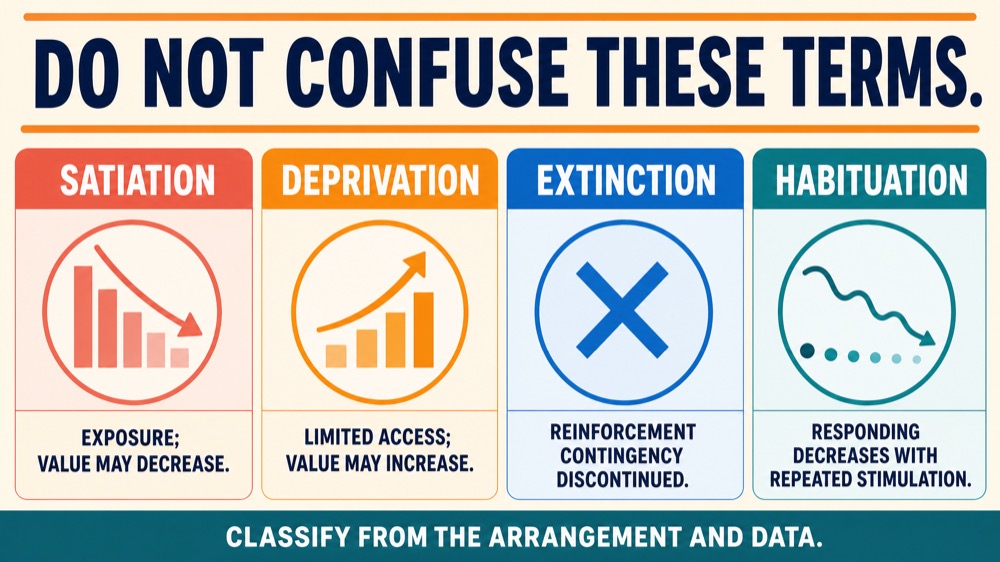
Satiation is a motivating operation that decreases the reinforcing value of a stimulus due to overconsumption. For example, if you eat a lot of candy, candy becomes less reinforcing (satiation). Habituation is a response decrement to a stimulus, independent of reinforcing value. A stimulus can be habituated even if it is still reinforcing. For instance, a child might habituate to a song as background noise, but the song could still serve as a reinforcer in a different context. In practice, both can reduce the effectiveness of reinforcers, but they are distinct processes. Satiation is an antecedent intervention, while habituation is a learning process.
To differentiate, consider whether the stimulus itself is still valued. In satiation, the individual may not want more of the stimulus; in habituation, the individual may still like the stimulus but simply stops responding to its repeated presentation. For example, a toddler might habituate to the sound of a toy rattle and stop reaching for it, but if you offer the toy after a break, they may play with it again. In contrast, after eating too much candy, a child may refuse candy even after a break because they are sated.
Common Traps in Identifying Habituation
Behavior analysts must avoid mislabeling habituation as other processes. Here are common errors often seen in practice:
- Assuming a response decrease is due to habituation when it could be extinction. Always check the reinforcement history.
- Confusing habituation with sensory adaptation, especially with continuous stimuli like background noise or odor.
- Treating habituation as punishment; habituation is not a consequence procedure, but a learning process that occurs without any programmed consequence.
- Believing habituation is a permanent change; it often recovers spontaneously, so it is not the same as extinction.
- Overlooking the role of dishabituation, which can temporarily restore a response and confuse data analysis.
Practical Examples of Habituation in Everyday Life
Here are original examples to illustrate habituation in different contexts:
- A student is initially startled by the fire alarm during a drill. After several drills, the student shows less of a startle reaction, even though the alarm is equally loud. The student may even continue reading during the alarm.
- An infant cries when a new toy is shaken, but after repeated shaking, the infant no longer cries. The toy is not painful, and the infant is not tired, so the response decrement is habituation.
- A dog barks at the sound of the doorbell. If the doorbell rings repeatedly without any consequence, the dog may stop barking. However, if a stranger then appears, the barking may resume (dishabituation).
- A person living near a train track initially wakes up at each train noise, but after a few weeks, they sleep through the night. The train still makes the same sound, but the startle response has habituated.
Habituation and Stimulus Control
Habituation interacts with stimulus control in important ways. Stimulus control refers to the extent to which a behavior occurs in the presence of a particular stimulus (the discriminative stimulus, SD) and not in its absence (the S-delta). Habituation can alter the effectiveness of SDs. If an SD is presented repeatedly without consequences, it may lose its controlling properties due to habituation, or it may be overshadowed by novel stimuli. For a deeper dive, see this article on stimulus control in ABA.
For example, a teacher might use a bell to signal a transition. If the bell is rung frequently for non-transitional purposes, students may habituate to the bell and no longer respond when it is used as an SD. To maintain stimulus control, it is essential to limit exposure to the SD to relevant occasions and to vary other stimuli. Additionally, habituation can be used clinically to reduce fear or anxiety responses. For instance, a child who is afraid of a vacuum cleaner can be exposed to the vacuum at a low volume for short periods, gradually increasing exposure while allowing habituation to occur. This process is similar to systematic desensitization, but it is grounded in the basic principle of habituation.
Consider also the role of stimulus generalization. If a child habituates to a specific sound, they may also show habituation to similar sounds, which is an example of stimulus generalization. This can be useful in therapy, but it also means that careful planning is needed to ensure that habituation does not reduce responding to important stimuli unintentionally.
Habituation Study Checklist for BCBA Candidates
Preparing for the BCBA exam? Use this checklist to solidify your understanding of habituation:
- Can you define habituation in your own words, without confusing it with extinction or sensory adaptation?
- Can you list the three key features of habituation: spontaneous recovery, stimulus generalization, and dishabituation?
- Can you provide two original examples of habituation from everyday life?
- Can you explain how habituation differs from satiation?
- Can you describe how habituation might affect stimulus control in practice?
- Can you identify common traps in identifying habituation on exam questions?
If you can confidently check off these items, you are well on your way to mastering habituation for the exam. For more comprehensive review, take advantage of our free BCBA mock exam to test your knowledge and identify areas for improvement.
Final Thoughts: Habituation as a Basic Learning Process
Habituation is a foundational concept in ABA that demonstrates how organisms adapt to their environment by learning to ignore irrelevant stimuli. Understanding habituation is not only important for passing the BCBA exam but also for effective clinical practice. By recognizing habituation in your clients, you can design interventions that maintain the effectiveness of reinforcers and stimuli, avoid unintended response decrements, and even use habituation therapeutically to reduce fear or anxiety. Remember to distinguish habituation from extinction and satiation, and always consider the role of stimulus control. We encourage you to continue exploring ABA principles through our practice materials and mock exams. For more study resources, sign up for our free mock exam today.
Reference
Next step for BCBA exam prep
Turn this topic into exam-day practice
Use this topic as a focused review, then test it in exam-style conditions with a free mock before deciding whether five full-length mocks are the right next step.
Start the Free BCBA Mock ExamContinue with Five Full-Length Mocks — $99
Review the included materials and access details before ordering. No pass guarantee is implied.



