
If you are asking when did ABA begin, the most accurate answer is not one person and not one universally accepted date. Applied behavior analysis developed over time from behavior science, operant research, and socially significant applications. For a BCBA exam, a useful timeline is: scientific foundations before the 1950s, important applied work in the 1950s and 1960s, and formal field-building milestones around 1968.
Table of Contents
- When Did ABA Begin? The Short Answer
- Why There Is No Single Start Date
- The Applied Behavior Analysis Timeline
- Milestones to Remember
- How to Answer “When Did ABA Begin?” on the BCBA Exam
- Was ABA Founded by One Person?
- ABA, Behaviorism, and Experimental Analysis
- Common History-Question Traps
- Fast Review Checklist
- FAQ
- Take the Free BCBA Mock Exam
The phrase “ABA was founded by one person in one year” is therefore too simple. B. F. Skinner was central to the experimental analysis of operant behavior, but he did not single-handedly found the applied field. Researchers including Ted Ayllon, Jack Michael, Donald Baer, Montrose Wolf, Todd Risley, and many others contributed to the transition from laboratory principles to applied behavior analysis. Table of Contents
When Did ABA Begin? The Short Answer
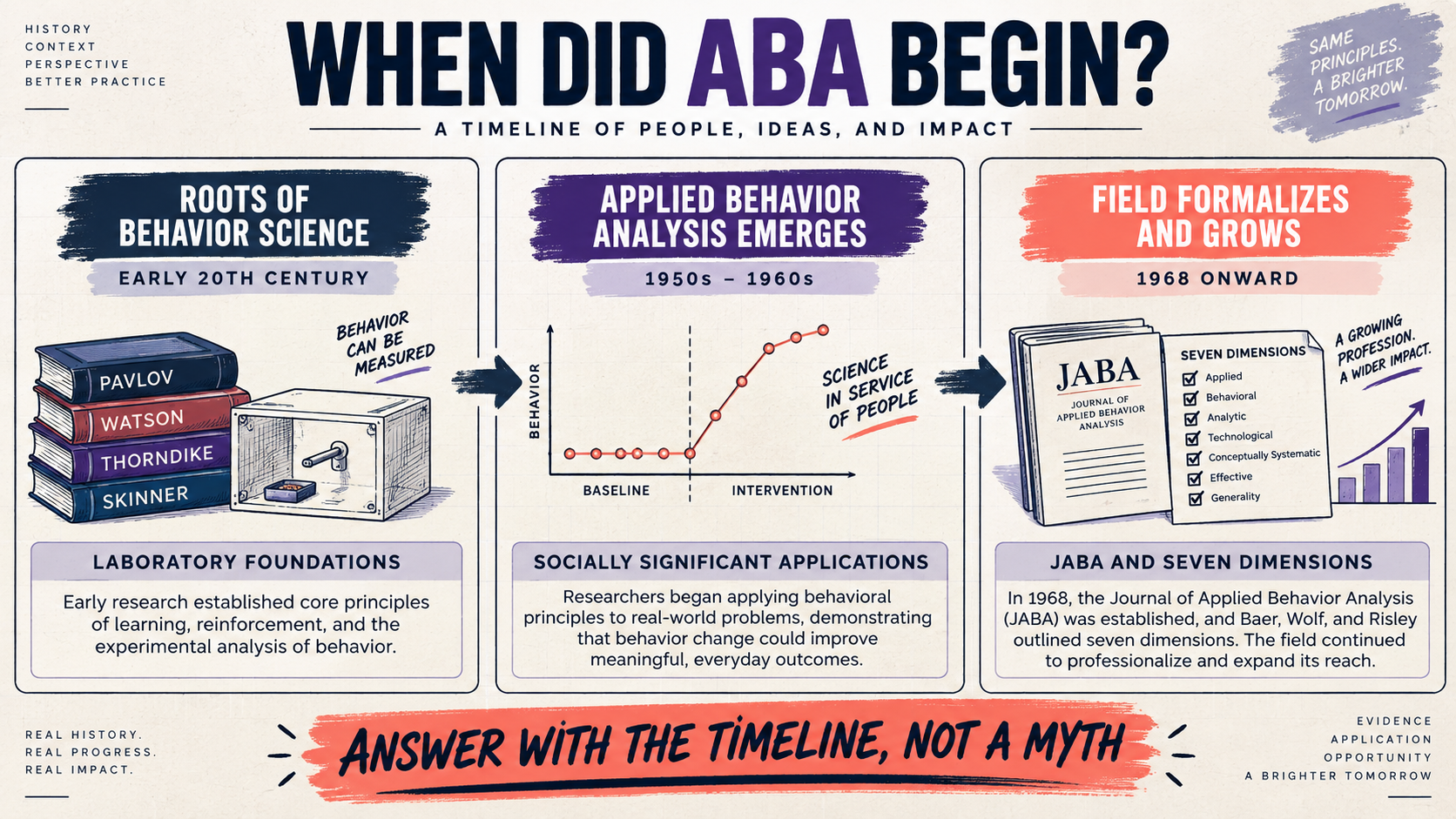
Applied behavior analysis began as a gradual development rather than a single event. The underlying behavior-science roots reach into the early twentieth century, including research on learning, conditioning, and operant behavior. Applied work became more visible in the 1950s and 1960s, when researchers used behavioral principles to address meaningful problems in real settings. In 1968, the Journal of Applied Behavior Analysis was established, and Donald Baer, Montrose Wolf, and Todd Risley published “Some Current Dimensions of Applied Behavior Analysis,” a landmark statement of the field’s defining dimensions.
So, if a study question asks for a single classroom-friendly date, 1968 is often the key formalization milestone. If it asks about the field’s origins, the better answer is a historical period that includes earlier behavior science and applied research. Do not confuse “when the field emerged,” “when the term was used,” “when a journal was founded,” and “when ABA was applied to autism.” These are related but different questions.
The peer-reviewed historical review A Study in the Founding of Applied Behavior Analysis Through Its Publications makes this nuance explicit: the field’s founding claims depend on how a researcher defines the relevant publications and boundaries. That is why a timeline is safer than a myth about one founder.
Why There Is No Single Start Date
“Beginning” can refer to at least four different things:
- Scientific roots: early studies of learning, conditioning, measurement, and the relation between behavior and environmental events.
- Operant foundation: Skinner’s experimental work gave behavior analysts a precise framework for analyzing behavior and its consequences.
- Applied demonstrations: researchers began using behavioral principles to improve socially significant outcomes in hospitals, schools, homes, and other settings.
- Field formalization: the 1968 journal and landmark paper helped name, organize, and communicate the field’s applied dimensions.
These milestones do not compete with one another. They answer different versions of the same historical question. The National Academies’ evidence-base overview for applied behavior analysis presents a similar timeline: roots in earlier learning research, Skinner’s operant work in the 1930s, applications beginning in the 1950s and 1960s, and later comprehensive applications in autism services.
History also changes depending on whether a source is discussing behavior analysis as a science, ABA as an applied discipline, behavior-analytic practice, or autism intervention. A source that says “ABA began in 1968” may be referring to the formal field and journal. A source that begins with Skinner in 1938 may be explaining the experimental foundation. Both can be useful if you understand the scope of the claim.
The Applied Behavior Analysis Timeline
Use the timeline below as a study scaffold, not as a claim that history has only four dates.
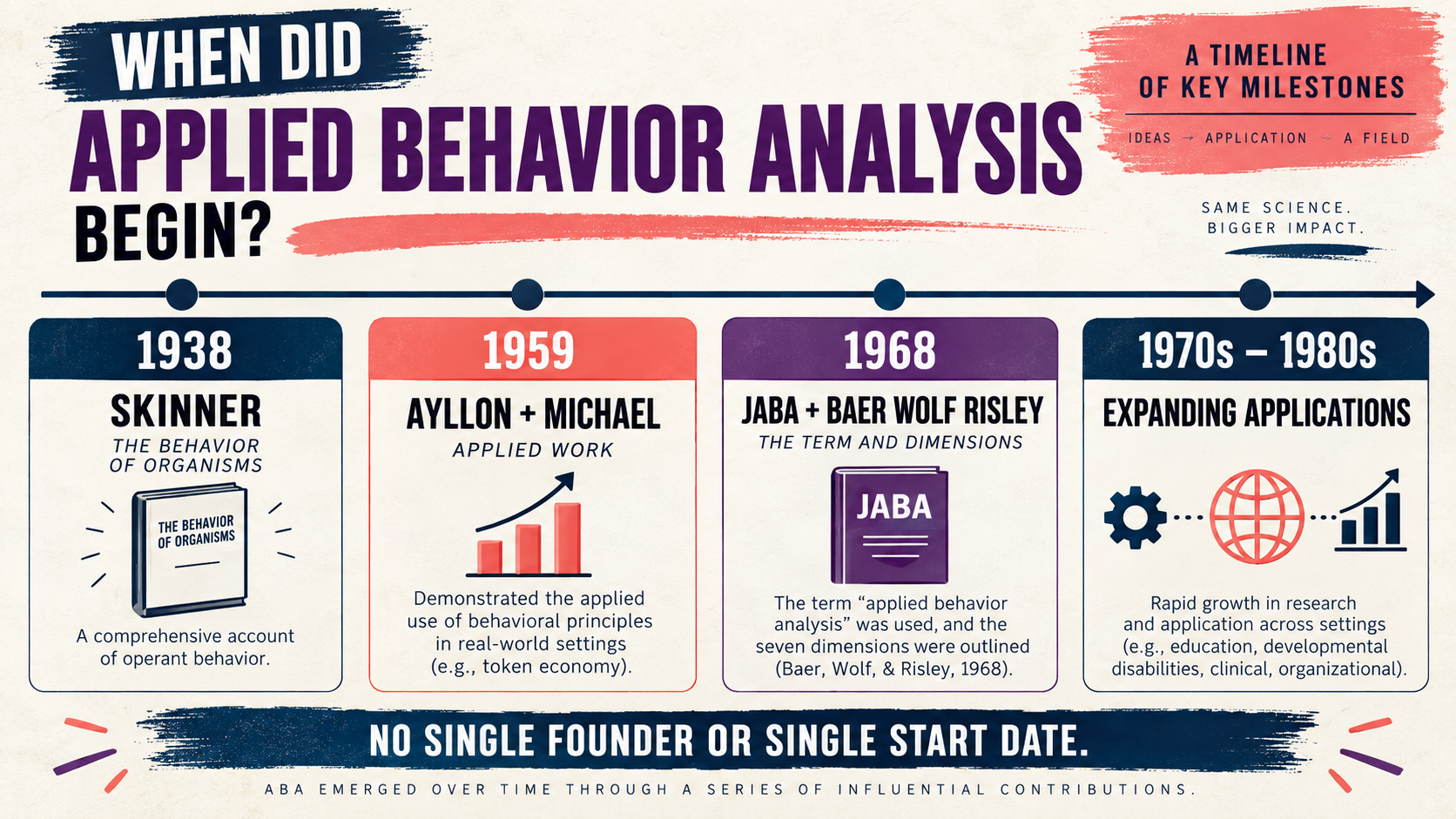
- Early twentieth century: behavior-science roots. Researchers studied observable behavior, learning, conditioning, and environmental relations. These traditions provided concepts and methods later used by behavior analysts.
- 1938: Skinner’s operant foundation. Skinner’s The Behavior of Organisms: An Experimental Analysis was a major statement of operant behavior research. It belongs to the experimental analysis of behavior, which supplied important foundations for later applications.
- 1950s: applied work expands. Researchers began translating behavioral principles into socially relevant settings. The 1959 work by Ted Ayllon and Jack Michael, often discussed as “The Psychiatric Nurse as a Behavioral Engineer,” is one important example of applied behavioral technology in a real service environment.
- 1960s: applied behavior analysis takes shape. Work in developmental, educational, clinical, and community settings accumulated. Researchers were applying behavioral principles to meaningful outcomes, not merely demonstrating laboratory effects.
- 1968: formal field milestone. The first volume of the Journal of Applied Behavior Analysis appeared, and Baer, Wolf, and Risley described seven dimensions associated with applied behavior analysis: applied, behavioral, analytic, technological, conceptually systematic, effective, and generality.
- 1970s onward: professional growth and wider applications. ABA expanded across education, developmental services, clinical work, organizational settings, and other areas. The field continued to debate methods, ethics, social validity, and how to improve practice.
Milestones to Remember
The table is useful when two answer choices use different dates. Match the date to the event instead of treating every date as “the founding.”
| Time or milestone | What it represents | How to use it in an answer |
|---|---|---|
| Early 1900s | Behaviorism, learning research, and conditioning traditions. | Use for broad scientific roots, not a claim that ABA was already a formal field. |
| 1938 | Skinner’s major operant research publication. | Use for experimental analysis foundations. |
| 1950s–1960s | Behavioral principles applied to socially significant problems. | Use when a question asks when ABA emerged as an applied practice. |
| 1968 | JABA and Baer, Wolf, and Risley’s seven dimensions. | Use as the common formalization milestone when a single year is requested. |
| 1970s onward | Professional growth and wider applications across settings. | Use for expansion, not the original beginning. |
How to Answer “When Did ABA Begin?” on the BCBA Exam
First identify what the question is actually asking. If the wording says “when did applied behavior analysis formally emerge as a field?” look for 1968 or the establishment of JABA and the seven dimensions. If the question asks about the scientific basis of operant behavior, Skinner’s earlier work may be the relevant answer. If it asks when behavioral principles were applied to autism or another population, look for the specific applied-history context rather than the general founding date.
Second, reject answers that assign the entire field to a single person. Skinner’s work is foundational, but “Skinner founded ABA” overstates the history. Likewise, saying that Ivar Lovaas founded ABA confuses influential autism-intervention research with the origin of the entire applied discipline.
Third, notice whether the question is using “ABA” to mean applied behavior analysis or the Association for Behavior Analysis International. Those are not the same thing. An organization’s founding date is not automatically the founding date of the science or applied field.
A concise exam answer can be phrased this way: “ABA developed from earlier behavior science and operant research, became an applied field through work in the 1950s and 1960s, and is commonly associated with a formalization milestone in 1968.” That response shows the timeline and avoids false precision.
Was ABA Founded by One Person?
No. It is more accurate to describe ABA as an evolving field shaped by multiple researchers, publications, applications, and professional communities. Skinner’s experimental analysis of behavior was highly influential. Ayllon and Michael demonstrated applied behavioral technology in service settings. Baer, Wolf, and Risley helped articulate the dimensions that distinguish applied behavior analysis from a general claim that behavior changed.
This does not minimize any contributor. It explains why “founder” questions require careful wording. A person may be a founder of a specific program, a major contributor to operant research, an early applied researcher, or an influential autism-treatment researcher without being the sole founder of ABA.
The history also includes ethical learning. Modern behavior analysis is expected to consider client welfare, dignity, social validity, informed participation, evidence, and the risks of intervention. Studying the field’s origins should not turn historical description into an endorsement of every past practice.
ABA, Behaviorism, and Experimental Analysis
Many history questions become confusing because they move among related terms:
- Behaviorism is a broad approach in psychology that emphasized behavior and its relations with the environment, with different versions developing over time.
- Experimental analysis of behavior is the basic-science tradition that studies behavioral processes under controlled conditions.
- Radical behaviorism is the philosophical foundation associated with Skinner’s approach, including a behavioral interpretation of private events.
- Applied behavior analysis applies behavioral principles to improve behavior that matters in people’s lives and evaluates whether the intervention produces meaningful change.
The categories overlap historically, but they are not interchangeable. A date associated with Skinner’s laboratory publication may describe experimental analysis, while 1968 is a common milestone for the applied field’s formal identity.
Common History-Question Traps
- One-founder trap: choosing a name simply because that person is famous in behavior analysis.
- One-date trap: treating 1968 as the first moment any applied behavioral work existed.
- Autism-only trap: assuming ABA began when comprehensive autism programs became prominent.
- Organization trap: confusing the founding date of an association with the emergence of applied behavior analysis.
- Term-versus-practice trap: assuming a field did not exist in any form before a label or journal appeared.
- Historical-endorsement trap: treating a description of early methods as a recommendation for current practice.
When two answers seem close, choose the one that matches the scope of the question. Good exam reasoning is precise about what started, what was formalized, who contributed, and which branch of behavior analysis the date describes.
Fast Review Checklist
- Does the question mean scientific roots, applied practice, field formalization, or autism intervention?
- Is the answer assigning ABA to one founder when the history is cumulative?
- Does 1938 refer to Skinner’s operant foundation?
- Do the 1950s and 1960s refer to applied demonstrations and field development?
- Does 1968 refer to JABA and the Baer, Wolf, and Risley dimensions?
- Is the question actually asking about an organization rather than applied behavior analysis?
- Are you separating historical description from current ethical practice?
FAQ
When did applied behavior analysis officially begin?: There is no universally accepted single start date. 1968 is a common formalization milestone because JABA began and Baer, Wolf, and Risley described the field’s seven dimensions. The applied work itself developed through earlier research and applications.
Did B. F. Skinner found ABA?: Skinner made foundational contributions to the experimental analysis of operant behavior, but ABA developed through the work of many researchers and applied programs. Calling him the sole founder is too broad. Did ABA begin in 1968?: 1968 is best understood as a major field-formalization date, not the first year anyone applied behavioral principles. Earlier scientific and applied work contributed to the field’s emergence.
When did ABA begin for autism treatment?: Applied behavioral work with autistic children developed during the 1960s, and later research helped shape comprehensive autism programs. That history is a specific application story, not the entire history of applied behavior analysis.
What is the safest short answer for a BCBA exam?: Say that ABA emerged gradually from earlier behavior science and operant research, developed through applied work in the 1950s and 1960s, and is commonly associated with a formalization milestone in 1968. Then match the date to the event described in the question.
The answer to “when did ABA begin?” depends on whether the question means roots, applied demonstrations, the name and journal, or a specific application. Remember the sequence: foundations, applied growth, and formalization. For more practice with BCBA history and concepts questions, try our free BCBA mock exam.
Take the Free BCBA Mock Exam
If you want a low-pressure way to check your recall, use the free practice resource below. Take the Free BCBA Mock Exam



